Artificial Analysis@ArtificialAnlys
MiniMax has released MiniMax-M2.7, delivering GLM-5-level intelligence for less than one third of the cost
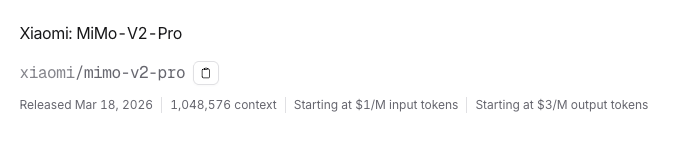
MiniMax-M2.7 from @MiniMax_AI scores 50 on the Artificial Analysis Intelligence Index, an 8-point improvement over MiniMax-M2.5, which was released one month ago. This is driven by stronger performance on real-world agentic tasks and reduced hallucinations. MiniMax-M2.7 is now ahead of MiMo-V2-Pro (Reasoning, 49) and Kimi K2.5 (Reasoning, 47), and equivalent to GLM-5 (Reasoning, 50) while using 20% fewer output tokens and costing less than a third as much to run. MiniMax-M2.7 is a reasoning-only model and maintains the same per-token pricing as MiniMax-M2.5.
Key takeaways:
➤ Strong performance on real-world agentic tasks: MiniMax-M2.7 achieves a GDPval-AA Elo of 1494, a significant improvement from MiniMax-M2.5 (1203) and ahead of MiMo-V2-Pro (Reasoning, 1426), GLM-5 (Reasoning, 1406), and Kimi K2.5 (Reasoning, 1283). It remains behind frontier models such as GPT-5.4 (xhigh, 1667) and Claude Opus 4.6 (Adaptive Reasoning, max effort, 1606)
➤ Reduced hallucinations: MiniMax-M2.7 scores +1 on the AA-Omniscience Index, up from MiniMax-M2.5 (-40). This is competitive with GPT-5.2 (xhigh, -1) and GLM-5 (Reasoning, +2), and well ahead of Kimi K2.5 (Reasoning, -8). The improvement from M2.5 is purely driven by reduced hallucinations, meaning the model is more likely to abstain from answering when it doesn’t know the answer, rather than guessing. M2.7 achieves a hallucination rate of 34%, lower than Claude Sonnet 4.6 (Adaptive Reasoning, max effort, 46%) and Gemini 3.1 Pro Preview (50%).
➤ Gains across most evaluations compared to MiniMax-M2.5: Outside of the GDPval-AA and AA-Omniscience improvements noted above, MiniMax-M2.7 improves in HLE (+9 p.p.), TerminalBench Hard (+5 p.p.), SciCode (+4 p.p.), IFBench (+4 p.p.), GPQA (+3 p.p.), and LCR (+3 p.p.). We saw a notable regression in τ²-Bench (-11 p.p.).
➤ Increased token use: MiniMax-M2.7 used ~87M output tokens to run the Artificial Analysis Intelligence Index, up 55% from MiniMax-M2.5 (~56M). It remains more token-efficient than other models such as GLM-5 (Reasoning, 110M) and Kimi K2.5 (Reasoning, ~89M)
➤ Leading cost efficiency: MiniMax-M2.7 cost $176 to run the Artificial Analysis Intelligence Index, maintaining the same $0.30/$1.20 per 1M input/output pricing as M2.5. This places it on the Pareto frontier of our Intelligence vs. Cost chart. For context, GLM-5 (Reasoning) cost $547 at equivalent intelligence, Kimi K2.5 (Reasoning) cost $371, and Gemini 3 Flash Preview (Reasoning) cost $278
Key model details:
➤ Context window: 200K tokens (equivalent to MiniMax-M2.5).
➤ Pricing: $0.30/$1.20 per 1M input/output tokens (unchanged from MiniMax-M2.5).
➤ Availability: MiniMax first-party API only.
➤ Modality: Text input and output only (no multimodality).
➤ Licensing: MiniMax has not announced whether MiniMax-M2.7 will be open weights. MiniMax-M2.5 is available under the MIT license.