Jonathan Kopp

11.4K posts

Jonathan Kopp banner
Jonathan Kopp

Jonathan Kopp

@jonathankopp

Husband/dad. Jew. Bklyn Democrat. Partner, @FGS_Global. J Street NY Chair. ✡️

Brooklyn, NY Katılım Nisan 2007
3.9K Takip Edilen2.3K Takipçiler
Jonathan Kopp retweetledi
Ami Dar
Ami Dar@AmiDar·
Let me say it: the settlers rampaging through the West Bank right now, and the people in the government who support them, are a bigger threat to Israel and its future than Iran ever was.
English
50
316
1.5K
68.7K
Jonathan Kopp retweetledi
Brian Allen
Brian Allen@allenanalysis·
🚨 The Jerusalem Post confirms: an American F-35 has been hit for the first time in history. Iran’s air defenses — which Trump said today were completely destroyed — just hit America’s most advanced stealth fighter. The F-35 costs $80 million per aircraft. It has never been hit in combat in its entire operational history. Until today. Trump said the defenses are destroyed. An F-35 got hit. Joe Kent confirmed there was no nuclear program worth stopping. Hegseth told his son they died to stop a nuclear Iran that didn’t exist. 14 Americans dead. $21 billion spent. Zero allied warships. Pearl Harbor invoked to Japan. And Iran just hit the plane we said they couldn’t touch. Never stop connecting the dots.
English
259
2.9K
6.5K
192.5K
Jonathan Kopp retweetledi
Benjy Sarlin
Benjy Sarlin@BenjySarlin·
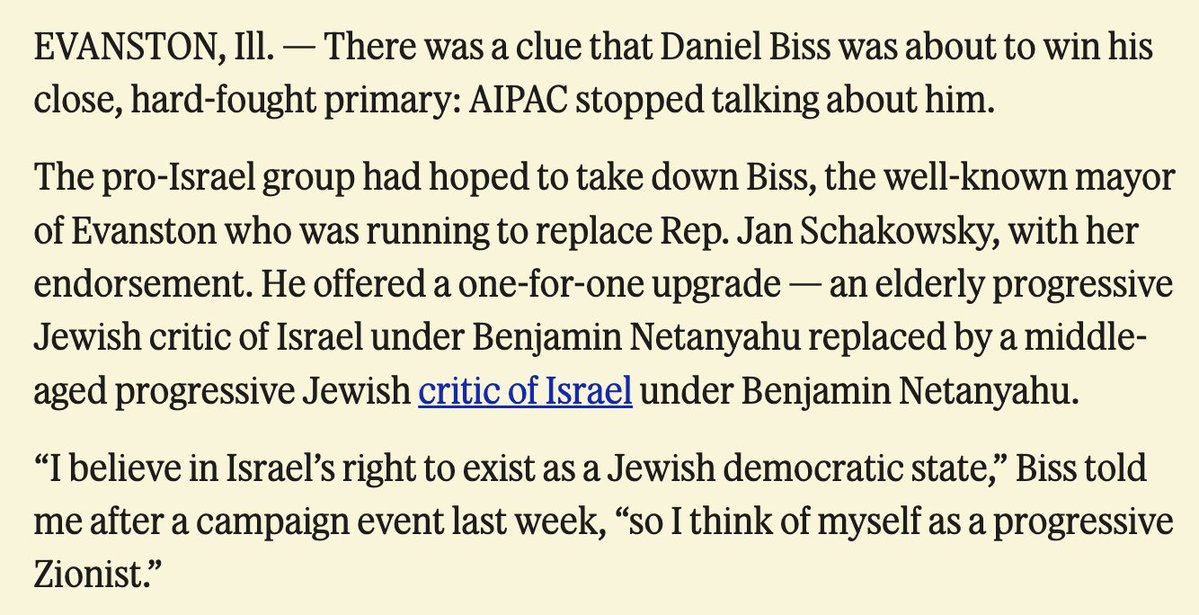
Pro-Israel movement deciding to go all-in to stop this guy is real 2010s thinking. They're going to need to carve out space for liberal pro-Israel/anti-war voices to have any hope of containing further left. At this rate, they'll wish they had more Dan Biss types soon.
Benjy Sarlin tweet media
English
18
43
229
50.8K
Jonathan Kopp retweetledi
Jeremy Ben-Ami
Jeremy Ben-Ami@JeremyBenAmi·
Let’s be clear what happened in Illinois’ 9th district tonight: AIPAC spent millions in a Democratic primary, funded in large part by Republican donors, trying to stamp out opposition to Netanyahu’s policies. But voters had other plans - and rejected that effort. AIPAC targeted Daniel Biss not because he’s anti-Israel, but because he represents the kind of balanced, pro-Israel leadership they fear: committed to Israel’s security, while also standing up for Palestinian rights and U.S. interests. They went after him and others because a growing Democratic Party consensus says support for Israel cannot be a blank check, and that U.S. aid must be consistent with our laws and our values. And they tried to hide their fingerprints because their direct involvement would only hurt. If there’s a lesson in tonight’s result, it’s this: you can’t rebuild support for Israel through fear, intimidation, and outside money. Those tactics are doing the opposite - accelerating the erosion of support, especially among younger voters who are already asking why the U.S. is backing policies that don’t reflect the values they were raised with.
AP Race Calls@AP_RaceCalls

WASHINGTON (AP) — Daniel Biss wins Democratic nomination for U.S. House in Illinois' 9th Congressional District. #APRaceCall at 10:36 p.m. EDT. apnews.com/projects/elect…

English
38
106
423
116.2K
Max Cohen
Max Cohen@maxpcohen·
Evanston Mayor Daniel Biss wins #IL09 Dem primary over Fine and Abughazaleh. Biss was backed by CPC PAC and Schakowsky, among others. AIPAC groups spent against Biss+ to elect Fine, before pivoting to attacking Abughazaleh to avoid the most anti-Israel contender winning
AP Race Calls@AP_RaceCalls

WASHINGTON (AP) — Daniel Biss wins Democratic nomination for U.S. House in Illinois' 9th Congressional District. #APRaceCall at 10:36 p.m. EDT. apnews.com/projects/elect…

English
1
2
10
8.3K
Adam Carlson
Adam Carlson@admcrlsn·
Endorsement success tonight: Warren: 2 for 4 (Stratton, Biss) AIPAC: 2 for 4 (Bean, Miller) Think Big (pro-AI PAC): 1 for 2 (Bean) Fairshake (pro-crypto PAC): 1 for 4 (Bean) Congressional Progressive Caucus: 1 for 4 (Biss) Congressional Black Caucus: 0 for 3 Bernie: 0 for 2 Justice Dems: 0 for 2
English
27
81
839
224K
Jonathan Kopp retweetledi
Ilan Goldenberg
Ilan Goldenberg@ilangoldenberg·
This article is compelling and smart. I’ve seen it forwarded around a lot. Let’s walk through why it’s wrong.  1. The author argues that Iran’s military infrastructure especially its drones and missiles are being systematically taken apart.  True. But in the aftermath who is going to keep it that way? After the 12 day war Israel and Trump declared Iran’s capacity to make war “obliterated” and set back for a generation. Less than a year later they went back to war because of how quickly Iran was rebuilding. This campaign is much more comprehensive, but the same problem still applies. How to avoid being stuck in the aftermath in a “mow the lawn” scenario where the US has to expend tremendous assets that could be directed elsewhere in the world - especially towards the Indopacific. And where the region operates at a new unstable normal where all previous taboos on military action are off. 2.  He argues that the nuclear infrastructure had to be disassembled because one president after another had just let Iran’s nuclear program grow. Not true. Obama had managed to dramatically and verifiably reduce Iran’s nuclear capacity through the JCPOA. Trump killed that. 3. He argues Iran is self harming by stopping its own oil from going through the Strait of Hormuz. This was always an assumption before the war, but they’ve managed to shut down the Strait for everyone else while still exporting 1 million bbls per day of their own stuff.  That makes this much more sustainable.  4. He Argues that Iran’s proxy networks are dramatically weakened. True, but also as we’ve learned from previous conflicts they will regenerate and it’s impossible to root them out with a military strategy alone if there is no political follow up to create a better alternative. That is why Israel is on the verge of a major campaign in Lebanon only a year and a half after supposedly setting back Hezbollah for a generation. These fights are costly Pyrrhic victories that will just need to be fought again and again and again unless there is a political strategy to consolidate victory which both Israel and the US have failed at since October 7th.  5. Finally, the author argues that we need to ignore the President’s own words about regime change and the Iranian people rising up and focus on what the military is doing.  But that’s not how war works. War is fought to achieve a political objective. If there is no clear objective set out by the political leadership it’s impossible to translate battlefield victories into a consolidated win.  By setting the bar at regime change Trump has made it extraordinarily hard for the US to be perceived as winning even if the military executes the plans. Perception is a big part of the battle in war. And again the costs are incredibly high. And as the author argues, the only way this works is if there is a plan to contain and keep Iran down in the aftermath. Do we have any faith in Trump to do that? Again that is going to be incredibly expensive and require a presence like what the US left in the Middle East after the first Gulf War to contain Saddam.  That’s something we could afford in 1991 when the US was a unipolar power. But not in 2026 when we have a real competitor in China that we need to manage.  aljazeera.com/amp/opinions/2…
English
134
341
1.1K
382.1K
Jonathan Kopp retweetledi
Ilan Goldenberg
Ilan Goldenberg@ilangoldenberg·
Three weeks into the war with Iran, a number of observations as someone who spent years war-gaming this scenario. 1. The U.S. and Israel may have produced regime transition in the worst possible way. Ali Khamenei was 86 and had survived multiple bouts of prostate cancer. His death in the coming years would likely have triggered a real internal reckoning in Iran, potentially opening the door to somewhat more pragmatic leadership, especially after the protests and crackdown last month. Instead, the regime made its most consequential decision under existential external threat giving the hardliners a clear upperhand. Now we appear to have a successor who is 30 years younger, deeply tied to the IRGC, and radicalized by the war itself – including the killing of family members. Disastrous. 2. About seven years ago at CNAS, I helped convene a group of security, energy, and economic experts to walk through scenarios for a U.S.--Iran war and the implications for global oil prices. What we’re seeing now was considered one of the least likely but worst outcomes. The modeling assumed the Strait of Hormuz could close for 4–10 weeks, with 1–3 years required to restore oil production once you factored in infrastructure damage. Prices could spike from around $65 to $175–$200 per barrel, before eventually settling in the $80–$100 range a year later in a new normal. 3. One surprising development: Iran is still moving oil through the Strait of Hormuz while disrupting everyone else. In most war games I participated in, we assumed Iran couldn’t close the Strait and still use it themselves. That would have made the move extremely self-defeating. But Iran appears capable of harassing global shipping while still pushing some of its own exports through. That changes the calculus. 4. The U.S. now finds itself in the naval and air equivalent of the dynamic we faced in Iraq and Afghanistan. It’s a recipe for a quagmire where we win every battle and lose the war. We have overwhelming military dominance and are exacting a tremendous cost. But Iran doesn’t need to win battles. They just need occasional successes. A small boat hitting a tanker. A drone slipping through defenses in the Gulf. A strike on a hotel or oil facility. Each incident creates insecurity and drives costs up while remind everyone that the regime is surviving and fighting. 5. The deeper problem is that U.S. objectives were set far too high. Once “regime change” becomes the implicit or explicit goal, the bar for American success becomes enormous. Iran’s bar is simple: survive and keep causing disruption. 6. The options for ending this war now are all bad. You can try to secure the entire Gulf and Middle East indefinitely – extremely expensive and maybe impossible. You can invade Iran and replace the regime, but nobody is seriously going to do that. Costs are astronomical. You can try to destabilize the regime by supporting separatist groups. It probably won’t work and if it does you’ll most likely spark a civil war producing years of bloody chaos the U.S. will get blamed for. None of these are good outcomes. 7. The other escalatory options being discussed are taking the nuclear material out of Esfahan or taking Kargh Island. Esfahan is not really workable. Huge risk. You’d have been on the ground for a LONG time to safely dig in and get the nuclear material out in the middle of the country giving Iran time to reinforce from all over and over run the American position. 8. Kharg Island can be appealing to Trump. He’d love to take Iran’s ability to export oil off the map and try to coerce them to end the war. It’s much easier because it’s not in the middle of IRan. But it’s still a potentially costly ground operation. And again. Again, the Iranian government only has to survive to win and they can probably do that even without Kargh. 9. The least bad option is the classic diplomatic off-ramp. The U.S. declares that Iran’s military capabilities have been significantly degraded, which is how the Pentagon always saw the purpose of the war. Iran declares victory for surviving and demonstrating it can still threaten regional actors. It would feel unsatisfying. But this is the inevitable outcome anyway. Better to stop now than after five or ten more years of escalating costs. Remember in Afghanistan we turned down a deal very early in the war with the Taliban that looked amazing 20 years later. Don’t need to repeat that kind of mistake. 10. The U.S. and Israel are not perfectly aligned here. Trump just needs a limited win and would see long-term instability as a negative whereas for Netanyahu a weak unstable Iran that bogs the U.S. down in the MIddle East is a fine outcome. If President Trump decided he wanted Israel to stop, he likely has the leverage to push it in that direction just as he pressured Netanyahu to take a deal last fall on Gaza. 11. When this is over, the Gulf states will have to rethink their entire security strategy. They are stuck in the absolute worst place. They didn’t start this war and didn’t want it and now they are taking with some of the worst consequences. Neither doubling down with the U.S. and Israel nor placating the Iranians seems overwhelmingly appealing. 12. One clear geopolitical winner so far: Russia. Oil prices are rising. Sanctions are coming off. Western attention and military resources are shifting away from Ukraine. From Moscow’s perspective, this war is a win win win. 13. At some point China may have a role to play here. It is the world’s largest oil importer, and much of that supply comes from the Middle East. Yes they are still getting oil from Iran. But they also buy from the rest of the Middle East, and a prolonged disruption in the Gulf hits Beijing hard. That gives China a real incentive to help push toward an end to the conflict.
English
460
2.3K
7.4K
2M
Jonathan Kopp retweetledi
Ilan Goldenberg
Ilan Goldenberg@ilangoldenberg·
Actually, the guy who was the point person for Iran at the White House and was fired by the Trump Administration after being Loomered wrote EXACTLY that warning 4 days before the war started. The article was titled “Why Iran Will Escalate.” But who needs experts… foreignaffairs.com/middle-east/wh…
Acyn@Acyn

Doocy: You said: they hit Qatar, Saudi Arabia UAE, Bahrain, Kuwait nobody expected that. We were shocked. Are you surprised that nobody briefed you ahead of time that that might be their retaliation? Trump: Nobody. Nobody. No no no no. The greatest experts—nobody thought they were going hit…

English
170
5.4K
15K
1.3M