Julius

2.4K posts

Julius banner
Julius

Julius

@juliuss1907

Doing some stuff

Web3 Katılım Ağustos 2022
1K Takip Edilen1.1K Takipçiler
Sabitlenmiş Tweet
Julius
Julius@juliuss1907·
Consistency is the only shortcut to success. Compound effort is like compounding interest. It grows and builds, turning small wins into massive achievements over time. Never skip a day: every moment you keep trying is a lucky day in disguise. Stay committed. Stay ready to bounce back and try again, no matter the setback. This is the fastest route to the top. In a world that gets more competitive by the day, persistence isn’t just the best way, it’s the only way. Rise. Repeat. Never surrender. Your journey to the peak starts here.

Julius tweet media
English
0
0
2
306
Julius
Julius@juliuss1907·
BREAKING: This is the 3rd attack targeting President Trump within the past 2 months. - Time: Approximately 6:00 PM EST, Friday, May 23, 2026 - Location: Intersection of 17th Street & Pennsylvania Avenue NW (White House checkpoint) - Suspect: Nasire Best, 21 years old. Situation: - Suspect suddenly drew a weapon and fired 20-30 shots at Secret Service agents - Secret Service agents responded quickly, eliminating the suspect with return fire - One bystander sustained minor injuries, treated and released from hospital - President Trump remained safe in the Oval Office Within one month, there have been 3 attacks/plots targeting the President's family: 1. April 25, 2026 - Attack at White House Correspondents' Association Dinner (suspect Cole Allen) 2. May 4, 2026 - Shooting at Washington Monument 3. May 23, 2026 - White House checkpoint attack
Julius tweet media
English
0
0
0
88
Julius
Julius@juliuss1907·
8/8 — If you use Github ✅ Rotate every API key, token, .env file — private repos included ✅ Audit your VS Code extensions — remove anything you don't need ✅ Disable auto-update on extensions ✅ Check if any npm/PyPI packages you use appear in the compromise list Supply chain attacks aren't theoretical anymore. One just went straight through GitHub, the platform crypto relies on every single day.
English
0
0
0
53
Julius
Julius@juliuss1907·
7/8 — Professional-grade, not amateur The sophistication level makes this clear: • 3-channel exfil: HTTPS + GitHub API + DNS tunneling • Backdoor receives commands via GitHub Search API "dead drop" • Commands signed with RSA-4096 • Self-discovers backup C2 by scanning public GitHub commit messages • Auto-propagates across EC2 → Kubernetes • Detects Israel/Iran origin → self-destructs
English
1
0
0
103
Julius
Julius@juliuss1907·
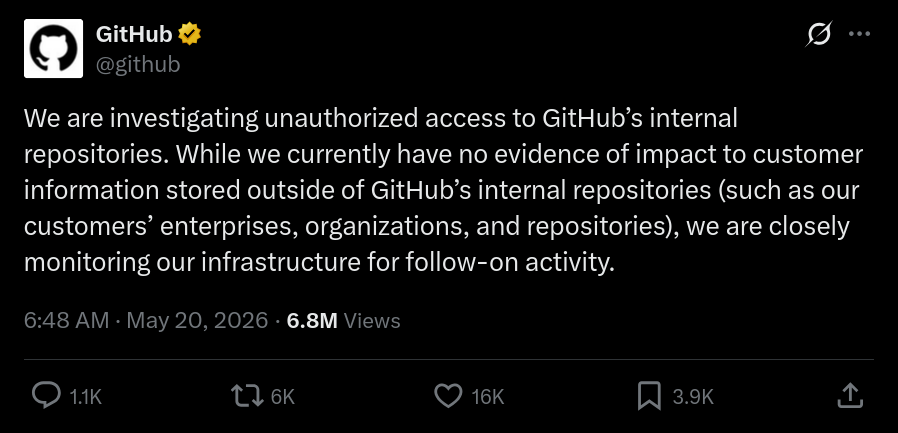
🚨 Rotate every API key, token, and .env file on your GitHub RIGHT NOW!! @github just confirmed an internal breach. Nearly 4,000 internal repos have been exfiltrated. The attacker had a 24-hour head start. Full breakdown 🧵👇
Julius tweet media
English
1
0
0
71
Julius
Julius@juliuss1907·
The Obsidian dashboard isn't a productivity tool. It's a mirror. It gives you clarity if you already had it. Vague properties → vague briefing. Messy vault → messy dashboard. The tool doesn't save you. It punishes sloppiness. And that's precisely why it works.
CyrilXBT@cyrilXBT

x.com/i/article/2056…

English
0
0
1
31
Julius retweetledi
Fuli Luo
Fuli Luo@_LuoFuli·
Two days ago, Anthropic cut off third-party harnesses from using Claude subscriptions — not surprising. Three days ago, MiMo launched its Token Plan — a design I spent real time on, and what I believe is a serious attempt at getting compute allocation and agent harness development right. Putting these two things together, some thoughts: 1. Claude Code's subscription is a beautifully designed system for balanced compute allocation. My guess — it doesn't make money, possibly bleeds it, unless their API margins are 10-20x, which I doubt. I can't rigorously calculate the losses from third-party harnesses plugging in, but I've looked at OpenClaw's context management up close — it's bad. Within a single user query, it fires off rounds of low-value tool calls as separate API requests, each carrying a long context window (often >100K tokens) — wasteful even with cache hits, and in extreme cases driving up cache miss rates for other queries. The actual request count per query ends up several times higher than Claude Code's own framework. Translated to API pricing, the real cost is probably tens of times the subscription price. That's not a gap — that's a crater. 2. Third-party harnesses like OpenClaw/OpenCode can still call Claude via API — they just can't ride on subscriptions anymore. Short term, these agent users will feel the pain, costs jumping easily tens of times. But that pressure is exactly what pushes these harnesses to improve context management, maximize prompt cache hit rates to reuse processed context, cut wasteful token burn. Pain eventually converts to engineering discipline. 3. I'd urge LLM companies not to blindly race to the bottom on pricing before figuring out how to price a coding plan without hemorrhaging money. Selling tokens dirt cheap while leaving the door wide open to third-party harnesses looks nice to users, but it's a trap — the same trap Anthropic just walked out of. The deeper problem: if users burn their attention on low-quality agent harnesses, highly unstable and slow inference services, and models downgraded to cut costs, only to find they still can't get anything done — that's not a healthy cycle for user experience or retention. 4. On MiMo Token Plan — it supports third-party harnesses, billed by token quota, same logic as Claude's newly launched extra usage packages. Because what we're going for is long-term stable delivery of high-quality models and services — not getting you to impulse-pay and then abandon ship. The bigger picture: global compute capacity can't keep up with the token demand agents are creating. The real way forward isn't cheaper tokens — it's co-evolution. "More token-efficient agent harnesses" × "more powerful and efficient models." Anthropic's move, whether they intended it or not, is pushing the entire ecosystem — open source and closed source alike — in that direction. That's probably a good thing. The Agent era doesn't belong to whoever burns the most compute. It belongs to whoever uses it wisely.
English
174
231
1.8K
765.8K
Julius retweetledi
Andrej Karpathy
Andrej Karpathy@karpathy·
LLM Knowledge Bases Something I'm finding very useful recently: using LLMs to build personal knowledge bases for various topics of research interest. In this way, a large fraction of my recent token throughput is going less into manipulating code, and more into manipulating knowledge (stored as markdown and images). The latest LLMs are quite good at it. So: Data ingest: I index source documents (articles, papers, repos, datasets, images, etc.) into a raw/ directory, then I use an LLM to incrementally "compile" a wiki, which is just a collection of .md files in a directory structure. The wiki includes summaries of all the data in raw/, backlinks, and then it categorizes data into concepts, writes articles for them, and links them all. To convert web articles into .md files I like to use the Obsidian Web Clipper extension, and then I also use a hotkey to download all the related images to local so that my LLM can easily reference them. IDE: I use Obsidian as the IDE "frontend" where I can view the raw data, the the compiled wiki, and the derived visualizations. Important to note that the LLM writes and maintains all of the data of the wiki, I rarely touch it directly. I've played with a few Obsidian plugins to render and view data in other ways (e.g. Marp for slides). Q&A: Where things get interesting is that once your wiki is big enough (e.g. mine on some recent research is ~100 articles and ~400K words), you can ask your LLM agent all kinds of complex questions against the wiki, and it will go off, research the answers, etc. I thought I had to reach for fancy RAG, but the LLM has been pretty good about auto-maintaining index files and brief summaries of all the documents and it reads all the important related data fairly easily at this ~small scale. Output: Instead of getting answers in text/terminal, I like to have it render markdown files for me, or slide shows (Marp format), or matplotlib images, all of which I then view again in Obsidian. You can imagine many other visual output formats depending on the query. Often, I end up "filing" the outputs back into the wiki to enhance it for further queries. So my own explorations and queries always "add up" in the knowledge base. Linting: I've run some LLM "health checks" over the wiki to e.g. find inconsistent data, impute missing data (with web searchers), find interesting connections for new article candidates, etc., to incrementally clean up the wiki and enhance its overall data integrity. The LLMs are quite good at suggesting further questions to ask and look into. Extra tools: I find myself developing additional tools to process the data, e.g. I vibe coded a small and naive search engine over the wiki, which I both use directly (in a web ui), but more often I want to hand it off to an LLM via CLI as a tool for larger queries. Further explorations: As the repo grows, the natural desire is to also think about synthetic data generation + finetuning to have your LLM "know" the data in its weights instead of just context windows. TLDR: raw data from a given number of sources is collected, then compiled by an LLM into a .md wiki, then operated on by various CLIs by the LLM to do Q&A and to incrementally enhance the wiki, and all of it viewable in Obsidian. You rarely ever write or edit the wiki manually, it's the domain of the LLM. I think there is room here for an incredible new product instead of a hacky collection of scripts.
English
2.9K
7.2K
59.3K
21.2M
Julius retweetledi
Gideon Ng
Gideon Ng@gideonfip·
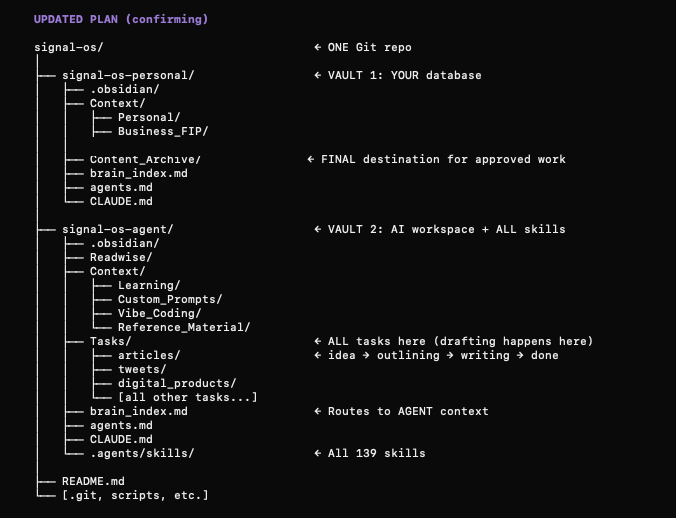
I was organising my Obsidian vault wrongly by combining my personal work with my agents in one big repo. Instead, I should have used @karpathy and @kepano's advice to preserve all my work and thoughts in a separate vault, while the agents have a messy workspace with all the context I've gathered that's relevant to me. Thoughtful organisation of your vault is the best way to reduce token burn while giving AI enough context on the task you want to complete.
Gideon Ng tweet media
kepano@kepano

I like @karpathy's Obsidian setup as a way to mitigate contamination risks. Keep your personal vault clean and create a messy vault for your agents. I prefer my personal Obsidian vault to be high signal:noise, and for all the content to have known origins. Keeping a separation between your personally-created artifacts and agent-created artifacts prevents contaminating your primary vault with ideas you can't source. If you let the two mix too much it will likely make Obsidian harder to use as a representation of *your* thoughts. Search, bases, quick switcher, backlinks, graph, etc, will no longer be scoped to your knowledge. Only once your agent-facing workflow produces useful artifacts would I bring those into the primary vault.

English
1
1
19
1.5K