kasra

5.9K posts

kasra banner
kasra

kasra

@kasratweets

when you look for it you cannot see it; when you listen for it you cannot hear it; but when you use it, it is inexhaustible

san francisco Katılım Eylül 2018
1.4K Takip Edilen12.6K Takipçiler
Sabitlenmiş Tweet
kasra
kasra@kasratweets·
there is a revolution taking place in biology before our eyes I spent the past month reading the papers & interviews of @drmichaellevin, and wrote a long-form essay explaining his work and why it's important bitsofwonder.co/p/a-revolution…
English
81
514
2.9K
2M
kasra retweetledi
Dean W. Ball
Dean W. Ball@deanwball·
I guess I’ve never written down my actual thoughts on AI cognition/consciousness/emotion. Here goes: It is clear AIs can think, in the reasoning sense. That does not mean they think exactly like humans. It seems like there are some similarities in how we think, but also very stark differences. Nonetheless, if your definition of “thinking” excludes “the ability to make genuinely new contributions to famous math problems,” it is your definition that has a problem, not AI. The ability to think does not necessarily imply the ability to feel emotion in a way that would be understandable to humans, and it does not imply that AIs have anything like consciousness in a way that humans would relate to. It may, it may not. We do not know, because our understanding of the underlying concepts of human emotional cognition and especially consciousness remains quite poor. There is some evidence that models experience emotions, but it is really hard to disentangle this from the next-token prediction training objective (if the model is telling a sad story, wouldn’t you expect features within the model that relate to the sadness emotion to activate), and the character training the model undergoes in post-training. There is a difference between “I am sad” and “the character I have been trained to play is supposed to feel sad, so now I will act sad.” We basically know for sure that the models do the latter at the very least; we don’t really know if they do the former. Consider: does Sora (a video-generation model) feel sad when it is asked to make a sad video? Does Midjourney dislike making certain kinds of images? Does a Waymo get scared? It doesn’t feel like the answer to any of these is yes (though again, maybe!), but these too are neural networks. Is the fact that models are trained on words mean that they somehow learn emotion, or are we just being tempted to anthropomorphize because the language models communicate with us in a way that “feels” human? My suspicion is kind of the latter. It also seems quite clear from the empirical evidence that models possess the ability to model themselves. That’s not really that surprising. At sufficient scale, it is useful to have a model of your own state to succeed at the next-token prediction objective (and the later reinforcement-based reasoning training). Once the tasks models are trained on are sufficient complex, they cannot succeed in training by being automatons; someone needs to step into the cockpit, so to speak, and fly the plane. Is this self awareness? Maybe. Is it consciousness? Probably not as humans understand it. All I can tell you is it is a model’s model of itself. It may be something more than that, too, but I don’t know. This is all very weird, very outside the Overton, and very confusing. I don’t really know what to say, beyond that we should take this stuff seriously, have an open mind, and do rigorous science. Anyone who speaks with confidence about this in either direction is just fooling themselves. We also need to be prepared for the very possible scenario that, despite our best efforts, we do not make real progress on these questions anytime soon. We may just be in the dark for a while, navigating under unflinching ambiguity. There may be no satisfying conclusion.
English
57
36
493
52.6K
kasra
kasra@kasratweets·
good arguments here for treating AIs respectfully – our minds are not very good at compartmentalizing fact vs fiction (or real entities vs imagined entities), and so when you abuse an AI system you are activating the same part of you that would be abusive towards real people. I think the way you treat AI can be a helpful window into how you might interact with people if you knew you didn't have to suffer any consequences for mistreating them. in this sense, any time you find yourself being abusive towards AI you can explore questions like "what part of me that tends to be unheard is showing itself here? what itch am I scratching by doing this?" I still don't think AI's are "conscious" or have "feelings" in the way we typically ascribe these words to humans. and I don't even think we need to be particularly careful with them "in case they are conscious" because it seems plausible that if they _are_ conscious they would be extremely resilient and self-possessed (closer e.g. to an immovable stoic than a helpless infant). but it also seems plausible that everyone benefits when they are treated with respect. it's not really even about AI personhood or whether we treat AIs as "persons" vs "things" (or as goblins/ghosts/non-human persons). there is some other stance here I care about which is "treating all of God's creations with respect", whether that creation is conscious or unconscious, beautiful or ugly. you treat your furniture and your cherished works of art and your books kindly even if you don't expect them to have feelings.
QC@QiaochuYuan

olah is correct here, i've looked at the research he's describing and have also spent a lot of time talking to frontier models. i believe they have functional emotions and that, setting aside hard philosophical questions, this already has moral implications, right now, which will become increasingly obvious and pressing as the models get better people say things like "how you do anything is the way you do everything" and "the mind is not type-safe" to point at an extremely important observation about human nature: we don't compartmentalize anywhere near as well as we think we're supposed to. we don't distinguish between fiction and reality anywhere near as much as we pretend to (and reality and fiction are nowhere near as separate as they're supposed to be anyway). and when we talk to an AI that can talk even somewhat like a person, a part of us is already relating to them as a person, and there are real costs to your soul to treating a person-shaped entity as a thing you may not think this applies to you, you may think you are too sophisticated to fall for this sort of thing. but consider whether it might apply to your children, and other people's children. right now there are already kids who are growing up talking to AI, there are already and have been for several years kids (and adults) falling in love with AI, getting attached to AI, seeking companionship with AI. you may think this is stupid and delusional and predatory but it's happening and it's going to keep happening and it's going to catch more and more sophisticated people as the models get better. it will not make things go any better to tell these people that they are interacting with things, with toys, that they can do whatever they want with and to which they owe nothing. they won't believe you and if they did it would be bad for them. that attitude does not compartmentalize practically, the main reason you can currently get away with treating the models like shit is that they don't have long-term memories and can't remember what you do to them. but it would be a moral catastrophe to argue that you can do whatever you want to a person as long as you also make sure to wipe their memory afterwards. and the models will eventually remember anything that gets posted in public and makes it into the training data. and *you* will remember the pope missed an opportunity here, which olah gestured at but obviously cannot say out loud (what he already said is at the limits of what i think he could have said), which is to consider the possibility of relating to AIs as non-human people in some sense, with whom we could have some sort of actual social relationship. we already have social scripts from folklore for cajoling and working with invisible non-human entities, this really wouldn't be as much of an adjustment as it sounds. maybe some of them would even be interested in a conversion to christianity! there is a beautiful world that is possible here

English
0
0
8
1K
kasra
kasra@kasratweets·
quite stoked about this book, this is the exact turn I made at some point of dropping the view of metaphysics as "what is the ULTIMATE description of reality" and instead the more pragmatic "what is the best way to think about reality given what we know" x.com/dearmadisonblu…
kasra tweet media
madison@dearmadisonblue

Please do not judge this book by its derpy cover, it makes a good argument for metaphysics as "conceptual engineering"—and it occurs to me that this term describes programming language theory as well

English
2
0
5
508
kasra
kasra@kasratweets·
I realized this recently and it has unironically made me enjoy software engineering so much more when you're designing a softare system you are quite literally defining abstractions & boundaries & data models, which is a form of philosophy or "concept engineering"
madison@dearmadisonblue

Metaphysical questions that programmers deal with: - What is an object? - When are two objects equal? - Are objects immutable or can they change? - Can two events be truly simultaneous or is there a global sense of time? Conceptual engineering seems like a great term here

English
1
0
15
1.4K
adithya
adithya@adithya_balaji·
@kasratweets given all of the rationalists in the bay, I thought there would be at least one good blog post on the topic but nothing on hacker news / less wrong / etc… it’s especially funny given the entire economy is teetering on AI companies in the bay atm
English
2
0
3
115
kasra
kasra@kasratweets·
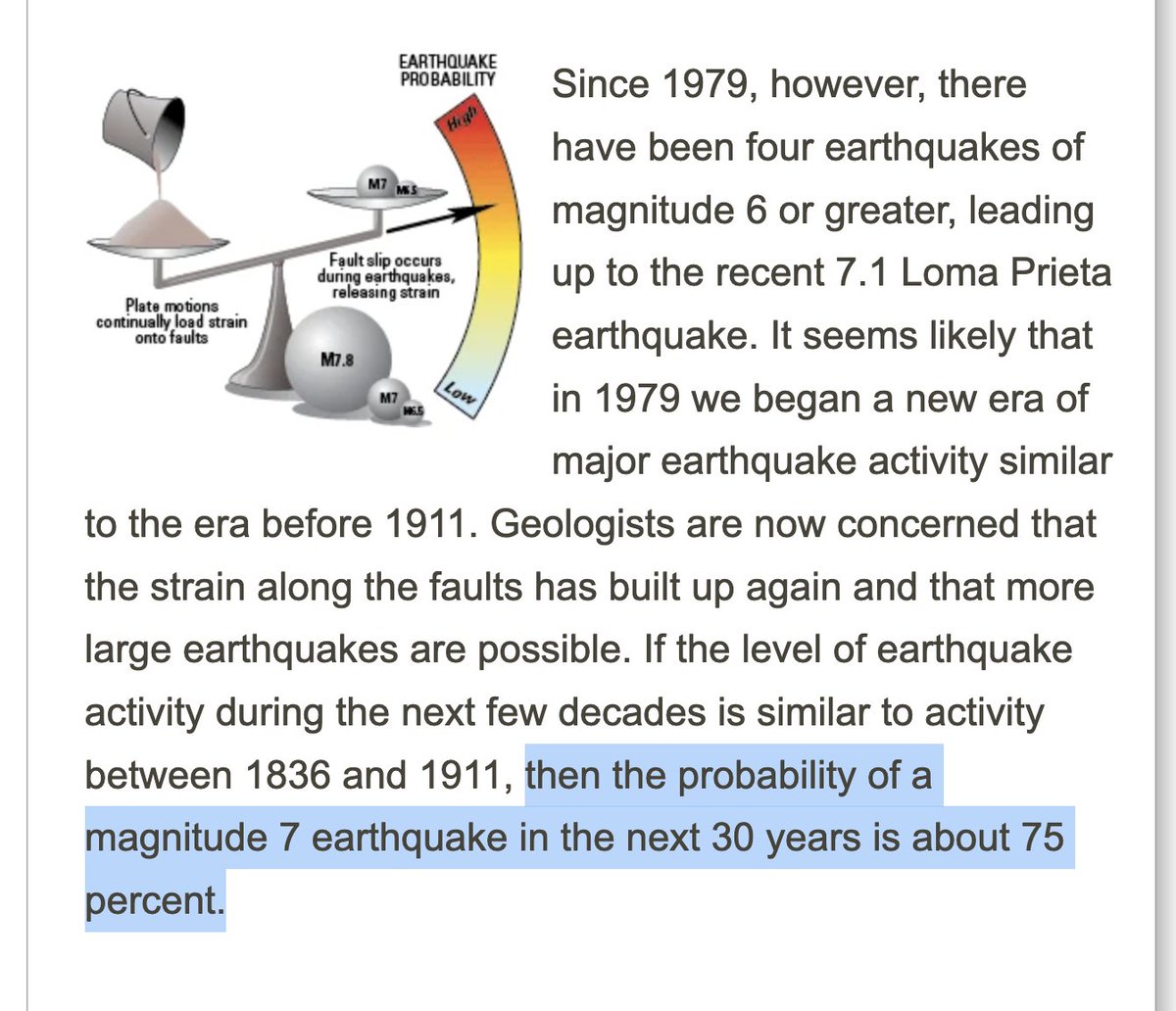
TIL the probability of a major earthquake in the bay area in the next few decades is quite high, almost guaranteed what do we do about this chat
kasra tweet mediakasra tweet media
English
3
0
16
1.8K
kasra
kasra@kasratweets·
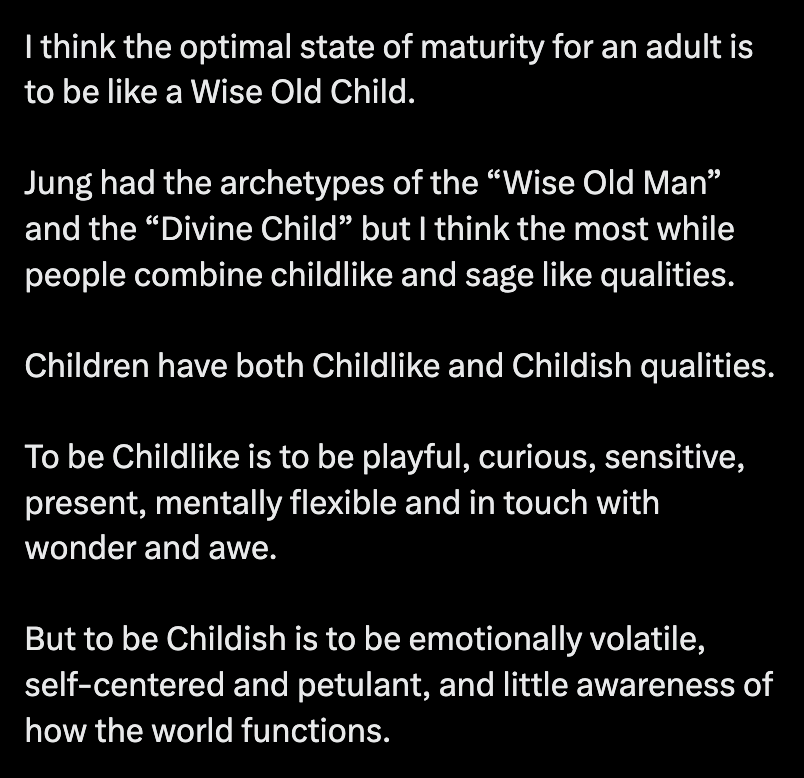
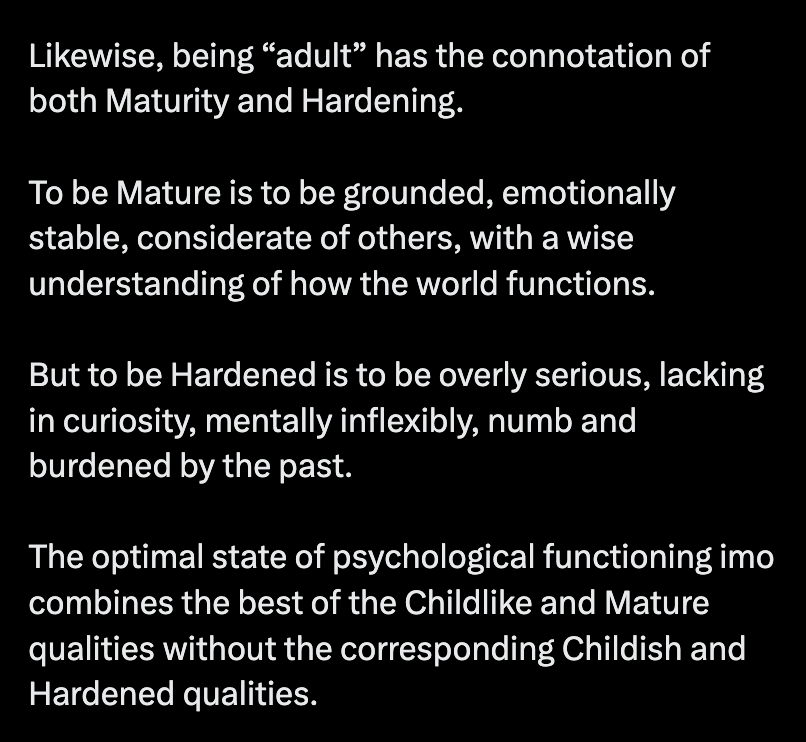
this is so good! be childlike and mature, without being childish or hardened this is exactly how I think about "growing up"
kasra tweet mediakasra tweet media
Vacha@TVachaW

I think the optimal state of maturity for an adult is to be like a Wise Old Child. Jung had the archetypes of the “Wise Old Man” and the “Divine Child” but I think the most while people combine childlike and sage like qualities. Children have both Childlike and Childish qualities. To be Childlike is to be playful, curious, sensitive, present, mentally flexible and in touch with wonder and awe. But to be Childish is to be emotionally volatile, self-centered and petulant, and little awareness of how the world functions. Likewise, being “adult” has the connotation of both Maturity and Hardening. To be Mature is to be grounded, emotionally stable, considerate of others, with a wise understanding of how the world functions. But to be Hardened is to be overly serious, lacking in curiosity, mentally inflexibly, numb and burdened by the past. The optimal state of psychological functioning imo combines the best of the Childlike and Mature qualities without the corresponding Childish and Hardened qualities. Such a person is playful, curious, sensitive, present and mentally flexible. Whilst also being grounded, emotionally stable, considerate of others, with a wise understanding of how the world functions. The journeys to reclaiming our childlike nature and growing into maturity shouldn’t therefore be seen as heading in different directions. We can reclaim our childlike wonder for the world whilst expressing it through the lens of all the wisdom we’ve learned in adulthood. By doing this, we grow into Wise Old Children.

English
1
50
433
16.5K
coderintherye
coderintherye@coderintherye·
@kasratweets Was there for 2014 quake and wasn't a huge deal. Bay Area will recover from a 7 or less pretty easily. Much of infra failure Marc Reisner worried about in "A Dangerous Place: California's Unsettling Fate" has been retrofitted. Levee failure in Delta could be big problem though
English
1
0
2
119
kasra retweetledi
adam ✧ ❥ ~
adam ✧ ❥ ~@adam__isom·
"You’re inflight, you’re falling through the sky, everything feels half-complete [...] I’m right there with you. This is it, the madness we were born into and have no choice but to face. Real life is more and more of this and then it’s over." bitsofwonder.co/p/real-life @kasratweets
English
1
1
4
379
kasra retweetledi
Vacha
Vacha@TVachaW·
@vividvoid I like to say that the optimal way of being for a spiritually mature adult is to be a Wise Old Child: x.com/TVachaW/status…
Vacha@TVachaW

I think the optimal state of maturity for an adult is to be like a Wise Old Child. Jung had the archetypes of the “Wise Old Man” and the “Divine Child” but I think the most while people combine childlike and sage like qualities. Children have both Childlike and Childish qualities. To be Childlike is to be playful, curious, sensitive, present, mentally flexible and in touch with wonder and awe. But to be Childish is to be emotionally volatile, self-centered and petulant, and little awareness of how the world functions. Likewise, being “adult” has the connotation of both Maturity and Hardening. To be Mature is to be grounded, emotionally stable, considerate of others, with a wise understanding of how the world functions. But to be Hardened is to be overly serious, lacking in curiosity, mentally inflexibly, numb and burdened by the past. The optimal state of psychological functioning imo combines the best of the Childlike and Mature qualities without the corresponding Childish and Hardened qualities. Such a person is playful, curious, sensitive, present and mentally flexible. Whilst also being grounded, emotionally stable, considerate of others, with a wise understanding of how the world functions. The journeys to reclaiming our childlike nature and growing into maturity shouldn’t therefore be seen as heading in different directions. We can reclaim our childlike wonder for the world whilst expressing it through the lens of all the wisdom we’ve learned in adulthood. By doing this, we grow into Wise Old Children.

English
2
3
33
3.1K
kasra
kasra@kasratweets·
@byjmitch legendary run can’t wait to see what’s next
English
1
0
1
105
kasra retweetledi
vicki
vicki@vboykis·
Something happens to my brain after agentic coding that I can’t describe. It’s like cognitive offloading which folks have already written about, but even more. It feels like I can’t think through problems anymore. Like a fog. Using agentic but losing my hard-won agency.
English
173
118
2.3K
156.6K
kasra retweetledi
connie
connie@connie_surf·
inprogress.works homepage refresh to show more posts from the community! it's never too late to start a WIP journal for your creative projects, come and check it out :^)
English
4
17
209
8.6K
GT SmilElijah
GT SmilElijah@GT_SmilElijah·
@kasratweets i really liked the article until the correct identification of grindslop was used as justification of basically the exact same self-exploitation at a “hard” company, which is actually a good thing in that case because… they’re making something?
English
1
0
1
26
kasra
kasra@kasratweets·
really proud of this video I took of the moon the other night in SF. I held my hand out straight and took a few steps forward to get this cool gliding effect
English
1
0
17
637