Justino Carneiro

2.7K posts

Justino Carneiro banner
Justino Carneiro

Justino Carneiro

@katechon22

Orthodox Christian • Ρωμιοσύνη–Romanitas • Antiglobalism • Metastrategic counterconspiracy of being https://t.co/Kp196PxqUb

Portugal Katılım Şubat 2022
153 Takip Edilen1.5K Takipçiler
Sabitlenmiş Tweet
Justino Carneiro
Justino Carneiro@katechon22·
My speech at Iurie Roșca's Chișinău Forum 2023. True power resides in principium. But "power is made perfect in weakness” (2 Corinthians 12:9). Text here: arcaluinoe.info/en/blog/2023-0… @chisinauforum:5/Katechontic-Metapolitics-in-Orthodox-Christian:c?r=FTtHxdrSapW1r7cm6gb3hNoeySPFt62V" target="_blank" rel="nofollow noopener">odysee.com/@chisinauforum
Română
2
1
47
21.7K
Justino Carneiro retweetledi
Wolfgang
Wolfgang@Zalmoxis7534·
“A theory of atonement expressed in such an extreme form [Anselm] cannot be accepted by the Orthodox Church. It is one-sidedly legalistic, since it presents the entire matter of human salvation solely within the framework of the law (God's commandment), its violation, the resulting guilt, and the punishment of the guilty party, as required by abstract justice. These legal premises are tinged with feudal notions, characteristic of the medieval West, that an insult inflicted on a member of the upper class can only be absolved by a person of equal social standing. The institution of the duel was founded on this principle. However, the concept of offending God's majesty and the need to satisfy it is alien to Holy Scripture and the Patristic understanding of the atonement.” - Archbishop Basil Krivoshein, The Saving Work of Christ on the Cross and in the Resurrection
Wolfgang tweet media
English
2
18
74
1.2K
Justino Carneiro retweetledi
Justino Carneiro
Justino Carneiro@katechon22·
Yes. They fell to the Franks in the 11th century. The Papal states were a diplomatic extension of the Duchy of Rome. The Pope acted as Ethnarch of the Romans in the west, protecting them from the Germanics. The usurpation of the papacy by Frankish popes around 1054 ended this.
Papal Zouave International🇻🇦@PapalZouaveInt

English
0
2
14
606
Justino Carneiro retweetledi
Wolfgang
Wolfgang@Zalmoxis7534·
“This, then, is how far and how deep the roots of foreign stranglehold on our theology extend. In Muscovite Rus the foreign influence on theology met with due opposition by zealots of Orthodoxy and by the steadfast ecclesiastical authorities. During the Petrine revolution, the ecclesiastical authorities were trampled and suppressed, and foreign theology was transplanted onto Russian soil as if by force. This sin lies not so much with the church hierarchy as with the civil government created by Peter and by a spirit foreign to the Russian people. The enslaved church could not shake off from its theology the Latino-German yoke laid upon it with heavy hand by the civil authorities of the eighteenth century. The government found the heresies of the West closer and more comprehensible than Eastern Orthodoxy.” - Saint Hilarion Troitsky, Bible, Church, History: A Theological Examination, p. 372
Wolfgang tweet media
English
0
9
48
1.3K
Justino Carneiro retweetledi
NEPSIS
NEPSIS@nepsisblog·
"Nothing in this world can replace faith in God: neither philosophy, nor science, nor treasure, nor glory, nor the entire world from one end to the other with all its transitory illusions." St. Nicholai Velimirovic Homily on the Steadfastness of Faith
NEPSIS tweet media
English
0
29
189
2K
Justino Carneiro retweetledi
Wolfgang
Wolfgang@Zalmoxis7534·
It’s very silly when people act like Orthodoxy is incompatible with the west for being “eastern” when all of western religion and thought is pretty much based on pagan Greek philosophy. Also Christ, the Apostles, and all the first Christians were easterners too.
English
2
5
44
1.3K
Justino Carneiro retweetledi
Roman Omen
Roman Omen@snaketrampler·
Archimandrite Raphael Karelin makes a distinction between Lucifer, Belial, Beelzebub, and Asmodius as four separate demonic entities, rather than different masks for one Satan figure.
Roman Omen tweet mediaRoman Omen tweet media
English
5
16
104
4.6K
Justino Carneiro retweetledi
NEPSIS
NEPSIS@nepsisblog·
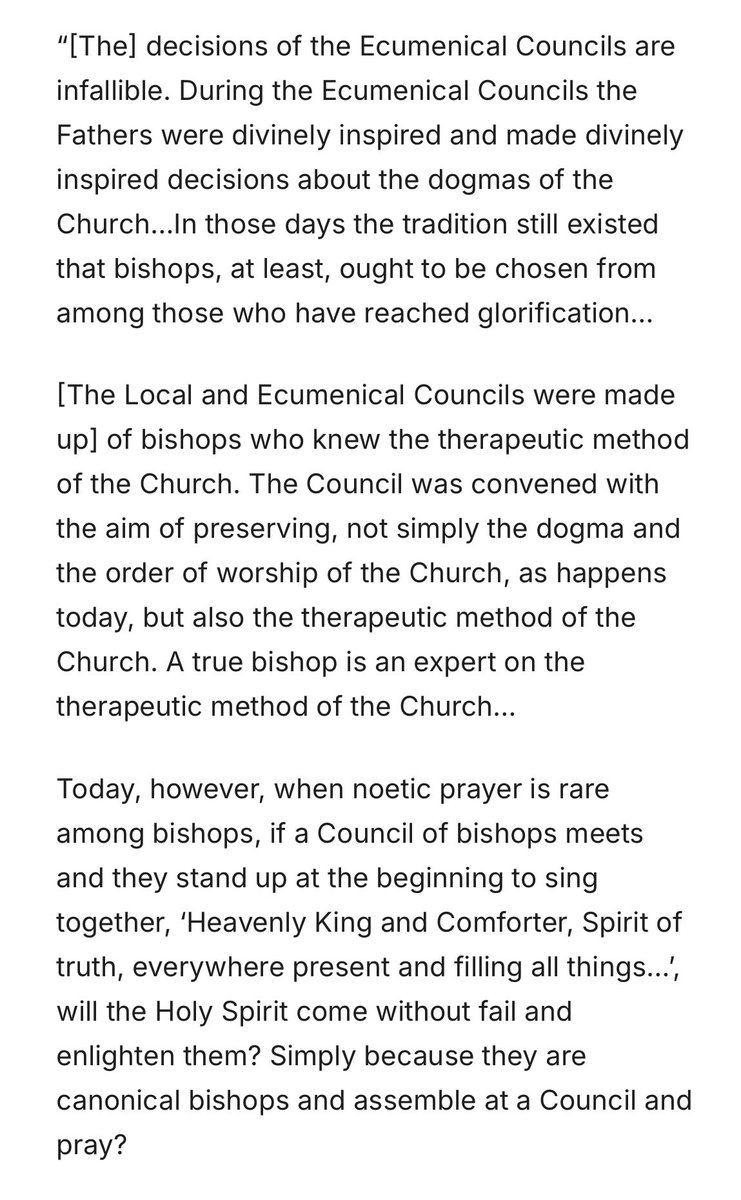
What determines that a Local or Ecumenical Council is Orthodox is whether the majority of the bishops who take part in it are in the state of illumination of the nous. The glorified Fathers gave validity to the Council, not the Council to the Fathers, and the institution of the Ecumenical Councils is a charismatic one, not an institutionalized institution. As Fr. John says, "on these preconditions the Ecumenical Councils are infallible, because illuminated and glorified Fathers took part in them." And these are who we commemorate for the feasts.
English
2
6
19
363
Justino Carneiro
Justino Carneiro@katechon22·
Was the Second Ecumenical Council (Constantinople, 381 AD) ecumenical?
English
6
1
6
2.7K
Justino Carneiro
Justino Carneiro@katechon22·
"True councils—those which express Orthodox truth—are accepted by the Church’s catholic consciousness; false councils—those which teach heresy or reject some aspect of the Church’s Tradition—are rejected by the same catholic consciousness. The Orthodox Church is the Church not of “councils” as such, but only of the true councils, inspired by the Holy Spirit, which conform to the Church’s catholic consciousness." Father Michael Pomazansky, Orthodox Dogmatic Theology
English
2
3
23
981
Justino Carneiro
Justino Carneiro@katechon22·
Fr. Georges Florovsky on the Ecumenical Councils as charismatic events: "In a certain sense the General Councils as inaugurated at Nicea may be described as “Imperial Councils,” die Reichskonzile, and this was probably the first and original meaning of the term “Ecumenical” as applied to the Councils. (...) It is significant that no attempt to develop a legal or canonical theory of “General Councils,” as a seat of ultimate authority, with specific competence and models of procedure, was made at that time, in the fourth century, or later, although they were de facto acknowledged as a proper instance to deal with the questions of faith and doctrine and as an authority on these matters. It will be no exaggeration to suggest that Councils were never regarded as a canonical institution, but rather as occasional charismatic events. Councils were not regarded as periodical gatherings which had to be convened at certain fixed dates. And no Council was accepted as valid in advance, and many Councils were actually disavowed, in spite of their formal regularity. It is enough to mention the notorious Robber Council of 449. Indeed, those Councils which were actually recognized as “Ecumenical,” in the sense of their binding and infallible authority, were recognized, immediately or after a delay, not because of their formal canonical competence, but because of their charismatic character: under the guidance of the Holy Spirit they have witnessed to the Truth, in conformity with the Scripture as handed down in Apostolic Tradition. (...) In other words, the ultimate authority and the ability to discern the truth in faith is vested in the Church which is indeed a “Divine institution,” in the proper and strict sense of the word, whereas no Council, and no “Conciliar institution,” is de jure Divino, except in so far as it happens to be a true image or manifestation of the Church herself. We may seem to be involved here in a vicious circle. We may be actually involved in it, if we insist on formal guarantees in doctrinal matters. But, obviously, such “guarantees” do not exist and cannot be produced, especially in advance. Certain “Councils” were actually failures, no more than conciliabula, and did err. And for that reason they were subsequently disavowed. The story of the Councils in the fourth century is, in this respect, very instructive. The claims of the Councils were accepted or rejected in the Church not on formal or “canonical” ground. And the verdict of the Church has been highly selective. The Council is not above the Church; this was the attitude of the Ancient Church. The Council is precisely a “representation.” This explains why the Ancient Church never appealed to “Conciliar authority” in general or in abstracto, but always to particular Councils, or rather to their “faith” and witness." Fr. Georges Florovsky, The Authority of the Ancient Councils and the Tradition of the Fathers
English
0
7
29
1.8K
Justino Carneiro retweetledi
NEPSIS
NEPSIS@nepsisblog·
"...My mind is found to be constantly on the Holy Mountain and with every opportunity I try to enlighten my acquaintances about it. I emphatically believe that the revival of Orthodoxy will come only with the restoration of our monastic life. Precisely because the Church in the world is cut off from the monastic tradition, the collapse of spiritual life in our days is manifested. Satan has distorted so much the theology of the heretics and those supposed Orthodox influenced by the West, to the point where some think that salvation is not from the dominion and grasp of the enemy, but of God. God became man in order to save us from Himself! Because of this the West has abandoned the ascetic life. They neither fast nor pray much. They only seek happiness... When theology is false, then Christianity is reduced to activities. Unfortunately we do not have one ascetic or monastery, and there is no living example of Orthodox life... I wanted to know your opinion about the possibility of establishing a monastic community of 5-10 monks in the land of America. If this does not happen, Orthodoxy will vanish here or will transform into something else, as it has already happened to a great degree. I have tried in my book [The Ancestral Sin, 1957] to say these things which you also say in your book [Between Heaven and Earth: Athonite Monasticism, 1956], but here nobody understands these things. You see, Greeks have assimilated with the happiness of the West and in their eyes happiness is the will of God. So why would he go to the top of the mountains and do vigils and so on? I would like very much to correspond with you. I believe the devil will be saddened that we do not like the Christianity he is promoting, but what's to be done? Nobody can be like him if they want to be like God. Saint Symeon the New Theologian beautifully describes how Satan assists in the prayers and good works of some." —Fr. John Romanides, in a letter to Fr. Theokletos, Abbot of Dionysiou Monastery, 1958.
NEPSIS tweet media
English
1
9
60
2.6K
Justino Carneiro retweetledi
Orthodox Ethos
Orthodox Ethos@OrthodoxEthos·
Keep reading. This is classic taking something out of context. He clearly does not deny the infallible decrees of the ecumenical councils that have been accepted by the church. He’s saying that they’re not automatically infallible as such because they were called to be or held to be ecumenical, since we have false councils that were considered ecumenical for a time
English
6
15
100
1.9K
Justino Carneiro retweetledi
Orthodox Ethos
Orthodox Ethos@OrthodoxEthos·
There are some interesting matters to observe here. . .both for the Orthodox and those searching among the RCs: From the proclamation below, it is apparent that the SSPX holds Holy Tradition, its preservation and imparting, to be above the Pope and the Papacy, when the latter has departed from the former. In this they depart from Vatican I and draw closer to the perennnial, diachronic truth of Holy Orthodoxy and the Patristic ecclesiology. . . Certainly, their own dedication to what they have received, in spite of certain old errors, is what keeps them from a blind obedience even to the Pope. How can anyone among RCs who is serious about Holy Tradition not see this as praiseworthy, even if this causes doubt in the declaration of Vatican I? Even though they are still far from Orthodoxy, this dedication showcases a perennially important principle: that before one departs from the Truth he has often has departed from the Way. That is, impiety/worldliness/innovation in LIFE is inseparable from, and often precedes, departure from orthodoxy and confession of the true faith. If all you see here is disobedience, then you have closed your eyes to this principle, and are like the blind following the blind and declaring blind obedience (even in matters of dogma) the greatest virtue.
Michael Haynes 🇻🇦@MLJHaynes

SSPX Consecrations: Asked if the four bishops have the apostolic mandate, the notary replies -- “It is the Catholic & Roman church, always faithful to the traditions received from the apostles, who in entirely exceptional circumstances demands that we provide for the upholding of these traditions, that is the deposit of faith & that we take the means necessary to transmit them faithfully to all men for the salvation of their souls. Since the Second Vatican Council up to the present day the authorities in the church have been animated by a spirit that is contrary to the faith & have been acting against holy tradition. They will no longer endure sound doctrine” Schreiber then makes the episcopal oath.

English
22
37
275
22.1K
Justino Carneiro retweetledi
Orthodox Ethos
Orthodox Ethos@OrthodoxEthos·
🎥 TONIGHT at 5:00pm PST / 8:00pm EST: Against the False Enlightenment: St. Athanasius of Paros Join Fr. Peter as he introduces the forthcoming titles from Uncut Mountain Press, the three volume work by St. Athanasius of Paros “Against the Enlightenment,” available for pre-order now at a discount at uncutmountainpress .com Volume One: Defense of the Christian Faith Volume Two: On the True Philosophy Volume Three: Antidote to Atheism WATCH HERE ON X. And… —>
Orthodox Ethos tweet media
English
2
13
54
1.9K