Patrick Madrid ✌🏼

74.7K posts

Patrick Madrid ✌🏼 banner
Patrick Madrid ✌🏼

Patrick Madrid ✌🏼

@patrickmadrid

Host of the “Patrick Madrid Show” on @relevantradio Father of 11, grandfather of 32 https://t.co/wfFo951WS1 Articles: https://t.co/DBW9pegsvY KEEP GOING

Katılım Kasım 2008
58 Takip Edilen104.4K Takipçiler
Patrick Madrid ✌🏼 retweetledi
Memento Mori
Memento Mori@TempusFugit4016·
"There is a story in the Confessions of St. Augustine where he relates what heroism his mother, Monica, practiced in living with her pagan husband, Patricius. Patricius was often unfaithful to Monica. He was given to outbursts of furious anger against his Christian wife. But, says Augustine, she kept forgiving his infidelity, and patiently enduring his verbal cruelty. Why? So that she might convert him, and her son, to Christianity. She succeeded admirably. And for over 1,500 years the world has been nourished on the wisdom of St. Augustine, as a result we may say by the heroism of his mother, St. Monica." - Fr. John Hardon
Memento Mori tweet media
English
7
229
1.1K
14.7K
Patrick Madrid ✌🏼
Patrick Madrid ✌🏼@patrickmadrid·
@Grok's critique of the claims made in this post: The X post (by @ihtesham2005) presents an engaging, dramatic retelling of Ibn al-Haytham (Alhazen, c. 965–1040 CE) as the lone genius who "invented the scientific method" under house arrest in Cairo around 1011, authoring the Book of Optics that supposedly laid the groundwork for Bacon, Galileo, Descartes, and even Newton—while Europe languished in the "Dark Ages." It includes a real quote from his work emphasizing skepticism toward ancient authorities in favor of "argument and experiment," credits him with overturning the Greek extramission theory of vision via the camera obscura, and contrasts this with standard textbook narratives. This is inspirational popular history with a kernel of truth, but it romanticizes and overstates several claims in ways that echo (and invert) the very Eurocentric textbook biases it criticizes. No single person "invented" the scientific method—it evolved gradually across cultures and centuries through observation, hypothesis-testing, experimentation, and skepticism. Al-Haytham was a major pioneer who systematized and applied these elements rigorously in optics, but he built on predecessors, and similar (often exaggerated) claims have been made for earlier and later figures, including Christian scholars. Accurate achievements and context Al-Haytham's Kitāb al-Manāẓir (Book of Optics, written c. 1011–1021) was groundbreaking. He:Rejected blind trust in authorities (Aristotle, Ptolemy, Galen) in favor of empirical verification: "The seeker after truth is not the one who follows his natural disposition to trust the writings of the ancients... but rather the one who suspects them." Used controlled, repeatable experiments (combined with mathematics) to test hypotheses, such as showing light travels in straight lines and enters the eye (intromission theory) rather than rays emitting from it. Provided the clearest early experimental analysis of the camera obscura (pinhole "dark room") to demonstrate image formation, inversion, and light behavior—advancing its use far beyond prior descriptions. His work was translated into Latin in the 12th–13th centuries and directly influenced European optics scholars like Roger Bacon, Witelo, John Peckham, and later Johannes Kepler (whose retinal image theory drew on it). This fed into the Scientific Revolution. He deserves far more recognition in Western popular histories than he typically gets.The house-arrest story has some basis (13th-century biographer Ibn al-Qifṭī describes him being summoned by the erratic Caliph al-Hakim for a Nile project he deemed impossible, leading to restricted living until 1021), but the "faked madness to avoid execution" details are legendary embellishments, not from his own writings. Key overstatements and inaccuracies in the post "Invented the scientific method": This is the core exaggeration (a common trope applied to many figures—Aristotle, Roger Bacon, Galileo, Francis Bacon, Descartes, Newton). Historians widely reject the "lone inventor" framing; the method developed incrementally. Predecessors included:Ancient Egyptians (Edwin Smith papyrus, c. 1600 BCE: empirical examination/diagnosis/prognosis in medicine). Greeks (Aristotle's emphasis on induction from observation + deduction; limited experiments by Herophilos/Erasistratus). Earlier Islamic scholars (al-Kindi, Jabir ibn Hayyan stressed experiment + theory). Al-Haytham refined this into a more systematic cycle (observation → hypothesis → controlled experiment → verification) within optics, but even he didn't originate the full modern hypothetico-deductive approach. His use of experiment was pioneering for physics but limited compared to later developments. Camera obscura: He didn't invent it or first use it scientifically. The principle was known to Aristotle (and earlier Chinese/Indian sources); he advanced its experimental application dramatically. Newton "studied" the book 600 years later: Influence was real but indirect and mediated (via Kepler and the optics tradition). By Newton's era (late 17th century), the Optics had been largely superseded in specifics, though the experimental ethos persisted. "Europe in the Dark Ages": Oversimplification. While the post-Islamic Golden Age transmission via Spain/Sicily was crucial, Christian Europe had active scholarship (monasteries, early universities). The 12th-century Renaissance involved massive translation of Greek/Arabic works, including al-Haytham's. Similar claims about Christian (or pre-Islamic Christian-era) scientists The post's framing implicitly critiques Western-centric narratives that credit later Europeans while ignoring al-Haytham. Fair point—but the "first/inventor" game cuts both ways, and there were earlier empirical/skeptical approaches in Christian contexts (Byzantine/early medieval). John Philoponus (c. 490–570 CE): A Christian theologian/philosopher in Byzantine Alexandria who directly challenged Aristotle's physics with empirical arguments and thought-experiments (e.g., on falling bodies, motion/impetus theory as an "implanted force" rather than air pushing—foreshadowing inertia and Galileo by ~1,000 years). He used observation to reject authority, advancing a proto-empirical critique that some historians link to later experimental science. His ideas influenced medieval scholastics (via preserved texts). Later Christian figures (post-al-Haytham): Robert Grosseteste (c. 1175–1253) and his student Roger Bacon (c. 1219–1292) explicitly promoted experimentation ("scientia experimentalis") as verification, building directly on Arabic translations including al-Haytham. Bacon cited him extensively. These are the Christians often credited in older Western histories with "founding" experimental science—precisely because al-Haytham's work reached them. Some scholars argue medieval Christian theology (a rational, law-giving God creating an orderly, intelligible universe) provided fertile ground for systematic science in Europe, enabling the full Scientific Revolution—distinct from (though building on) Islamic/earlier contributions. Others note parallel monotheistic motivations in the Islamic world. In short: The post rightly highlights an underappreciated Muslim scholar whose experimental rigor was transformative in optics and helped transmit/advance empiricism to Europe. But claiming he "invented" the method (while Europe slept) mirrors the very mythmaking it decries—history is collaborative and cumulative, not a zero-sum contest of "firsts." Al-Haytham, Philoponus, Grosseteste, Bacon, and many others all contributed pieces.
English
1
15
71
5.4K
Ihtesham Ali
Ihtesham Ali@ihtesham2005·
An Arab scholar in 1011 was placed under house arrest in Cairo for 10 years. He used the time to invent the scientific method, prove how vision actually works, and write a 7-volume book that Newton studied 600 years later. I read about him last night and could not stop thinking about it. His name was Ibn al-Haytham. The book is called the "Book of Optics." The textbook story names Bacon, Galileo, and Descartes as the founders of modern science. All three of them came 600 years after Ibn al-Haytham. All three of them studied his work directly or through Latin translations. The man who actually invented the scientific method was working alone in a single room in Cairo while Europe was still in the Dark Ages. Here is the story almost nobody tells you. He was born in Basra around 965 CE. By his 40s he had a reputation across the Arab world as one of the most original minds alive. Then he made the mistake that almost killed him. He claimed publicly that he could regulate the flooding of the Nile. The mad caliph al-Hakim of Cairo summoned him to Egypt to do it. Ibn al-Haytham took one look at the river and realized the project was impossible with the technology of his era. The caliph had executed dozens of scholars for less. So he faked madness. The caliph believed him and put him under house arrest in his own home in Cairo for the next 10 years. Most people would have lost their actual mind. He used the time to invent science. Before him, knowledge worked one way. You quoted authority. If Aristotle had said it, it was true. If Galen had written it, it was correct. The role of a scholar was to memorize and defend the ancient Greeks. I Ibn al-Haytham broke this completely. He wrote a sentence in the Book of Optics that quietly destroyed 1,400 years of intellectual culture. "The seeker after truth," he said, "is not the one who follows his natural disposition to trust the writings of the ancients. The seeker after truth is the one who suspects them, questions them, and submits only to argument and experiment." That single sentence is the foundation of modern science. He wrote it 600 years before the European Renaissance. The second thing he did was build the actual machinery of experimentation. He insisted that no claim about the physical world was acceptable until it had been verified by an experiment anyone could repeat. He gave detailed instructions for every experiment in his book. He told his readers, in writing, not to take his word for any of it. Build the equipment. Run the tests yourself. Verify or destroy my claims with your own eyes. The third thing he did was use the method to overturn one of the most settled questions in physics. The Greeks had taught for centuries that vision worked because the eye emitted invisible rays. Ibn al-Haytham proved them wrong with a darkened room, a small hole, and a wall. The first camera obscura. He showed that light from the outside world enters the eye, the exact opposite of what every Greek thinker had taught. Two hundred years later his book was translated into Latin in Spain. Roger Bacon cited him. Kepler cited him. Galileo's work on the telescope was built on his optics. Newton's foundational work on light rested on his framework. Walk into any physics department today. Ask who founded the scientific method. Almost nobody will say Ibn al-Haytham. The man who invented the way humanity actually knows things did the work under house arrest, with no funding, no laboratory, and a paranoid caliph next door waiting for an excuse to kill him. He did it anyway. Most of the world is still pretending it was someone else's idea.
Ihtesham Ali tweet media
English
201
3.5K
9.2K
417.1K
Patrick Madrid ✌🏼
Patrick Madrid ✌🏼@patrickmadrid·
Excellent response, Joshua. As you note, the graphic is worthless because it’s fallacious; its entire argument resting on a false premise. The Catholic Church has never taught that the Fathers are the “Final Authority” over Scripture. The graphic misrepresents and thus fails to interact with the actual Catholic position, which is tripartite: Scripture, Sacred Tradition, and the Magisterium together. What the Catholic Church actually teaches regarding the Fathers is the consensus patrum: their moral (not absolute) unanimity and convergent witness across centuries, receiving, confirming, and handing on the living Tradition and the authentic meaning of Scripture, never replacing it. Once that’s understood, the graphic’s central fallacy becomes clear and each of its four claims collapse on their own, because, collectively, they argue against a position the Catholic Church doesn’t hold. From its title to its final bullet point, the graphic is one extended straw man fallacy.
English
1
20
174
4.4K
Joshua Charles🇻🇦
Joshua Charles🇻🇦@JoshuaTCharles·
There is much to say about each of these points, which either proceed from protestant assumptions nowhere in Church history, and/or misrepresent the Catholic position. But one thing that is absolutely false is the first point. As someone blessed to be in their writings almost every day for almost 9 years now, I have found astounding unanimity among the Fathers on many different subjects, and even small details of Scriptural interpretation (to say nothing of their unanimity on the Church—more below). But even on this, when one Father observes something different than another in Scripture, virtually every time, this isn’t a contradiction, but equally Catholic, and in accordance with the “Rule of Faith.” Protestants often automatically present this as a contradiction, but Catholics don’t, and have never seen it that way. For example, our answer to the question “Was the Rock Christ, St. Peter, or Peter’s Confession?” is simply “Yes,” because each aspect symphonically reinforces the others. And beyond even that, all the Fathers agreed that the Catholic Church had authority from God to issue binding definitions on the faith, and that such definitions could only issue from the successors of the Apostles, the bishops (with virtual unanimity about a superior authority of some kind in the bishop of Rome). They believed this because they knew they were not inspired, or infallible, as individual men. But they knew the Church was indeed infallible, and had authority from Christ to teach the whole world ONE and the SAME faith. They always and everywhere speak of the Church as having ONE teaching, ONE government, ONE worship, ONE canon law, ONE faith, etc. Protestants cannot make this claim for themselves, and have never been able to. So even if they got things wrong—which many of them admitted they could—the Fathers knew the Church would not. They knew that when a theological issue was resolved, it would ONLY be resolved within THAT Church. Not by a heretical sect who had long since left it; or by a schismatic group that stood aloof from it. I hope this shows why attempts such as those below by this protestant fellow are superficial at best, if not outright false.
Josh Barzon@JoshuaBarzon

Very good points here. I love and respect many of the early church fathers. But their teachings and writings must always be viewed as below scripture. Not equal with it.

English
30
125
1.2K
27.7K
MrCasey
MrCasey@MrCasey62·
“Kill shot” 🤣 Paul WASN’T writing a catechism. He visited cities first, taught them orally (months to years), then wrote letters to clarify PARTICULAR ISSUES within those communities.* There’d be no reason to further address beliefs about Mary if no clarification was needed. 🧵
MrCasey tweet media
English
29
16
299
5.2K
MrCasey
MrCasey@MrCasey62·
Christ and St. Paul said you CAN. And they said it repeatedly. 🧵
MrCasey tweet media
English
25
14
291
6.7K
The Catholic Engineer
The Catholic Engineer@TheCatholicEngr·
Fangirling right now cause THE Patrick Madrid commented on my tweet (I love your radio show, sir!)
Patrick Madrid ✌🏼@patrickmadrid

@marasmith7 @TheCatholicEngr “Have you not read in the book of Moses, in the passage about the bush, how God told him, ‘I am the God of Abraham, the God of Isaac, and the God of Jacob’? He is not the God of the dead but of the living. You are greatly misled” (Mark 12:26–27) patrickmadrid.substack.com/p/any-friend-o…

English
1
2
25
2.4K
Mara Smith
Mara Smith@marasmith7·
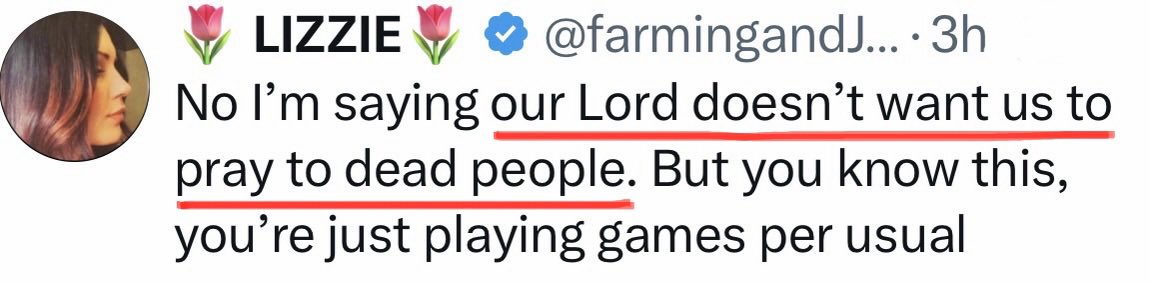
@TheCatholicEngr God uses living humans on earth, not dead people in heaven. Stop putting God in a box!
English
10
0
7
5.1K
The Catholic Engineer
The Catholic Engineer@TheCatholicEngr·
I don't remember where I watched it, either YouTube Shorts or Instagram reels, but I saw a video of Dave Ramsey on a podcast sharing how for one Christmas he bought $10 million of medical debt that belonged to other people, and he told each employee in his company, their Christmas treat this year was to call 10 debtors each and tell them their debt has been paid off They happily did so, and the employees cried with the callers when they shared the news The employees reported back saying that that was the best Christmas gift they ever received Dave Ramsey could've easily called the debtors himself or sent out a mass email, but he allowed his employees to share in the joy of helping people Now I'm thinking about how this anecdote applies to God and the saints in heaven. God can easily snap his fingers and grant every request, but the reason He assigns saints in heaven as Patrons of things (like St. Anthony of Padua for lost items, St. Gianna Molla for infertility etc.) is because God is allowing His followers to share in the joy of helping people God is always the source, but the saints are the conduit
English
29
135
1.8K
58.9K
Thursday
Thursday@thesanityrevolt·
Ed, if you aren’t willing to defend your own positions or even somewhat engage with opposition please butt out of politics. I’m dead serious. You’re so great and so intelligent, but stay in your lane or at least operate in good faith, rather than making other Catholics live harder. A lot of Catholic men work very hard to maintain the Catholic seat at the table in American Politics and people like you just calling our allies and needed voters dumb, then refusing to engage does more harm than good. If you can’t have an adult discussion with opposition shut up rather than acting like a child and embarrassing yourself.
Edward Feser@FeserEdward

@thesanityrevolt Blah blah. It's a guy saying "We've had enough of Trump!" in seashells, nothing more. This whole thing is so stupid.

English
8
2
38
5.9K
Patrick Madrid ✌🏼
Patrick Madrid ✌🏼@patrickmadrid·
Keep at it, Ed. You’re doing the Lord’s work. Pointing out the incoherence of those who try, morally, to square circles and explain away real and urgent concerns is vitally needed right now. Besides, you tower intellectually over your ideological interlocutors, and that seems to infuriate those who recognize it. You ARE in your lane, the condescending jibes from sanctimonious prigs notwithstanding. Keep going.
English
3
0
18
510
Edward Feser
Edward Feser@FeserEdward·
I've engaged and defended it plenty and most of the response has been unbelievably intellectually dishonest and nakedly partisan. If that momentarily made me a bit too tart with you personally, then I apologize, but these accusations of bad faith and remarks like "shut up," "stop acting like a child" and resort to the braindead "stay in your lane" Twitter cliche - all in defense of as transparently lawless and vindictive an act of lawfare as can be imagined - can only further try the patience of even the most reasonable person.
English
8
0
91
3.4K
"Elections" Have Consequences
@patrickmadrid I lost a lot of interest in novels because publishers discourage standalone stories. Almost everything you read becomes a series with no ending. They can get more money, I think. FYI: Read Project Hail Mary. Even if you don't like sci-fi it's a great story. With a great ending.
English
1
0
2
114