Gennaro Vietri

2.8K posts

Gennaro Vietri

Gennaro Vietri

@kesonno

Terrone emigrante, padre e marito. Cofounder/CTO @Bitbull_it
Milan/Naples Katılım Ekim 2008
480 Takip Edilen374 Takipçiler
Gennaro Vietri retweetledi
George from 🕹prodmgmt.world
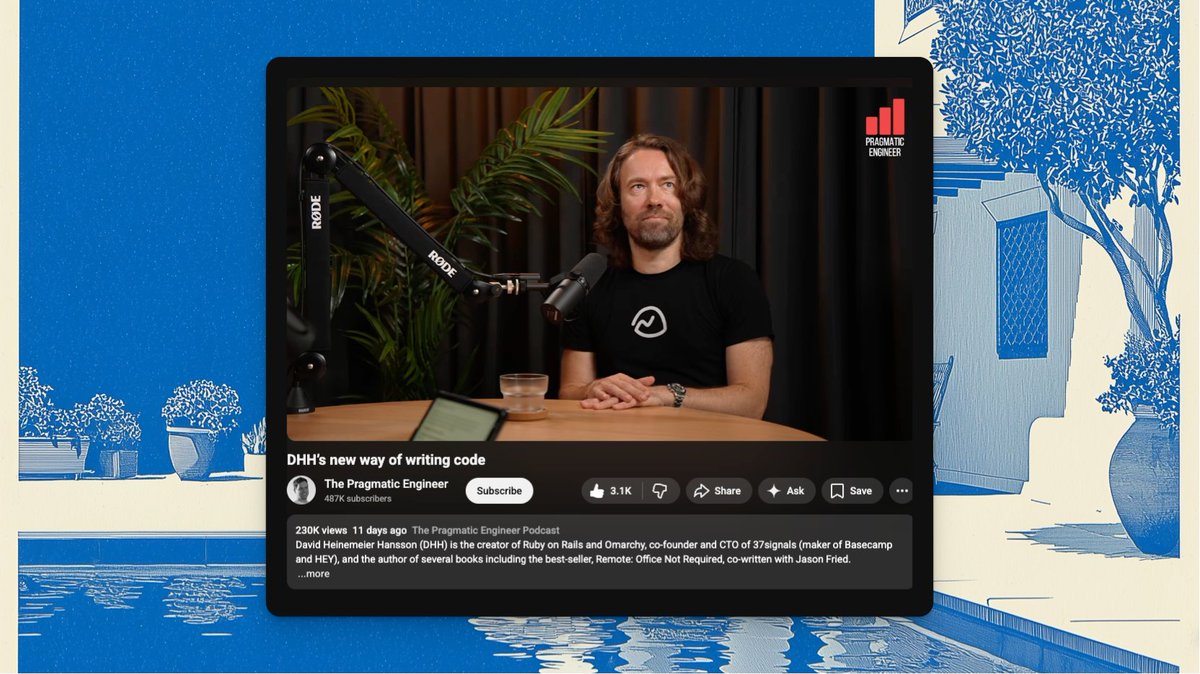
DHH spent 20 years dismissing product management. Then 1h21 into his Pragmatic Engineer interview, he caught himself and admitted he was wrong. He was listing what matters now that AI writes the code: figuring out what to build, how to build it, which customers to talk to, where to focus. Then his exact next words: "It's product management. It's so funny for me too because historically I've not necessarily had the highest esteem for product management as a function. I thought there was a lot of BS." He explained why. Implementation was always the constraint. Engineers needed four weeks to ship anything, so PMs spent those weeks talking, planning, strategizing. Nothing looked like output until the code landed. "They were underutilized. They were not the constraint." They were rate-limited. The loudest PM-skeptic changing his mind (and DHH has strong opinions!) -- that should count for something. let's toast to that 🥂
George from 🕹prodmgmt.world tweet media
English
27
67
888
97.1K
antirez
antirez@antirez·
In the next months I'll provide you with a Hacker News replacement that I'll run myself and I'll guarantee personally: no benefit for whatsoever individual, a team of 10/20 persons since the start, from different time zones, clear rules, total transparency, and a "karma" system. I really want to fix HN and provide something that is not bound to a specific company.
English
82
63
1.2K
58.4K
Gennaro Vietri retweetledi
Ricardo
Ricardo@Ric_RTP·
America spent $285 billion to LOSE the AI war. Stanford dropped a 423 page report yesterday and revealed the most damning stat on page 200: The number of AI researchers moving to the United States has collapsed 89% since 2017. 80% of that collapse happened in the LAST 12 MONTHS. Let that sink in. The country that invented the transformer. The country that built OpenAI, Anthropic, Google DeepMind, and xAI. The country pouring $285.9 billion of private capital into AI in a single year (23x more than China). Can no longer attract the people who actually build the technology. And here's the part that should concern every founder, operator, and investor reading this: The Trump administration just made it official. The H-1B visa now costs employers $100,000 PER HIRE. So OpenAI wants to hire a Chinese postdoc from Tsinghua? $100K before they write a line of code. Anthropic wants a French ML engineer? $100K. Google wants the Indian PhD who literally co-authored the paper their entire model is based on? $100K. And these are the LUCKY ones who even get a visa. The result was instant. 89% drop over 8 years. 80% of it in the last year alone. The talent pipeline got destroyed. Now look at the other side of the chart: China's top model is now 2.7 percentage points behind Anthropic's best. Down from a 20+ point gap two years ago. China leads the world in AI publications. China leads in AI patents. China leads in industrial robot installations. US and Chinese models have traded the #1 spot multiple times since early 2025. Switzerland and Singapore now have more AI researchers per capita than the US. The US ranks 24TH globally in actual AI adoption. Behind the UAE. Behind Singapore. Behind countries most Americans couldn't find on a map. And here's the truly insane part: 50% of the world's top AI researchers are Chinese. Jensen Huang said this on a podcast 3 weeks ago. For 20 years, the US strategy was simple: Let them study at Stanford and MIT, then keep them. Pay them $800K. Give them green cards. Build the future on imported brains. That deal is dead. We just told the smartest people in the world: "Pay $100,000 for the privilege of working here, or go home." And guess what they're doing. They're going to Zurich, where Anthropic and OpenAI are quietly opening offices because they can't get the talent into San Francisco anymore. The strategy is the same as building a Ferrari factory and then banning mechanics from entering the building. You can pour hundreds of billions into data centers. You can buy 4 million Nvidia chips. You can sign $300 billion cloud contracts with Oracle. You can build nuclear reactors to power your GPUs. None of it matters if the people who write the algorithms aren't allowed in the country. Wall Street thinks AI is a capex race. But in reality, it's a TALENT race. Every dollar Microsoft and Meta and Google are spending assumes the same army of researchers will keep showing up to use it. That assumption just broke. And the smart money already knows: Why is Anthropic opening a Zurich office? Why is DeepMind expanding in London instead of Mountain View? Why is OpenAI hiring in Dublin and Singapore? Because the math no longer works in America. The government turned the world's biggest brain magnet into the world's most expensive border wall. 3 years from now, when China launches a frontier model that outperforms anything in the US and the headlines scream "How did we lose the lead?" - remember this post. The lead wasn't lost in a lab. It wasn't lost on a benchmark. It wasn't lost to a smarter algorithm. It was lost at customs.
English
165
869
1.9K
230K
Gennaro Vietri retweetledi
Dustin
Dustin@r0ck3t23·
Yann LeCun just exposed AI’s fundamental flaw. We’re celebrating systems that can’t do what insects do effortlessly. LeCun: “The biggest difficulty is not to get fooled into thinking that a computer system is intelligent simply because it can manipulate language.” Language feels like intelligence because we experience it as the highest form of human thought. So when a machine produces fluent, articulate, convincing text, the instinct is to conclude it understands. It doesn’t. LeCun: “It turns out the real world is much, much more complicated.” Language is actually the easy part. A sequence of discrete symbols with a finite number of possibilities. Predicting the next word is a tractable mathematical problem. Impressive at scale. Not understanding. Pattern matching in symbol space. The real world is something else entirely. A high-dimensional, continuous, noisy signal that changes every millisecond in ways no text corpus can capture. Physical reality doesn’t come in tokens. LeCun: “Which your house cat is perfectly able to deal with. But not computers yet.” This is the Moravec paradox. The things that feel hard to humans: writing essays, solving equations, passing bar exams. Computationally straightforward. The things that feel trivially easy: walking across a room, catching a falling object, folding a shirt. Extraordinarily difficult for machines. Your house cat navigates a complex three-dimensional physical environment in real time. Predicts trajectories. Adjusts to surprises. Understands cause and effect through direct interaction with the world. The most powerful AI systems ever built cannot do what your cat does before breakfast. That’s not a minor gap. That’s the entire frontier. Language is the easy problem that looks hard to humans. The physical world is the hard problem that looks easy because evolution solved it billions of years ago. We’re pouring hundreds of billions into making language models marginally better at the simple problem. The actual intelligence problem remains unsolved. LeCun has spent fifteen years on this. Not making chatbots more fluent. Giving machines the ability to understand, predict, and interact with physical reality the way animals do instinctively. The benchmark that matters isn’t passing a bar exam. It’s folding a shirt. Loading a dishwasher. Navigating an unfamiliar room without a map. We built systems that can write your dissertation before we built systems that can tie your shoes. That’s where AI actually is. Everything else is autocomplete at scale.
English
236
877
2.9K
283.8K
Gennaro Vietri retweetledi
antirez
antirez@antirez·
If you explain how to do it, Claude Code is able to use Codex when it is incapable of solving certain issues. This way you have the best of both worlds. Here is the skill file that lets Claude use Codex. gist.github.com/antirez/2e0772…
antirez tweet media
English
38
49
862
97.1K
Gennaro Vietri retweetledi
Southern Chestnut 🇺🇸
Southern Chestnut 🇺🇸@AppyOrtho·
You can see the soul drain from society in real time.
Southern Chestnut 🇺🇸 tweet media
English
1.5K
9.6K
63.4K
3.8M
Gennaro Vietri retweetledi
Sam Greene
Sam Greene@samagreene·
I study authoritarianism for a living, so I do not say this lightly: America isn't facing an authoritarian future. America is living an authoritarian present. (A long 🧵) /1
English
1
9.2K
35.8K
1.2M
Gennaro Vietri retweetledi
Aakash Gupta
Aakash Gupta@aakashgupta·
The entire robotics industry is about to compress a decade of progress into 18 months, and nobody’s pricing it in. The hardware has been ready for years. Boston Dynamics had Atlas doing backflips in 2018. The bottleneck was never motors or actuators. It was that every robot behavior had to be hand-coded. Pick up a box? That’s one program. Pick up a bottle? Different program. Move the box from shelf A to shelf B in a warehouse with slightly different lighting? Start over. Foundation models broke this completely. Before VLAs, teaching a robot one skill gave you exactly one skill. Zero compounding. Zero transfer. A robot trained to fold shirts couldn’t fold towels without starting from scratch. The labor intensity of data generation meant robotics datasets stayed narrow, robots overfit, and small variations like object weight or table height caused failures. Now a single Gemini Robotics model handles tasks it has never seen in training. Google’s On-Device model learns new behaviors with 50-100 demonstrations. Not 50,000. Fifty. That’s a 1000x reduction in the data requirement for new capabilities. The speed implications cascade through everything. First order: deployment timelines collapse. What took robotics teams 6-12 months of custom programming now takes days of fine-tuning. Second order: the addressable market explodes. Tasks that were never economical to automate suddenly are, because the integration cost dropped by orders of magnitude. Third order: the data flywheel accelerates. Every robot running Gemini Robotics feeds learning back into the foundation model. More deployments means faster improvement means more deployments. Physical Intelligence raised at $2.4B because investors finally understood this. Boston Dynamics partnered with Toyota Research Institute to bolt Large Behavior Models onto Atlas. Every humanoid company is scrambling to either build or license the intelligence layer they don’t have. The market is still valuing robotics companies on their hardware differentiation. But hardware is commoditizing. Boston Dynamics spent a decade perfecting locomotion, and now that’s table stakes. The value is migrating entirely to whoever owns the foundation model that generalizes across embodiments. Google trained Gemini on the largest multimodal corpus ever assembled. Then they added physical actions as an output modality. That’s not a robotics company bolting on AI. That’s an AI company whose models now output motor commands. The companies pricing this correctly are building around foundation model access, not around proprietary hardware. The companies pricing this wrong are still acting like the moat is in the mechanical engineering. AGI moving into the physical world isn’t a 10-year prediction. Gemini Robotics shipped in March. The 1.5 version with chain-of-thought reasoning shipped in September. They’re iterating on a 6-month release cycle while hardware companies iterate on 3-year cycles. The gap between software intelligence timelines and hardware development timelines is the entire trade.
Jon Hernandez@JonhernandezIA

📁 Demis Hassabis, CEO of DeepMind, says robotics didnt fail because of hardware. It failed because intelligence was missing. Gemini level models finally give robots the software brain they needed. When intelligence works, hardware follows. AGI doesnt live behind a screen. It moves.

English
244
935
6.4K
1.3M
Gennaro Vietri retweetledi
Florian S
Florian S@airesearch12·
Introducing screengrasp - The new SOTA agent click position model - beating Anthropic Computer Use, OmniParser and Molmo by a wide margin. - Simplified API access to the best click models on the market. 🔁Retweet and DM for free API credits. More details 👇
English
26
51
261
54.3K
Gennaro Vietri retweetledi
Rajiv Mehta
Rajiv Mehta@rajivmehta19·
*BIG BREAKING * the People's #Bank of #China suddenly announced that the digital RMB (Renminbi, Chinese Yuan) cross-border settlement system will be fully connected to the ten ASEAN countries and six Middle Eastern countries, which means that 38% of the world's #trade volume will bypass the SWIFT system dominated by the US dollar and directly enter the "digital RMB moment". This financial game, which The #Economist called the "Bretton Woods System 2.0 Outpost Battle", is rewriting the underlying code of the global economy with blockchain technology. While the #SWIFT system is still struggling with the 3-5 day delay in cross-border payments, the #digital #currency bridge developed by China has compressed the clearing speed to 7 seconds. In the first test between Hong Kong and Abu Dhabi, a company paid a Middle Eastern supplier through digital RMB. The funds no longer went through six intermediary banks, but were received in real time through a distributed ledger, and the handling fee dropped by 98%. This "lightning payment" capability makes the traditional clearing system dominated by the US dollar instantly look clumsy. What makes the West even more frightened is the technical moat of China's digital currency. The blockchain technology used by the digital RMB not only makes transactions traceable, but also automatically enforces anti-money laundering rules. In the China-Indonesia "Two Countries, Two Parks" project, Industrial Bank used digital RMB to complete the first cross-border payment, which took only 8 seconds from order confirmation to funds arrival, 100 times more efficient than traditional methods. This technical advantage has enabled 23 central banks around the world to actively join the digital currency bridge test, among which Middle Eastern energy traders have reduced settlement costs by 75%. The deep impact of this technological revolution lies in the reconstruction of financial sovereignty. When the United States tried to sanction Iran with SWIFT, China had already built a closed loop of RMB payments in Southeast Asia. Data shows that the cross-border RMB settlement volume of ASEAN countries exceeded 5.8 trillion yuan in 2024, an increase of 120% over 2021. Six countries including Malaysia and Singapore have included RMB in their foreign exchange reserves, and Thailand has completed the first oil settlement with digital RMB. This wave of "de-dollarization" made the Bank for International Settlements exclaim: "China is defining the rules of the game in the era of digital currency." But what really shocked the world was China's strategic layout. Digital RMB is not only a payment tool, but also a technical carrier of the "Belt and Road" strategy. In projects such as the China-Laos Railway and the Jakarta-Bandung High-Speed ​​Railway, the digital RMB is deeply integrated with Beidou navigation and quantum communication to build a "Digital Silk Road". When European car companies use digital RMB to settle freight through the Arctic route, China is using blockchain technology to increase trade efficiency by 400%. This virtual-real strategy makes the US dollar hegemony feel a systemic threat for the first time. Today, 87% of countries in the world have completed the adaptation of the digital RMB system, and the scale of cross-border payments has exceeded 1.2 trillion US dollars. While the United States is still debating whether digital currency threatens the status of the #US #dollar, China has quietly built a digital payment network covering 200 countries. This silent financial revolution is not only about monetary sovereignty, but also determines who can control the lifeline of the future global economy! This is very big news It means De-dollarisation in a big way. It can completely re-set the world
English
405
2.6K
7.9K
2.1M
Gennaro Vietri retweetledi
Mikhail Parakhin
Mikhail Parakhin@MParakhin·
Today we've acquired @VantageAI and welcomed founders @nigelcdn, Lance Riedel and the team to Shopify. Their incredible Search platform will level up the search experience for Shopify users. Now, why Search is important is left as an exercise for the inquisitive reader :-)
English
21
9
144
63.7K
Gennaro Vietri retweetledi
Simon Willison
Simon Willison@simonw·
Stop saying "certainly"!
Simon Willison tweet media
English
1
3
37
9K
Gennaro Vietri retweetledi
Miguel de Icaza ᯅ🍉
Miguel de Icaza ᯅ🍉@migueldeicaza·
Yes, I would love for my timeline to be my favorite tech topics and my continuous brand of mediocre humor, but this ongoing genocide we are funding makes everything else seem futile. Free Palestine.
English
0
144
652
22.2K
Gennaro Vietri retweetledi
Fernando Oliver, Esq.
Fernando Oliver, Esq.@Fernand46357857·
PLEASE DON’T RETWEET THIS PICTURE OF ME
Fernando Oliver, Esq. tweet media
English
214
10.7K
11.3K
203.7K
Gennaro Vietri retweetledi
Simon Willison
Simon Willison@simonw·
I hadn't seen the McNamara Fallacy before - this may also explain why it's so easy for companies to fall into the trap of depending heavily on A/B tests over product design intuition, even A/B tests that rarely produce statistically significant results
Ethan Mollick@emollick

I see firms falling into the McNamara Fallacy with LLMs Step 1: Measure what can be easily measured Step 2: Disregard that which cannot be measured easily Step 3: Presume that which cannot be measured easily isn’t important Step 4: Say what can’t be easily measured doesn’t exist

English
8
37
186
58.8K
Gennaro Vietri retweetledi
Brendan Falk
Brendan Falk@BrendanFalk·
🎉 Exciting news We have officially re-launched @fig as Amazon CodeWhisperer for command line It's completely free, signups are open to everyone (finally), and the app is more secure and stable than ever 😎
GIF
English
30
53
485
82.6K
Gennaro Vietri retweetledi
not just pixels
not just pixels@getifyX·
Here's my take (that nobody asked for) on what's going on these days with all the swing back to server-side JS framework activity (RSC, streaming/hydration, resumability, etc etc).
English
5
22
140
42.2K