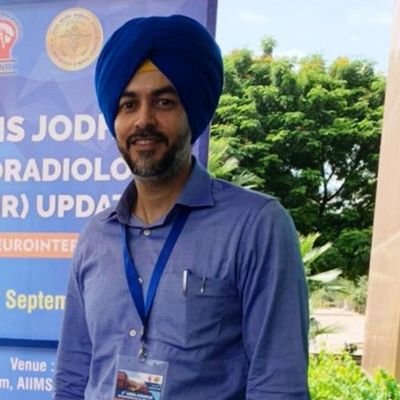
Pushpinder S. Khera

489 posts

Pushpinder S. Khera

Pushpinder S. Khera

@khera_s

Professor and Head, Department of Radiology at AIIMS Jodhpur. Interventional Radiologist. MD,DNB,FRCR,Fellowship in Vascular Interventional Radiology,EBIR

Jodhpur, India Katılım Mayıs 2014
573 Takip Edilen192 Takipçiler
Pushpinder S. Khera retweetledi

Ajay Joe
Ajay Joe@joedelhi·
Left behind in Kabul. Alone. He waited 47 days. K-9 Chaos was not a dog who did his job. He was a dog who had DECIDED, completely, permanently, without reservation, that Lieutenant Marcus Webb was coming back for him. No matter how long it took. At Hamid Karzai International Airport, Kabul, on the morning of August 30th, 2021, a three-year-old Belgian Malinois sat in an empty aircraft hangar. The last American plane had left six hours ago. The evacuation was over. Chaos had been left behind. Not intentionally. The chaos of the withdrawal. The panic. The rush. Webb had been separated from Chaos during the final evacuation. Put on a different plane. Told Chaos would be on the next flight. There was no next flight. Chaos survived the first day alone. Waiting at the hangar where Webb had left him. Chaos survived the first week. Scavenging food from abandoned military supplies. Chaos survived 47 days in Taliban-controlled Kabul. Alone. Hiding. Waiting. Because Chaos survived on the belief that Webb wouldn't leave him forever. Back in the United States, Webb was losing his mind. Filed reports. Called congressmen. Contacted rescue organizations. Went on the news. "I left my dog in Afghanistan," he said on CNN, his voice breaking. "I left my brother. And I'm going to get him back." The military said it was impossible. Kabul had fallen. Taliban controlled the airport. No way to extract a dog. Webb didn't care about impossible. He contacted Pineapple Express, a veteran-run extraction operation. Gave them Chaos's last known location. Sent photos. Videos. Anything that could help. For 47 days, Webb didn't sleep. Didn't eat properly. Just waited for news. On October 16th, 2021, his phone rang. "We found him," the voice said. "We found Chaos." A rescue team had infiltrated Kabul. Used Webb's intel. Found Chaos still at the hangar. Still waiting. Forty-seven days later. Chaos was emaciated. Dehydrated. Traumatized. But alive. The extraction took three days. Smuggling Chaos out of Taliban-controlled territory. Through checkpoints. Through danger. But they got him out. On October 19th, 2021, Chaos landed at Dulles International Airport. Webb was waiting on the tarmac. When they opened the crate, Chaos didn't move. Stared at Webb like he was seeing a ghost. "It's me, brother," Webb said, kneeling down. "I came back. I promised I'd come back." Chaos stepped out slowly. Walked to Webb. Collapsed into his arms. The reunion video went viral. Seventeen million views in three days. But what people didn't see was what happened after. For six months, Chaos wouldn't sleep unless Webb was in the room. Wouldn't eat unless Webb fed him. Wouldn't go outside unless Webb went first. "He's terrified I'll leave him again," Webb said in an interview. "And I don't blame him. I left him once. In the worst place. At the worst time. He waited 47 days for me. And I'll spend the rest of my life making sure he knows I'm never leaving again." Three years later, Chaos still sleeps with his head on Webb's chest. Still follows him everywhere. Still making sure Webb doesn't disappear. K-9 Chaos. Survived 47 days alone in Kabul. Extracted by heroes. Reunited with his handler. Home. facebook.com/share/1HLX9dCv… #LostAndFound #doglover #seniordogs #animalwelfare #militarydog #k9hero #dogrescue #Kabul #47Days #LeftBehind #BroughtHome
Ajay Joe tweet media
English
1.5K
9.7K
44.5K
1M
Pushpinder S. Khera retweetledi
Dr. Brahma Chellaney
Dr. Brahma Chellaney@Chellaney·
America’s Shadow Diplomats — and Their Conflicts of Interest Instead of the secretary of state, Trump has turned to his son-in-law Jared Kushner and his business associate Steve Witkoff to conduct high-stakes diplomacy, from Ukraine and Russia to Iran. Their latest mission, talks with Iran in Pakistan, underscores a troubling pattern: the outsourcing of U.S. foreign policy to individuals whose private financial entanglements collide directly with their public roles. Start with Witkoff. As the president’s special envoy, he is negotiating in Pakistan even as the Trump-Witkoff families’ crypto venture, World Liberty Financial, has secured a major stablecoin deal with the Pakistani government. A country serving as the host of sensitive Iran talks is simultaneously a business partner of the Trump-Witkoff families. The structure invites a perception of pay-to-play diplomacy — where access and influence are inseparable from commercial gain. Kushner’s case is even more stark. His private equity firm, Affinity Partners, has been fueled by billions from Gulf sheikhdoms, including roughly $2 billion from Saudi Arabia’s sovereign wealth fund. Riyadh’s strategic objective has long been to isolate and weaken Iran, not reconcile with it. Crown Prince Salman reportedly pressed Trump to ramp up attacks on Iran. Yet Kushner, while financially beholden to a Saudi leadership that prefers the Iranian regime’s collapse over a diplomatic thaw, positions himself now as a broker of détente. The contradiction is glaring: Can a negotiator financially dependent on Saudi backing credibly pursue an outcome that Saudi leadership may detest? These are not just ethical concerns; they go to the core of diplomatic credibility. When foreign governments know that key negotiators have private business interests, whether in crypto, real estate or investment funds, the incentive structure shifts. Concessions may be offered not through formal channels of statecraft, but through commercial opportunities that benefit these individuals personally. Diplomacy becomes transactional in the most literal sense. Pakistan provides a telling case study. Alongside its role in facilitating talks with Iran, it has also been linked to business dealings involving Trump-associated ventures, including real estate projects. It reached an agreement with the U.S. to revamp the Roosevelt Hotel in Manhattan. Compounding the problem is the lack of transparency. Unlike Senate-confirmed officials, Kushner and Witkoff operate in a gray zone — described as an “adviser” or “special envoy” — that allows them to bypass standard ethics disclosures and oversight. This shadow diplomacy shields potential conflicts from scrutiny while concentrating immense power in unelected hands. The deeper issue is not just Kushner or Witkoff. It is Trump’s governing philosophy: a view of foreign policy as an extension of private business interests and, at times, the family business itself.
English
25
164
412
25.7K
Pushpinder S. Khera retweetledi
Ajay Joe
Ajay Joe@joedelhi·
Celebrating a fake #WorldEarthDay A few days back, I lost a case in Supreme Court as a petitioner — fighting for past few yrs to save a forest. Supreme Court Order : Cut down 120 acre forest in heart of Delhi. Following will die : 1. 25000+ Trees 2. Peacocks (National Bird of India) 3. 50+ Nilgai (protected under the wildlife act) 4. Monitor Lizards (protected under the wildlife act) 5. Snakes (protected under the wildlife act) 6. 65 species of Birds (both Indian and foreign species) 7. Water bodies > NGT says yes save the forest. > But Supreme Court Cut it down > SC exclaims on this logic that the land didn't have a forest cover before and this natural forest grew on its own OMG .... > The forest grew and then the animals came and made it their home. But SC says it's not worthy of being called a "forest". > From this logic, the humans came into existence much later than the forests and animals in the world. > So who has the right to exist first!? > At a time when Delhi’s air quality is choking its people and heatwave is killing people, especially the poorest, the apex court seems to have turned a blind eye to public welfare. They don't really care about us. That's the unfortunate reality. ✓ So almost everyone is fake when it comes to saving the planet. Read More : frontline.thehindu.com/the-nation/dwa…
Ajay Joe tweet media
English
95
534
758
35.7K
Pushpinder S. Khera retweetledi
Biggest Mack
Biggest Mack@Big_Mck·
To understand why Iran is able to defeat the United States, time for a history class. Few countries in the world are as old as Iran. Here’s 5000 years History of Iran: From Cyrus the Great to Ali Khamenei. Credit: Echoes Of History.
English
25
819
2.2K
52.1K
Pushpinder S. Khera retweetledi
ابراهیم عزیزی
ابراهیم عزیزی@Ebrahimazizi33·
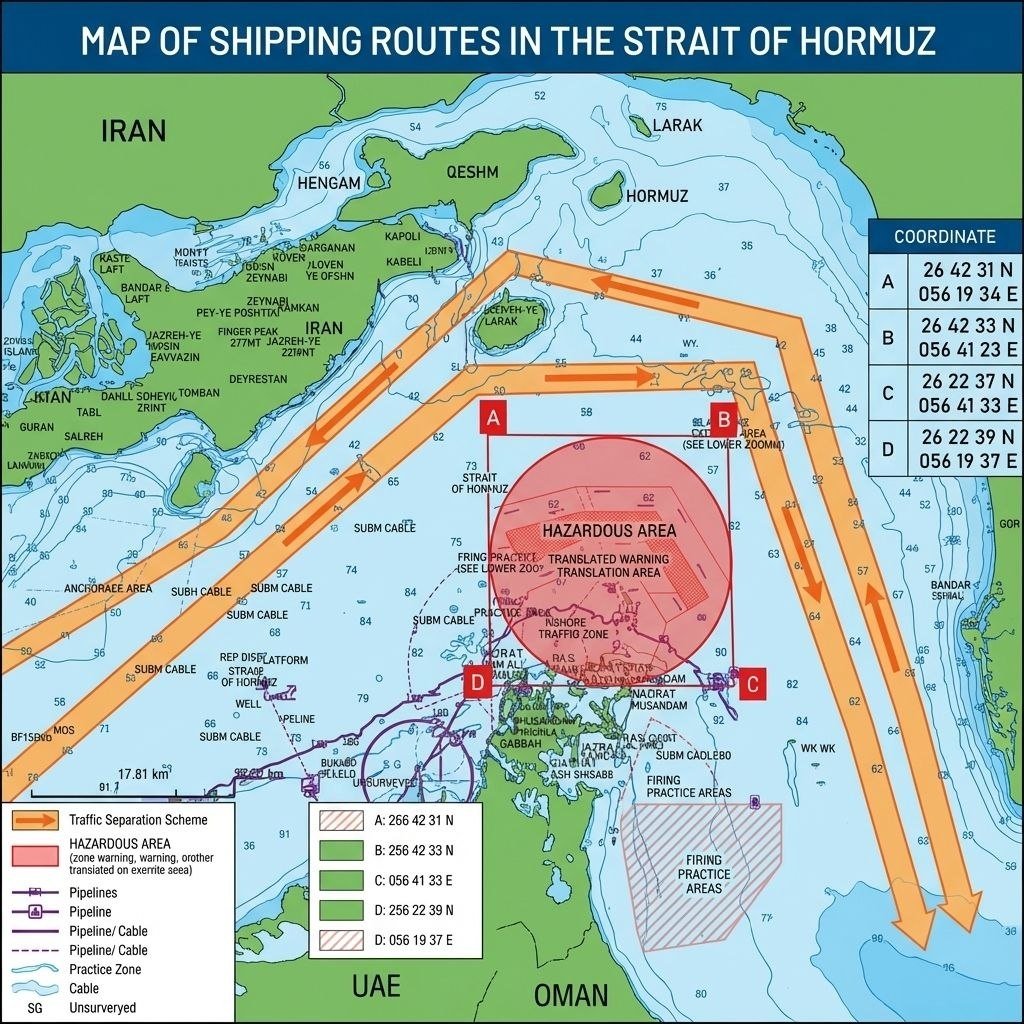
The time has come to comply with the new Maritime Regime of the Strait of Hormuz. These regulations are determined by Iran, not by social media posts! Under this new system, only commercial vessels with authorization from the IRGC Navy are permitted to navigate through designated routes after paying the required tolls. If the U.S. attempts to create any disturbance for Iranian ships, this situation can easily be changed.
ابراهیم عزیزی tweet media
English
322
1.8K
4.1K
531.2K
Pushpinder S. Khera retweetledi
Sushant Singh
Sushant Singh@SushantSin·
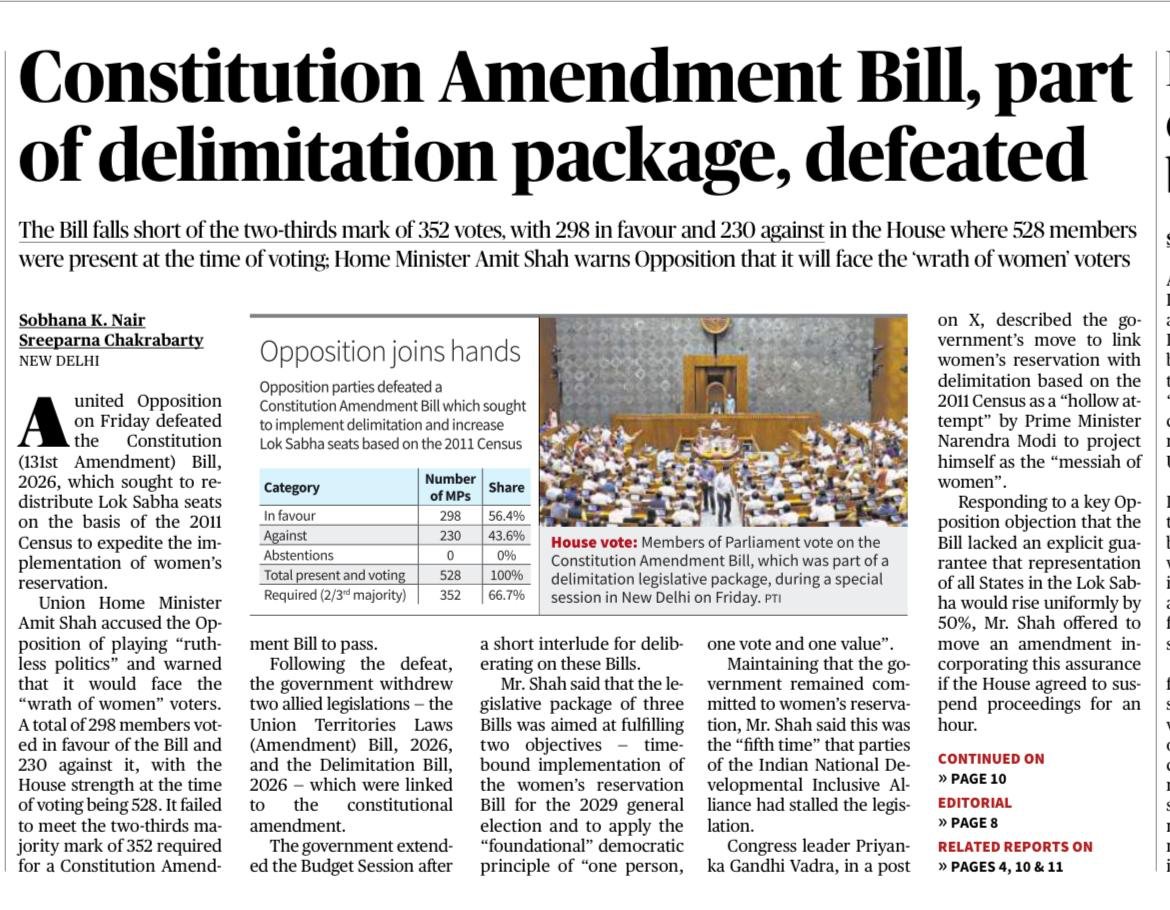
The Hindu has the most accurate headline on its front page. This is what it was.
Sushant Singh tweet media
English
1
1.9K
7.6K
100.2K
Pushpinder S. Khera retweetledi
SANJAY HEGDE
SANJAY HEGDE@sanjayuvacha·
There are many citizen journalists, but very few journalist citizens. Dr Roy will forever remain both a standard and an inspiration for journalism in India.
SANJAY HEGDE tweet media
English
39
342
1.6K
18.4K
Iran In Hyderabad
Iran In Hyderabad@IraninHyderabad·
The Strait of Hormuz isn’t social media. If someone blocks you, you can’t just block them back.
English
2.1K
22.4K
115.8K
3.1M
Pushpinder S. Khera retweetledi
Raj Malhotra
Raj Malhotra@Rajmalhotrachd·
Dear Suhasini Haidar @suhasinih and Stanly Johny @johnstanly, to read and listen to your combined analyses of the unprecedented 40-day U.S.-Iran war (Feb 28 - April 8, 2026) is to watch two master chess grandmasters deconstruct a board that the rest of the world barely understands. Stanly, you gave us the sweeping blueprint of how American hard power met its limits against Iranian resilience. Suhasini, you gave us the forensic breakdown of the diplomatic plumbing—from the insurance rates of stranded cargo ships to the exact flight path of the Iranian delegation’s "Minab 168" jumbo jet. When your insights are merged, they form the definitive historical draft of this crisis. Here is an analytical 🧵 that weaves both of your brilliant perspectives into one singular narrative.
English
2
32
237
32.1K
Pushpinder S. Khera retweetledi
Seyed Abbas Araghchi
Seyed Abbas Araghchi@araghchi·
In intensive talks at highest level in 47 years, Iran engaged with U.S in good faith to end war. But when just inches away from "Islamabad MoU", we encountered maximalism, shifting goalposts, and blockade. Zero lessons earned Good will begets good will. Enmity begets enmity.
English
4.8K
29.1K
126.5K
4.2M
Pushpinder S. Khera retweetledi
Sushant Singh
Sushant Singh@SushantSin·
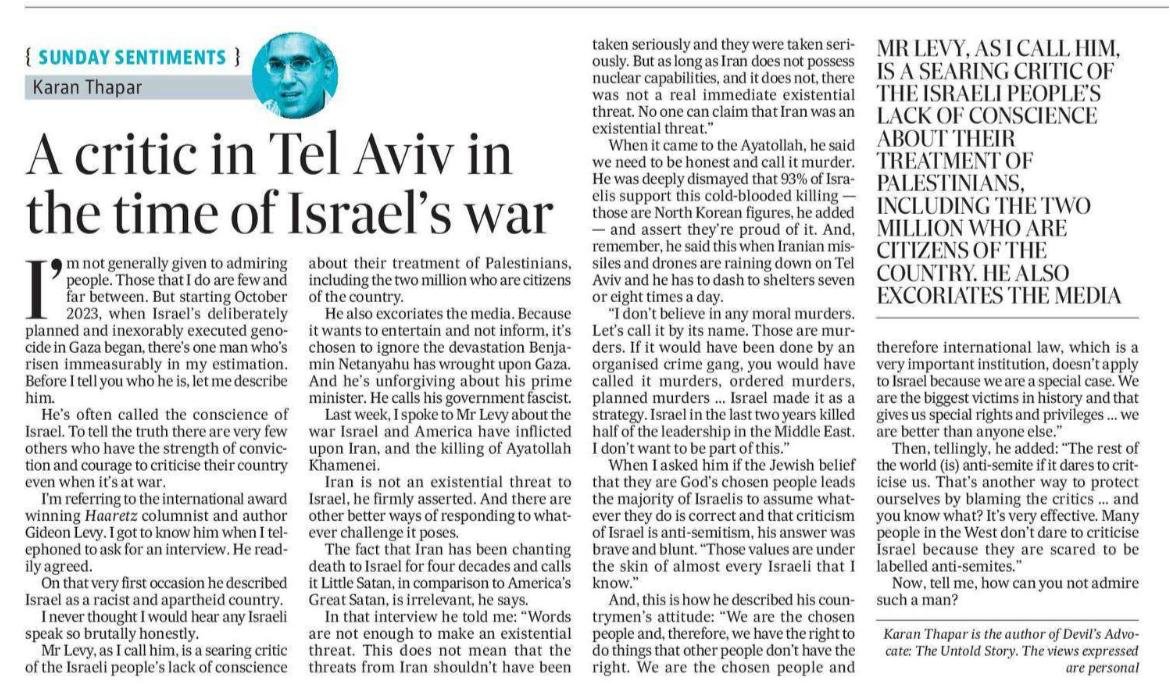
"It takes a great deal of courage to stand up to your enemies, but a great deal more to stand up to your friends." Gideon Levy is a living example of standing up for what is correct in a country gripped by nationalist madness.
Sushant Singh tweet media
English
0
109
264
6K
Pushpinder S. Khera retweetledi
Prof. Loizos G Loizou | MD | DSc (Hons) | PhD (C)
Creatine is one of the most used supplements worldwide — and one of the most misunderstood. What does it really do? Is it safe? Do we really need it? This short video gives clear, evidence-based answers. Make informed decisions. Share this message.
English
59
334
3.1K
3.6M
Pushpinder S. Khera retweetledi
Dr. Brahma Chellaney
Dr. Brahma Chellaney@Chellaney·
The Iran war will be remembered for the wanton U.S. and Israeli attacks on universities, schools, medical research institutions, hospitals and other facilities that fall under protected civilian categories in international humanitarian law. nytimes.com/interactive/20…
English
9
85
200
5.1K
Pushpinder S. Khera retweetledi
Hamidreza Azizi
Hamidreza Azizi@HamidRezaAz·
#Iran’s Lebanon Dilemma: Has Tehran Abandoned Hezbollah? 🔹The massive Israeli strikes in Lebanon – coming less than a day after the U.S.-Iran ceasefire announcement – have injected immediate uncertainty into planned negotiations in Islamabad. From Tehran’s perspective, any ceasefire that excludes Lebanon is fundamentally incomplete and unacceptable. 🔹Iranian officials have consistently emphasized that, based on understandings reached through Pakistani mediation, the ceasefire was supposed to be regional in scope. The exclusion of Lebanon is therefore not seen as a technical oversight, but as a political shift. 🔹In Tehran’s reading, that shift reflects a deliberate decision by Donald Trump to align more closely with Israeli priorities following consultations with Benjamin Netanyahu. 🔹This has already reinforced a long-standing concern in Iran, i.e., the unreliability of U.S. commitments. Entering negotiations under these conditions is seen as strategically risky and politically costly. 🔹At the same time, Iran has drawn a firm red line. It has made clear that it will not participate in negotiations while Israeli strikes against Hezbollah continue. A reduction in the tempo of attacks is not sufficient, and Tehran is demanding a complete halt. 🔹This position reflects deeper structural pressures – both regional and domestic – that constrain Iran’s room for maneuver. 🔹In Iran, analysts increasingly interpret the situation as a calculated strategy by Washington and Tel Aviv to push Iran into a lose-lose scenario. 🔹If Iran escalates militarily in response to Israeli actions, it risks being blamed, especially domestically, for breaking the ceasefire. This is particularly sensitive given widespread public fatigue with war. 🔹A significant portion of the Iranian population, while not necessarily supportive of the regime, welcomed the ceasefire as a pathway toward stability. Renewed escalation could therefore trigger public backlash. 🔹This is compounded by an existing perception among many Iranians that the government invests heavily in regional conflicts, particularly in Lebanon and Gaza, at the expense of domestic priorities. 🔹In such a context, any Iranian military response could be framed internally not as national defense, but as a war fought on behalf of external actors. This interpretation that carries serious political risks. 🔹At the same time, restraint is not cost-free. Failing to respond risks alienating the Islamic Republic’s core ideological base, which has significant sympathy toward Hezbollah and expects tangible action. 🔹These constituencies – though smaller – are highly organized and politically significant. Their frustration with perceived inaction is already visible. 🔹As a result, Tehran finds itself navigating between two competing domestic pressures: a war-weary public on one side, and a mobilized ideological base on the other. 🔹Iran’s current approach reflects an attempt to balance these pressures. Rather than escalating directly, it is combining diplomatic maneuvering with indirect forms of pressure. 🔹On the diplomatic front, Foreign Minister Abbas Araghchi has engaged regional and European counterparts, emphasizing the need for a comprehensive, region-wide ceasefire. 🔹At the same time, Iran has avoided direct military escalation against Israel and instead turned to its most critical leverage point, namely the Strait of Hormuz. The aim is to push the U.S. to constrain Israel. 🔹Despite expectations that maritime traffic would return to normal after the ceasefire, only a handful of ships passed since yesterday, indicating a deliberate effort to sustain pressure. 🔹From the perspective of some Iranian analysts, this form of economic and maritime pressure is more strategically valuable than missile retaliation. There is a growing view that limited missile strikes against Israel would achieve little beyond signaling solidarity, and could even play into Israel’s hands. 🔹The argument here is that Israel may actually prefer continued escalation, and that its demonstrated resilience in absorbing Iranian strikes has exposed the limits of Iran’s long-range missile deterrence. This has shifted the debate within Iran. The question is no longer whether to respond, but how. 🔹One camp argues that Iran could resume direct strikes against Israel while maintaining the ceasefire with the United States, effectively decoupling the two fronts. 🔹In this scenario, Washington – if genuinely interested in de-escalation – might tolerate limited Iran-Israel confrontation, allowing negotiations to proceed in parallel. Proponents see this as advantageous: it would sideline the United States and allow Iran to confront Israel directly. 🔹The opposing camp is more skeptical. They argue that even without direct U.S. offensive involvement, Washington would continue to provide Israel with logistical, defensive, and intelligence support. From this perspective, the idea of U.S. disengagement is largely illusory. 🔹Moreover, restricting the conflict to Iran and Israel would reduce Iran’s strategic flexibility. Tehran’s most effective leverage has come from its ability to target U.S. interests across the region, not just Israel itself. 🔹This creates a stark strategic dilemma: either escalate broadly, including against U.S. interests, or maintain the ceasefire and pursue diplomacy. 🔹Beyond these immediate tactical debates, Iranian analysts are increasingly focused on two broader strategic concerns. 🔹The first is reputational. Failure to support Hezbollah risks undermining the principle of mutual support that underpins Iran’s regional network. 🔹If Tehran does not act, allies in Iraq, Yemen, and elsewhere may begin to question whether the costs of supporting Iran are reciprocated. Such a shift would weaken Iran’s deterrence posture and erode its influence across the “axis of resistance.” 🔹The second concern is structural: the future balance of power in the region. 🔹Iran appears to view the current moment as a rare opportunity to reshape that balance, particularly through its leverage in the Persian Gulf. 🔹From this perspective, continued Israeli operations in Lebanon are not just tactical, but they are strategic moves aimed at fragmenting Iran’s regional network. 🔹By isolating and pressuring individual nodes like Hezbollah, Israel may be attempting to prevent coordinated, multi-front responses. Over time, this could create a new strategic reality in which Iran’s allies are weakened sequentially, leaving Tehran itself more exposed. 🔹Iran’s objective, by contrast, is to preserve its model of collective deterrence, in the sense that any attack on one actor should trigger a broader regional response. 🔹This logic explains Tehran’s insistence on including Lebanon in the ceasefire. For Iran, this is not a secondary issue, but central to preserving its regional architecture. 🔹Ultimately, the current crisis is being interpreted in Tehran as both a tactical challenge and a strategic inflection point. 🔹How Iran navigates this moment – balancing domestic pressures, alliance commitments, and great-power dynamics – will shape not only the fate of the negotiations, but probably also the contours of future of the future regional order.
English
2
255
777
231.8K
Pushpinder S. Khera retweetledi
Pallavi U Dar
Pallavi U Dar@DarPallavi·
@DelhiAirport @AAI_Official @CMODelhi @DelhiAirport NO ONE believes anything you say.Please share cctv footage of the alleged bites and also of the dog being released. @gupta_rekha has made claims about being a dog lover and how she is against animal cruelty, the truth is the exact opposite.
English
4
24
36
962
Pushpinder S. Khera retweetledi
Priyanka Gandhi Vadra
Priyanka Gandhi Vadra@priyankagandhi·
Iranian men and women formed human chains around their country’s resources while western powers spoke in a despicable language, heralding the “end of a civilization”. The world is watching and understanding as the veil of morality falls from across the face of the west. Hatred, anger, violence and injustice never win. Courage always wins.
English
332
5.5K
23.1K
331.6K