
@TradexWhisperer @smartertrader Its pumping 7 now. It was doing 4 before the invasion
English
Kevin Hernandez
3K posts
@khernandez
Just floating here

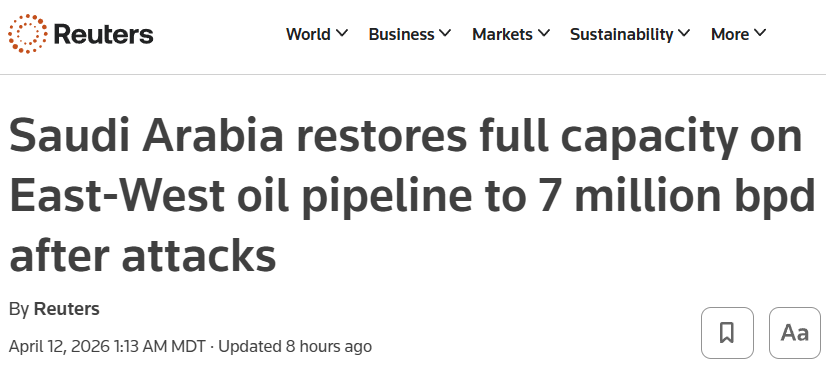
Surprise mfs. Pipes bypassing Strait of Hormuz: 1. Saudi Arabia's East-West Pipeline Capacity: Maximum/emergency design of 7 million bpd (expanded post-2019 Abqaiq incident via parallel line conversions). Pre-crisis flows: ~2.8 million bpd before early March disruptions. Ramp-up status: Aramco CEO Amin Nasser announced on March 10, 2026, that flows were increasing rapidly and would reach full 7 million bpd "in the next couple of days" — prioritizing Arab Light and Arab Extra Light grades to meet export targets. Export reality: ~2 million bpd feeds western domestic refineries, leaving ~5 million bpd for potential exports via Yanbu (Red Sea). Yanbu terminal constraints limit effective crude loadings to ~4–4.5 million bpd (nominal; historically untested at peak), with recent surges to ~2.2–2.5 million bpd (330%+ vs. pre-crisis). Strategic role: ~750–1,200 km system bypasses Strait of Hormuz, linking eastern fields (Abqaiq) to Yanbu — critical for rerouting ~70% of normal Hormuz exports amid the closure, though not fully replacing eastern Gulf terminals' scale. This rapid mobilization has cushioned global supply shocks, with Yanbu loadings already at records despite port bottlenecks. 2. UAE's Habshan-Fujairah line Official name: Abu Dhabi Crude Oil Pipeline (ADCOP), also called Habshan–Fujairah pipeline. Length: ~360–370 km (≈248 miles), running from Habshan onshore fields (western Abu Dhabi) to Fujairah export terminal on the Gulf of Oman. Commissioned: 2012, built to bypass the Strait of Hormuz. Capacity: Nameplate/design 1.5 million bpd; maximum/emergency potential up to 1.8 million bpd (with ADNOC able to push higher temporarily if needed). Current status (March 2026): Operating at ~1.5 million bpd (around 71% utilization per Kpler analysts), with ~400–440 kbpd spare headroom. ADNOC has confirmed it's actively routing flows to maintain exports amid the Hormuz closure, using Fujairah's large storage (18 million m³) and loading facilities. Strategic role: Provides a fully Hormuz-independent route for ~50–60% of UAE's typical crude exports (UAE normally exports ~2.5–3 million bpd total). Combined with Saudi's East-West line, it helps offset part of the ~15–20 million bpd Gulf supply disruption. Limitations: While the pipe can reach 1.8 mbpd, actual sustained exports depend on Fujairah terminal throughput (historically handles ~1.5–1.7 mbpd crude + products comfortably; wartime tanker congestion and recent regional risks add constraints).








*TRUMP: MET OWN GOALS ON IRAN CONFLICT, WEEKS AHEAD OF SCHEDULE

We're excited to announce 'The Situation Room' by Polymarket is coming to Washington, D.C. The world's first bar dedicated to monitoring the situation. 🧵