
Kiran Vaidhya Venkadesh
1.5K posts

Kiran Vaidhya Venkadesh
@kiranvaidhya93
Co-founder & CTO at Plain Medical


"Early-stage lung cancer can manifest as small pulmonary nodules, with CT examinations highly effective at depicting these nodules. @jacobscolin1 @kiranvaidhya93 bit.ly/3vkatyx

The most unknown most common shortcut I use on my MacBook is: - Command+Option+Shift+4 to select a small part of the screen and copy it into clipboard as an image - Command+Shift+4 to do the same, but save it as a file on Desktop as png Life-changing.


One pattern I noticed is that great AI researchers are willing to manually inspect lots of data. And more than that, they build infrastructure that allows them to manually inspect data quickly. Though not glamorous, manually examining data gives valuable intuitions about the problem. The canonical example here is Andrej Karpathy doing the ImageNet 2000-way classification task himself. And in the era of large language models, manually examining data is probably even more insightful since completions are hard to evaluate via benchmarks. In this spirit, I recently did a few days of pair programming with @hwchung27 where we were starting on a new problem. Instead of trying to replicate baselines and design new methods, we ran some evaluations and manually inspected them to gain insights. We first paid about one day of overhead getting all the relevant information in a single UI so we could examine the data without having to click through multiple web pages. The second day, we spent an afternoon reading examples together and taking notes on the patterns that we noticed in the examples. ChatGPT generates long text, and we actually read the whole thing carefully, even if one example took 20 minutes to understand. I think we both gained a deeper understanding of the problem that we could not have gotten from reading research papers. (In 2018, for example, I helped pathologists label a lot of data to train a lung cancer classifier. After having manually labeled 200+ images (with pathologist correction), I’d probably gained a pathologist-level understanding at that one particular lung cancer classification task :))


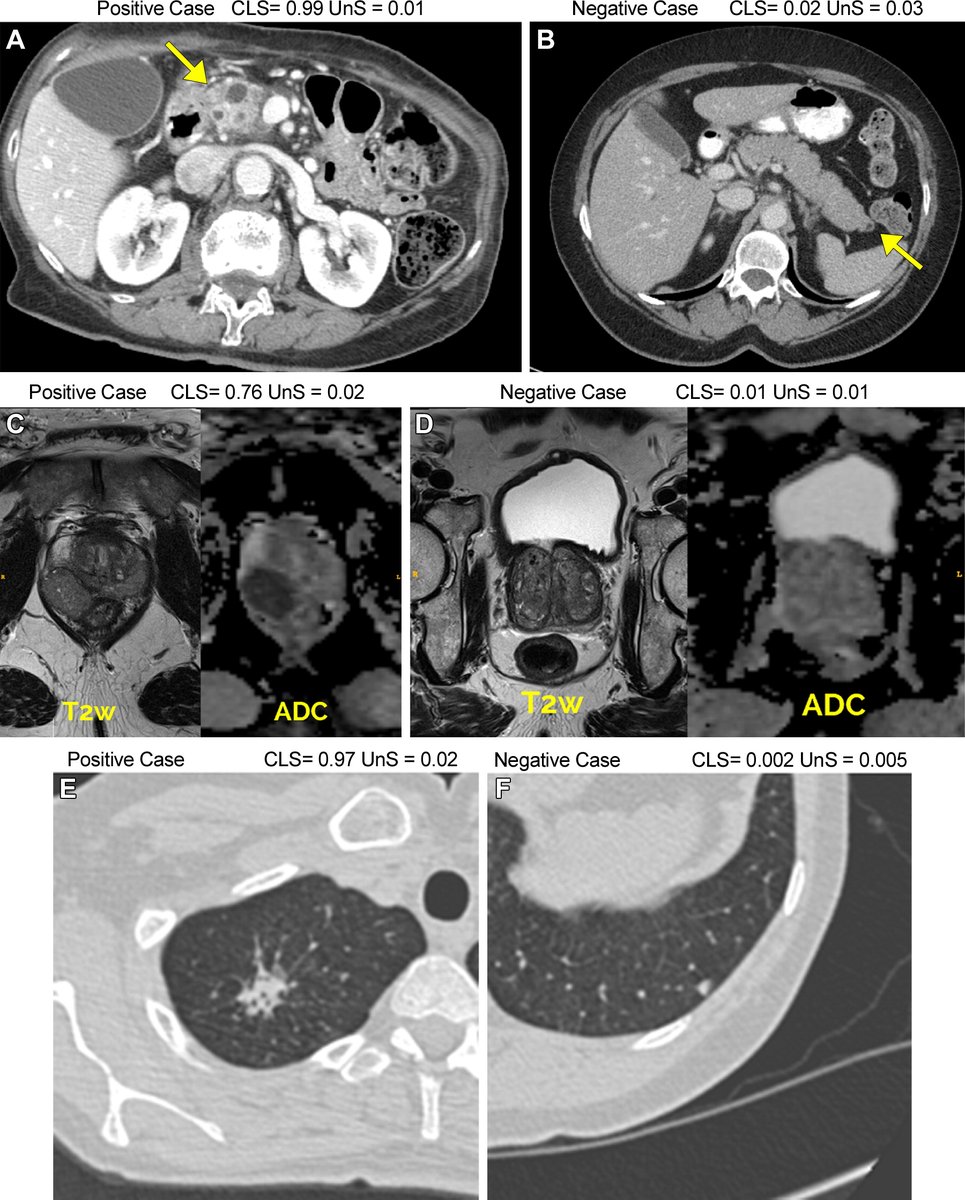
We all know that no AI algorithm will work for every single patient. But what if there was a way to know which cases AI will perform well and which cases it's most likely giving a wrong prediction? Curious? Join our #RadAIchat tonight to find out more!


A deep learning algorithm trained to estimate 3-year malignancy risk for screening-detected pulmonary nodules using current and prior low-dose CT scans outperformed validated models that used a single CT scan. @kiranvaidhya93 @jacobscolin1 @radboudumc bit.ly/3qe9hKZ

A deep learning algorithm trained to estimate 3-year malignancy risk for screening-detected pulmonary nodules using current and prior low-dose CT scans outperformed validated models that used a single CT scan. @kiranvaidhya93 @jacobscolin1 @radboudumc bit.ly/3qe9hKZ