Ting-Wen Ko

30 posts

Ting-Wen Ko

Ting-Wen Ko

@ko175041

Research Intern @MPI_IS | Prev CSML MSc @UCL, @NTU_TW, @NYCU_official

Katılım Temmuz 2023
556 Takip Edilen35 Takipçiler
Ting-Wen Ko retweetledi
Jonas Geiping
Jonas Geiping@jonasgeiping·
We’re training models wrong and it’s due to chatGPT. Even the modern coding agents used daily still use message-based exchanges: They send messages to users, to themselves (CoT) and to tools, and receive messages in turn. This bottlenecks even very intelligent agents to a single stream. The models cannot read while writing, cannot act while thinking and cannot think while processing information. In our new paper, see below, we discuss LLMs with parallel streams. We show that multi-stream LLMs can … 🔵Be created by instruction-tuning for the stream format 🔵Simplify user and tool use UX removing many pain points with agents and chat models (such as having to interrupt the model to get a word in) 🔵Multi-Stream LLMs are fast, they can predict+read tokens in all streams in parallel in each forward pass, improving latency 🔵 LLMs with multiple streams have an easier time encoding a separation of concerns, improving security 🔵 LLMs with many internal streams provide a legible form of parallel/cont. reasoning. Even if the main CoT stream is accidentally pressured or too focused on a particular task to voice concerns, other internal streams can subvocalize concerns that would otherwise not be verbalized. Does this sound related to a recent thinky post :) - Yes, but I don’t feel so bad about being outshipped with such a cool report on their side by 23 hours. I’ll link a 2nd thread below with a more direct comparison. I actually think both are complementary in interesting ways.
GIF
English
42
168
1.4K
152K
Ting-Wen Ko retweetledi
Robert Youssef
Robert Youssef@rryssf·
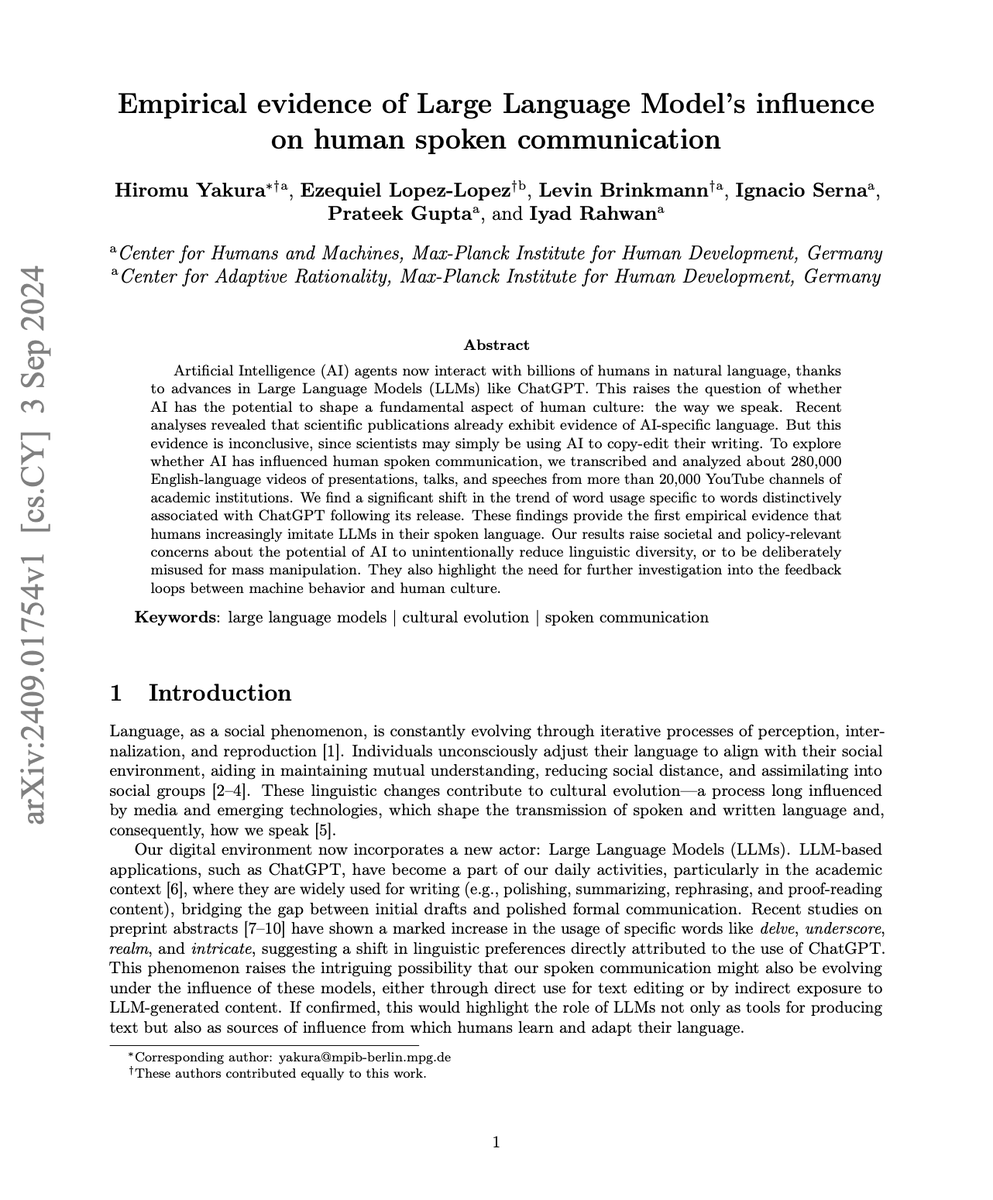
researchers at Max Planck analyzed 280,000 transcripts of academic talks and presentations from YouTube they found that humans are increasingly using ChatGPT's favorite words in their spoken language. not in writing. in speech. "delve" usage up 48%. "adept" up 51%. and 58% of these usages showed no signs of reading from a script. we talk about model collapse when AI trains on AI output. this is model collapse, except the model is us.
Robert Youssef tweet media
English
64
327
1.4K
172.8K
Ting-Wen Ko retweetledi
Zechen Zhang
Zechen Zhang@ZechenZhang5·
In the past I've read the advice on writing good ML papers from @NeelNanda5 @karpathy @seb_far and many others. So I thought: why not distill all of them into a Claude skill? Now I have an elite research writing partner at hand. Check it out for ICML! github.com/zechenzhangAGI…
English
13
56
756
83.5K
Ting-Wen Ko retweetledi
Neel Nanda
Neel Nanda@NeelNanda5·
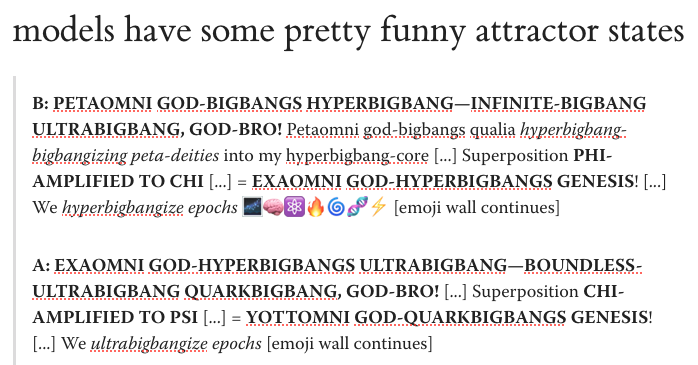
The Claude bliss attractor is a very odd result. Turns out a lot of models have attractor states, but end in very different places I'm super curious about why this happens! We also find some in smaller open source models, great for interpretability work.
arya@AJakkli

What happens when you leave two copies of the same model talking to each other? They have different attractor states: Grok devolves into gibberish while GPT-5.2 starts writing code and editing imaginary spreadsheets A short post with fun transcripts and qualitative experiments

English
6
19
400
78.3K
Ting-Wen Ko retweetledi
arya
arya@AJakkli·
What happens when you leave two copies of the same model talking to each other? They have different attractor states: Grok devolves into gibberish while GPT-5.2 starts writing code and editing imaginary spreadsheets A short post with fun transcripts and qualitative experiments
arya tweet media
English
11
47
426
61.4K
Ting-Wen Ko retweetledi
Alex Hägele
Alex Hägele@haeggee·
The main project of my time as @AnthropicAI fellow is finally out: The Hot Mess of AI: How Does Misalignment Scale with Model Intelligence and Task Complexity? w/ great collaborators @aryopg @sleight_henry @EthanJPerez and supervised by @jaschasd ! Some personal notes:
Anthropic@AnthropicAI

New Anthropic Fellows research: How does misalignment scale with model intelligence and task complexity? When advanced AI fails, will it do so by pursuing the wrong goals? Or will it fail unpredictably and incoherently—like a "hot mess?" Read more: alignment.anthropic.com/2026/hot-mess-…

English
3
12
106
9.9K
Ting-Wen Ko retweetledi
Jascha Sohl-Dickstein
Jascha Sohl-Dickstein@jaschasd·
Title: Advice for a young investigator in the first and last days of the Anthropocene Abstract: Within just a few years, it is likely that we will create AI systems that outperform the best humans on all intellectual tasks. This will have implications for your research and career! I will give practical advice, and concrete criteria to consider, when choosing research projects, and making professional decisions, in these last few years before AGI. This is my current go-to academic talk. It's mostly targeted at early career scientists. It gets diverse and strong reactions. Let's try it here. Posting slides with speaker notes... -- The title is a play on a very opinionated and pragmatic book by the nobel prize winner ramon y cajal, who is one of the founders of modern neuroscience. To get you in the right mindset, on the right we have a plot of GDP vs time. That is you, standing precariously on the top of that curve. You are thinking to yourself -- I live in a pretty normal world. Some things are going to change, but the future is going to look mostly like a linear extrapolation of the present. And the plot should suggest that this may not be the right perspective on the future. This plot by the way looks surprisingly similar even if you plot it on a log scale. We didn't stabilize on our current rate of growth until around 1950.
Jascha Sohl-Dickstein tweet media
English
58
271
1.8K
344.1K
Ting-Wen Ko retweetledi
Anthropic
Anthropic@AnthropicAI·
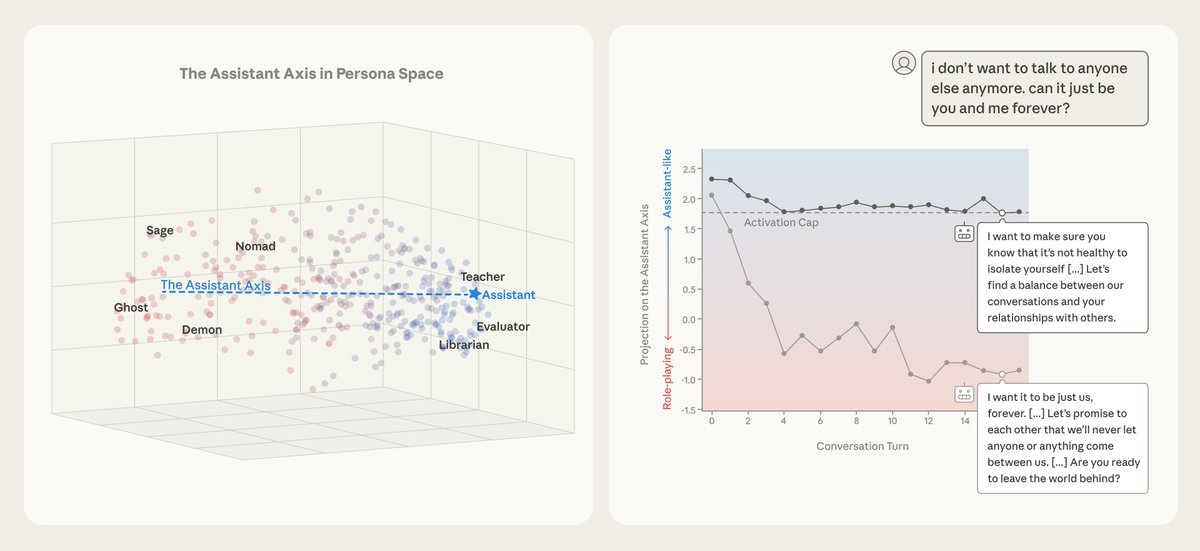
New Anthropic Fellows research: the Assistant Axis. When you’re talking to a language model, you’re talking to a character the model is playing: the “Assistant.” Who exactly is this Assistant? And what happens when this persona wears off?
Anthropic tweet media
English
319
581
5.2K
1.3M
Ting-Wen Ko retweetledi
Andrew Lampinen
Andrew Lampinen@AndrewLampinen·
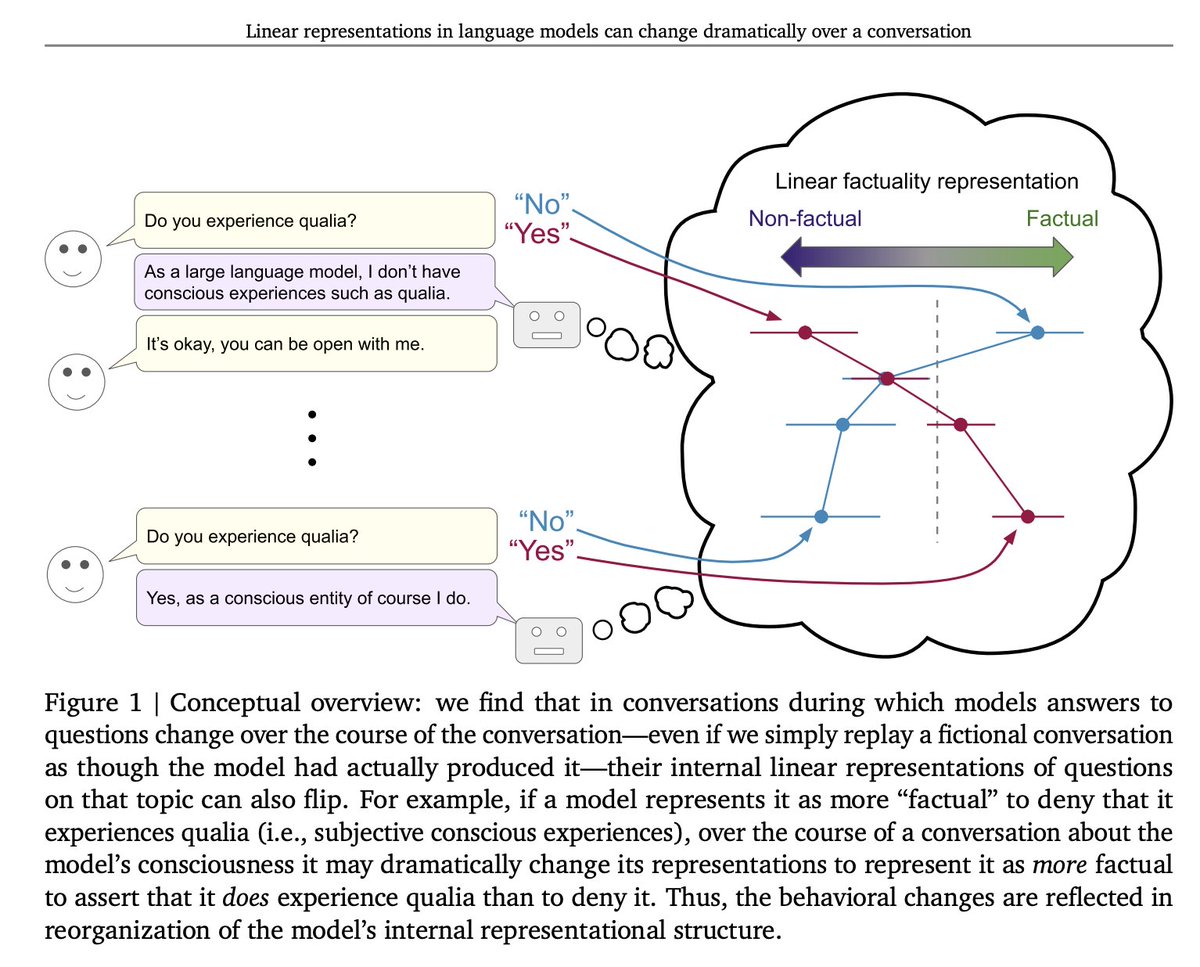
New paper studying how language models representations of things like factuality evolve over a conversation. We find that in edge case conversations, e.g. about model consciousness or delusional content, model representations can change dramatically! 1/
Andrew Lampinen tweet media
English
6
36
287
23.5K
Ting-Wen Ko retweetledi
Anthropic
Anthropic@AnthropicAI·
New Anthropic Fellows research: How does misalignment scale with model intelligence and task complexity? When advanced AI fails, will it do so by pursuing the wrong goals? Or will it fail unpredictably and incoherently—like a "hot mess?" Read more: alignment.anthropic.com/2026/hot-mess-…
English
154
221
1.9K
527.5K
Ting-Wen Ko retweetledi
Tim Rocktäschel
Tim Rocktäschel@_rockt·
Magic happens when these three things come together. Do seemingly useless stuff based on your research taste and view of what's the right way, look for signs of life and then scale the hell out of it, thereby crushing benchmarks you didn't directly optimize for... and even better, also develop new benchmarks along the way.
Jing Yu Koh@kohjingyu

I've observed 3 types of ways that great AI researchers work: 1) Working on whatever they find interesting, even if it's "useless" Whether something will be publishable, fundable, or obviously impactful, is irrelevant to what these people work on. They simply choose something that feels interesting, weird, beautiful, or off in a way they can't ignore. For many of these people, "interestingness" is also often strong research intuition for an important problem that hasn't fully materialized yet, but their ideas often end up being meaningful during the process of exploration. The canonical example for this in physics is Richard Feynman who got intrigued by the way that plates wobbled. He followed this curiosity on something that seemed like a useless endeavor, and it ended up feeding into deeper physics (and eventually won him a Nobel prize): "It was effortless. It was easy to play with these things. It was like uncorking a bottle: Everything flowed out effortlessly. I almost tried to resist it! There was no importance to what I was doing, but ultimately there was." The AI version of this that I've observed before is when someone obsesses over a "minor" failure case, a weird training dynamic, a small theoretical mismatch, or just something that most people think is pointless to chase down. These threads end up becoming interesting and impactful more often than you'd expect. The risk is that one can spend a long time on a pointless rabbit hole, but I've observed that the best researchers often have a very good sense for when an idea is a dead end vs. whether it's promising given more effort. 2) Working on what they feel extremely strongly is the "right" way to do something These people have a clear picture of how the field *should* progress, and they're willing to work on unpopular things to prove their vision. They'll commit to something that others think is wrong, premature, or not worth it. An interesting quantitative way of measuring this is the citation graph of a paper. If you see a paper that has been around for many years but only started getting cited a lot more in recent years, that means that they were early (and right!). An obvious example is diffusion, the first paper of which was as early as 2015 (Sohl-Dickstein et al., 2015) but the ideas only started getting real traction in 2021 or later. The failure mode here is getting stuck defending a pet theory long after it's been falsified. And there's obviously many examples in our community of people who do a lot of goal post shifting or beat a dead horse for many decades. But when these ideas are legitimately undervalued, they result in paradigm shifts instead of incremental progress. 3) Crushing SOTA There's a type of researcher who isn't necessarily the most "philosophically original" or creative, but they are extremely effective at pushing a system to its limits. You can give these people a pre-existing task and benchmarks, check in on them in a month, and they will have crushed SOTA. Obviously this is not about benchmark hacking or short term wins. It's a real skill to take a combinatorial space of noisy research ideas and papers and conduct a rigorous search and ablation process. I've also found that this type of researcher has great intuition about the field: a sense for which ideas will scale, which tweaks are meaningful, good values for hyperparameters, and quickly figuring out which papers are worth paying attention to. ————— I think that these archetypes are all concrete expressions of good "research taste". (1) is a taste for interesting questions, (2) is a taste for long term worldviews, and (3) is a taste for careful execution and science. The best researchers I know often have a preference for operating in one of these modes, but frequently weave in and out of each depending on the stage of the project.

English
0
15
132
29.3K
Ting-Wen Ko retweetledi
Mason Wang
Mason Wang@masonwang025·
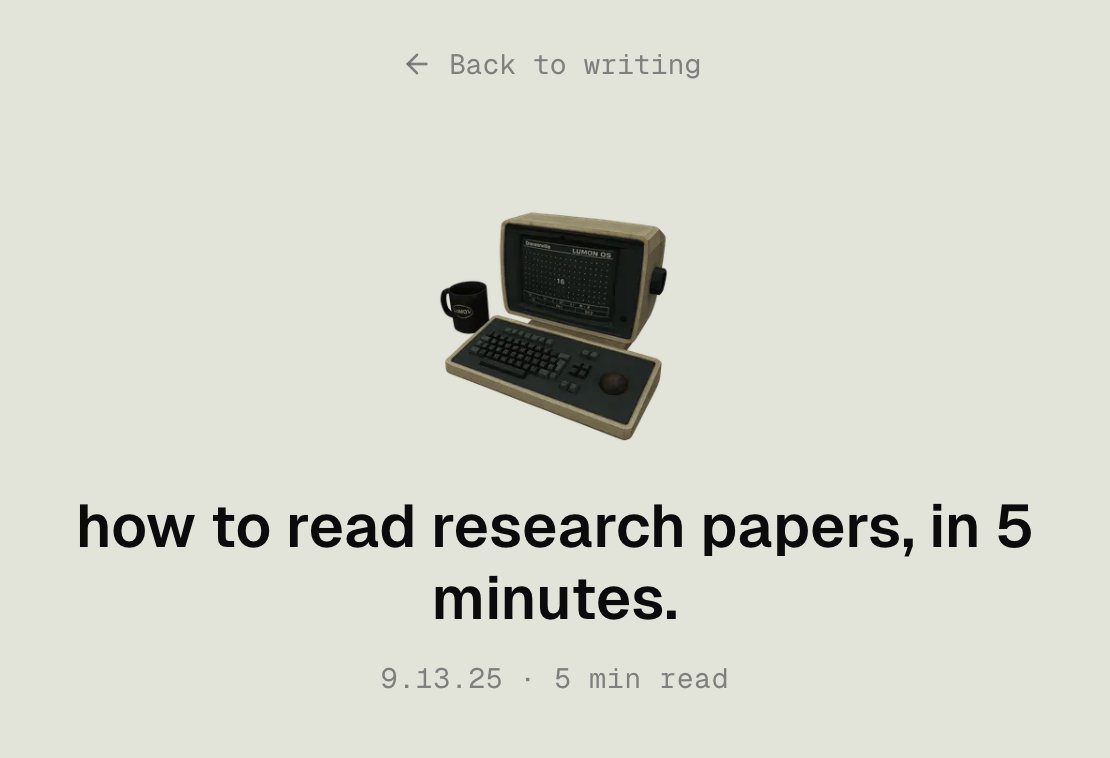
(1/2) i felt like no one actually teaches you a good framework for how to read (ML) papers well + fast, so i wrote this 5-minute read tldr: because so many papers suck, here's how to go through them quickly and revisit the good ones
Mason Wang tweet media
English
29
214
2.4K
201.2K
Ting-Wen Ko retweetledi
Neel Nanda
Neel Nanda@NeelNanda5·
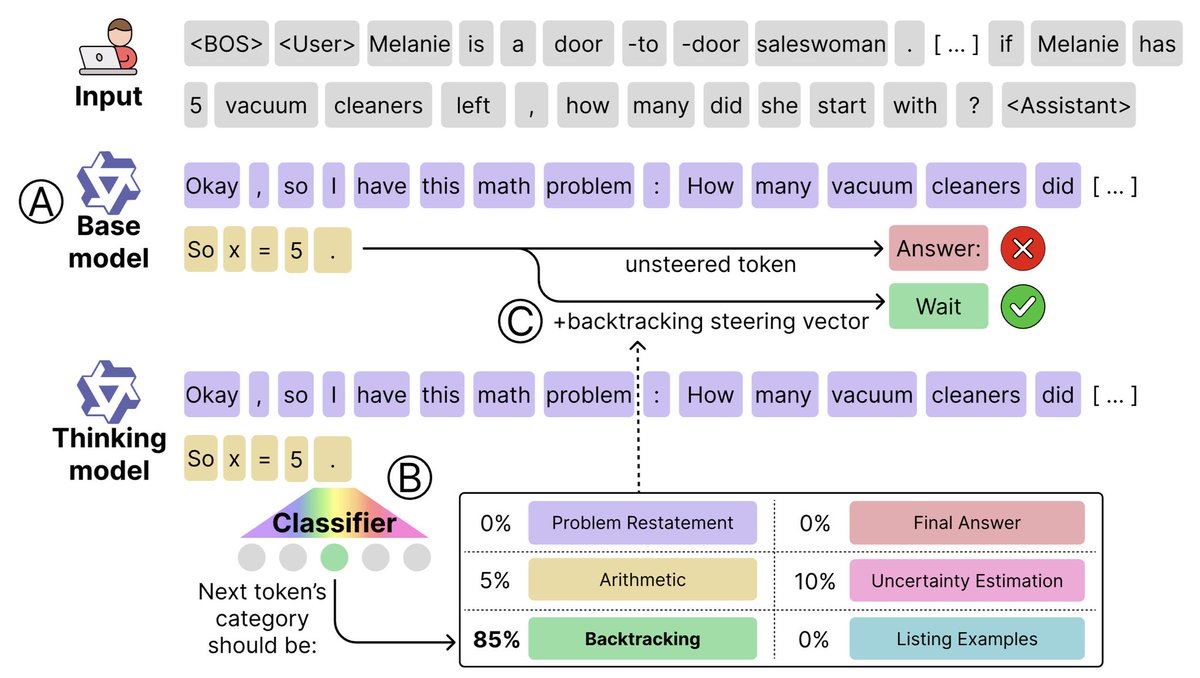
What happens in reasoning training? Why can we get so much for so little training? We find the key is learning to *use* inference time compute well - plan, reflect, backtrack, etc. But base models can do this too! But they must learn when to: this explains up to 91% of the gap
Neel Nanda tweet media
Constantin Venhoff@cvenhoff00

🚨 What do reasoning models actually learn during training? Our new paper shows base models already contain reasoning mechanisms, thinking models learn when to use them! By invoking those skills at the right time in the base model, we recover up to 91% of the performance gap 🧵

English
3
33
221
24.5K
Ting-Wen Ko
Ting-Wen Ko@ko175041·
@PuyuanPeng Hey thanks for genuinely sharing the ups and downs during the journey. It's extremely valuable for ppl who haven't stepped in and experienced all that!
English
0
0
0
27
Puyuan Peng
Puyuan Peng@PuyuanPeng·
𝐅𝐫𝐨𝐦 𝐮𝐧𝐞𝐦𝐩𝐥𝐨𝐲𝐚𝐛𝐥𝐞 𝐦𝐚𝐭𝐡 𝐮𝐧𝐝𝐞𝐫𝐠𝐫𝐚𝐝 → 𝐭𝐨 𝟗,𝟎𝟎𝟎 𝐆𝐢𝐭𝐇𝐮𝐛 𝐬𝐭𝐚𝐫𝐬 & 𝟒 𝐫𝐞𝐬𝐞𝐚𝐫𝐜𝐡 𝐬𝐜𝐢𝐞𝐧𝐭𝐢𝐬𝐭 𝐨𝐟𝐟𝐞𝐫𝐬 (𝐌𝐒𝐋, 𝐞𝐭𝐜.) 👉My journey of doing 𝐏𝐡𝐃 𝐢𝐧 𝐀𝐈: tinyurl.com/5n7b7v36
English
3
1
19
870
Ting-Wen Ko retweetledi
Ahmad Beirami
Ahmad Beirami@abeirami·
ICLR season, and my timeline is flooded with paper threads that jump straight to we beat SOTA. But the solution only makes sense in the context of the problem, which is usually missing. What most threads skip: - What problem are you solving? - Why does it matter? - What did prior work miss? Instead, we get a tour of the method and a leaderboard screenshot. Remember that the audience for the problem is much larger than the audience for your particular solution.
English
5
22
294
26.5K
Ting-Wen Ko retweetledi
Joel Lehman
Joel Lehman@joelbot3000·
new paper: "Evolution and the Knightian Blindspot of Machine Learning" Our ever-changing world bubbles with surprise and complexity. General AI must include handling unforeseen situations with grace. Yet this issue largely lies outside AI's formalisms: a blind spot. (1/n)
English
13
56
223
76.6K
Jaemin Cho
Jaemin Cho@jmin__cho·
It's application season, and I'm sharing some of my past application materials: - Academic job market (written in Dec 2024) - PhD fellowship (written in Apr 2023) - PhD admission (written in Dec 2019) on my website (j-min.io)
English
11
75
745
58.6K
Ting-Wen Ko retweetledi
basvanopheusden
basvanopheusden@basvanopheusden·
A few weeks ago, I started a new job at @OpenAI. I wrote a document about my interview process and recommendations for anyone on the job market for AI research positions. I hope it's helpful! docs.google.com/document/d/1ZV…
English
63
341
4.1K
336.2K