Konark Modi

4.2K posts

Konark Modi banner
Konark Modi

Konark Modi

@konarkmodi

Innovate Faster. Scale Smarter. Helping companies get efficient via https://t.co/3Ts1jLSvPx

Munich, Germany Katılım Mart 2009
1.1K Takip Edilen1.1K Takipçiler
Konark Modi
Konark Modi@konarkmodi·
@raw_works This is amazing work. Curious to learn more about your setup//snippets on how you are using DSP.RLM
English
0
0
1
230
Raymond Weitekamp
Raymond Weitekamp@raw_works·
Ran Qwen3-8B (8.2B dense, open) on LongCoT-Mini. Vanilla: 0/507. dspy.RLM: 33/507 (6.5%). Same model. Same weights. No fine-tuning. The scaffold is doing 100% of the lifting. Context: leaderboard's smallest open MoE is GLM-4.7 at 358B total / 32B active params. Qwen3-8B is ~4x smaller by active params and ~44x smaller by total. A scaffolded 8B dense model matching a GLM-4.7-style overall number (5.9%) on a benchmark designed to reward long-horizon reasoning is the point of RLMs — decomposable problems don't need scale, they need a REPL.
Raymond Weitekamp@raw_works

ok so the default DSPy.RLM is literally going to destroy this benchmark before the end of the day. running now for sonnet 4.5... 🏆 Scoreboard (live) RLM: 90/94 (95.7%) Vanilla: 0/94 (0.0%) anyone want to pay for the opus run? 😉

English
2
6
47
13.4K
Konark Modi
Konark Modi@konarkmodi·
@_swanand Very True, I took a hard mental stance + assumed I can’t afford Claude anymore,how do I build from there on. It took a while, now I default to non-Claude first, if not happy, ask Claude to improve, make a note. This mental model prompted me to hone things outside the model
English
0
0
0
53
Swanand
Swanand@_swanand·
@konarkmodi Claude’s adherence to my instructions is keeping me anchored on them. Codex often ignores directives, I suspect it’s context or prompt optimisation thing, but Claude just “gets it”.
English
1
0
0
383
Swanand
Swanand@_swanand·
Upgraded to Claude Max 20x plan again. This month will be a test. I lost patience with the abysmal rate limits on the Pro plan. Next month, will try Qwen & Kimi with OpenCode.
English
14
0
67
8.4K
Konark Modi retweetledi
Edward Boswell
Edward Boswell@boswell_labs·
Watching a dspy.RLM go recursive is magicial!!! If you are not using dspy with RLM, than you are sleeping on something amazing
English
0
4
68
4.4K
Konark Modi retweetledi
Sooraj
Sooraj@iAnonymous3000·
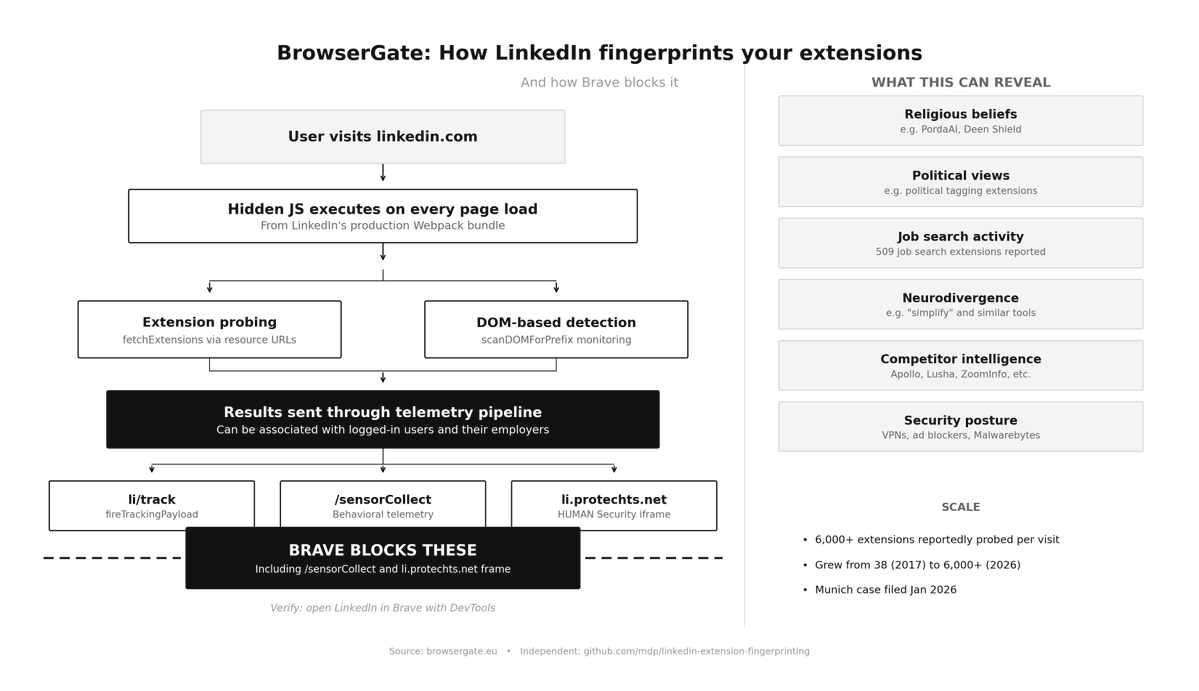
BrowserGate documented something serious. LinkedIn silently fingerprint installed Chrome/Chromium extensions on page load - using extension probing and DOM-based detection, then send those results through its telemetry pipeline. The scanned list reportedly includes competitor sales tools, job-search extensions, and privacy/security software. Detecting those extensions can reveal political views, religious beliefs, neurodivergence-related usage, or that someone is actively looking for a new job. That matters more on LinkedIn than almost anywhere else, because LinkedIn already knows who you are, where you work, and who your employer is. Brave already blocks the relevant LinkedIn tracking endpoints - including /sensorCollect and the hidden li.protechts.net frame. Open LinkedIn in Brave with DevTools open and check the requests yourself. A Munich case is now on file. This deserves real regulatory scrutiny.
Sooraj tweet media
English
11
146
587
34.7K
Konark Modi retweetledi
Georgi Gerganov
Georgi Gerganov@ggerganov·
Let me demonstrate the true power of llama.cpp: - Running on Mac Studio M2 Ultra (3 years old) - Gemma 4 26B A4B Q8_0 (full quality) - Built-in WebUI (ships with llama.cpp) - MCP support out of the box (web-search, HF, github, etc.) - Prompt speculative decoding The result: 300t/s (realtime video)
English
134
261
3.3K
736.5K
AVB
AVB@neural_avb·
Can somebody tell me what is the best web-search api service right now? 🫡 I need a fair free tier/good pricing, available, and optionally be able to webfetch urls. - brave - tavily - exa - google custom search - no to serpapi coz no free tier
English
15
1
48
24.4K
Konark Modi retweetledi
Mario Zechner
Mario Zechner@badlogicgames·
ok, this is awesome. but TIAL that arxiv host LaTex sources as well, which changes everything for me personally :D and now you know too. github.com/karpathy/nanoc…
Andrej Karpathy@karpathy

Three days ago I left autoresearch tuning nanochat for ~2 days on depth=12 model. It found ~20 changes that improved the validation loss. I tested these changes yesterday and all of them were additive and transferred to larger (depth=24) models. Stacking up all of these changes, today I measured that the leaderboard's "Time to GPT-2" drops from 2.02 hours to 1.80 hours (~11% improvement), this will be the new leaderboard entry. So yes, these are real improvements and they make an actual difference. I am mildly surprised that my very first naive attempt already worked this well on top of what I thought was already a fairly manually well-tuned project. This is a first for me because I am very used to doing the iterative optimization of neural network training manually. You come up with ideas, you implement them, you check if they work (better validation loss), you come up with new ideas based on that, you read some papers for inspiration, etc etc. This is the bread and butter of what I do daily for 2 decades. Seeing the agent do this entire workflow end-to-end and all by itself as it worked through approx. 700 changes autonomously is wild. It really looked at the sequence of results of experiments and used that to plan the next ones. It's not novel, ground-breaking "research" (yet), but all the adjustments are "real", I didn't find them manually previously, and they stack up and actually improved nanochat. Among the bigger things e.g.: - It noticed an oversight that my parameterless QKnorm didn't have a scaler multiplier attached, so my attention was too diffuse. The agent found multipliers to sharpen it, pointing to future work. - It found that the Value Embeddings really like regularization and I wasn't applying any (oops). - It found that my banded attention was too conservative (i forgot to tune it). - It found that AdamW betas were all messed up. - It tuned the weight decay schedule. - It tuned the network initialization. This is on top of all the tuning I've already done over a good amount of time. The exact commit is here, from this "round 1" of autoresearch. I am going to kick off "round 2", and in parallel I am looking at how multiple agents can collaborate to unlock parallelism. github.com/karpathy/nanoc… All LLM frontier labs will do this. It's the final boss battle. It's a lot more complex at scale of course - you don't just have a single train. py file to tune. But doing it is "just engineering" and it's going to work. You spin up a swarm of agents, you have them collaborate to tune smaller models, you promote the most promising ideas to increasingly larger scales, and humans (optionally) contribute on the edges. And more generally, *any* metric you care about that is reasonably efficient to evaluate (or that has more efficient proxy metrics such as training a smaller network) can be autoresearched by an agent swarm. It's worth thinking about whether your problem falls into this bucket too.


English
7
3
53
10.7K
Konark Modi
Konark Modi@konarkmodi·
@emollick This is sooo cool, what’s the underlying dataset or Claude also was tasked on finding the right dataset?
English
0
0
0
168
Ethan Mollick
Ethan Mollick@emollick·
Here are all the lighthouses of the Northern Seas, each light is the right color, each turns or pulses at the right frequency, and is scaled with its brightness. You can also see how far they are visible. I had Claude Code build this and upload it here: lighthouse-atlas.netlify.app
English
75
114
1.3K
102.9K
Konark Modi
Konark Modi@konarkmodi·
@levelsio Very weird. May be try adding via UFW once to see if that resolves.
English
0
0
0
161
@levelsio
@levelsio@levelsio·
I keep getting abuse reports on Hetzner about portscans on port 22 outbound But I have port 22 outbound blocked in Hetzner's firewall and yes it's enabled etc. I'm starting to think their abuse reports are some kind of abuse itself?
English
59
1
379
240.6K
Konark Modi
Konark Modi@konarkmodi·
@stevekrouse @stevekrouse : We at Tesseracted.com specialize in creating bespoke solutions around this problem statement and can get you started in under 60 hours. Let me know if you’d like to discuss further.
English
0
0
0
32
Steve Krouse
Steve Krouse@stevekrouse·
I have a customer with a ton of PDFs they want an LLM on top of, but we're hitting context window limits Is there a high-level API that lets me upload a bunch of PDFs, and then provides a "tool" that I can give to an LLM?
English
353
32
833
331.6K
Konark Modi
Konark Modi@konarkmodi·
@mitsuhiko Safe to assume you’ve read them all, at-least once ? 😊
English
0
0
0
38
Armin Ronacher ⇌
Armin Ronacher ⇌@mitsuhiko·
Found some of my old books in my parent’s cellar. I wonder how many of these are at all useful today. Probably game engine architecture :)
Armin Ronacher ⇌ tweet mediaArmin Ronacher ⇌ tweet mediaArmin Ronacher ⇌ tweet media
English
18
0
61
9.1K
Konark Modi retweetledi
Ministry of Statistics & Programme Implementation
NSO India unveils the MCP Server for eSankhyiki, enabling seamless integration of official statistics with AI tools. Users can now connect directly to seven official datasets like PLFS, CPI, ASI, IIP, NAS & more through this beta version . Faster insights and smarter analysis through seamless access. 🔗 datainnovation.mospi.gov.in/mospi-mcp #AIReadyData #OpenGovernmentData #DigitalIndia #ViksitBharatBudget @PMOIndia @Rao_InderjitS @_saurabhgarg @PIB_India @PibMospi @mygovindia @NITIAayog
English
70
429
2.7K
396.5K
Konark Modi
Konark Modi@konarkmodi·
@mitsuhiko Do you use some tricks to auto select models or every time manually select it? BTW: Thanks for the article on Pi, was finally the nudge I needed to get on board.
English
1
0
1
604
Armin Ronacher ⇌
Armin Ronacher ⇌@mitsuhiko·
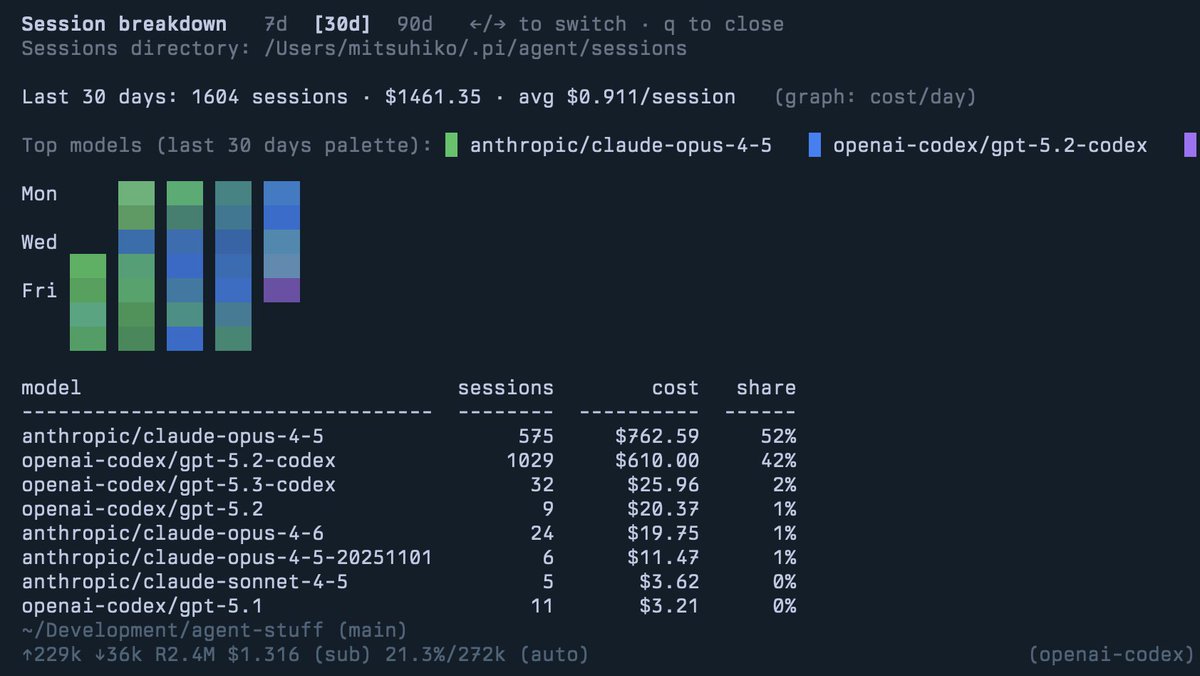
My last 30 days of pi sessions on my laptop. Notice that I don't actually use that many tokens! I'm a handcranker with my clanker.
Armin Ronacher ⇌ tweet media
English
16
3
225
16.8K
Konark Modi
Konark Modi@konarkmodi·
@mitsuhiko Congrats @mitsuhiko. I still kick myself that in a short span of a few days in November, was in the same room & the same flight as you, but got cold feet and managed to not approach you, not once but twice. Wanted to thank you for all your contributions, it has shaped my career.
English
1
0
1
486
Konark Modi retweetledi
Charles 🎉 Frye
Charles 🎉 Frye@charles_irl·
We now have all the pieces for _actually_ open AI: capable open models and performant, tunable OSS inference engines. We're sharing how we've put these pieces together at @modal to help customers serve these workloads in production, at scale. modal.com/llm-almanac/wo…
Charles 🎉 Frye tweet media
English
9
38
311
20.1K
Konark Modi retweetledi
SikhPark
SikhPark@SikhPark·
We see countless shots of the Golden Temple, but I wanted something different. This morning at 6 AM, I got that chance. With temperatures at 2°C, the freezing air, and the soft winter morning mist, I think i captured the perfect shot.
SikhPark tweet media
English
310
968
9.4K
196.5K
Alex Groberman
Alex Groberman@alexgroberman·
A new study of 500 brands confirms 1 specific thing leads to increased traffic from Google and ChatGPT. It also fully validates the approach SEO Stuff (seo-stuff.com) has been using all 2025. Now that none of this is a secret anymore, let’s talk about. Alright, so a newly released dataset from Noah Goldfarb that spans across 500 brands just confirmed something important. (Link to his post below) AI search and traditional organic search are not totally separate channels. They run on many of the same inputs, same signals and same structural constraints. Here is what the data showed: When you plot monthly organic traffic against LLM citations across ChatGPT, Perplexity, Claude and Gemini, you get a clean upward trend. When you plot monthly organic traffic against Google AI Overview citations, the correlation is even stronger. This doesn't mean that these things are entirely identical, but it does support the idea that if you focus heavily on boosting your organic search traffic, increased AI search visibility is likely to follow. Google’s ranking systems and LLM ranking systems both depend on: Embeddings (semantic similarity) Chunk-level structure (how your content is broken into meaningful sections) Entity clarity (does the model know who you are and what you do) Authority signals (backlinks, brand mentions, review platforms, domain trust) Freshness windows (LLMs rely heavily on recently updated content) Predictive engagement models (Google uses PCTR tiers, LLMs mimic them indirectly) Both Google and ChatGPT are optimizing for the same output: Which brands can they safely recommend as the answer. If your domain has the authority, clarity, and structure that Google trusts, LLMs treat you the same way. The underlying math is shared. This is also why SEO Stuff (seo-stuff.com) has been outperforming standalone “AI visibility services” all 2025. SEO Stuff's Gold Plan aligns with the exact mechanics that power both systems. seo-stuff.com/gold-plan-pack… You get: 10 long form comparison pages question based H2s that LLMs can chunk cleanly two to three sentence answers under each heading internal linking that builds semantic neighborhoods clean HTML that LLMs can parse without noise schema that reinforces entities 3 DR50+ backlinks that boost both authority graphs (Google and LLM) This is why Gold Plan customers consistently see visibility growth across: Google ChatGPT Gemini Perplexity Claude The Premium Content Bundle is built on the same architecture. seo-stuff.com/premium-conten… You get: 60 comparison driven articles 2000+ word depth that LLMs prefer section lengths optimized for chunk extraction consistent heading patterns that replicate how AI stores knowledge internal linking that builds category level expertise freshness signals when you update, which LLMs reward even more strongly than Google This is content that teaches LLMs how to think about your brand and gets you organic search traffic. The Premium Backlink Bundle reinforces what both systems interpret as trust. seo-stuff.com/premium-backli… You get: 3 DR50+ links from real business domains external entity reinforcement stronger authority signals for both Google’s link graph and LLM’s trust graph the domain reputation you need to move out of the “low authority bucket” that Ahrefs found in 35% of cited lists All of which is to say, currently AI search is compressing SEO into the signals that have always mattered and punishing everything else. Authority Entity clarity Structure Depth Freshness Semantic relevance Both Google and AI platforms care about these and both will reward you if you focus on them. If you want cheat codes for increasing your ChatGPT visibility within 30 days, RT this, follow me, and reply “AI SEO Cheat Codes.” You must do all 3 for the DM.
Alex Groberman tweet mediaAlex Groberman tweet mediaAlex Groberman tweet mediaAlex Groberman tweet media
English
26
7
62
14.9K