

John Michael Pennington
104 posts

John Michael Pennington
@lamichaelpenny
Head of BD at JST Digital. Prev @Macquarie, @Circle, @pennblockchain, ZX Ventures. views my own / not financial advice.
Katılım Mayıs 2016
992 Takip Edilen163 Takipçiler

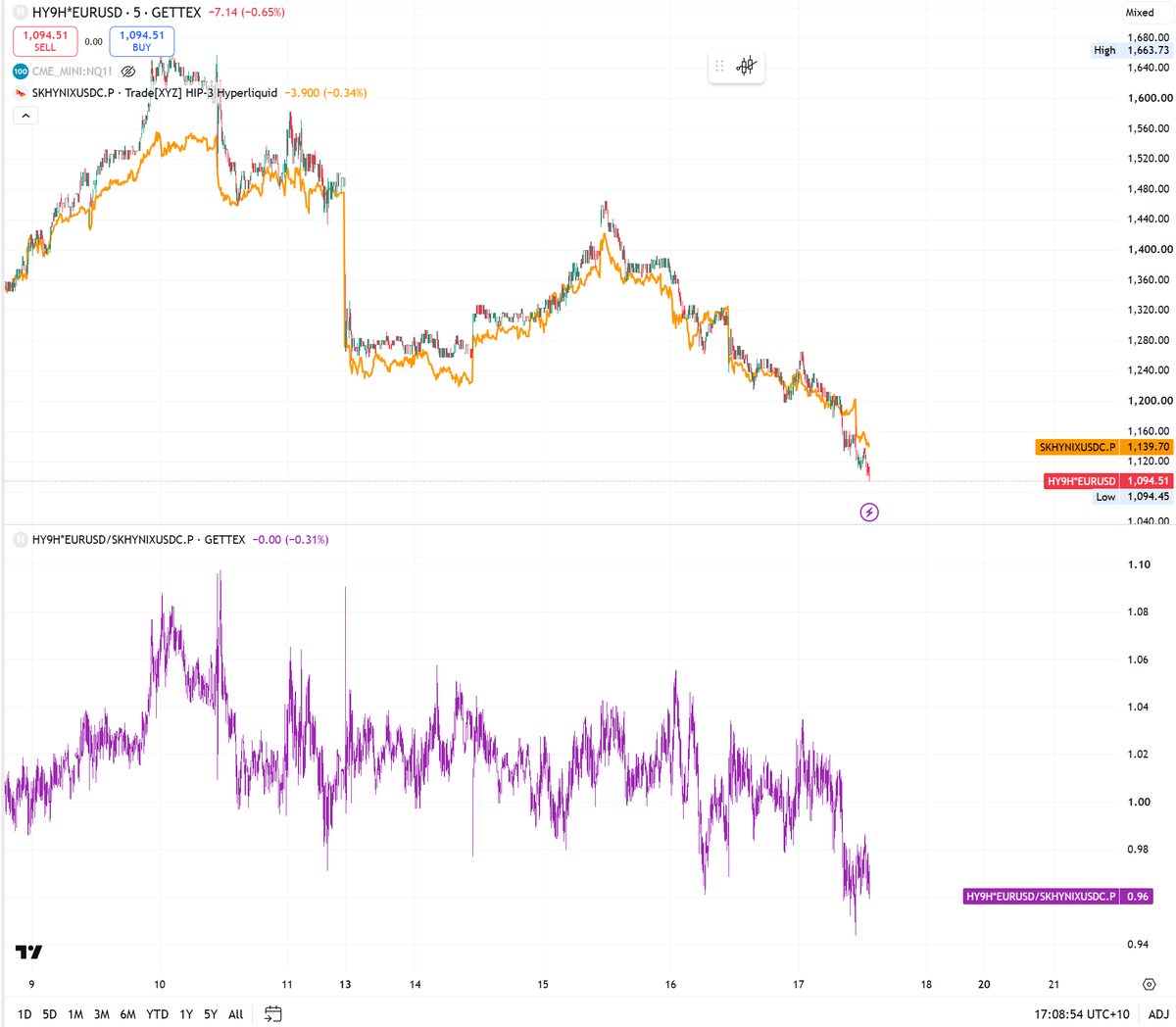
Rip $HY9H (Skhynix GDR) holders
After paying as much as 10% prem last week
its now time to sell at 5% disc
English

Former ADR arb trader here....its conceptually similar in terms of being a "one way fungible" trade: can always redeem for local but creations are limited by whats called "headroom". When there is no creation capacity (which there isn't), the "arb" isn't just difficult....there is no arb. Non-fungible spread trade, yes....'arb', no.
In the case of SK Hynix, the company has to authorize additional creations, which they rationally wouldn't when the ADR is trading at a premium (they can benefit from the premium by selling shares in the US as less dilutive source of $'s).
English

A similar story to SKHY/SKHYNIX is TSM/2330 i.e. the TSM ADR, which was issued back in 97' at a 1:5 ratio against TSMC (ticker 2330 on the Taiwanese stock market).
My understanding is that the arbitrage is difficult to perform when the ADR trades at a premium (as seen below).
There is a limit on ADR issuance (converting Taiwan-listed shares into TSM), and therefore a limit to how easily the spread can be closed when TSM trades at a premium to TSMC.
Not sure how similar this is to the current SKHY/SKHYNIX situation so keen to hear opinions/insights.
If it is similar and there's a strict limit on ADR issuance it could potentially mean that the premium persists for longer?
Chart slightly overstates premium at times due to differences in open hours on the American vs Taiwanese market.

Thor@0xThoor
Created a dashboard to track the SKHY/SKKHYNIX 'arb' on Hyperliquid. Current price spread at around 34% and appears conversion might be possible starting in ~14 days. Keep in mind: · The spread could widen significantly from here before closing · Funding costs are fairly high. ~2% cost holding the position open in the past 3 days alone Dashboard lets you monitor both the price spread and funding rates on each perp. Check it out: skhy-dashboard.vercel.app
English
@skyquake_1 How I feel repeating that there will be no new headroom outside of the company selling more DRs….
GIF
English
Fairly misleading because the real lock is $000660 SK hynix itself
Citi, KSD, FSC are plumbing which doesnt matter if the spigot is off
Why would they give free money to arbs when they can eg issue stock in the US and buy back local (MSTR 2.0)
Markos@MarkosAAIG
$SKHY ADR sits 20%+ over Seoul. Not a structural premium. the arbitrage just frozen until July 29, when conversion opens. Then you can buy the cheap line and convert up. Convergence hits Seoul, not the ADR. Watch Citi’s terms tho As the US ADR can be capped for now.
English
It depends on the structure, and since "tokenized stocks" gets used as a catch-all for a variety of structures I find it helpful to segment based on this taxonomy:
1. Note / Tracker Certificate: by holding the "tokenized stock" you own a tracker certificate. Depending on the issuer, either redeemable by the holder for cash value or have to rely on a approved third party (akin to an AP in ETFs) to provide liquidity, but either way, not redeemable for the share
2. Wrapped / Custodied: the token itself is a wrapped on a custodied share. Holder of the token can redeem for the share through the custodian and transfer to a brokerage account
3. Native On-Chain Equity: the token itself is the share, with the transfer agent recording ownership of the share on the blockchain
Secondary market liquidity is important in all three, but especially relevant in #1, where the holder owns neither the underlying nor a direct means of redeeming for it, so the secondary market is effectively the only exit.
English

@CryptoEthan Yup. Before the listing I explained why this was primed to happen: x.com/lamichaelpenny…
John Michael Pennington@lamichaelpenny
I haven't posted here in years. Tomorrow's SK Hynix listing is worth breaking the silence. It prices tonight — reportedly $149/ADR, a ~$26.5B raise. If that holds, it passes Alibaba as the largest US listing by a foreign company ever. But it's an ADR offering, not a traditional IPO. And buried in the prospectus is a structural quirk most people aren't thinking about: the US line is built to trade at a persistent premium to the Korean one. I traded ADR arb in Asian markets for a living. Here, it all comes down to one word: headroom. 🧵
English
@degentradingLSD Also to add, the company itself has to authorize creations which they won't since a premium means they can raise more capital in a dilution-efficient manner if/when they so choose.
English

Again - $SKHY trades at a 30% premium. There is no "arb" because $SKHY and $0660 trades in their own separate pools. Regulators are also unlikely to allow conversion because of asset outflow and FX concerns. How long can this last? Look at $TSMC, the widest was 80%.. good luck.
degentrading@degentradingLSD
$SKHY will trade at a premium to $0660, this is similar to $TSMC and $2330 - for TSMC, 20% of the float is on the US, for $SKHY, just 2.5%. If KR regulators dont allow for conversion from KR into US ADR - then effectively they will trade their own separate ways. Anyone trying to do an "Arb" - you can think about how painful doing the Naspers/700 HK "arb" was.
English
Not really apples-apples to compare to current $TSM premium. More important to remember that with no headroom available, $SKHY and the 000660KS local are effectively two different instruments with two different capital sources chasing them. For historical context in the early days of the TSM adr / dotcom boom TSM peaked ~80% premium.
TBD what happens here (and not financial advice) but I'd expect this to trade at a healthy premium on an ongoing basis.
English

@lamichaelpenny Do you think the 40% premium is sustainable when TSMC is at 20% ? also with Korea trading today would you expect the premium to caught up to say Baseline 20%?
English
Last post on this for now....$SKHY ADR premium now out >40%. This reminds me of the saying that "capital flows like water".
In this case pent up offshore capital finally flowed around structural inefficiencies via the ADR, but the headroom cap creates a dam that currently manifests as nonfungible premium.

English
With $SKHY premium now out >25%, fascinating seeing what people are paying in funding to "arb" on #Hyperliquid. Ignoring whether the trades driving this funding blowout are misguided or not, the market structure nerd in me finds it very cool that these sorts of trades are now possible 24/7 via perps

English
@SoskaKyle @ThinkingUSD People not understanding the concept of headroom / capped ADR creations and thinking they’re “arbing”
English

I can't recall many times where traders chronically paid 300%+ APY in funding to be so often directionally wrong on perps

English
As anticipated rally did not follow through. SK Hynix local line opens lower. ADR premium now ~20%.

English
The Korean stock market opens in <6 hours. Seeing some people expecting a massive follow through in #SKHynix local shares after $SKHY traded to a ~17% premium Friday in NY. Here's why I don't think that happens:
1. this isn't a pure arb trade. as mentioned previously, there is no available creation capacity for SKHY ADRs. in a fully two-way fungible market you'd see follow through buying locally but that trade isn't possible here.
2. different pools of capital at play. part of why the ADR listing was particularly attractive for SK Group is that Korea remains a complex market for outside capital to enter
3. whether by coincidence or not, SKHY is trading at a very similar premium to $TSM which has similar headroom constraints. I doubt arb players are going "short premium" (sell ADR buy local)
While I don't expect a big rally in the local, that has nothing to do with whether the market thinks the AI hardware rally is done / not done, nor does it mean $SKHY reverses its rally Monday in NY. Just market structure and different pockets of capital at play.
Best guess is the local line trades within a few % of flat and we actually see the DR premium expand from here in the near future.
English
@degentradingLSD Yup. Headroom the key here. My thread from yesterday predicting this dynamic if interested in digging into the nuances of a former ADR arb trader: x.com/lamichaelpenny…
John Michael Pennington@lamichaelpenny
I haven't posted here in years. Tomorrow's SK Hynix listing is worth breaking the silence. It prices tonight — reportedly $149/ADR, a ~$26.5B raise. If that holds, it passes Alibaba as the largest US listing by a foreign company ever. But it's an ADR offering, not a traditional IPO. And buried in the prospectus is a structural quirk most people aren't thinking about: the US line is built to trade at a persistent premium to the Korean one. I traded ADR arb in Asian markets for a living. Here, it all comes down to one word: headroom. 🧵
English
$SKHY will trade at a premium to $0660, this is similar to $TSMC and $2330 - for TSMC, 20% of the float is on the US, for $SKHY, just 2.5%. If KR regulators dont allow for conversion from KR into US ADR - then effectively they will trade their own separate ways. Anyone trying to do an "Arb" - you can think about how painful doing the Naspers/700 HK "arb" was.
Paradis Labs@ParadisLabs
With the gap between different SK Hynix listing locations: I do think it's more likely that it'll persist, rather than close for now. Since $HY9H (Germany) and $SKHYV (US) are anchored to different things: - $HY9H is effecitively a proxy for Korea - $SKHYV is however a distinct US asset aka a different demand curve So $HY9H isn't really at a discount per se. Rather, $SKHYV is at a premium. I wouldn't read into premiums yet though since day 1 post IPO is noisy af e.g. $SPCX just recently. And on top, the ~14% pop in $SKHYV today can easily bleed off next week once regular trading starts on Monday for $SKHY ticker. Then if Korean regulators liberalise deposits into the ADR facility, or SK Hynix issues more US shares (Chairman just said that they might do that), then the premium compresses.
English
@EricJhonsa I use to trade EM ADR arb and expected this to trade at a premium. Given market structure dynamics I think we actually see premium over the local expand even further in the near term. Wrote some thoughts on the dynamic at play here: x.com/lamichaelpenny…
John Michael Pennington@lamichaelpenny
I haven't posted here in years. Tomorrow's SK Hynix listing is worth breaking the silence. It prices tonight — reportedly $149/ADR, a ~$26.5B raise. If that holds, it passes Alibaba as the largest US listing by a foreign company ever. But it's an ADR offering, not a traditional IPO. And buried in the prospectus is a structural quirk most people aren't thinking about: the US line is built to trade at a persistent premium to the Korean one. I traded ADR arb in Asian markets for a living. Here, it all comes down to one word: headroom. 🧵
English

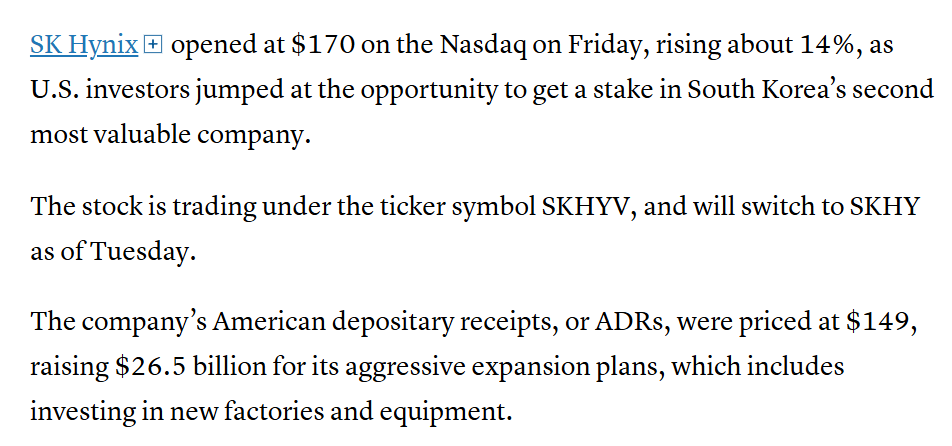
$TSM trades at a 16% premium to TSMC's Taipei shares. That suggests $SKHY's premium to Hynix's Seoul shares could expand meaningfully from its current ~3%...especially since Hynix trades at a 20%-plus forward EPS discount to $MU in spite of having more HBM/data center exposure.
English
@BrettHarrison Small world @BrettHarrison. I too started in ADRs. Agreed on your thoughts here. Finite creations / headroom limits something folks don't appreciate.
English
SK Hynix listed today as an American Depositary Receipt (ADR) on Nasdaq. ADRs are the primary instrument for US investors to gain exposure to foreign stocks. and they’re what I started my career trading at Jane Street. The main advantages of perpetual futures over ADRs:
• Coverage isn't gated by a bank. An ADR only exists if a depositary bank builds the ADR program with permission from the underlying company. SK Hynix illustrates the gap this creates: until this week, a US investor seeking exposure to the second-largest global memory maker had to trade an illiquid over-the-counter line or open a Korean equities account. Perpetuals require only a reliable price feed to enable a listed foreign name to be tradeable, with no sponsorship, roadshow, or multi-billion-dollar offering required to unlock access.
• No fixed pool of receipts. ADRs are registered in a finite quantity on Form F-6. When demand exceeds that pool and the depositary suspends creation of new receipts, the ADR detaches from the underlying and trades at a large premium. A perpetual has no such ceiling. Its funding-rate mechanism is what keeps the price tethered to fair value, rather than a bank's inventory,
• Ability to short. Shorting an ADR requires locating borrow, paying a stock-loan fee, and living with recall risk. In November 2023 Korea imposed a full short-selling ban that was only lifted in March 2025, which carried through to depositary receipts. Shorting a perpetual, on the other hand, is structurally symmetric to buying a perpetual. High borrow costs will be reflected in the perpetual funding rate, but shorting perpetuals will always be mechanically possible.
• No depositary fees. Depositary banks charge custody and servicing fees on ADR positions, typically extracted from dividends. Perpetuals don’t carry these fees, and the full amounts of dividends are reflected in the funding rate.
• Better price discovery. The SKHY ADR on Nasdaq and its underlying stock 000660 on KRX have no trading hours in common. There is never an opportunity for true arbitrage where the two markets can be brought in line. Perpetuals can easily trade 24/7 and provide ample time for the derivative and the underlying stock prices to converge.
SK Hynix ringing the Nasdaq bell is a genuine milestone for the ADR model as the largest ADR offering by a foreign company in history. Regulated US perpetuals will augment our ADR markets and provide investors wider exposure to strategic global companies in AI and other advanced industries.

English