
Liam Karr

1.2K posts

Liam Karr banner
Liam Karr

Liam Karr

@liam_karr

Africa Team Lead for @criticalthreats. Focus on political and security dynamics in sub-Saharan Africa. Opinions are my own. RTs, follows, likes ≠ endorsements.

Washington, D.C. Katılım Ocak 2022
776 Takip Edilen4K Takipçiler
Sabitlenmiş Tweet
Liam Karr
Liam Karr@liam_karr·
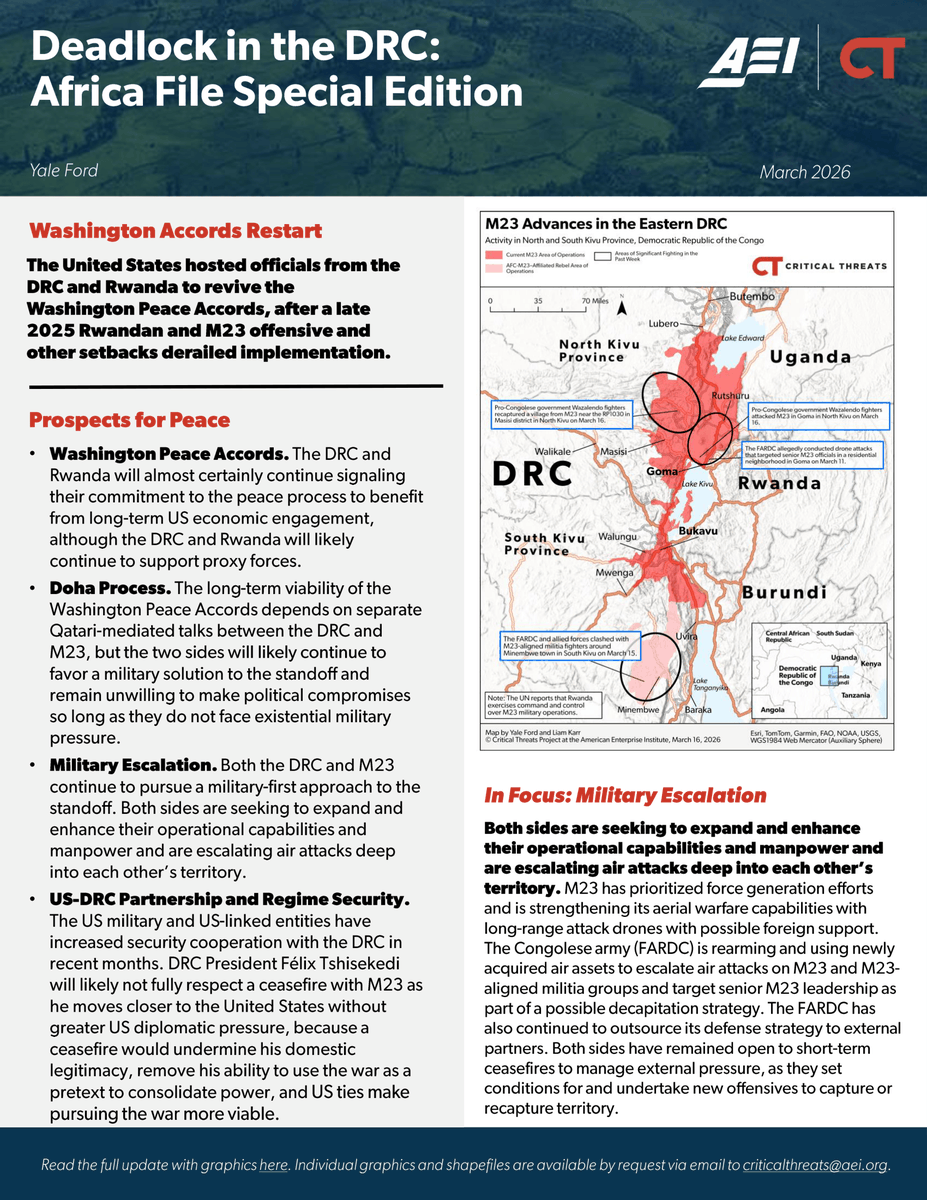
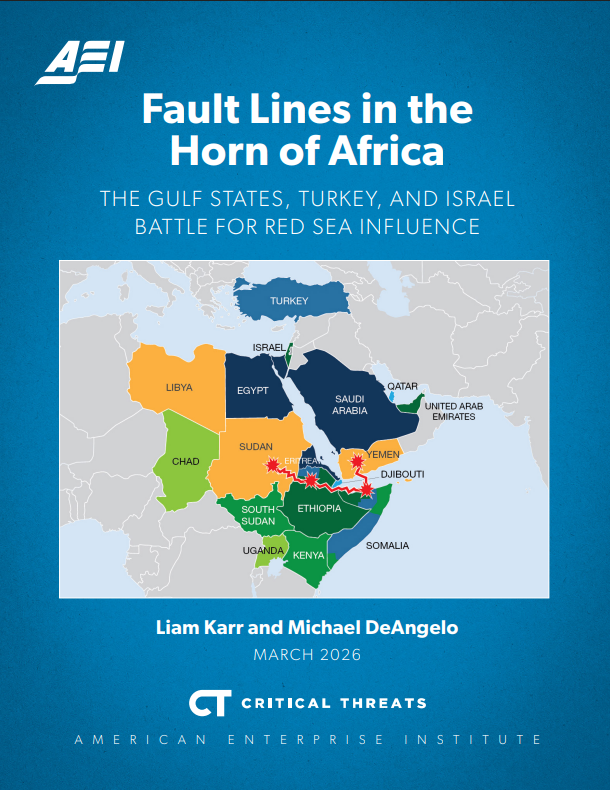
Thrilled to get this out. I think it’s the most comprehensive overview for Africa & Middle East audiences of the current state of play in the Red Sea, how things got here, what lies ahead, and what's at stake. It’s long but worth the read, and there’s a one-page summary.
Critical Threats@criticalthreats

NEW REPORT | The Gulf states, Turkey, and Israel have become increasingly involved in the Horn of Africa, effectively splitting the broader Red Sea region into two coalitions & raising the risk of a regional proxy war across the Red Sea. Link & executive summary below⬇️

English

4
29
107
18.4K
Liam Karr retweetledi
Critical Threats
Critical Threats@criticalthreats·
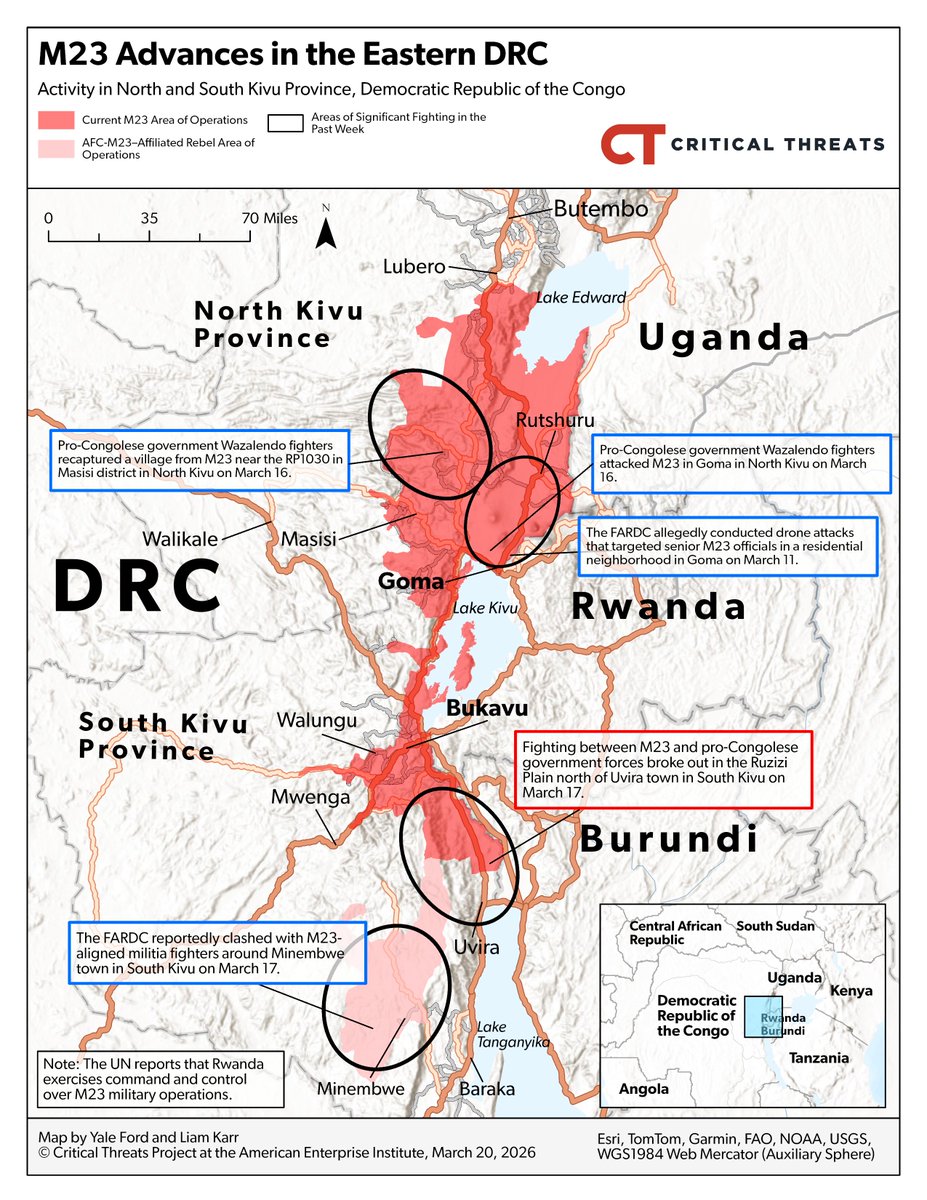
The US State Department hosted senior officials from the DRC and Rwanda to jumpstart the Washington Peace Accords last week. The restart is a positive step, but several significant challenges could continue to hinder the prospects of peace. ⬇️🧵
Critical Threats tweet mediaCritical Threats tweet mediaCritical Threats tweet media
English
1
15
39
20.8K
Liam Karr
Liam Karr@liam_karr·
Reports from late 2025 claimed that CAR was another target of UAE "bailout diplomacy" to create RSF supply hubs. This goes beyond Sudan. Africa Intelligence claimed the deal included the UAE covering CAR's $15 million monthly fee to keep Russia's Wagner/Africa Corps. Details⬇️ CAR is not the only place the UAE is aligned with Moscow, as the Emiratis are also partnered with Libyan strongman Khalifa Haftar, who has opened Emirati supply routes to the RSF via eastern Libya. It is worth noting, however, that the Kremlin has publicly backed the SAF in the Sudanese civil war in the hopes of securing a Red Sea naval base. We discussed in greater detail how the UAE is using "bailout diplomacy" with states surrounding Sudan to create supply lines for the RSF in our recent report, Fault Lines in the Horn of Africa. Saudi officials visited CAR President Touadéra in late February, as well as Ethiopia and South Sudan, likely to counter this Emirati campaign and overall Emirati influence as part of the Emirati-Saudi rivalry across the Horn of Africa and peripheral countries. Links below⬇️
Liam Karr tweet mediaLiam Karr tweet media
Cameron Hudson@_hudsonc

Excellent reporting on the UAE's active efforts to diversify its supply routes to the RSF to sustain the war through CAR, Ethiopia and South Sudan, while moving away from Chad and Libya, dispelling the belief the Iran war would distract from #Sudan. lemonde.fr/en/le-monde-af…

English
3
18
52
43.9K
Liam Karr retweetledi
Critical Threats
Critical Threats@criticalthreats·
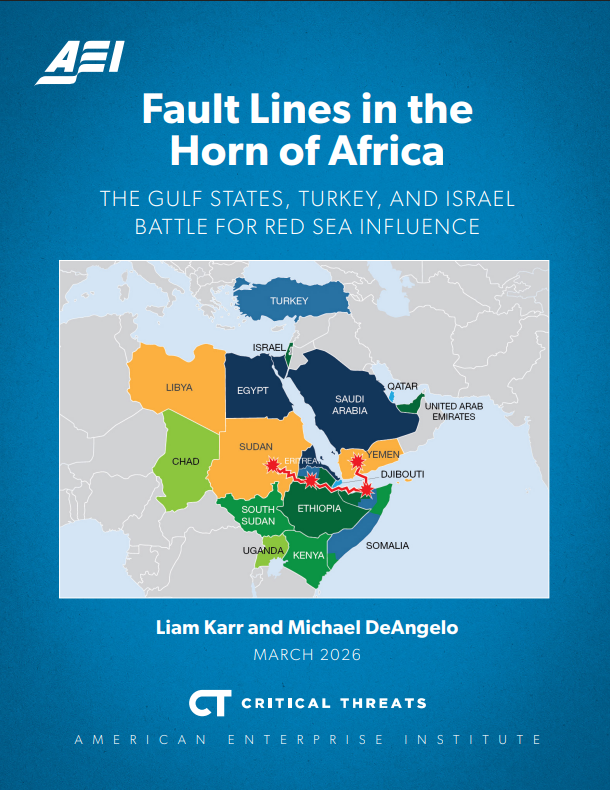
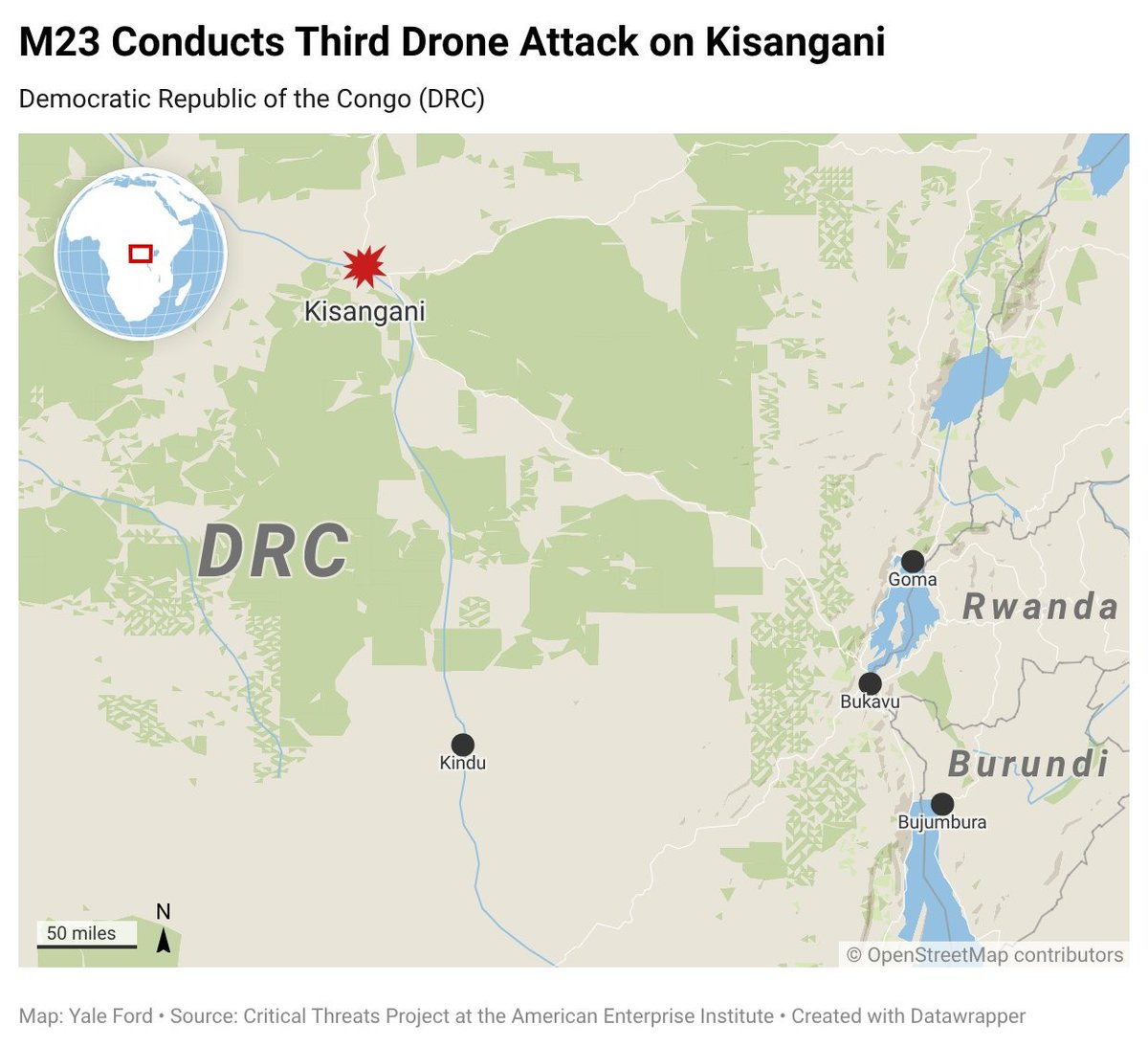
NEW REPORT | Deadlock in the DRC 🇨🇩 🇷🇼 The United States hosted officials from the DRC and Rwanda to revive the Washington Peace Accords, after a late 2025 Rwandan and M23 offensive and other setbacks derailed implementation. Key findings: 1️⃣ Washington Peace Accords. The DRC and Rwanda will almost certainly continue signaling their commitment to the peace process to benefit from long-term US economic engagement, although the DRC and Rwanda will likely continue to support proxy forces. 2️⃣ Doha Process. The long-term viability of the Washington Peace Accords depends on separate Qatari-mediated talks between the DRC and M23, but the two sides will likely continue to favor a military solution to the standoff and remain unwilling to make political compromises so long as they do not face existential military pressure. 3️⃣ Military Escalation. Both the DRC and M23 continue to pursue a military-first approach to the standoff. Both sides are seeking to expand and enhance their operational capabilities and manpower and are escalating air attacks deep into each other’s territory. 4️⃣ US-DRC Partnership and Regime Security. The US military and US-linked entities have increased security cooperation with the DRC in recent months. DRC President Félix Tshisekedi will likely not fully respect a ceasefire as he moves closer to the United States without greater US diplomatic pressure, because a ceasefire would undermine his domestic legitimacy, remove his ability to use the war as a pretext to consolidate power, and US ties make pursuing the war more viable. Read CTP’s full report here: criticalthreats.org/analysis/deadl…
Critical Threats tweet mediaCritical Threats tweet mediaCritical Threats tweet mediaCritical Threats tweet media
English
1
10
20
4.1K
Liam Karr retweetledi
Critical Threats
Critical Threats@criticalthreats·
NEW | The RSF and SAF separately advanced on multiple fronts across Sudan. External backers, including Egypt and the UAE, have continued to fuel the warring sides—despite the Iran war—to the detriment of US peace efforts.🧵⬇️
Critical Threats tweet media
English
5
23
85
27.4K
Liam Karr
Liam Karr@liam_karr·
Have seen some viral tweets about SAF “momentum” recently, citing the impact of the Iran war on the RSF’s UAE backers. Little evidence to back that up, especially with the SAF being unable to hold Bara, which was its most operationally significant gain since the Iran war began.
Sudan War Updates@sudan_war

🚨 عاجل | مجددًا.. مليشيا الدعم السريع تسيطر اليوم الإثنين على مدينة «بارا» بشمال كردفان غربي البلاد

English
0
0
10
689
Liam Karr retweetledi
Critical Threats
Critical Threats@criticalthreats·
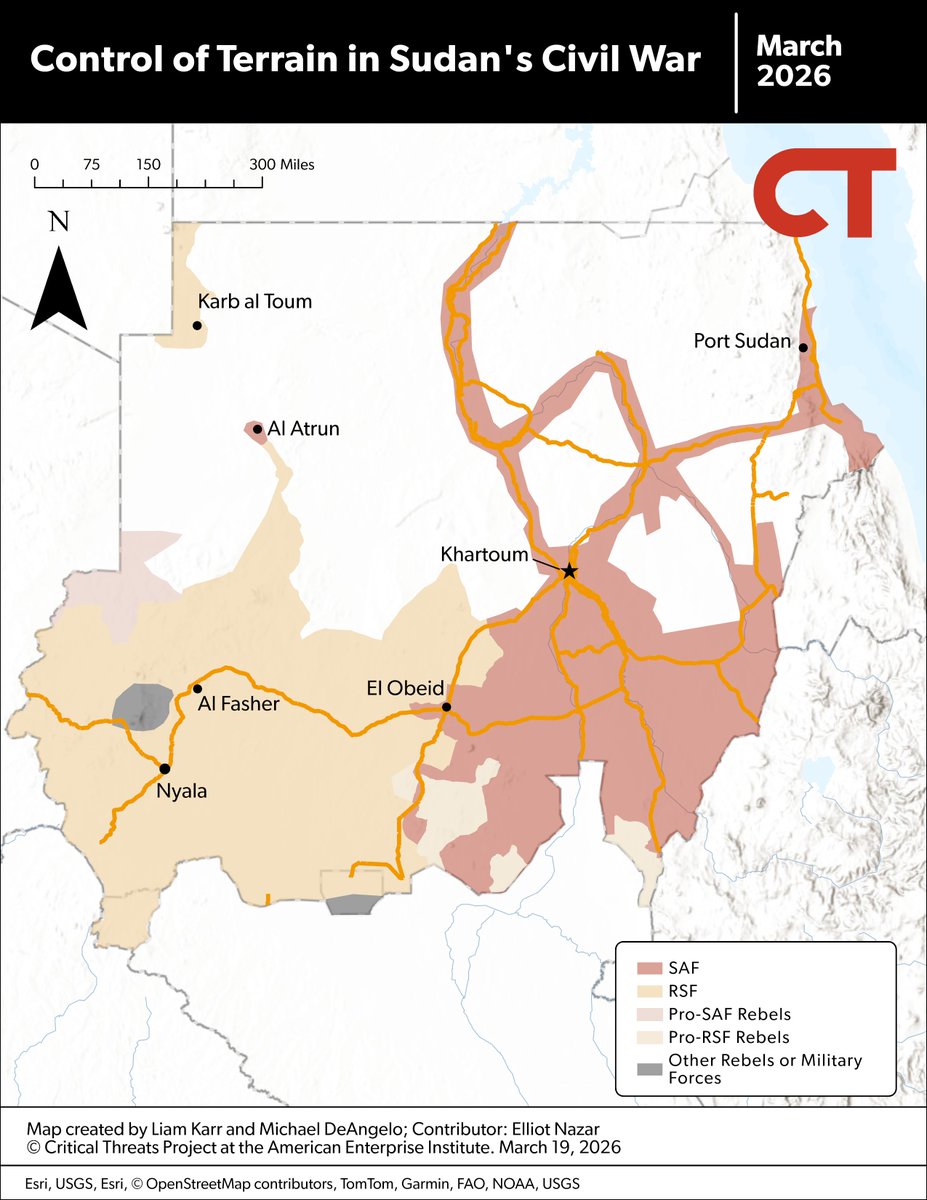
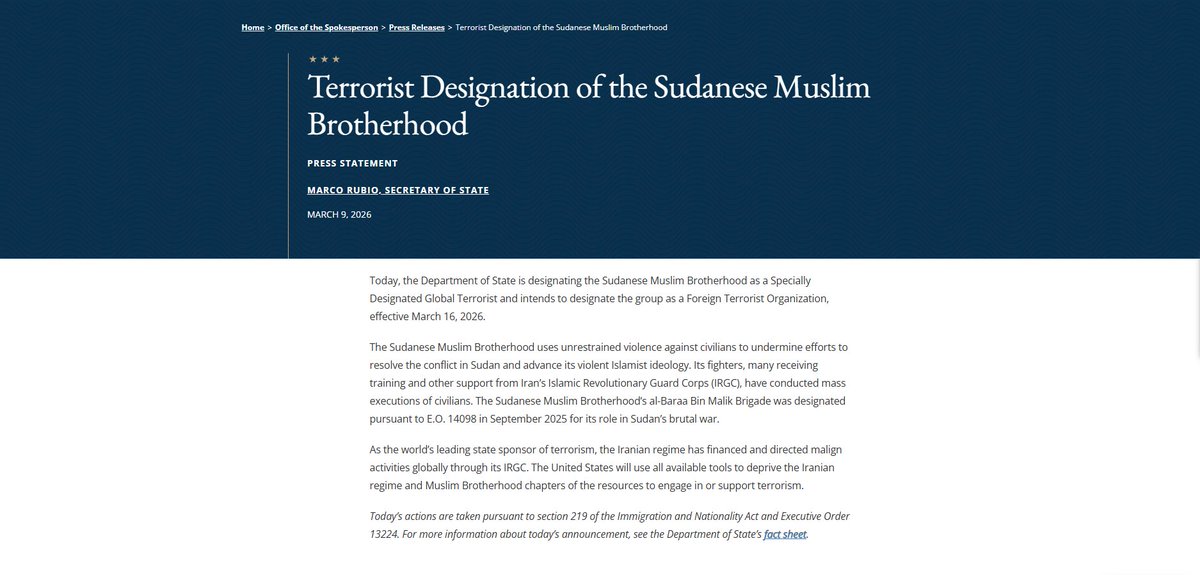
NEW | The United States designated Sudanese Islamist factions affiliated with the SAF, including the Muslim Brotherhood-associated Sudanese Islamic Movement and its armed wing, the al Baraa bin Malik Brigade, as terrorist organizations on March 9. The designation cited civilian targeting in the Sudanese civil war and ties to Iran. Both the RSF and SAF, and members of the US-led Quad peace process—Egypt, Saudi Arabia, and the UAE—accepted the designation, although they gave varying levels of approval. Sudan’s Ministry of Foreign Affairs called for the United States to also designate the RSF as a terrorist organization, a stance that US Senate Foreign Relations Committee Chairman Jim Risch has echoed. The designations could spur SAF resentment and stymie US peace efforts without further action against the RSF, as the SAF has already accused the United States of favoring RSF and Emirati interests at the expense of the SAF in the Quad peace process. Read the full overview of the designations and their impact in this week's Africa File, linked below! 1/2
Critical Threats tweet media
English
2
21
72
21K
Liam Karr
Liam Karr@liam_karr·
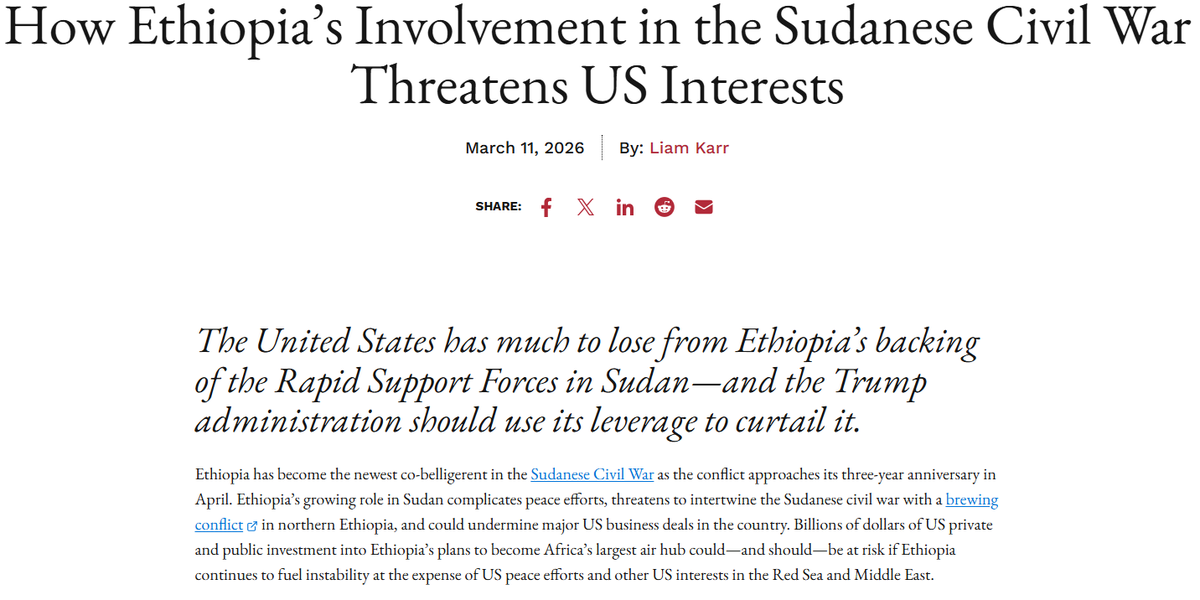
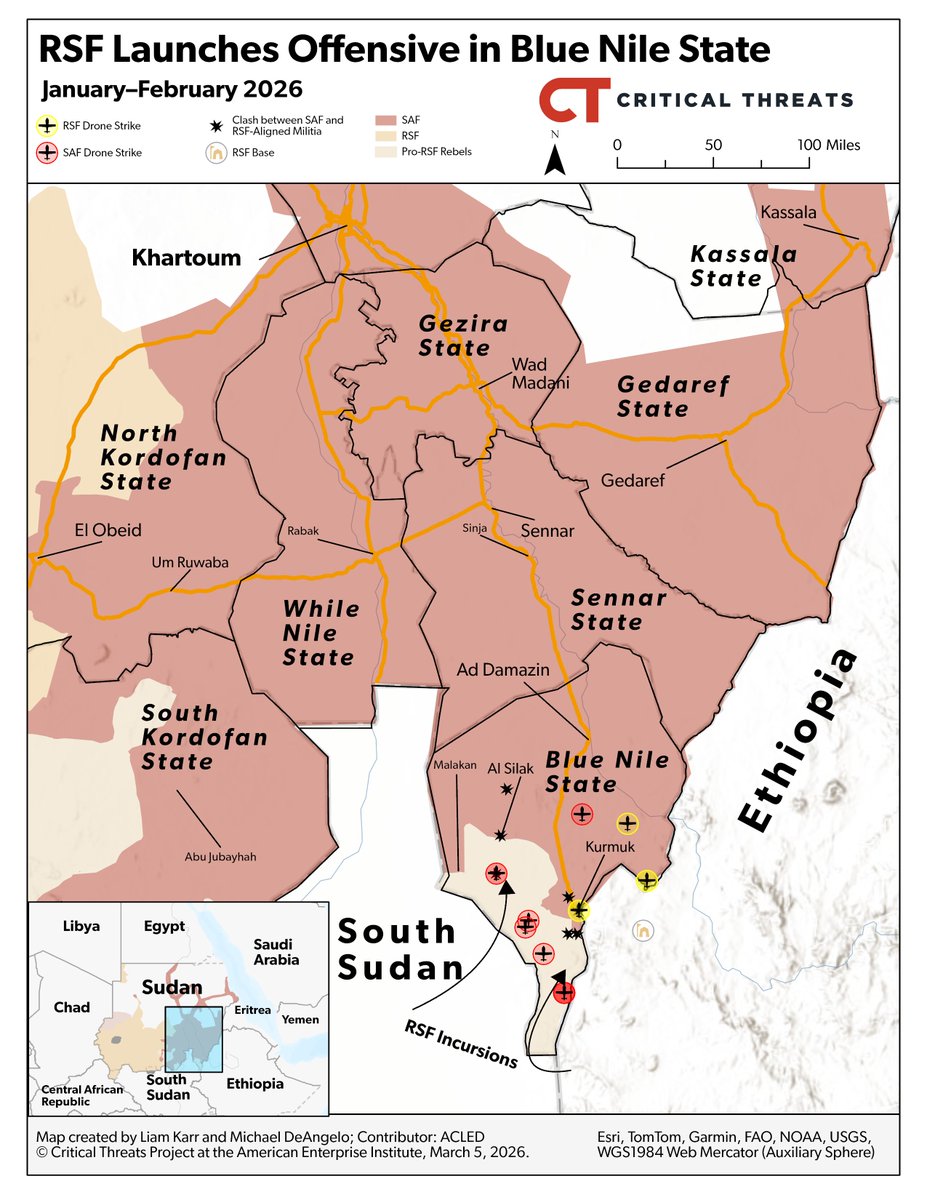
Northern Ethiopia and Ethiopian support for the RSF were likely topics. The economic piece is also important. Yesterday, I warned that Ethiopian involvement in Sudan poses risks to multibillion-dollar US investments in Ethiopian aviation that involve Boeing and the US DFC. ⬇️🔗 Aside from the economic concerns, we've warned for months that Ethiopian support for the RSF threatens to further link the Sudanese civil war with a potential war in northern Ethiopia, creating a regional war in the Horn of Africa. As Rubio and the administration engage Abiy, they should use economic tools to strengthen cooperation with Ethiopia, contingent on Abiy respecting the sovereignty of Ethiopia's neighbors and working to promote regional stability. There are the aforementioned multi-billion dollar investments in Ethiopian aviation, critical IMF support for Ethiopia's faltering economy, and potential future diplomatic or economic support for greater Ethiopian commercial sea access. This toolkit is the foundation for a strong, economic-based, win-win partnership, but also coercive leverage if Abiy wants to go down the path of becoming a regional destabilizer.
Liam Karr tweet media
U.S. Embassy Addis@USEmbassyAddis

Secretary of State Marco Rubio spoke yesterday with Ethiopian Prime Minister Abiy Ahmed Ali.  The Secretary and Prime Minister discussed their shared commitment to regional stability, counterterrorism cooperation, economic prosperity, and building a foundation for long-term security in the Horn of Africa. @StateDept et.usembassy.gov/secretary-rubi…

English
14
36
88
17.3K
Liam Karr
Liam Karr@liam_karr·
My piece from last week, discussing how Iran and the Houthis could target US, Israeli, or Emirati positions in the Horn of Africa as part of their retaliatory campaign, and how Iran could activate attack cells on the continent as part of the campaign: criticalthreats.org/analysis/iran-… Bloomberg's @MarksSimon writing on Israel's strategic interests in Somaliland, including some counter-Turkey elements we've highlighted previously: bloomberg.com/news/features/… Quick @BBCAfrica video on Camp Lemmonier: x.com/BBCAfrica/stat… @JoshMargolin and ABC on Iranian sleeper cells: abcnews.com/US/iran-activa… US security alert: x.com/TravelGov/stat…
English
0
1
6
923
Liam Karr
Liam Karr@liam_karr·
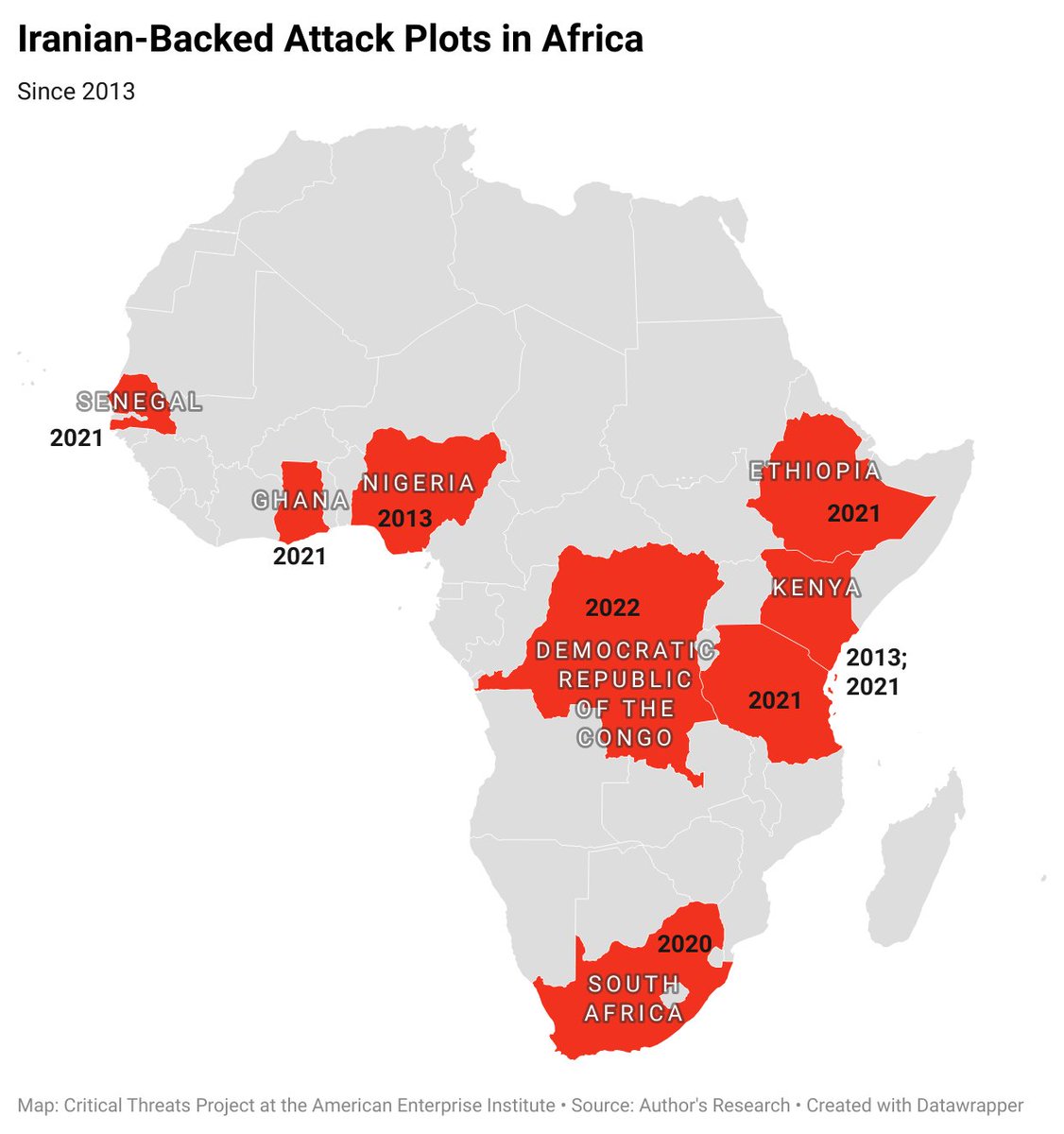
Some new reporting highlights the Iran war spillover risks for Africa that I pointed out last week.🔗⬇️ - Bloomberg reporting on Israeli interest in a base in Somaliland to counter the Houthis - BBC Africa detailing the importance of US Camp Lemmonier in Djibouti for Red Sea security - ABC News story on Iran potentially activating foreign sleeper assets - The US Embassy in Nigeria put out a security alert warning of a terrorist threat against US facilities and US-affiliated schools in Nigeria. Unclear what is behind it, but the warning did extend to Lagos, where Lebanese Hezbollah has a presence.
Liam Karr tweet mediaLiam Karr tweet media
English
5
31
85
14.1K
Liam Karr
Liam Karr@liam_karr·
More pressure on both warring sides is great. FTO designation on the RSF must be next. Yesterday's sanctions cite "unrestrained violence against civilians to undermine efforts to resolve the conflict in Sudan" & "mass executions of civilians." This is also 100% applicable to the RSF, which has committed multiple genocides. RSF sanctions are also critical for the Trump administration to remain a neutral mediator in the region. It loses legitimacy with SAF, as well as SAF-backers (including Saudi Arabia and Egypt, who are very anti-Islamist themselves), if it only responds to valid Emirati concerns with SAF Islamist ties but does nothing to hold the RSF accountable for its terrorizing and destabilizing actions. Designating the RSF as an FTO and working to maintain neutrality are two key recommendations from our recent report, link below⬇️🔗
Liam Karr tweet mediaLiam Karr tweet media
Senate Foreign Relations Committee Chairman@SenateForeign

This is a vital step to curb the Muslim Brotherhood’s influence in the region, especially as hardline Islamists seek to reassert themselves. Now, we must also seriously consider the same FTO designation for the genocidal Rapid Support Forces and their terror campaign in Sudan.

English
1
7
24
5.7K
Liam Karr
Liam Karr@liam_karr·
Original assessment here: #Russia" target="_blank" rel="nofollow noopener">criticalthreats.org/analysis/wagne…
English
0
1
1
618
Liam Karr
Liam Karr@liam_karr·
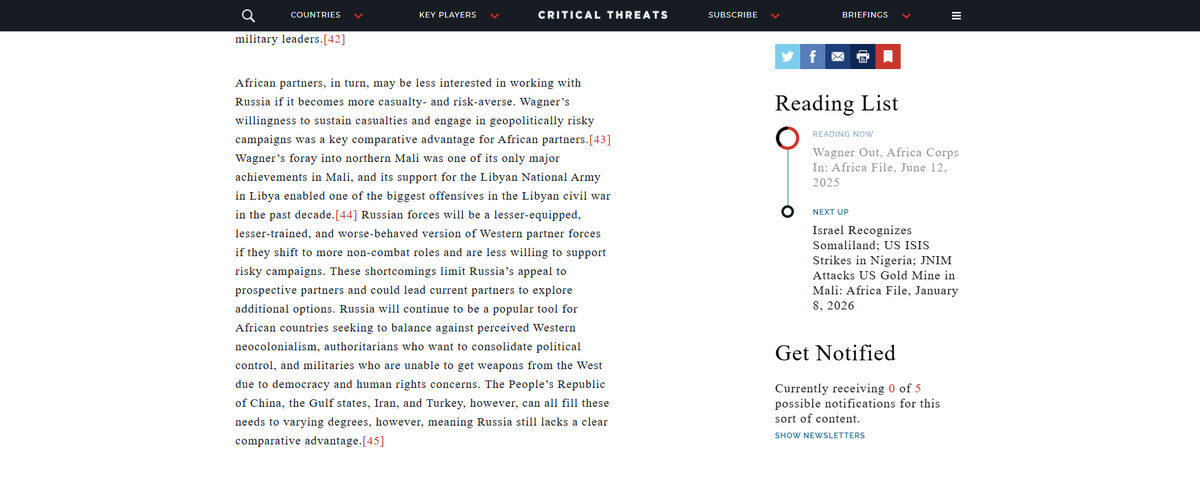
Great reporting on Russian forces becoming less active in Mali, which I forecasted right after Wagner officially "withdrew" from Mali last June. The shift to Africa Corps aligned Russian forces with the Kremlin's strategic aims at the cost of plausible deniability, operational flexibility, and risk-taking. The problem for the Kremlin is that the operational flexibility and risk-taking were part of what made the Russian offer so attractive. As I said last June, Russia risks shifting toward a more traditional state-to-state model and becoming "a lesser-equipped, lesser-trained, and worse-behaved version of Western partner forces if they shift to more non-combat roles and are less willing to support risky campaigns." This fits perfectly with JA's note that the Russian mission is becoming "Barkhane-ized."
Liam Karr tweet media
Jeune Afrique@jeune_afrique

Mali : pourquoi les opérations militaires russes s’essoufflent depuis l’arrivée d’Africa Corps l.jeuneafrique.com/Tyd

English
4
47
175
51.1K
Liam Karr
Liam Karr@liam_karr·
More details and graphics in our new report, “Fault Lines in the Horn of Africa: Gulf States, Turkey, and Israel Battle for Red Sea Influence,” in which we break down how Africa fits into the Gulf state’s strategic aims to diversify their economies: aei.org/research-produ…
English
0
3
7
717
Liam Karr
Liam Karr@liam_karr·
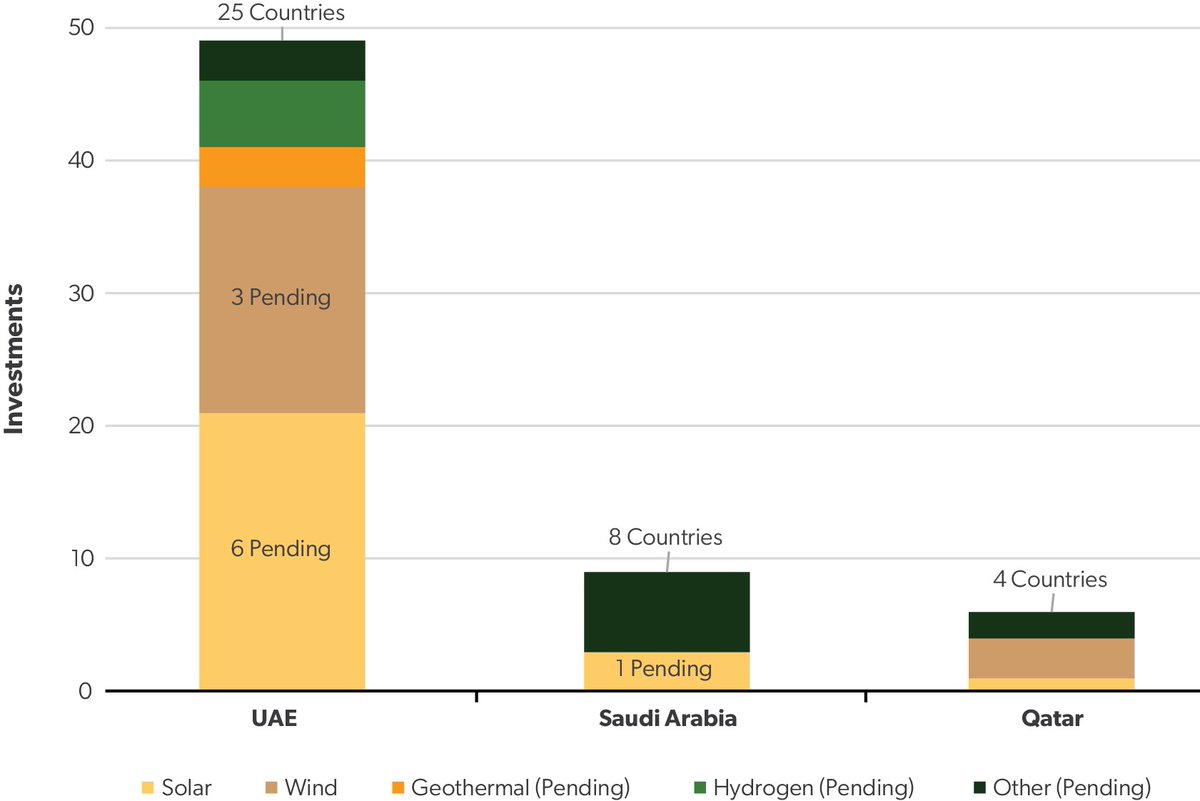
This could be a huge blow to African countries. The UAE alone is the fourth-largest source of capital on the continent, and GCC pledges over the last few years have surpassed the EU and tripled Chinese pledges over the same period. Some graphics from our recent report⬇️
Liam Karr tweet mediaLiam Karr tweet mediaLiam Karr tweet mediaLiam Karr tweet media
Financial Times@FT

FT Exclusive: Pressure on the Gulf states’ budgets could cause them to review their overseas investments and future commitments as they consider options to ease the financial strain caused by the US-Israeli war against Iran. ft.trib.al/3Kk0Kcg

English
6
49
123
17.3K
Liam Karr retweetledi
Critical Threats
Critical Threats@criticalthreats·
NEW | Ethiopia is likely deepening its engagement in the Sudanese civil war in support of the RSF. Ethiopian support for the RSF could cause the SAF and its allies—Egypt & Eritrea—to retaliate against Ethiopia, further regionalizing the war. 1/5🧵🇸🇩🇪🇹🇪🇬🇪🇷
Critical Threats tweet media
English
15
105
291
48.4K
Liam Karr retweetledi
Cameron Hudson
Cameron Hudson@_hudsonc·
The Trump Administration's involvement in Sudan, the Horn, the GERD, etc is all predicated on the notion that Trump has the trust and respect of all the Gulf states, who are themselves the ones driving the conflicts, politics, and economics across the Horn. If that is no longer the case, and the US has just abandoned its influence and leverage with the Gulf, then Washington has most certainly lost its leverage across the Horn as well. Trump has been squandering this leverage since he came into office, but the Iran war could well be the beginning of the end of US influence there. That writing has been on the wall for a while already and its testament to the fact that the US Quad mediation in Sudan has been essentially stuck with no forward momentum since last October. Increasingly, Gulf states have been pursuing their own objectives across the Horn, not just Sudan, but in Ethiopia and Somalia as well, without consulting with or seeking a green light from Washington--and in spite of having an open and ongoing dialogue with senior US officials. It's hard to see the Administration caring much about lost influence in the Horn in the short term--and Im sure many senior officials will likely be happy to just let local or Gulf actors try to sort out the rats nest of competing interests and ambitions. Their interests have only ever really been counterterrorism and freedom of navigation in the Red Sea. As long as those interests are met, and the US will be happy to work through local or regional partners as necessary, then I can very quickly imagine a much diminished role for the US across the region, including any efforts to mediate current or future conflicts. For the Gulf, lets see how long it takes for them to turn their focus back to the Horn once things settle down for them at home. Its too early to say whether the current KSA-UAE rapprochement will hold and whether it will extend to the Horn, but its clear that unbridled competition between them in Africa is bad for Africa from all perspectives: political, economic, security. But the fact is, they are rapidly becoming both the war enablers and the peacemakers all at the same time. Its impossible to see Trump making a credible case to anyone in the region that he is still the President of Peace. This tweet captures all the angst, anger, and frustration of a region that has been dragged into a conflict not of their making and makes me wonder whether they will ever trust this Administration again to mediate between them or dictate outcomes to them? I somehow doubt it. Which means that the rupture that Canada's PM talked about is not just in the trans-Atlantic alliance but could well extend deep into the Arab world.
English
9
27
103
143.2K
Liam Karr retweetledi
Critical Threats
Critical Threats@criticalthreats·
Iranian attacks on the Gulf countries demonstrate a willingness to expand the conflict and attack relatively softer US-allied targets than Israel or US bases in the region, which could extend to targets in the Horn of Africa if the Houthis join the conflict. More from @criticalthreats @liam_karr ⬇️
English
0
14
24
7.1K