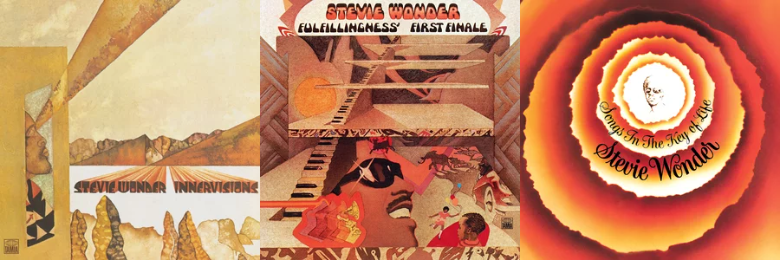
Born on this Day, Stevie Wonder (@StevieWonder) (Saturday, May 13, 1950) Born Stevland Hardaway Judkins in Saginaw, Michigan and raised in Detroit, Stevie Wonder emerged from one of the most fertile Black American musical ecosystems of the 20th century. Blind shortly after birth due to retinopathy of prematurity, he developed extraordinary sensitivity to sound, becoming a multi‑instrumental prodigy on harmonica, piano, and drums before he reached adolescence. Discovered by Ronnie White of The Miracles, Wonder was signed to Motown’s Tamla label at just 11 years old. Introduced to the world as “Little Stevie Wonder,” he delivered a historic breakthrough at 13 when his electrifying live recording of “Fingertips (Pt. 2)” became the first No. 1 single by a solo artist so young. But his true transformation came on his 21st birthday in 1971, when he allowed his Motown contract to expire and negotiated a groundbreaking new deal granting him full artistic control, moving from Detroit to New York City, moving him beyond the "Motown Sound." With that freedom, Wonder entered his legendary Classic Period, serving as singer, songwriter, producer, arranger, and sonic architect. Working closely with Malcolm Cecil and Robert Margouleff, he used the TONTO synthesizer system to push electronic music into new emotional territory, crafting the warm, human textures of Music of My Mind and Talking Book. His momentum nearly ended in 1973 when a devastating car accident in North Carolina left him in a coma for four days. His recovery, marked by him tapping the rhythm of “Higher Ground” on his hospital bed, deepened the spiritual urgency of his work. What followed was one of the most extraordinary creative streaks in popular music: Innervisions (1973), Fulfillingness’ First Finale (1974), and Songs in the Key of Life (1976). These albums blended social commentary, political critique, romance, and Afro‑futurist imagination, earning Wonder an unprecedented distinction: he remains the only artist to win the Grammy for Album of the Year for three consecutive studio releases. His genius extended far beyond his own catalog. Wonder wrote the funk landmark “Tell Me Something Good” for Rufus and Chaka Khan, gifting them one of the defining grooves of the 1970s. He also co‑wrote “It’s a Shame” for The Spinners, helping bridge Motown’s classic sound with the emerging sophistication of 1970s soul. His harmonica became a signature voice across genres, from Roberta Flack to Eurythmics, solidifying him as one of the greatest chromatic harmonica players in history. Wonder’s humanitarian and political impact is equally profound. His tireless advocacy, alongside Coretta Scott King, was instrumental in establishing the Dr. Martin Luther King Jr. Day federal holiday, with his song “Happy Birthday” becoming a beloved cultural anthem. He later played a key role in the creation of “We Are the World,” coaching vocalists and shaping the song’s global message. As a United Nations Messenger of Peace since 2009, he has continued this mission, championing the rights of people with disabilities on a global stage. Across his career, Wonder has been honored with 25 Grammy Awards, an Academy Award, the Presidential Medal of Freedom, the Gershwin Prize for Popular Song, induction into the Rock & Roll Hall of Fame (1989), and recognition as the youngest Kennedy Center Honoree in history (1999). In 2005, Songs in the Key of Life was preserved in the Library of Congress National Recording Registry, cementing its status as an essential American treasure. More than seven decades after his birth, Stevie Wonder stands as one of the most technically sophisticated, spiritually resonant, and culturally transformative artists in human history, a visionary whose music continues to teach, uplift, and expand what we believe sound can do. Photo: James Kriegsmann, publicity portrait for Tamla Records / Motown, Detroit, Michigan, circa mid-1960s