blank

2.9K posts

blank banner
blank

blank

@lidkzz

this used to be real estate now it's only fields and trees

Kraków Katılım Mayıs 2012
4.1K Takip Edilen594 Takipçiler
blank retweetledi
Aakash Gupta
Aakash Gupta@aakashgupta·
The math on a 24-hour day stopped working decades ago and most people just never run the numbers. 8 hours sleep. 8 hours work. That's 16, before anything else. Add the modern requirements that nobody counts. 1 hour of real exercise. 30 minutes of getting ready and showering. 30 to 90 minutes of commute. Cooking and eating three meals, or shopping and prepping for them, is 90 minutes minimum if you're being honest. Dishes, laundry, basic household upkeep, hygiene, packing tomorrow's bag is another hour. That's 5 to 6 hours of obligations the original framework never accounted for. Running total: 21 to 22 hours. With a 45-minute one-way commute and a real kitchen, you have under 90 minutes left. Inside that window you're supposed to read books, see friends, date, pursue hobbies, learn skills, watch the shows everyone references at work, and call your parents. The "eight hours labour, eight hours recreation, eight hours rest" framework comes from Robert Owen in 1817, written for a factory worker who walked to the mill, ate whatever was in front of him, and didn't lift weights. We kept his arithmetic and added 5 hours of modern obligations on top. The people who appear to "have it all" are doing one of five things: outsourcing domestic labor to a spouse or paid help, cutting sleep, cutting exercise, having no kids, or living in a 30-square-meter apartment with no maintenance burden. Usually multiple. The math is the same for everyone, the cuts are just hidden. The honest answer is you choose. Most people cut sleep and pay for it in cognition. Some cut exercise and pay for it in long-term health. The cultured ones cut the culture and read 5 books a year instead of 30. There is no version where you don't choose.
きつねもり🐓🍳@fuchswaldcrow

最近1日8時間睡眠と1時間の運動を習慣にしているんですけど、これをやると残業のない職場なのにも関わらず本当に平日に仕事と生活以外の事をする時間が何も残らず、もしかして健康的で文化的な生活と仕事ってめちゃくちゃ相性が悪いのでは……?の気持ちになっている

English
52
452
2.6K
212K
blank retweetledi
Bitturing
Bitturing@Bitturing·
一位麻省理工学院教授教了同一门数学课程62年。退休那天,来自世界各地的学生在线观看了他的最后一堂课。 我凌晨2点打开播放列表,结果连看了三堂课。 他叫吉尔伯特·斯特朗。课程是麻省理工18.06线性代数。 每位机器学习工程师、数据科学家、量化分析师、真正理解AI工作原理的自学程序员都从这一个人那里学习数学。他们大多从未踏足麻省理工校园,只是在YouTube上打开免费播放列表让他授课。 这是几乎没人讲述的故事。 斯特朗于1962年加入麻省理工数学系。他于2023年退休。那是61年来在同一块黑板前教同一科目给18岁的学生。 有趣的是他在麻省理工推出开放课程网时的做法。大多教授持怀疑态度,担心在线讲座会让课堂失去意义。斯特朗没有犹豫。他说人生使命是向全球学生开放数学。他录制每堂课并免费分享。 这个决定悄然改变了世界学习数学的方式。 数十年来线性代数教学方式错误。教授们从抽象向量空间和域公理证明开始。学生被抽象淹没,多数无法恢复。他们离开时以为自己不擅长数学,其实只是被教了大脑无法吸收的顺序。 斯特朗颠倒了整个课程。 他从矩阵乘法开始。你能在纸上写下来的东西。你能手工计算的东西。你能看到的东西。然后他展示学生线性代数中其他一切——特征向量、奇异值分解、正交性、四个基本子空间——都只是理解矩阵实际做什么的不同角度。 他的规则很严格。如果学生不能用具体3×3例子解释概念,就说明还没真正理解。抽象应该最后而非最先。直觉是基础。证明只是确认直觉正确。 斯特朗改变的第二件事是课堂本身。他对学生说请和谢谢。每堂讲座都这样。他在推导中途暂停问'我可以吗?'以检查是否有人迷茫。他从不用'显然'或'平凡'因为他深知这些词对落后一步的学生有什么影响。他对初学者的对待方式就像对待同事。耐心。尊重。假设他们属于这里。 62年来。 结果是教育史上从未发生过的事。单一数学教授成为全球该科目的默认教师。 印度、中国、巴西、尼日利亚的大学,每个有计算机科学系的国家,都开始让学生看斯特朗讲座。伊利诺伊大学修改了线性代数课程,几乎不做面对面讲授。原因很坦诚。教授说他们无法与视频竞争。 他的最后讲座在2023年5月。 礼堂里挤满从未见过他的学生。他走向黑板,讲了一小时,最后整间教室站起来鼓掌。他看起来困惑了一下,真的不理解为什么他们在欢呼。然后他微笑挥手离开。 他在那堂最后讲座YouTube视频下的评论只有四句。他说教学是美好人生。他感谢所有看到线性代数重要性的人。他说良好教学的运动会继续因为它是对的。 就这样。没有书籍推广。没有告别演讲。没有遗产管理。 他的教学是现代AI基础的人就这样感谢观众回家了。 2000万次观看。零自我。整个AI革命引擎建立在数百万人从剑桥一位安静教授那里免费学到的数学之上。 课程仍在麻省理工开放课程网上。每堂讲座、每套习题、每场考试、每个答案。免费。 21世纪最重要的数学课程就在你一键之遥的地方。大多数人永远不会打开它。
Bitturing tweet media
中文
41
496
2.3K
201.8K
blank retweetledi
Michael Inzlicht
Michael Inzlicht@minzlicht·
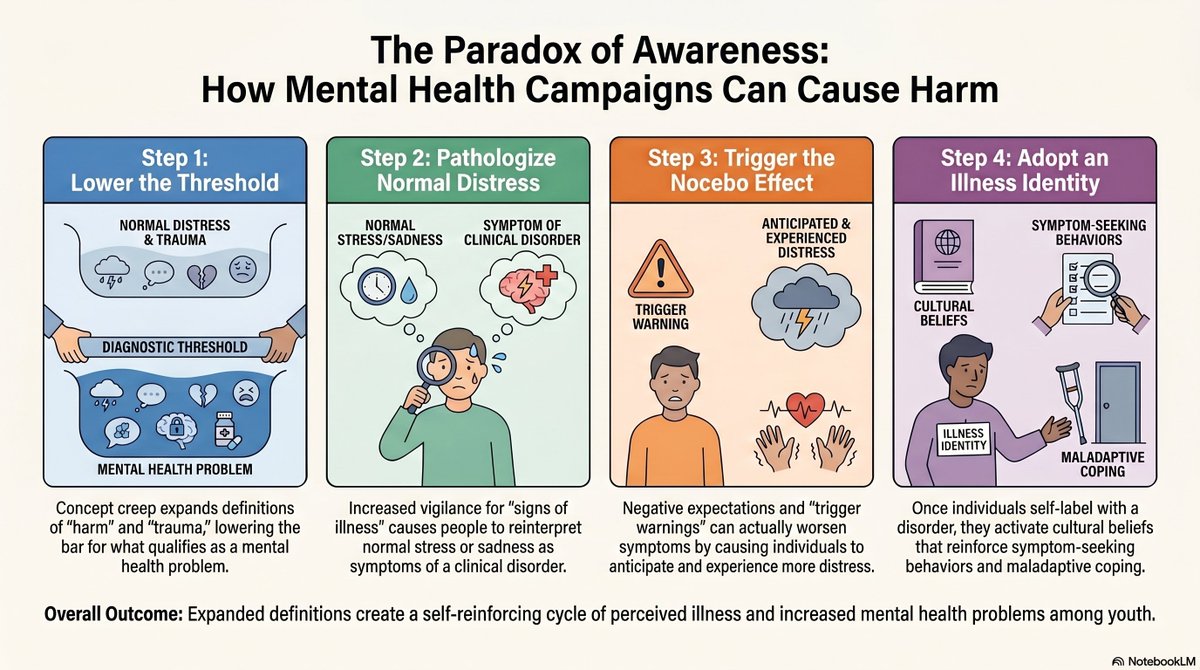
Imagine a 19-year-old scrolling TikTok. She watches a creator list five "signs you have undiagnosed anxiety." She recognizes three in herself. By the end of the week, she's describing herself as anxious to her friends. A month later, she's avoiding situations she used to handle fine. What went wrong? In a new paper by my PhD student Dasha Sandra, titled "Why mental health awareness can harm: Converging explanations for a societal problem", we argue that well-meaning mental health awareness can backfire, and we identify how. Four separate literatures (concept creep, nocebo effects, prevalence inflation, and illness self-labeling) have been circling the same problem from different angles. We show they converge on three mechanisms: 1.Awareness lowers the threshold for what counts as a disorder. 2. It trains people to scan their inner lives for symptoms and reinterpret normal distress as pathology. 3. Once someone adopts an illness identity, they behave in ways that confirm and deepen it. The evidence is wide. Learning that loneliness is harmful makes solitude feel worse. Learning that stress is harmful worsens well-being and performance. Awareness videos about fake conditions like "wind turbine syndrome" produce real headaches. Trigger warnings raise anticipatory anxiety without reducing distress. This does not mean awareness should stop. It means awareness can have unintended consequences, including manufacturing the suffering it tries to prevent. Inoculating people against these mechanisms works, and we already have evidence it does. Link to paper: michael-inzlicht.squarespace.com/s/The-psycholo…
Michael Inzlicht tweet media
English
235
1.8K
7.5K
532.5K
blank retweetledi
Ismael Sanz
Ismael Sanz@sanz_ismael·
Universidades del Reino Unido están enseñando a los estudiantes cómo leer un libro largo. 📚 Nuevos cursos de “reading resilience” buscan ayudar a jóvenes acostumbrados a textos cortos y móviles a concentrarse en novelas extensas y análisis literario. THE TIMES
La caída del interés por Literatura Inglesa ha llevado a universidades a cambiar su enfoque: menos solo teoría y más habilidades como leer críticamente, escribir blogs o hacer podcasts sobre libros. 📖🎧 La lectura profunda vuelve a enseñarse en clase. thetimes.com/uk/education/a…
Ismael Sanz tweet media
Español
51
1.5K
3.2K
146.9K
blank retweetledi
Radiohead videos
Radiohead videos@raradiohead·
Radiohead Black Star (acoustic Stockholm,1995)
Svenska
0
170
701
28.1K
blank retweetledi
Xiaoyin Qu
Xiaoyin Qu@quxiaoyin·
I have kids. I work in AI every day. And honestly? I have no idea what their careers will look like in 15 years. But I know what will carry them through. First, and this might sound unromantic: make money and save it for them. We can debate educational philosophy all day, but the world is changing so fast that financial security might be the most practical gift we can give. Buy some gold bars. Seriously. Second, nurture their imagination. AI rewards people with initiative and wild ideas. The kid who daydreams, who asks weird questions, who wants to try ten things at once? That kid will thrive. AI can execute. AI can be disciplined. What AI can't do is dream up something nobody's thought of before. Third, build resilience. There are no more iron rice bowls (guaranteed lifetime jobs). Any stable, predictable job is exactly the kind of job AI will learn to replace. Our kids will likely switch directions many times in their lives. Learn something new, get replaced, pivot, repeat. It's more like being a hunter than a farmer. Schools don't teach this. Schools teach you to follow a linear path: high school, college, grad school, stable job. That linear path is becoming the most dangerous one. Last, invest in their ability to connect with other humans. Not networking. Not schmoozing. Real emotional connection. Building trust, offering support, making people feel seen. As AI handles more of the rational, analytical work, the human ability to genuinely relate to other humans becomes more rare and more valuable. I don't have all the answers. But I know that imagination, resilience, and genuine human warmth aren't going out of style anytime soon. #AI #Parenting #Education #FutureOfWork
English
302
1.1K
6.8K
595K
blank retweetledi
jorge cm
jorge cm@joan_cm·
“The radio sucks balls The radio sucks balls The radio sucks balls I don't relate to Any of the music they're playing at all” Orange Juice Stanley Brinks & The Wave Pictures
English
0
1
2
435
blank retweetledi
John Vining
John Vining@__vining·
Introducing a new, stupid website to find a piece of classical music whose duration most closely matches that of your next trip. busundreu.com
John Vining tweet media
English
58
1.6K
12.5K
460.7K
blank retweetledi
Dr. Dominic Ng
Dr. Dominic Ng@DrDominicNg·
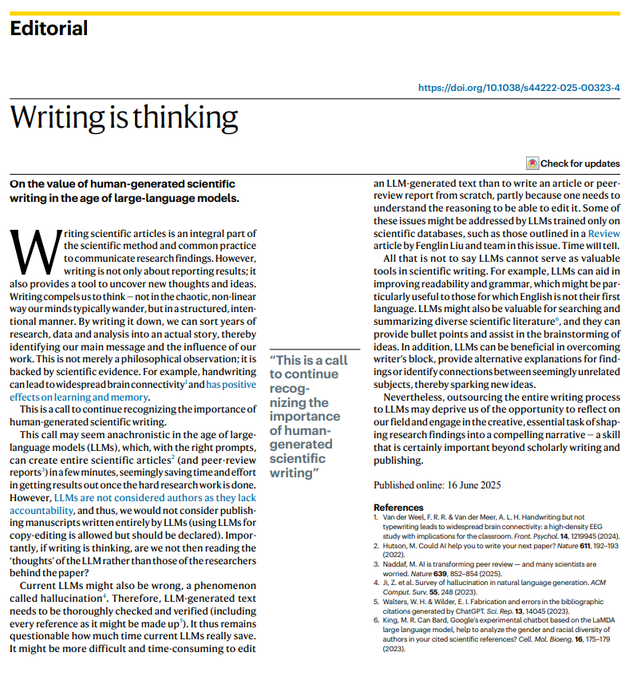
Writing forces your brain to coordinate memory, reasoning, and meaning-making simultaneously. Every time you write, you rewire toward clearer thinking. Every time you let an LLM do it, you rewire toward consumption.
Dr. Dominic Ng tweet media
English
190
4.3K
18K
615.2K
blank retweetledi
Santa Fe Institute
Santa Fe Institute@sfiscience·
How can we best learn about the world? A new paper applies the scientific method to itself, finding that some common strategies that scientists consider gold standards for designing experiments perform worse than random choice. In other words: random exploration may produce better theories than carefully-planned experiments. “These results contradict some common intuitions about the scientific method,” says lead author and SFI Complexity Postdoctoral Fellow Marina Dubova (@dubova_marina). santafe.edu/news-center/ne…
Santa Fe Institute tweet media
English
22
94
391
22.4K
blank retweetledi
ℏεsam
ℏεsam@Hesamation·
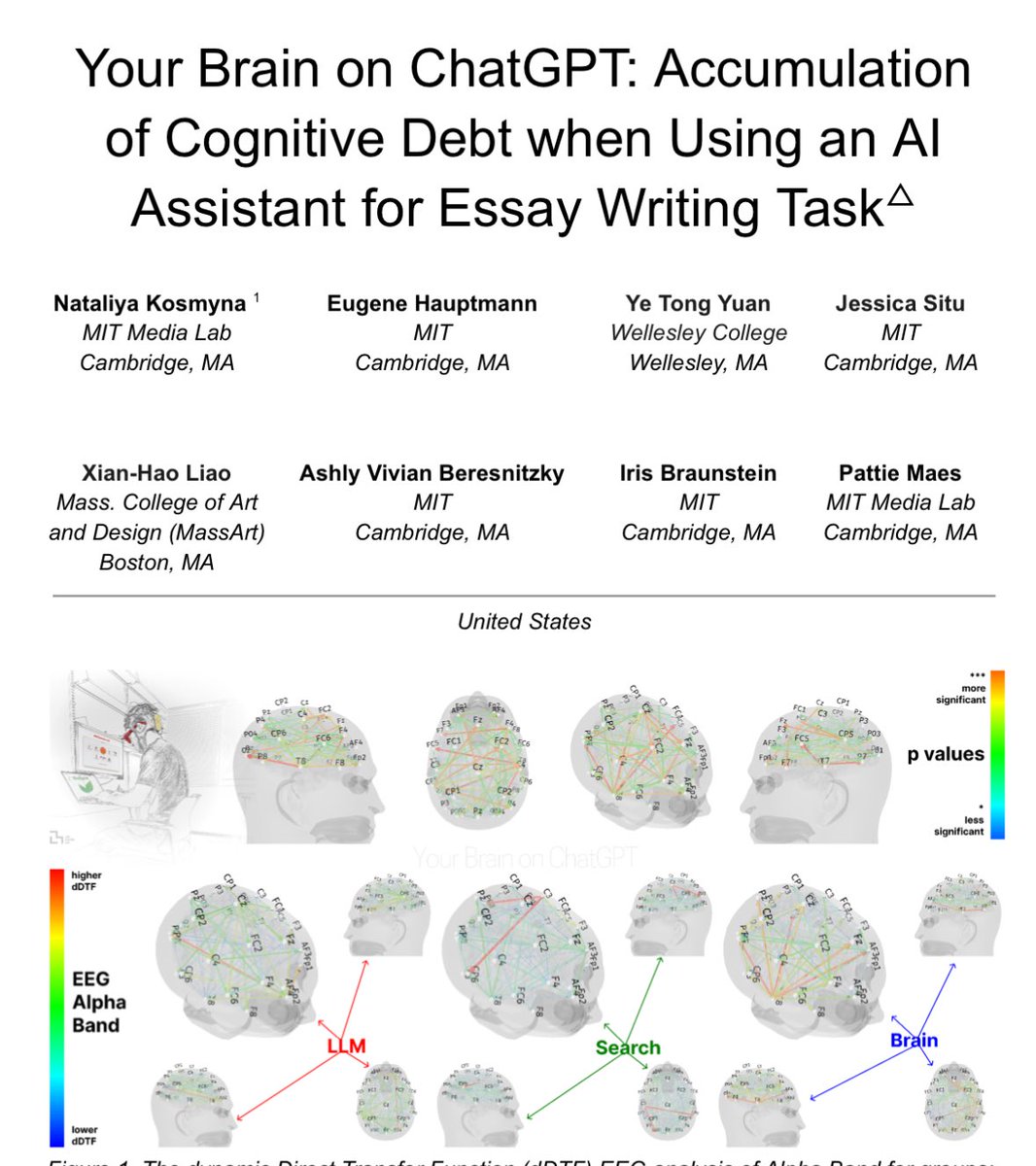
this is in fact true. MIT did a complete research on the effect of AI on your cognitive abilities and i’ve never looked at AI the same way since then: > LLM use accumulate cognitive debt > the more you rely on AI the worse you get at thinking without it > you stop exercising cognitive muscles, they grow weaker, you get lazy the goddamn thing is worse than narcotics if you really think about it. i hope this research is wrong.
ℏεsam tweet media
Wise@trikcode

Unpopular opinion. Excessive use of AI will make you dumb. Very dumb.
English
224
1.9K
10.5K
518.8K
blank retweetledi
Jay Van Bavel, PhD
Jay Van Bavel, PhD@jayvanbavel·
A new article in Nature Medicine found that social connections were a surprisingly powerful predictor of a long life. Living with a partner was roughly as beneficial as exercise. Regular visits with family or having someone to confide in also appeared to be associated with lower mortality. Loneliness also affects mental wellbeing—another factor in longevity. Happy Valentine's Day! powerofusnewsletter.com/p/debunking-bl…
Jay Van Bavel, PhD tweet media
English
55
432
2.2K
239.3K
blank retweetledi
HIDEO_KOJIMA
HIDEO_KOJIMA@HIDEO_KOJIMA_EN·
I finally bought Stanisław Lem’s “Cyberiada,” which I’d been meaning to buy.
HIDEO_KOJIMA tweet mediaHIDEO_KOJIMA tweet media
English
157
609
12K
329K
blank retweetledi
jon drake
jon drake@DrakeGatsby·
Putting more and more weighted blankets on me until finally I am pressed like a panini
English
166
23.1K
192.4K
0
blank retweetledi
Sherry
Sherry@SchrodingrsBrat·
One morning in January, I woke up and it was like a spell had been broken the way I looked around my room and saw how dull everything was, not because it was lacking but because of how full it was of stuff. Stuff I didn’t particularly love. Stuff with no serious meaning to it. Stuff I didn’t care about. Stuff that, if you had secretly tossed, I wouldn’t even realize went missing. Stuff I bought because it was trendy at the time, because my friend had it, because I had seen attractive influencers my age brag about it on Instagram, and it made me think that I could be her. So, I did a bit of Marie Kondo-ing and produced a few large bags of clothes and trinkets and stuff for donation. Standing in front of all my stuff, it hit me that all of it used to be money, and all of that used to be time. I was standing in front of the metabolic waste of my existence, materialized. I was looking at the amount of my time, therefore my life, that had been turned into garbage. And the worst part is that I could’ve prevented it. A movie scene that has stuck with me for years comes from Spirited Away, where Chihiro finds her parents turned into pigs. It’s comical to describe, but when you put yourself in her shoes, it’s terrifying: it’s every child’s nightmare to lose their parents to a force they can’t control. The panic she feels in that scene speaks to me deeply, the feeling of watching your loved ones do something that you know is wrong but being called “silly” when you try to stop them. Materialism isn’t evil; it can be gorgeous through the frames of abundance or art. Miranda Priestly’s “stuff” monologue from The Devil Wears Prada, for example, shows how material creates jobs, fuels culture, and shapes history. Miyazaki’s plates of food are dramatically overblown and colorful and delicious, but Chihiro’s parents don’t think about what they consume, only about how much. When she confronts them, her father shrugs: “It’s okay. I have my credit card and some cash.” This is the mindset that will make you waste your life away into bags of garbage: the idea that shopping is a material issue, and overconsumption is a budgeting problem, rather than a spiritual problem. It’s easy to be Spirited Away, whisked into another world operated by desires that come from ads and friends and fleeting trends. Your appetite for novelty and your fear of missing out sucks the joy out of you—the more you eat, the hungrier you are. The more you spend, the more vapid you feel. You lack spirit, not another fashion identity. You don’t need another aesthetic, you need stronger values. The title Spirited Away in Japanese is Sen to Chihiro no Kamikakushi, and kamikakushi means “hidden by the gods,” a folk belief where people mysteriously vanish into another realm. This film is about magical abduction and losing your identity. Chihiro loses her name and becomes “Sen”: to be spirited away is like being stolen from yourself, forgetting who you are under the influence of forces like greed, fear, anger—and who’s to say that emotions aren’t magical? That desires aren’t demonic possessions of the mind (“demonic” meaning “godlike divisive superfactor” in Greek)? Who’s to say that feeling horny isn’t its own kind of spell? We literally use “mania” and “craze” to describe the way people desire something: Beatlemania, the craze with Labubus, matcha being ‘all the rage’. Lust, for example, is the feeling of wanting something really badly. It doesn’t have to be a carnal desire but it’s about a possessive craving that ends in a feeling of collapse, an appetite that, once appeased, reveals its emptiness: "Lust is the deceiver. Lust wrenches our lives until nothing matters except the one we think we love, and under that deceptive spell we kill for them, give all for them, and then, when we have what we have wanted, we discover that it is all an illusion and nothing is there. Lust is a voyage to nowhere, to an empty land, but some men just love such voyages and never care about the destination." —Bernard Cornwell Shopping has this effect on me, the voyage is more satisfying than the destination. There is such thing as post-purchase clarity: the moment when you buy something trendy and you suddenly sober up to how much you don’t care about it (let alone like it); you just want to be seen having it. Spirited Away is most known for the character with the least lines: a masked ghost who can conjure gold. He has no backstory, we only know that he is banned from entering the bathhouse. Chihiro, out of kindness, lets him in. No-Face is refused service at first, but the staff quickly compromise their values upon seeing his gold. They serenade him, “Welcome the rich man. He’s hard for you to miss. His butt keeps getting bigger, so there’s plenty to kiss!” while they fight for the gold nuggets that plop out of his fat hands. Then, he devours the workers in despair when he realizes their kindness is bought, and only Chihiro is genuine. The painful part of loneliness is the realization that most people are ass-kissers and friendship is rare. Likewise, people feel the most alienated when they suddenly sober up to the fact that most of their desires are herd-driven, that most of them are no where close to the truth, if they even have a clear enough sense of what that is that matters to them. It’s like waking up from a trance state and realizing, What have I done to myself? I certainly felt this way standing in front of my garbage bags. Loneliness, alienation, addictions and self-defeating loops—these are not material problems, but ‘desire’ problems. I’m finally coming to understand what Girard meant by, “All desire is a desire for being.” We think we want things, but every desire points to a way of life, a kind of person we long to become. Objects seduce us not with their utility but with their promise of transcendence—status, attention, belonging. That’s why No-Face has no face: he is desire itself, the appetite to become, the emptiness that consumes while wishing it were someone else. Money reveals this: In Roman mythology, the temple of Juno Moneta was both sanctuary and mint (it’s where we get the words “money” and “monetary”). To strike a coin was to sanctify it with divine authority, so it circulated as both economic and spiritual power. It still does: money organizes meaning. Fiat currency works because we collectively believe it means something—fiat literally “let it be” in Latin—its meaning assigned by our shared narrative. And because money is tethered to desire, it doesn’t just reflect value; it follows it. It’s the pull of eyes when a sports car glides down a street. It’s Bernard Arnault, CEO of LVMH, saying “when you create desire, profits are a consequence.” Shopping is not independent from the spiritual realm that strips away our names, and it’s a very literal form of kamikakushi. When we feel the weight of our limits, we start reaching toward idols to imitate, goals to chase, places to explore, people to meet. What we’re really chasing is a sense of immortality or infinity, something that lives longer than we ever will. We want to be remembered long after we’ve left a conversation, the company, the world. Desire is never about the object itself. If it were, once you acquired it, the desire would vanish. Yet, your wardrobe keeps getting stuffier while you still find yourself with nothing to wear. Desire is about what the object seems to promise us: a fuller, richer existence. This is why Marie Kondo’s “spark joy” test is great: it reframes consumption as discernment. It asks whether an object raises your spirit or weighs it down. Left unchecked, your possessions take away your freedom to be who you are. As Fight Club says, “The things you own end up owning you.” Every now and then, I feel my value system collapsing under the seduction of Alo’s knitwear sets through their windows. Overall, none of this is about “how to spend less”, it’s about the freedom to just be… you. "You are not your job, you’re not how much money you have in the bank. You are not the car you drive. You’re not the contents of your wallet. You are not your fucking khakis." —Chuck Palahniuk (Fight Club) Stronger values make you spend more mindfully because they shift the axis of desire. When you know what you worship—what you actually stand for and who you want to become—everything gets tested against that vision. Values act like a sieve: they filter out the empty cravings that come from comparison and they let through only the things that genuinely serve your spirit. Without values, desires lead you astray by following ads and algorithms and the envy of friends—a state commonly known as “being distracted”. The scariest part of Chihiro watching her parents turn into pigs is that they could’ve simply walked away. The unattended food stalls feel like a test of whether one can resist charming distractions. Like the family in Spirited Away, you’re rarely forced to follow one desire over another (until you choose wrongly, and only later realize what you’ve done, if you realize it at all). But if you aim at your highest value—placing no other gods above it, coveting nothing of your neighbor’s—you free yourself from the distractions that split your soul and can refocus your being on becoming who you want to be.
Sherry tweet mediaSherry tweet mediaSherry tweet media
English
87
384
3.8K
202.6K
blank retweetledi
Maria Popova
Maria Popova@themarginalian·
Did you know that the word "scientist" was coined for a woman? The polymathic Scottish mathematician Mary Somerville, born on this day in 1780. Here is her abiding wisdom on tenacity and the key to a flexible mind: themarginalian.org/2020/10/20/mar…
English
0
13
38
5.5K
blank retweetledi
NASA Earth
NASA Earth@NASAEarth·
The ozone hole over Antarctica is slowly recovering, according to @nasa & @noaa’s long-term record. This year’s ozone hole was the 5th-smallest on record, reaching an annual maximum extent of 8.83 million square miles on Sept. 9, 2025. go.nasa.gov/4pyV6tc
English
53
184
761
58.4K
blank retweetledi
Shungudzo Kuyimba
Shungudzo Kuyimba@shungudzo·
I hope “It’s a good day (to fight the system)” brings some joy into whatever fight you’re fighting. After all, what we’re fighting for IS joy — the joy of a life whose fullest potential can be reached without hitting, or being hit by, systemic roadblocks. Shungudzo.lnk.to/motsiTW
English
0
3
6
0