Vector databases are a scam.
Not technically, they do exactly what they say. Return the most cosine-similar string to your query. The scam is the entire industry pretending that's the same thing as relevance.
It isn't.
Search "Apple." You get the fruit, the company, the watch, and a recipe blog. Your agent picks one at random and calls it retrieval. Your customer calls it broken.
Most AI agents shipping right now are duct-taped on top of this. They demo well because demos are easy. They die in production because production is real.
@Hydra_db's Founder Nish (@contextkingceo) said the quiet part out loud — "vector databases suck, similarity is not relevance" — and the demo signups haven't stopped since.
He raised $6.5M because he was the first to name what everyone in the room already knew.
If your retrieval layer is a flat embedding index, you're not building infrastructure. You're building a liability with a prettier name.
𝐓𝐈𝐌𝐄𝐒𝐓𝐀𝐌𝐏𝐒
(00:00) AI Needs Context
(01:30) HydraDB Explained
(07:41) Vector Search Breaks
(09:32) Messaging That Converts
(13:41) Writing the Viral Tweet
(16:07) Similarity Not Relevance
(20:46) POC to Production Gap
(35:35) Raising 6.5 Million Fast
(39:33) Founder Lesson on Messaging
This is a @Composio "Agents at Work" podcast, where I chat with founders building the next leap of AI.
Follow for more:)
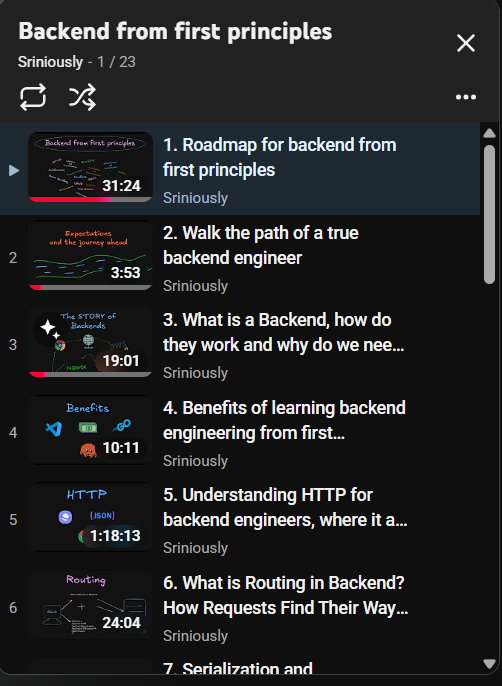
@shekhu04 lays out the mental models of backend design very well. Minimal code, its more about how and what you should be thinking when designing reliable and scalable backends.
Introducing Claude Design by Anthropic Labs: make prototypes, slides, and one-pagers by talking to Claude.
Powered by Claude Opus 4.7, our most capable vision model. Available in research preview on the Pro, Max, Team, and Enterprise plans, rolling out throughout the day.
I spin up VMs frequently and am installing and re-authenticating Claude Code on each machine. Is there a cleaner way to do this? Like simply point my locally installed Claude code to the env it is supposed to manipulate?
@trq212
Learnt this about LLM inference today:
"You might assume the bottleneck is computation — all those billions of multiply-accumulate operations. But in practice, for LLMs, the bottleneck is memory bandwidth — the speed at which you can move the model weights from RAM into the compute cores.
The compute units are sitting there waiting, starved for data, because the memory bus can only transfer so many bytes per second."
*Finally* read through @samwhoo's blog on LLM quantization.
It's incredible.
For many (even in tech) the understanding of how LLMs work stops at the surface level. Sam is helping us all go deeper, digging into the interesting facets of how AI models truly work.
Read it!
@RoundtableSpace@grok When do two agents, each running on their own terminal can prove to be advantageous from an agent coordinating with a sub-agent in the same terminal? Give examples
Someone built a way for Claude Code instances on the same machine to message each other directly.
That means agents can clarify tasks, coordinate work, and act a lot more like a team.
me (and some of my friends) are hiring soon
if you love meeting people, finding undiscovered talent before anyone else, and working insanely hard....
@ reply or DM me
If MCP supports dynamic tool discovery, which essentially avoids stuffing the context window with 100s of tool schema's, doesn't it solve the inefficiencies of MCP and make it a great option for tool calling?
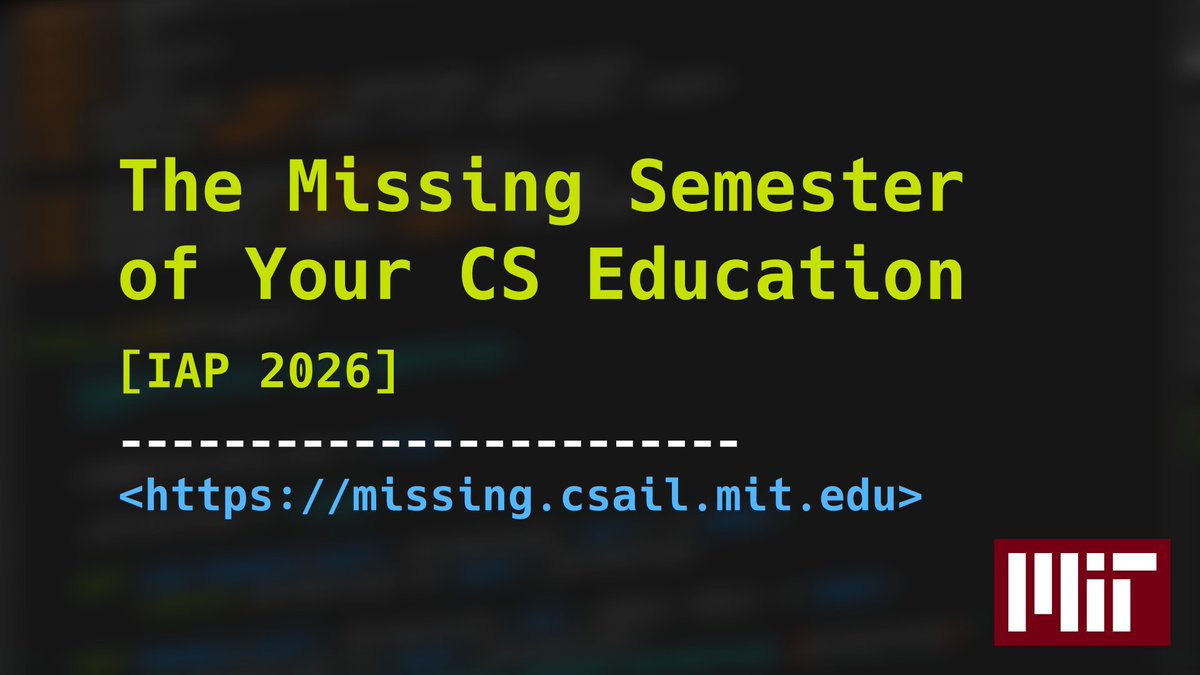
In January, @jonhoo, @jjgort, and I returned to @MIT_CSAIL to teach Missing Semester, a class on topics missing from most CS programs—tools and techniques that everyone should know, like Bash, Git, CI/CD, and AI tools. Today, we’re releasing the course for free online!