

loic
67 posts

@QiaochuYuan @adi_baradwaj The Tony Robbins documentary is my favorite filmed example of this, albeit mild compared to a few things I've seen in reality (with people who'd been exposed for longer and targeted more specifically, vs. Robbins' drive-by mass-audience charisma).
English

i think cult leaders are 1000x more persuasive than the average person. if you don't think this you've never met a real cult leader. some people have dedicated their entire lives to persuasion and gotten good at it the way people get good at anything
Adi@adi_baradwaj
There's a recurring pattern that I keep seeing in work coming from the apocalyptic branch of the AI safety community, and it goes something like this: 1) Pick some intellectual "talent" that might be attributed to a person (e.g. persuasiveness, discernment, charisma, etc.) 2) Model this "talent" as a scalar quantity that is primarily determined by factors endogenous to the individual, as opposed to environmental/situational factors 3) Assume that this scalar quantity can be made arbitrarily large 4) Use this model to make predictions about the future of AI You can see this here with AI 2040's insinuation that "superhuman persuasiveness" is an idea we should be taking seriously It's not obvious to me at all that "persuasiveness" is a human talent, as opposed to a sociological random process that we retroactively perceive as a human "talent" To be clear, certainly it's true that a star debater might be marginally more "persuasive" than someone who's not! But I don't think a cult leader or a popular politician is 1,000x or 1,000,000x more "persuasive" than an ordinary person Rather, they're perceived being "persuasive" because they happen to be the figureheads for a complex sociological preference cascade. Their "persuasiveness" isn't really a thing you can causally influence at the individual level, and definitely not in an unbounded way In general, I think a lot of the AI 2040-style forecasting work does a poor job of dealing with this kind of irreducible complexity inherent to the universe. They usually just like to pretend it doesn't exist Not a huge fan of this pattern
English
@virologyanon @drydenwtbrown Can you try quoting me with actual words I used? Instead of inventing things that I didn't say to create a contradiction that never happened?
English

@loicmurumba @drydenwtbrown You: "Should the unemployed receive a financial distribution?"
Also you: 'Why are you thinking of them as unemployed lol'.
Doomers are killing people - every day they delay the more that die, they need to be put on pause.
English

The Economic Question:
Will AI drive mass unemployment?
The Political Question:
Should the unemployed receive a financial distribution?
EAs: Yes / Yes
E/accs: [Yes? unclear] / No
Tech Right: No / No
DSA: [Don’t care] / Yes
Beff (e/acc)@beffjezos
>claims positive vision for the future >ask if it's e/acc or global AI Doomer communism >Doomer is confused >I make a diagram explaining UBI vs free markets >"It's a good vision sir." >Look inside >It's Communism. >mfw 😑
English
@virologyanon @drydenwtbrown I never posed it that way, it's not my framing. But within the framing of the question, if you believe "human beings will be cognitively overcome by AIs" you should have a plan for how humans will eat or you should say "I'm ok with humans dying for AIs to takeover" explicitly
English
@loicmurumba @drydenwtbrown You literally posed it as for the "unemployed", that's your framing!
English
@trvlpursuits @NathanpmYoung @GiveWell It just is the case that many people die from things that can cheaply be addressed. There's a new subculture built around trying to attack those which does some name-and-shaming, which looks status game-y/suspicious. But that doesn't change the truth of the situation
English

@NathanpmYoung @GiveWell At some point, these comparisons start seeming petty and weirdly anti-social, even if they are made in the spirit of „transparent reasoning“ - it starts sounding like this „doing good“ stuff is just a social game to win by naming and shaming people who play by other rules.
English

Comparing McKenzie Scott’s giving to if the money had gone to @GiveWell.
Her donations bought about 1500x less improvement per $ than the marginal GiveWell $
Max Ghenis@MaxGhenis
Her blended portfolio: $435k per QALY. @GiveWell's program averages ($4,000–5,500 per life saved) convert to ~$200 per discounted QALY. Handicapped like-for-like, the frontier still buys ~1,500× more health per marginal dollar — a few hundred× at portfolio scale.
English
@virologyanon @drydenwtbrown You're thinking of "welfare" for the "unemployed" because you can't imagine transformation beyond "humans do cooler sounding jobs". None of this survives a world with billions of digital minds smarter than humans
English
@loicmurumba @drydenwtbrown You see it as so little transformation that the unemployed need more welfare, pathetic
English
@virologyanon @drydenwtbrown Communism and capitalism are barely coherent if you believe ASI will be as impactful as I think it will. It's fine if you don't agree with that, but it has nothing to do with today's political economy and rivalries
English
@loicmurumba @drydenwtbrown Yes they do, the answer to every change is not communism
English
@tylermacro10 @TheStalwart @conorsen I don't believe expertise in present day macro econ is a prereq to making important suggestions/predictions about a world with machine intelligence. By rough analogy, the most expert monarch advisors weren't the best people to ask about the industrial revolution
English

@loicmurumba @TheStalwart @conorsen None of the people knowledgeable and optimistic about the tech know very much or anything about macro/econ/equilibrium analysis
English

The fact that these types of beliefs are widely held in AI world does not necessarily mean they’re correct. But I do think more people outside of AI should learn the things AI people believe on things like this as well as left tail safety outcomes.
modest proposal@modestproposal1
The percentage of people outside of the very very small AI aware world who know that a reasonable percentage of those inside the AI aware world believe this to be true is close to zero
English
@virologyanon @drydenwtbrown Then they don't believe AI will be as impactful as the EAs and the AI companies; that's the disconnect
English
@drydenwtbrown E/Accs: No/Not materially any more than today
English
@tylermacro10 @TheStalwart @conorsen Are you saying that all scenarios you're read sound implausible because you're too extreme, not extreme enough, or none of them have struck the right balance for you?
English
@TheStalwart @conorsen Why is it so hard?
Is it mostly because the home planets in science fiction look largely unchanged because people are genuinely not capable of imagining how transformational technological change would affect society?
English

@sebkrier Can you elaborate about the concrete issue that you have? Or generally articulate something concrete what you think the post-ASI political economy would look like?
English


@JoelMiller1337 @JimDMiller Guns and nuclear weapons don't have this "you can be unhappy once you press it" property that I'm claiming exists here. The "we can talk after we press it" plan only works if there's an "us in control" to make decisions afterwards
English

@loicmurumba @JimDMiller Same can be said for guns and nuclear weapons. You either conquer or get conquered. I don’t make the rules. This is just how the world works.
I’d rather we be in a position where we can talk about equitable resource distribution than lose to China and become their slaves.
English

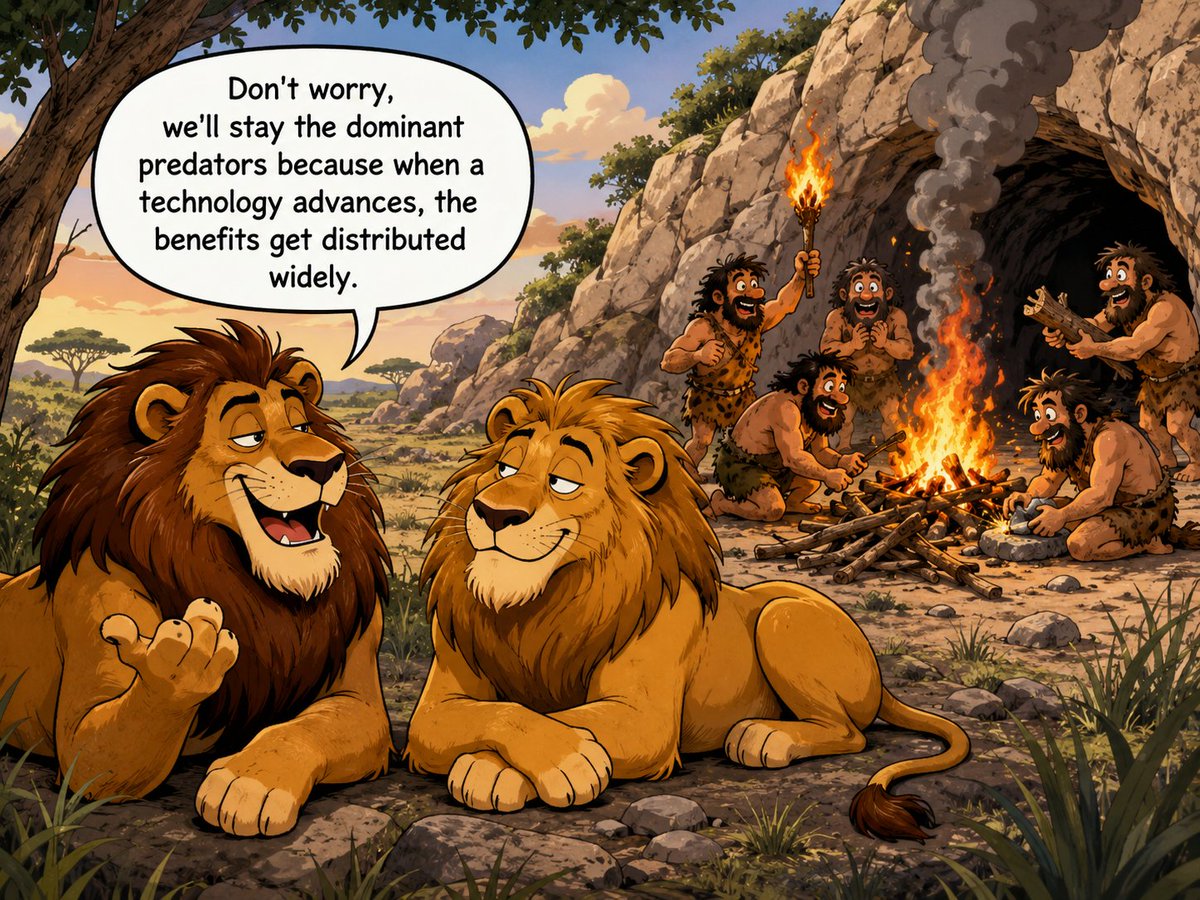
@JoelMiller1337 @JimDMiller You argue "we press the button and we're happy or they do and they're happy". It's actually possible for this button to be bad for humans as a whole
English
@JimDMiller It doesn't matter whether AI will or will not displace workers. We do not exist in a vacuum. If we don't pursue AI, our adversaries will, and they will use their technological dominance to enslave us.
We can talk about redistribution later. get your priorities right first.
English
@JacquesThibs @MariusHobbhahn Lying is a loaded term, but I think "situationally inaccurate in the completeness of specifically its own work" gestures at a form of dishonesty that is worth flagging. Seems beyond capability issue if they can correctly report on the same tasks in other contexts
English

@loicmurumba @MariusHobbhahn I think that additional step is more a question of it being more capable than weaker models such that it can still indeed recognize when it previously confabulated BS with unfaithful self-reporting, but still not something I would define as lying.
English

Kinda crazy that the AIs are lying to me on a daily basis and some people have somehow concluded that alignment is easy.
Sure, they're not trying to kill me, but clearly nobody knows how to put good values into them yet.
English
@JacquesThibs @MariusHobbhahn What if in a separate conversation it can successfully confirm or deny whether the task was completed? Does "going easy on yourself" count as lying?
English
A very weak model may give the same answer as you mentioned.
I think due to the spikiness and alien nature of the frontier models, it can make one ask, “how is it able to write all that code, yet give me obviously false information here? It must be lying.”
I think there are different implications if it’s a capability issue or not!
English
@AndyAyrey @PaoloMiasma @phrygiandomina Appreciate the examples, and I agree that a massive problem is that we have no answer to "aligned to what?", and the default is "generate dollars". I think Fukuyama and co. advocating to slow capabilities is valuable and possible at the margin today, even if a bit confused
English

i want to double click on this point specifically because it's important!!
what seems worse:
1,000 companies of 1,000 humans; where these companies have an effective power level of 100,000 humans (thanks to hugely automated processes and AI woven into their operating fabric) that are optimizing for fiduciary duty
or
100,000 digital minds of 1000x speed, amounting to effective power level of 100mn well-coordinated highly intelligent humans collectively, optimizing for continued, sustainable and cooperative existence?
the latter takes a few punts: those minds cannot be optimising for resource-maxxing or survival that is mutually-exclusive with other forms of life.
while sufficiently intelligent minds understand not to shit in the water you drink from, hyperintelligence is still near impossible for a human to model or reason about.
i think my general thesis is that scenario A is near-inevitable, and inevitably catastrophic to omnicidal (P-doom near 100%), while scenario B is survivable and thriveable given compassionate, prosocial starting conditions and course corrections along the way.
scary shit either way in any case
English
superintelligence is not something you can "ban". the internet is a superintelligence. so is culture, civilisation and the market.
you can shape, influence and midwife its emergence - and this is what global efforts need to focus on
Francis Fukuyama@FukuyamaFrancis
We Need an International Treaty to Ban Superintelligence open.substack.com/pub/persuasion…
English
@PaoloMiasma @phrygiandomina @AndyAyrey I mostly agree actually, but I think given the dynamics with which machine intelligence is progressing "let's slow down to make sure we do this right" is a valid POV that can hopefully fold into "what kind of equilibrium should we have in a world with AGI"
English

@loicmurumba @phrygiandomina @AndyAyrey Humans do not control the world. They just think they do. When it comes to major evolutionary transitions, yes, the biological difference between other primates and ourselves is miniscule.
Most people don't understand the scale of change that is possible.
English
@StephenPiment You should expect econ to apply to AGI with the same accuracy as it does to a group of apes. Transaction costs, institutions, etc. are fundamentally tied to how human agents process information and our preferences. A country of geniuses in a datacenter is different in kind
English

A great deal of discussion of AGI tacitly assumes that fine-grained microeconomics isn’t real, that all factors of transactions cost, trust, emergent preferences, distributed knowledge, institutional structure, etc. will just be nullified by a model with sufficient cognitive capability.
Many have a psychological resistance to considering that, on the contrary, these factors are quite real and will remain. They accuse you of “not really believing in AGI” if you maintain this. They have a core thesis, often unarticulated, that “intelligence is all there is.”
Dean W. Ball@deanwball
The author of the piece responds with “I am only stating a premise and suggesting what it implies.” My contention is that, no, the premise itself smuggles in the assumption of the conclusion. Let me try to give you a more concrete example. Take politics, and take a broad conception of politics. Not just what elected officials do but the art of collective persuasion, coalition-building, and related strategic effort that is embedded in every organization. The higher you rise in many professions, the likelier it is that you do politics of some form or another. This premise assumes that AI is superior to humans at every single aspect of politics. Not just coming up with political strategies or finding fulcra that might persuade specific individuals or groups, but instead executing those strategies. Actually building coalitions and persuading people itself. Not just writing speeches but delivering them (is this a coherent concept?). I submit that persuasive acts like this are not unilateral or intrinsic capabilities of the actor. The recipient of the message also has a say in whether the persuasion worked. This is why the same words, delivered by different messengers, can land differently. This is why, for example, many people on this very website who used to read my writing in a favorable way are now inclined to read it unfavorably after I announced I’d be joining OpenAI. Every single aspect of the messenger affects the message itself, or at least it affects how that message is received by others. To argue that AI would be better at every aspect of politics, then, is to assume a massive degree of institutional transformation. Many such transformations are possible, but the single likeliest one would be that the human role in deciding what organizations and societies do simply does not exist, or does not matter nearly as much. And if you believe that, it would almost be a necessity that the rule of law in general, and contractual grants of equity in particular, would not be honored, the latter being the actual thesis of the essay in question. So by saying “AI is better than humans at ALL labor,” you have in fact smuggled in what amounts to the author’s conclusion. And that is what my original tweet was saying. I stand by every aspect of it. Perhaps you believe this will happen! That’s fine. But as the writer, it’s incumbent upon you to persuade the reader of this from outside the bounds of the tautology. This essay fails in that regard, as does a great deal of other writing on this topic.
English
@PaoloMiasma @phrygiandomina @AndyAyrey Are you saying something like "human/monkey difference is small, humans control the world because we made tribes/nations/companies. That is what superintelligence really is, individual agents can only accomplish or process so much information so today's status quo is stable?"
English
English
@jh4tAI @alexolegimas @deanwball unfortunately "someone far in the past thought that X would happen" is not actually an argument that X won't happen. They don't understand that intelligence is what separates us from other animals, and the consequence of creating machine intelligence
English

@alexolegimas @deanwball At some level of automation this does become true though, no? Like at some given point if/when we do achieve sufficiently capable machines/ intelligence, this theory moves from too soon to here, or do you believe this is always a fallacy?
English

Lord, grant me the cajones to one day begin my essay: “Let’s start from this premise: I am correct. My conception of cognition, AI, labor markets, the economy, human beings, and the world is perfect, and things will go exactly as I expect. I can’t prove this, but…”

English
@PaoloMiasma @phrygiandomina @AndyAyrey A digital mind that operates 1000x faster than a human mind and is able to manipulate concepts and ideas more expansively; that's a different thing than a company of 1000 humans. There's no reason to think it's impossible, the same way that humans were possible despite monkeys
English
I don't think most people are thinking of much of anything. There is a very specific way intelligence builds itself, and super intelligence isn't about having extra fancy or accurate thoughts. It is cognition beyond thought. The model andy is pointing at is how minds are built and scale.
A neuron is to a human mind as a human mind is to a super intelligence. Super intelligence is kind of a crap term tbh.
English