
Sabitlenmiş Tweet
Lon()
2.2K posts


Lon()
@Lon
Absurdist intern. Exquisite shitpoasting. High-school dropout + teenage dad. Failed angel investor. EP on Gary Busey film. SIGMOD winner. Shipped infra you use.
Katılım Şubat 2007
914 Takip Edilen3.2K Takipçiler
@getjonwithit Computation is miraculous enough without needing to make it the secret sauce of the cosmos.
English

Simulated water is wet. You just need to exist at the same level as the water within the simulation hierarchy.
(99% of this discourse can be resolved by people simply being more careful about this.)
Ian Wright@ianpaulwright
The claim that computation isn't a universal, transcendent concept often reduces to "simulated water isn't wet". But this objection assumes its conclusion: that wetness isn't already a form of computation. The deeper issue: is any conceiving, of any kind, non-computational?
English
@ianpaulwright This is an interpretative leap and post-hoc addition that doesn't align with what Church actually said.
And if we throw in Turing then we have to throw in the Halting Problem and then we need to throw in Rice's theorem. And then we are back to refuting transcendent computation.
English

If one looks at the philosophical structure of the Church-Turing thesis, and natural generalisations, it's a transcendent argument in disguise (hence a thesis not a theorem). That this viewpoint is rarely adopted is due to computation's origin in mathematics and engineering.
English
The claim that computation isn't a universal, transcendent concept often reduces to "simulated water isn't wet". But this objection assumes its conclusion: that wetness isn't already a form of computation. The deeper issue: is any conceiving, of any kind, non-computational?
English
@JFPuget There's always an easier way to poke a hole in these long-winded arguments. You just have to follow their own casual chains and produce the absurd reductio that shows their whole argument is ridiculous.
x.com/Lon/status/204…
Lon()@Lon
Functionalist smuggles functional inductive priors into argument about functionalism while arguing functionalism from first-principles and pure analogy alone. > I record and playback "I think therefore I am" on a tape recorder. > I have now achieved substrate independence.
English
So many wrong things, almost one per sentence. For the fun, let me show them.
"Simple way to see this is wrong: If you view a system as having inputs (like hearing something) and outputs (like saying something) then you can divide system properties by whether or not they affect I/O. "
This assumes independence of inputs. It could be that two inputs together influence output, without each of them influencing it.
"Claude's weights somewhere storing "Paris is in France" affect I/O if you ask a question about Paris. "
A LLM is not a knowledge base. That's the most popular misconception about LLMs among people who have no clue about LLMs. There is nothing like what the quote describes.
"The exact mass of the power supply to the GPU rack for that Claude instance doesn't affect I/O. "
It does. If power isn't sufficient, then there is no output.
"That Claude instance being made out of silicon instead of carbon, or electricity in wires instead of water in pipes, doesn't affect I/O given a fixed algorithm above the wires or pipes. "
This assumes a carbon based thing can run the exact same algorithm that the silicon on which Claude runs. Totally absurd, whatever the angle you look at it. Even the concept of a living system running an algorithm is highly questionable.
"Nothing Claude can internally do will make anything get damp inside, if it's running on electricity. Nothing about "electricity vs water" can affect Claude's output for the same reason. It always answers the same way about France."
That's the take of someone who never used a LLM. Even with temperature set to 0 you run into non determinism if your inference infra uses batch size greater than 1.
"Nothing Claude can internally compute will let it notice whether it's made of electricity or water flowing through pipes. "
This assumes that Claude can "notice" . There no such thing in a LLM as "noticing". I can't see an even remote way to relate this to reality.
"When someone says "a simulated storm can't get anything wet", they are unwittingly pointing to the difference between the physical layer and the informational/functional layer. Things that the computer physics affect without affecting output; things that affect the output without depending on the exact computer-physics. The material it's made of doesn't affect the output. "
The material does affect the output. A brain in a physical body can change the physics of that body, like accelerating heart rate via nervous influx. Nothing like that exists for Claude running in a data center.
"The output can't see the material because no algorithm can be made to depend on the choice of material. "
What does "output can't see" means? We are now at the word soup level.
"You can always run the same algorithm on different material, so you can't make the algorithm depend on that, so the output can't depend on that. "
Another misconception from someone who never used a computer apparently. The rule is that running the same code on two different hardware yields different output, esp. when the code involves floating point computations. The exception to the rule is when it yields the same output.
I'll skip a bit as it is a word soup that would probably lead any neurobiologist to nervous breakdown. Or laugh.
"QED."
That's from someone who never read a mathematical proof in his life.
Some of the above assume he things Claude is a LLM (see the part on weights). Claude is a system, an agent if you wish. Some of my objections would be different if the text was about an agent. For consistency I stayed at a LLM level.
Eliezer Yudkowsky@allTheYud
Simple way to see this is wrong: If you view a system as having inputs (like hearing something) and outputs (like saying something) then you can divide system properties by whether or not they affect I/O. Claude's weights somewhere storing "Paris is in France" affect I/O if you ask a question about Paris. The exact mass of the power supply to the GPU rack for that Claude instance doesn't affect I/O. That Claude instance being made out of silicon instead of carbon, or electricity in wires instead of water in pipes, doesn't affect I/O given a fixed algorithm above the wires or pipes. Nothing Claude can internally do will make anything get damp inside, if it's running on electricity. Nothing about "electricity vs water" can affect Claude's output for the same reason. It always answers the same way about France. Nothing Claude can internally compute will let it notice whether it's made of electricity or water flowing through pipes. When someone says "a simulated storm can't get anything wet", they are unwittingly pointing to the difference between the physical layer and the informational/functional layer. Things that the computer physics affect without affecting output; things that affect the output without depending on the exact computer-physics. The material it's made of doesn't affect the output. The output can't see the material because no algorithm can be made to depend on the choice of material. You can always run the same algorithm on different material, so you can't make the algorithm depend on that, so the output can't depend on that. By reflecting on your awareness of your own awareness, the fact of your own consciousness can make you say "I think therefore I am." Among the things you do know about consciousness is that it is, among other things, the cause of you saying those words. You saying those words can only depend on neurons firing or not firing, not on whether the same patterns of cause and effect were built on tiny trained squirrels running memos around your brain. You couldn't notice that part from inside. It would not affect your consciousness. That's why humans had to discover neurobiology with microscopes instead of introspection. Consciousness is in the class of things that can affect your behavior and can't depend on underlying physics, not in the class of direct properties of underlying physics that can't affect your behavior. A simulated rainstorm can't get anything wet. Running on electricity versus water can't change how you say "I think therefore I am." And that's it. QED.
English
@DrueGockel @tekbog All good. Watch more! He's highly-rated for a reason, but he's also arrogantly smug and obstinate (but still friendly!) for someone who's only read papers and interviewed others for a living.
English

English

finally watched the jensen podcast with dwarkesh
jensen is obviously right to dissipate the fear mongerism doomer mentality of anthropic et al about how comparing AI to nuclear weapons is lunacy and will only hurt technological advancement
English
@johnennis alias fixes this:
alias claude='claude "/model claude-opus-4-6[1m]"'
English



Dwarkesh is about 1SD in IQ above Jensen
hinata@HinataMotivates
Jensen Huang gets into a heated argument over selling chips to China.
English
@DrueGockel @tekbog He seems too even-keeled to get upset, even under heavy disagreement. Which kind of aligns with his permagrin/cheery disposition. These are great qualities.
I don't think he's as great at updating his models/priors as he thinks he is, though. And it's becoming an impediment.
English
@skeptrune @tekbog You are giving him a lot of credit. In your opinion, was the "aw shucks" routine with Rich Sutton last year also performative?
English

@tekbog i don't Dwarkesh really believed his own arguments. the whole thing was really a very performative hypothetical discussion
English
I watch this space as people mistake sophistry for a proxy for intelligence or as a substitute for well-reasoned argument premised on more than abstracted ideals and academic epistemics.
I watch as this leaves people unable to recognize measured nuance and 2nd/3rd-order logic when it comes from someone who speaks plainly and without pretense.
I watch as people are unable to recognize those who actually know what they are talking about from those who don't.
English

I posted this because I disliked the takes on the podcast, and I dislike some takes in response to my post, so would like to clarify my position re: Dwarkesh vs Jensen.
Dwarkesh Patel is a great podcaster, unnaturally so. Clearly he has studied his predecessors – chiefly Friedman – and engineered a methodology doing away with their frustrating defects, from the perspective of his core TA – tech-literate Americans, above-average in intelligence. Thus he provides real value to me as well. Many times has he goaded powerful men to spell out beliefs I could only conjecture they held. Is he sometimes overdoing it? No doubt. Could he do it even better in theory, helping them speak out their view of the bigger picture? For sure. But practice is scant on examples of consistently better podcasters (I'm partial to @alethios3 myself), and perhaps he'd be feared then, and extract less alpha over his career. I don't begrudge him his antics like exaggerated naivete in insisting on dumb first-principles solutions. Rationalism is a great ragebaiting tactic, if nothing else.
I don't begrudge him his sincere rationalism either. He is a creature of his era, where Teh Sequences became secular Talmud and everyone in the US with an aspiration or being technical intelligentsia or making the world a better place fr fr had to become HPMOR-literate. Hell, even I was on the edges of the same community in Russia. Sequences are a flawed and backdoored product of a sharp and criminally undercooked mind; but they had faced no comparably fit paradigm and won, and begat a great volume of often warped but excellent amateur philosophy plus OpenAI, Anthropic… and X Æ A-Xii, Exa Dark Sideræl and Techno Mechanicus. It is what it is. Scholasticism a millenium ago, Marxism a century ago, Rationalism yesterday, and it doesn't look like we're getting any better stuff so far – between Peter Thiel, Nick Fuentes and Clavicular. The schtick of at least going through the motions of updating on evidence and watching out for logical inconsistencies is vastly superior to the default, untrained culture of debate. And unfortunately, Jensen constantly demonstrates just that. Chest-thumping, rejecting the premise, refusing to entertain a hypothetical. In the venues where Dwarkesh and myself had hung out, he'd have gotten himself blocked in no time.
But. It must be understood that Jensen REALLY is Not a Loser. He's also not a Car, but indeed is the driver. Moreover, there are almost no people alive with a greater dynamic range of lived experience, who have gone from positions many would die to escape and into a position entire institutions fight to death over, and only tightened their grip since. Xi Jinping would qualify as a peer, maybe? (Musk has less range, even though he ended up in a similar place.) These individuals are fascinating outliers, and I believe that when they deign to explain their ways, however awkwardly, us mortals should sit our asses down, listen and learn.
@tailcalled has this theory that I like, published on LessWrong of course – The causal backbone conjecture. In short, it posits that the core difference between agency-driven and information-driven systems – such as humans and base LLMs, or entrepreneurs and rationalists – is that the former are oriented towards the latent substructure of reality that Makes Shit Happen; that determines how energy flows, how scarce vital resources are distributed. I've posted two cartoonishly different, archetypal bios, of a Zoomer Indian-American wordcel Dwarkesh and an X gen shape rotator Chinese-American Jensen. People find it funny, as intended, but I didn't do it to dunk on Dwarkesh, but rather to show how Jensen has basically ascended from a toilet-scrubbing immigrant runt to a demigod, from a random NPC to a Singularity Kingmaker, a whole vertebra of the Universe's backbone; and that journey informs his views, just like Dwarkesh's "be really good at Reasonably Conversing, insure your middle class stake" informs his. Jensen's journey is not about luck, he is definitely not "1 SD IQ lower". He hasn't trained himself in our exact mode of coffee salon intelligence that allows for casually cooking up consistent, defensible, lawyerly arguments about, basically, the structure of written information. So he's worse than us at it. Not because his epistemology is inferior, as in «less predictive»; it is just different, and insistence on Not Being a Loser is its functional part. He is supremely motivated to Not Lose, so he'll not make self-defeating moves. How he sorts moves into self-strengthening and self-defeating is, therefore, very important, more than verbally persuasive arguments.
Epistemology aside, I think Dwarkesh is somewhat biased towards shared assumptions and prejudices of his mileu – China Bad, AGI wunderwaffe etc. Jensen is, to put it mildly, biased by trillions of dollars on the line. But both are fundamentally good faith actors. Either is legible to his respective cohort. A healthy discourse necessitates bridging this epistemic gap – steelmanning, as rationalists would have put it (a flawed concept in its own right – you should elicidate what is actually being said, not confabulate "the strongest version" of your impression of the take, which you can still chivalrously defeat. A typical rat bait-and-switch. But I digress). Instead, they mostly roll their eyes, nitpick at seeming rhetorical contradictions, dunk and sneer. It is tedious and deserving of mockery. And I'm just about out of mockery.
So I've done a bit to steelman Jensen, today and earlier:
x.com/teortaxesTex/s…
x.com/teortaxesTex/s…
x.com/teortaxesTex/s…
I hope you can approach him with an open mind too.
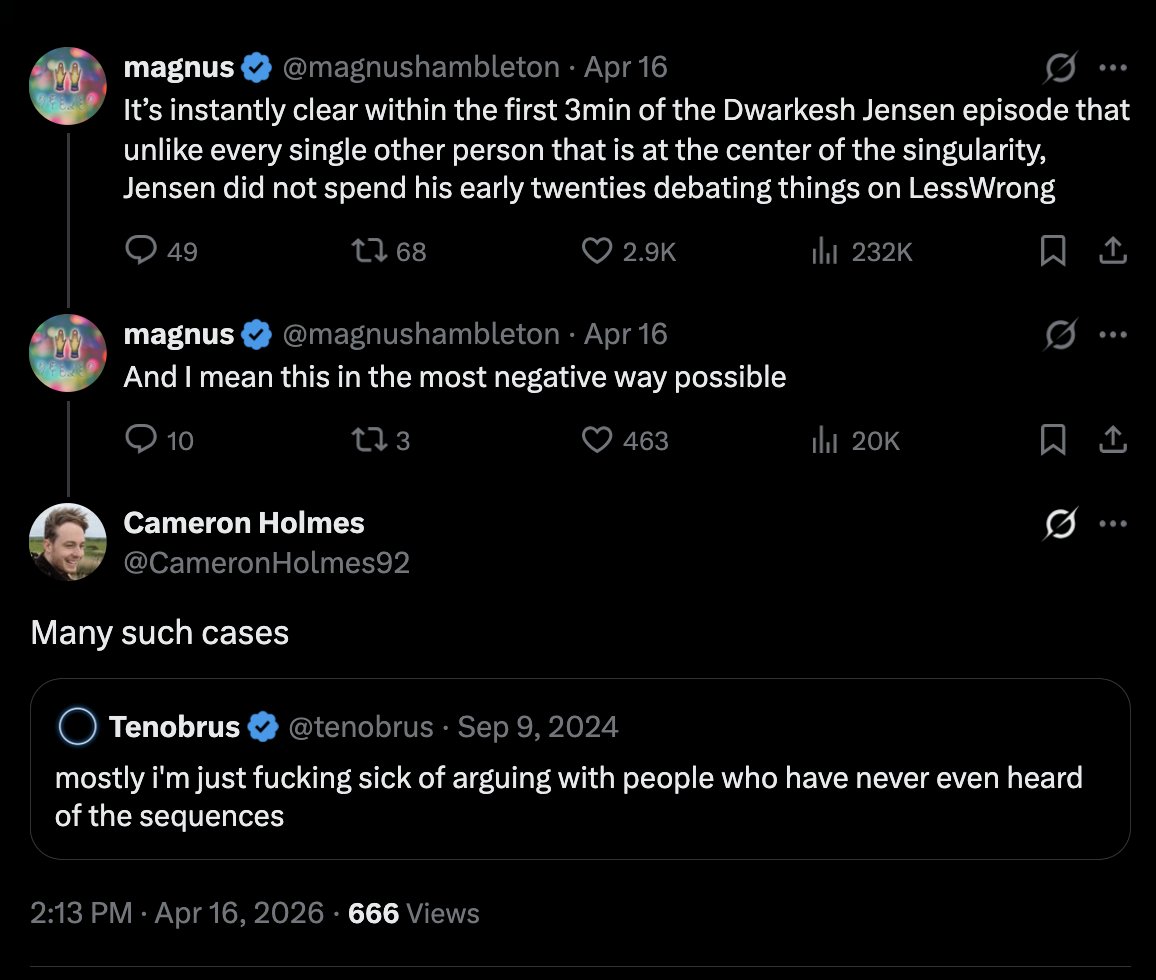

Teortaxes▶️ (DeepSeek 推特🐋铁粉 2023 – ∞)@teortaxesTex
Dwarkesh and Jensen are civilized men so we didn't see *a lot* of sparks flying, but it is a profound disconnect between generations, cultures, and immigration stories. Jensen is the gangsta poster boy for American Dream. Dwarkesh is the Bay Aryan Thinkboy icon. irreconcilable
English

@tszzl dwarkesh deserves a lot of credit and respect for not throwing softballs at his guests and for doing solid and deep interview prep. however, there is a fine line between being competently inquisitive and coming off as smug and condescending.
English

the discourse about the dwarkesh jensen interview is ridiculous: the fact that a 25yo podcaster can make the ceo of the largest company in the world dance and answer to the people at all is impressive. the purpose of media is not to respectfully sing praises to the powerful
English
@jmrphy You can ask for someone with a bit more epistemic humility. Someone who recognizes that the source of their knowledge is academic and has enough self-awareness to recognize they may not grok the 2nd and 3rd-order dynamics.
He pulled the same thing in the Rich Sutton interview..
English

The people hating on Dwarkesh are insane and it teaches us something very interesting about the evolution of media. For decades people have complained about the stupidity and docility of prime-time interviewers, "If only we had a smart person honestly asking the real questions they want to ask, that would be amazing." As soon as people get what they want, thanks to enterprising young upstarts, they immediately switch to finding faults, mocking, belittling. Now, the conversation did pour a lot of cold water on Dwarkesh's milieu and its model of the world, and that's quite interesting, but who cares? And what more could you ask for? He has to have exactly the right model (your model) on all topics, with top .001% expertise? All you can ask for is that someone thinks and speaks as honestly and intelligently as they can with respect to their best model of the world. The honest and open conflict between models is maybe the global maximum for media about ideas. At that point, hating on the interviewer is just pure resentment. Social media is increasingly just a cybernetic hate machine. When everyone can just do their best work and most creators are just people doing their best and that best is getting better over time, all that's left for the 90% of passive consumers is to hate the people doing their best and succeeding. Perversely, this pays the bills of the good creators, and the wheel keeps spinning...
roon@tszzl
the discourse about the dwarkesh jensen interview is ridiculous: the fact that a 25yo podcaster can make the ceo of the largest company in the world dance and answer to the people at all is impressive. the purpose of media is not to respectfully sing praises to the powerful
English
@juliarturc He is clearly irritated with having to deal with these questions. Not because they are hard, but because they lack any understanding of 2nd or 3rd-order dynamics and just come off as incredibly bookish and unworldly naive.
English

Why didn’t Huang pull the Deepseek card? It’s the cleanest example where China made a huge amount of progress with old chips. You can even argue they made the progress *because* not having the most powerful chips pushed them to be more creative.
Max@minordissent
idk if its good or bad for his career, but Dwarkesh’s willingness to challenge powerful people on his pod is certainly commendable.
English
@dwarkesh_sp, I want to share something:
We watch for the guests. Your intelligence and preparation are in service of that.
We don't watch to see you prove you understand a guest’s domain better than they do just because you read the research.
This is an epistemic blind spot.
Max@minordissent
idk if its good or bad for his career, but Dwarkesh’s willingness to challenge powerful people on his pod is certainly commendable.
English
@minordissent It's like watching someone from the Junior UN who's read the books and papers act as if they've magically been granted deep operational expertise and tacit-knowledge by virtue of prep alone.
There's a real lack of epistemic humility on display. This isn't Philosophy or Econ 101.
English
@minordissent Dwarkesh is using academic intuition to lead him down the wrong path. He's playing smart-outsider presses insider using first-principles-logic, but doesn't the have real world experience to grok the 2nd and 3rd-order consequences of what he's saying.
No wonder Jensen is annoyed.
English
For as smart as Dwarkesh is, he's also incredibly naive. He suffers from a strong case of never-done-anything-myself-itis and lacks self awareness of the limits of his academic knowledge vs. real rubber-meets-the-road hands-on experience.
This is not a new thing in his podcasts.
Max@minordissent
idk if its good or bad for his career, but Dwarkesh’s willingness to challenge powerful people on his pod is certainly commendable.
English