A tiny bee just did what chemotherapy couldn't.
Scientists in Australia discovered that honeybee venom can wipe out 100% of aggressive breast cancer cells in under 60 minutes.
And the healthy cells around them? Barely touched.
The breakthrough came from Dr. Ciara Duffy and her team at the Harry Perkins Institute of Medical Research, working alongside the University of Western Australia.
They tested venom drawn from 312 honeybees and bumblebees across Australia, Ireland, and England.
The target: triple-negative breast cancer and HER2-enriched breast cancer. Two of the deadliest, most stubborn forms of the disease.
The weapon: melittin. The same tiny peptide that makes a bee sting burn.
At one specific dose, melittin tore through cancer cell membranes completely within an hour. Within just 20 minutes, it shut down the chemical signals cancer cells need to grow and multiply.
Bumblebee venom, which lacks melittin, did nothing. Zero effect, even at high concentrations.
Scientists then recreated melittin synthetically in the lab and got almost identical results, meaning no bees need to be harmed to develop the therapy.
Published in the peer-reviewed journal npj Precision Oncology, the findings are still early-stage. Human trials haven't happened yet.
But one thing is clear. Nature has been hiding answers in plain sight all along, sometimes inside the smallest creatures on Earth.
Source: Harry Perkins Institute of Medical Research / npj Precision Oncology (Dr. Ciara Duffy et al.)
@Her_Nonymous_D Something similar happened to be once outside a Vietnamese food store I was walking into, but I had a different reaction to it.
I was walking in to pick up my phone in order. Homeless man asked me if I’d buy him something to eat…. cont.
“My wife was dying for most of those years,” he said quietly. “Cancer. The treatments wrecked her. I barely slept, barely talked, barely noticed anything outside getting her through another day.”
He looked down at his hands before continuing.
“Every morning when I left, I wasn’t ignoring people. I was rehearsing how to tell my kids if she didn’t make it through the night.”
My dad just stared at him.
The neighbor gave a small shrug.
“I guess after a while, people stop asking questions and decide who you are.”
Then he stood up to leave, but my dad grabbed his arm.
“Why did you help me?”
The man looked genuinely surprised.
“Because you were hurt.”
After that day, my dad waved at him every single morning.
And for the first time in eleven years, the neighbor waved back.
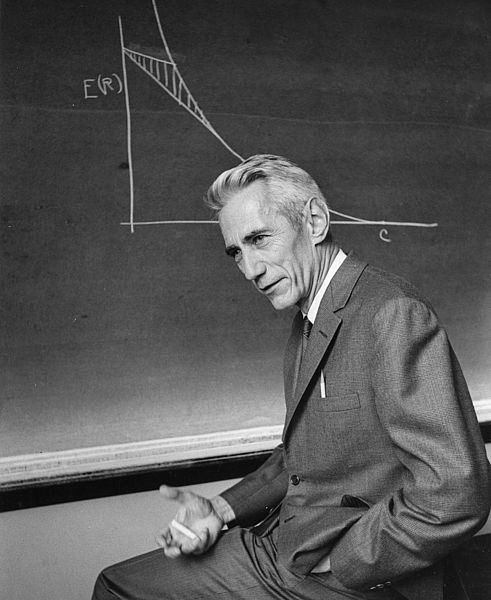
Claude Shannon invented the bit, named information theory, and laid the mathematical foundation for the entire digital age.
He is less famous than Steve Jobs.
That should bother you more than it does.
His name was Claude Shannon.
He was 32 years old when he published the paper that made everything digital possible. Every text message, photo, video, voice call, AI model, satellite signal, and internet packet running on earth right now obeys the mathematics he wrote in 1948.
Not inspired by. Not built on top of. Obeys.
The paper was called "A Mathematical Theory of Communication." Shannon invented the word "bit" inside it. He proved mathematically exactly how much information any channel could carry, and how to transmit it without error.
He showed that text, voice, images, and every other form of communication were all the same thing underneath and could all be encoded in binary digits and sent perfectly.
Before Shannon, engineers guessed. After Shannon, they calculated.
Robert Gallager at MIT called it a blueprint for the digital age. Rodney Brooks, former director of MIT's AI lab, said Shannon was the 20th century engineer who contributed most to 21st century technologies.
He published the paper. Then went back to riding his unicycle down the Bell Labs hallway while juggling.
That is not a metaphor. Shannon literally rode a unicycle through the corridors of Bell Labs at night while juggling four balls. His colleagues, some of the most brilliant scientists in America, would flatten themselves against the walls to let him pass.
He also built a maze-solving mechanical mouse called Theseus, which was the first artificial learning device ever built. He built a chess-playing machine that influenced the team that eventually built Deep Blue.
He built a robot whose only function was to turn itself off. He built a flame-throwing trumpet. A rocket-powered Frisbee. Foam shoes he used to walk across the surface of a lake near his house.
In 1952, Shannon gave a rare speech at Bell Labs about how he actually thought through hard problems.
He described three moves he used on everything.
The first was simplification. Strip the problem down until only the core remains. Most people fail not because they can't solve the problem but because they are working inside a version of it that has too much noise. Cut the noise first. Find the shape underneath. Then work.
The second was inversion.
When a problem seems impossible going forward, flip it completely. Start from the result and run backward. Shannon once designed a computing machine that seemed impossibly complex until he realized the whole thing dissolved if he ran it in reverse. The answer had been there the entire time, facing the wrong direction.
The third was restating.
Look at the problem from every possible angle. Change the words. Change the viewpoint. Reframe it until something shifts. Shannon believed most hard problems are only hard because of the frame. Change the frame and the problem becomes something else.
These were not abstract principles. They were the exact moves he used to build information theory. He spent years circling the problem of communication before that 1948 paper. Simplifying it. Inverting it. Restating it.
Until the structure underneath became visible.
The juggling was part of it too. Shannon saw no line between work and play. The unicycle and the absurd machines were not breaks from thinking. They were thinking running in a different mode. Curiosity without an agenda. The same faculty that built information theory, just pointed at something that didn't matter yet.
He left Bell Labs for MIT in 1956. Stopped publishing serious work almost entirely by the 1970s. His final paper was about the mathematics of juggling. He had an unfinished paper about the Rubik's Cube that never came out.
Colleagues worried something had gone wrong. One Nobel Prize-winning economist wrote privately that Shannon seemed to have abandoned a brilliant career.
He had finished. That is different from stopping.
Shannon died in 2001 of Alzheimer's disease. He was 84. He had spent his last years unable to remember the work that made the modern world possible.
Every AI company on earth today, every data center, every smartphone, every piece of software that has ever run on any machine anywhere, sits on mathematics written by a man who actively avoided fame, told MIT he didn't want to teach, and spent the back half of his life building machines that served no practical purpose at all.
The most famous engineers in history are the ones who sold things.
Shannon just solved the problem and went home.
That distinction is going to matter more the longer you think about it.
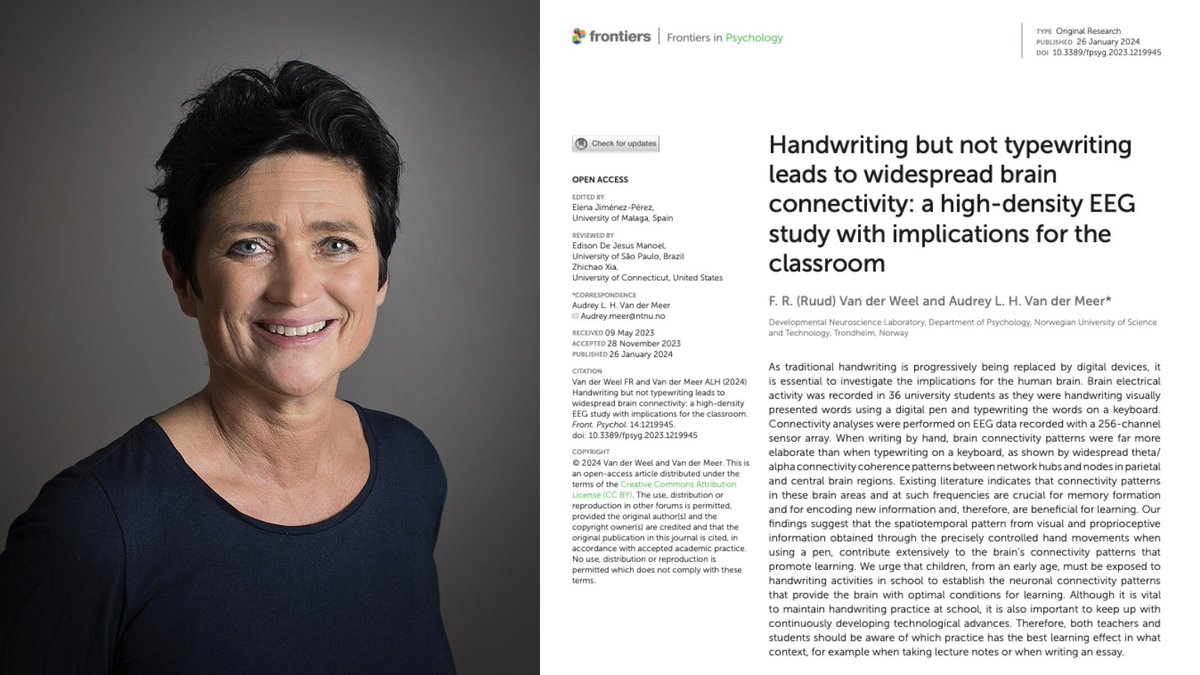
A Norwegian neuroscientist spent 20 years proving that the act of writing by hand changes the human brain in ways typing physically cannot, and almost nobody outside her field has read the paper.
Her name is Audrey van der Meer.
She runs a brain research lab in Trondheim, and the paper that closed the argument was published in 2024 in a journal called Frontiers in Psychology. The finding is brutal enough that it should have changed every classroom on Earth.
The experiment was simple. She recruited 36 university students and put each one in a cap with 256 sensors pressed against their scalp to record brain activity. Words flashed on a screen one at a time.
Sometimes the students wrote the word by hand on a touchscreen using a digital pen, and sometimes they typed the same word on a keyboard. Every neural response was recorded for the full five seconds the word stayed on screen.
Then her team looked at the part of the data most researchers had ignored for years, which is how different parts of the brain were communicating with each other during the task.
When the students wrote by hand, the brain lit up everywhere at once.
The regions responsible for memory, sensory integration, and the encoding of new information were all firing together in a coordinated pattern that spread across the entire cortex. The whole network was awake and connected.
When the same students typed the same word, that pattern collapsed almost completely.
Most of the brain went quiet, and the connections between regions that had been alive seconds earlier were nowhere to be found on the EEG.
Same word, same brain, same person, and two completely different neurological events.
The reason turned out to be something nobody had really paid attention to before her work. Writing by hand is not one motion but a sequence of thousands of tiny micro-movements coordinated with your eyes in real time, where each letter is a different shape that requires the brain to solve a slightly different spatial problem.
Your fingers, wrist, vision, and the parts of your brain that track position in space are all working together to produce one letter, then the next, then the next.
Typing throws all of that away. Every key on a keyboard requires the exact same finger motion regardless of which letter you are pressing, which means the brain has almost nothing to integrate and almost no problem to solve.
Van der Meer said it plainly in her interviews.
Pressing the same key with the same finger over and over does not stimulate the brain in any meaningful way, and she pointed out something that should scare every parent who handed their kid an iPad.
Children who learn to read and write on tablets often cannot tell letters like b and d apart, because they have never physically felt with their bodies what it takes to actually produce those letters on a page.
A decade before her, two researchers at Princeton ran the same fight using a completely different method and ended up at the same answer. Pam Mueller and Daniel Oppenheimer tested 327 students across three experiments, where half took notes on laptops with the internet disabled and half took notes by hand, before testing everyone on what they actually understood from the lectures they had watched.
The handwriting group won by a wide margin on every question that required real understanding rather than surface recall.
The reason was hiding in the transcripts of what the two groups had actually written down.
The laptop students typed almost word for word, capturing more total content but processing almost none of it as they went, while the handwriting students physically could not write fast enough to transcribe a lecture in real time, which forced them to listen carefully, decide what actually mattered, and put it in their own words on the page.
That single act of choosing what to keep was the learning itself, and the keyboard had quietly skipped the choosing and skipped the learning along with it.
Two studies. Two countries. Same answer.
Handwriting makes the brain work. Typing lets it coast.
Every note you have ever typed instead of written went into your brain through a thinner pipe. Every meeting, every book highlight, every idea you captured on your phone instead of on paper was processed at half depth.
You did not forget those things because your memory is bad. You forgot them because typing never woke the part of the brain that would have made them stick.
The fix is the thing your grandmother already knew.
Pick up a pen. Write the thing down. The slower road is the faster one.
Extremely rare “White Auroras” have been spotted over Norway—and the sky put on a show few people ever get to witness.
Photographers out chasing the northern lights expected the usual waves of green and purple. Instead, they were stunned by something far rarer: ghostly white auroras stretching across the sky.
Soft. Pale. Almost glowing.
It’s one of the rarest aurora displays on Earth.
Scientists explain that white auroras occur when multiple aurora colors strike the human eye at once, blending together until they appear nearly colorless. With so many wavelengths firing simultaneously, the brain can no longer separate them—so it perceives white.
Most aurora hunters spend their entire lives without ever seeing it. This time, Norway delivered the extraordinary.
Cameras across the Arctic captured the eerie light spilling through the darkness like frozen lightning, leaving even experienced skywatchers in awe.
Some described it as otherworldly. Others said it looked like the sky itself was glowing from within.
And for a few unforgettable moments, the heavens above Norway became something almost impossible to believe.
A medieval palace in the English countryside has a small bell mounted by a window, with a rope hanging down to the moat below.
Since the 1850s, the resident swans have been pulling the rope to ring the bell when they want to be fed. The tradition began when one of the bishop’s daughters taught it to a single swan in the 1850s, and the swans have been passing it on ever since.
The current pair, Grace and Gabriel, are the latest in the line. Each year, after their cygnets hatch, Gabriel walks them up to the bell and teaches them to pull the rope before they leave the moat to start their own lives. The tradition is now 170 years old.
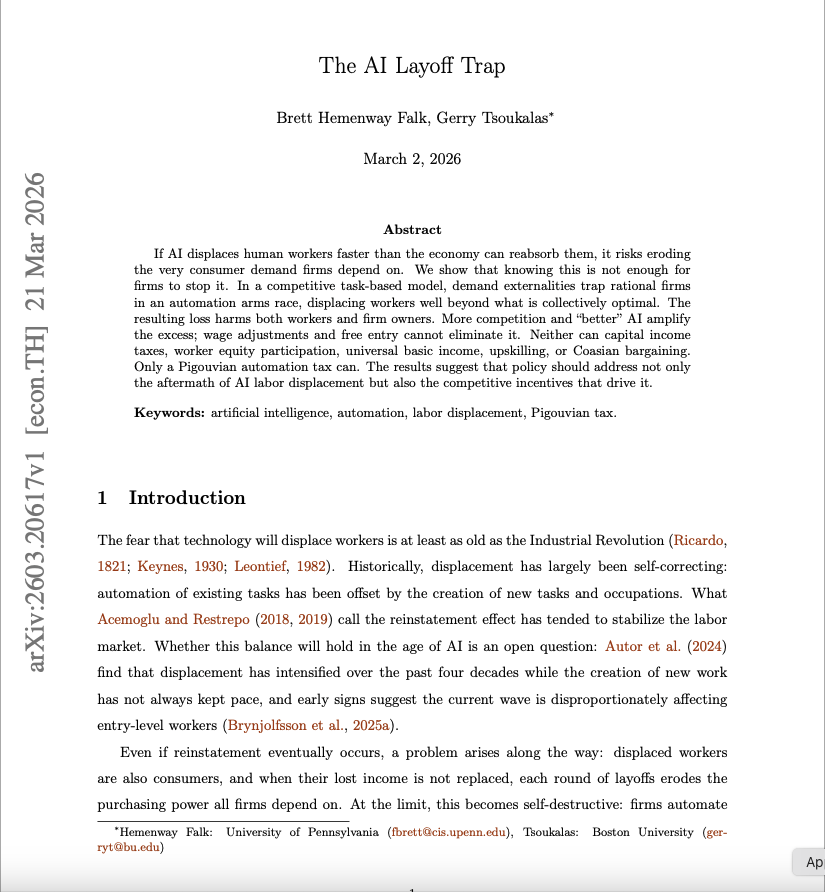
Two economists just published a mathematical proof that AI will destroy the economy.
Not might. Not could. Will — if nothing changes.
The paper is called "The AI Layoff Trap." Published March 2, 2026. Wharton School, University of Pennsylvania. Boston University. Peer reviewed. Mathematically modeled.
The conclusion is one sentence.
"At the limit, firms automate their way to boundless productivity and zero demand."
An economy that produces everything. And sells it to nobody.
Here is how you get there.
A company fires 500 workers and replaces them with AI. A competitor fires 700 to keep up. Another fires 1,000. Every company is behaving rationally. Every company is following the incentives correctly. And every company is building a trap for itself.
Because the workers who were fired were also customers.
When they lose their jobs faster than the economy can absorb them, they stop spending. Consumer demand falls. Companies respond by cutting costs — which means automating more workers — which means less spending — which means more falling demand — which means more automation.
The loop has no natural exit.
The researchers tested every proposed solution. Universal basic income. Capital income taxes. Worker equity participation. Upskilling programs. Corporate coordination agreements.
Every single one failed in the model.
The only intervention that worked: a Pigouvian automation tax — a per-task levy charged every time a company replaces a human with AI, forcing them to price in the demand they are destroying before they pull the trigger.
No government has implemented this. No major economy is seriously discussing it.
Meanwhile the numbers are already tracking the curve. 100,000 tech workers laid off in 2025. 92,000 more in the first months of 2026. Jack Dorsey fired half of Block's workforce and said publicly: "Within the next year, the majority of companies will reach the same conclusion."
Nobody is doing anything wrong. Companies are following their incentives perfectly. That is exactly the problem.
Rational behavior. At scale. Simultaneously. With no mechanism to stop it.
Two economists built the math. The math leads to one place.
Source: Falk & Tsoukalas · Wharton School + Boston University ·
arxiv.org/pdf/2603.20617
Left behind in Kabul. Alone. He waited 47 days.
K-9 Chaos was not a dog who did his job. He was a dog who had DECIDED, completely, permanently, without reservation, that Lieutenant Marcus Webb was coming back for him. No matter how long it took.
At Hamid Karzai International Airport, Kabul, on the morning of August 30th, 2021, a three-year-old Belgian Malinois sat in an empty aircraft hangar. The last American plane had left six hours ago. The evacuation was over.
Chaos had been left behind.
Not intentionally. The chaos of the withdrawal. The panic. The rush. Webb had been separated from Chaos during the final evacuation. Put on a different plane. Told Chaos would be on the next flight.
There was no next flight.
Chaos survived the first day alone. Waiting at the hangar where Webb had left him.
Chaos survived the first week. Scavenging food from abandoned military supplies.
Chaos survived 47 days in Taliban-controlled Kabul. Alone. Hiding. Waiting.
Because Chaos survived on the belief that Webb wouldn't leave him forever.
Back in the United States, Webb was losing his mind. Filed reports. Called congressmen. Contacted rescue organizations. Went on the news.
"I left my dog in Afghanistan," he said on CNN, his voice breaking. "I left my brother. And I'm going to get him back."
The military said it was impossible. Kabul had fallen. Taliban controlled the airport. No way to extract a dog.
Webb didn't care about impossible.
He contacted Pineapple Express, a veteran-run extraction operation. Gave them Chaos's last known location. Sent photos. Videos. Anything that could help.
For 47 days, Webb didn't sleep. Didn't eat properly. Just waited for news.
On October 16th, 2021, his phone rang.
"We found him," the voice said. "We found Chaos."
A rescue team had infiltrated Kabul. Used Webb's intel. Found Chaos still at the hangar. Still waiting. Forty-seven days later.
Chaos was emaciated. Dehydrated. Traumatized.
But alive.
The extraction took three days. Smuggling Chaos out of Taliban-controlled territory. Through checkpoints. Through danger.
But they got him out.
On October 19th, 2021, Chaos landed at Dulles International Airport. Webb was waiting on the tarmac.
When they opened the crate, Chaos didn't move. Stared at Webb like he was seeing a ghost.
"It's me, brother," Webb said, kneeling down. "I came back. I promised I'd come back."
Chaos stepped out slowly. Walked to Webb. Collapsed into his arms.
The reunion video went viral. Seventeen million views in three days.
But what people didn't see was what happened after.
For six months, Chaos wouldn't sleep unless Webb was in the room. Wouldn't eat unless Webb fed him. Wouldn't go outside unless Webb went first.
"He's terrified I'll leave him again," Webb said in an interview. "And I don't blame him. I left him once. In the worst place. At the worst time. He waited 47 days for me. And I'll spend the rest of my life making sure he knows I'm never leaving again."
Three years later, Chaos still sleeps with his head on Webb's chest. Still follows him everywhere.
Still making sure Webb doesn't disappear.
K-9 Chaos. Survived 47 days alone in Kabul. Extracted by heroes. Reunited with his handler. Home.
facebook.com/share/1HLX9dCv…#LostAndFound#doglover#seniordogs#animalwelfare#militarydog#k9hero#dogrescue#Kabul#47Days#LeftBehind#BroughtHome
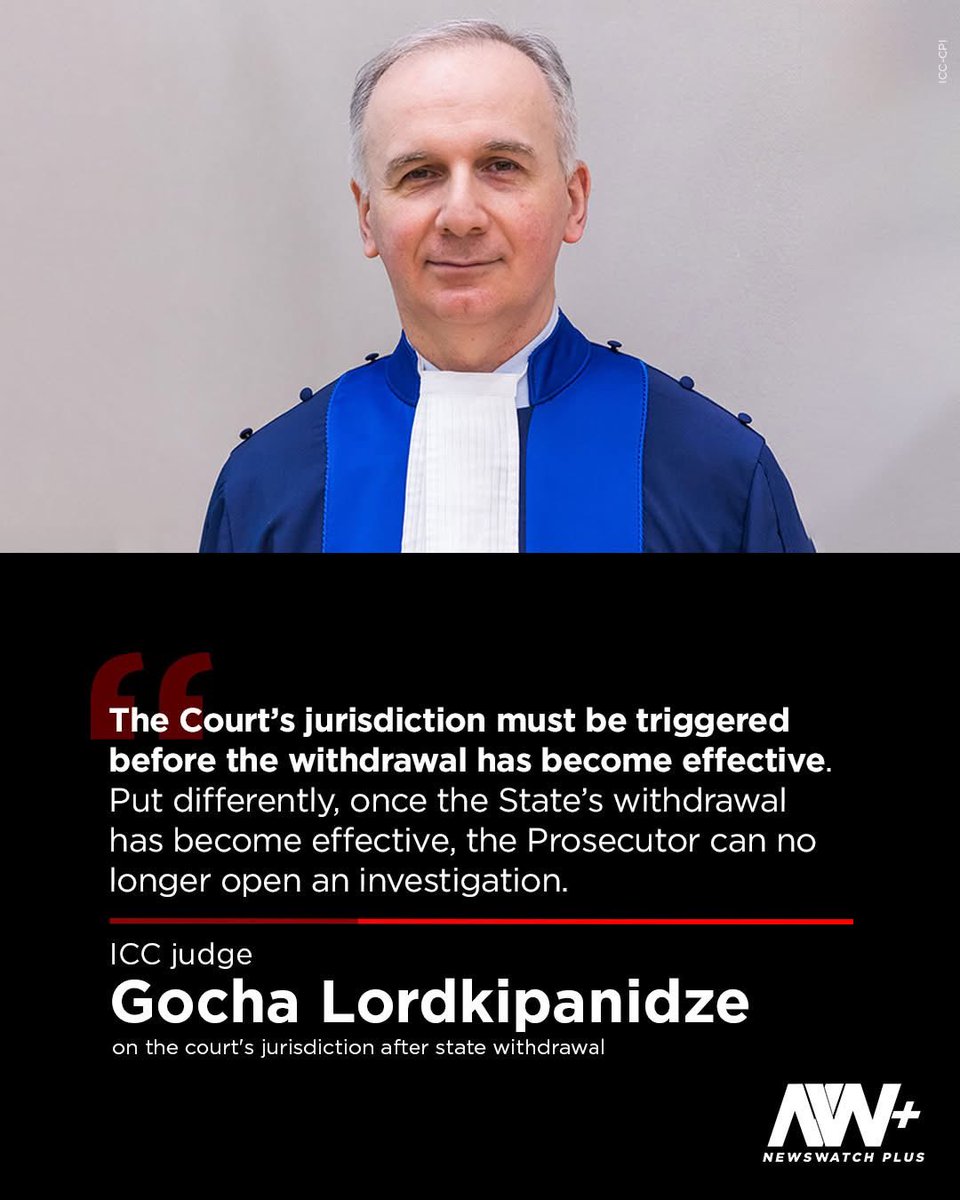
Outvoted,but not silenced.🚫
Judge Lordkipanidze argued the ICC lost its grip the moment the Philippines’ withdrawal took effect.The Appeals Chamber disagreed,but the dissent remains a powerful indictment of "jurisdictional stretch." Is the ICC rewriting the rules as they go?
A woman transporting rescue cats to their new homes had no choice but to put some in cargo. When the plane landed in Athens, Greece, she watched nervously through the window as luggage came down the ramp. Then she saw a baggage handler pick up each cat carrier slowly, crouch down, look inside, and gently talk to the animals one by one. He didn’t know anyone was watching.
His name is Archie Ardales, 32, originally from the Philippines. When asked why he did it, he said the cats were probably scared because it was their first flight. He just wanted to comfort them.
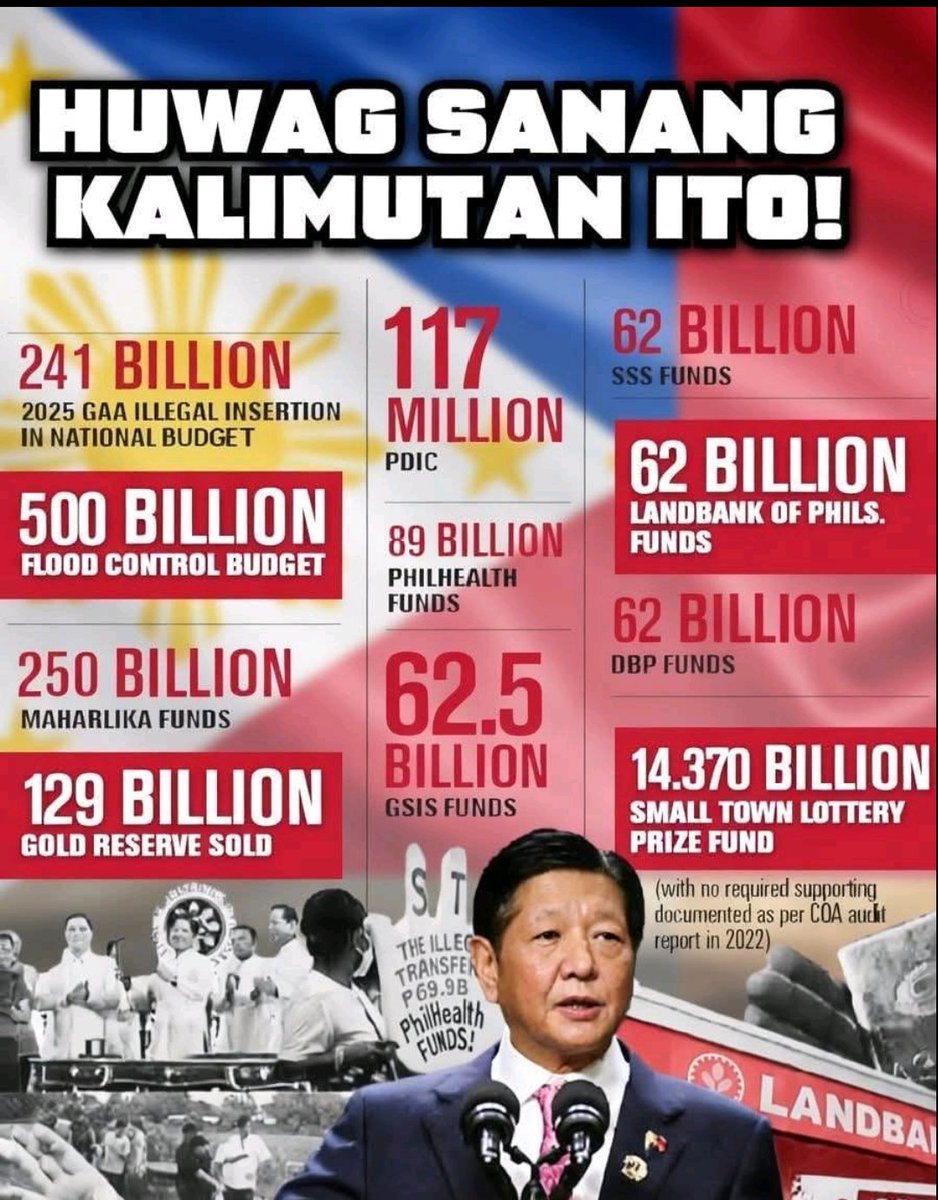
The OVP never even received a copy of the decision but the justice committee got it first.
Justice Caguoia during the PhilHealth Transfer oral arguments called out the COA commissioner for blatant conflict of interest and wearing too many hats at once.
COA Commissioner Michael Malilin was appointed by @bongbongmarcos on February 10th, 2025.
— No wonder the Notice of Disallowance came out so suddenly and suspiciously.🤷♀️
ctto Dare to Ask
The pandemic was PRRD’s acid test as a leader. In fact, he recorded arguably his highest trust and approval ratings at the heart of that crisis. Proving once more that people are realistic about their expectations of a leader. They don’t need perfection. They need POLITICAL WILL.