m0xt

2.9K posts

m0xt banner
m0xt

m0xt

@m0xt_

Analyst at @Milkroaddaily | Hunting mispriced conviction | Building @Portfolio_OS

Katılım Ağustos 2016
1.1K Takip Edilen2.9K Takipçiler
Sabitlenmiş Tweet
m0xt
m0xt@m0xt_·
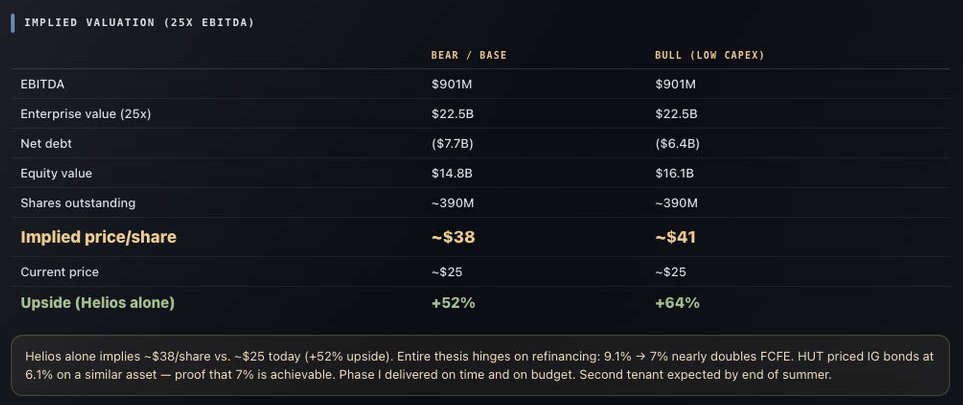
GLXY should be trading at ~$38+ just on Helios alone. I modeled Galaxy Digital's 800MW AI data center for CoreWeave. $9.6B capex, 15-year contract, ~$900M steady-state EBITDA. At 25x EBITDA (peer average for contracted AI infrastructure), Helios is worth ~$15B in equity value. That's $38/share. Galaxy trades at $25/share today. Meaning the market assigns negative value to their crypto portfolio, asset management, trading, mining, and ventures businesses. Not to mention Galaxy's construction loan is at ~9.1% (SOFR+475). If they refi to ~7% (which Hut 8 just did on a similar asset at 6.1%), free cash flow to equity nearly doubles. What derisks it: - Phase I delivered on time and on budget. - Second tenant expected by end of summer on similar or better terms. Either the market doesn't believe full buildout happens, or GLXY is significantly undervalued.
m0xt tweet media
English
9
15
93
7.4K
White Collar Exit
White Collar Exit@WhiteCollarExit·
I never ever thought in "target prices" about my investments, because they rarely really work and when they do, its mostly coincidence. But as 800VDC comes to full production, I expect this massive breakout quarter for IFX. Some great news also around them increasing prices by 15-20% beginning of July. So, much higher of the next 6-18 months!
English
1
0
1
24
White Collar Exit
White Collar Exit@WhiteCollarExit·
Infineon just made a quiet move on one of AI’s biggest bottlenecks: Power! It extends the $IFX thesis from the server rack to the entire data-center campus. (Save this) Infineon signed an MoU with LS Electric to co-develop three building blocks for next-generation DC data centers: Battery power-conversion systems, solid-state transformers, and solid-state circuit breakers. Infineon brings the power semis, controllers and software. LS integrates them into complete power systems. And LS Electric is a heavyweight, South Korea's leading data-center power supplier with roughly 60-70% of the domestic distribution market. In the clip below, Infineon President Adam White explains why solid-state transformers become critical as AI racks scale from roughly 120 kW today toward 500 kW and eventually 1 MW. At 1 MW per rack, data centers cannot simply push more power through today’s low-voltage systems. Doing so would require enormous currents, thicker copper cables, more cooling and create higher energy losses. Instead, power needs to be moved around the campus at a much higher voltage and only stepped down closer to the GPUs. That is where this MoU fits. The three technologies manage the power before it reaches the rack: → The solid-state transformer converts incoming grid power into the high-voltage DC network → The power-conversion system connects the data center’s batteries to that same network → The solid-state circuit breaker shuts down faults almost instantly to keep the system safe The takeaway is that this is a pattern that keeps repeating itself: Every few months, another piece of the AI power chain gets an Infineon partnership attached to it! You can track how I'm positioned across the 800VDC trade in Milk Road PRO. Link in bio.
English
2
3
6
978
m0xt
m0xt@m0xt_·
@KyleReidhead Uber is playing the very same strategy on AVs.
English
0
0
1
55
Kyle Reidhead | Milk Road
Kyle Reidhead | Milk Road@KyleReidhead·
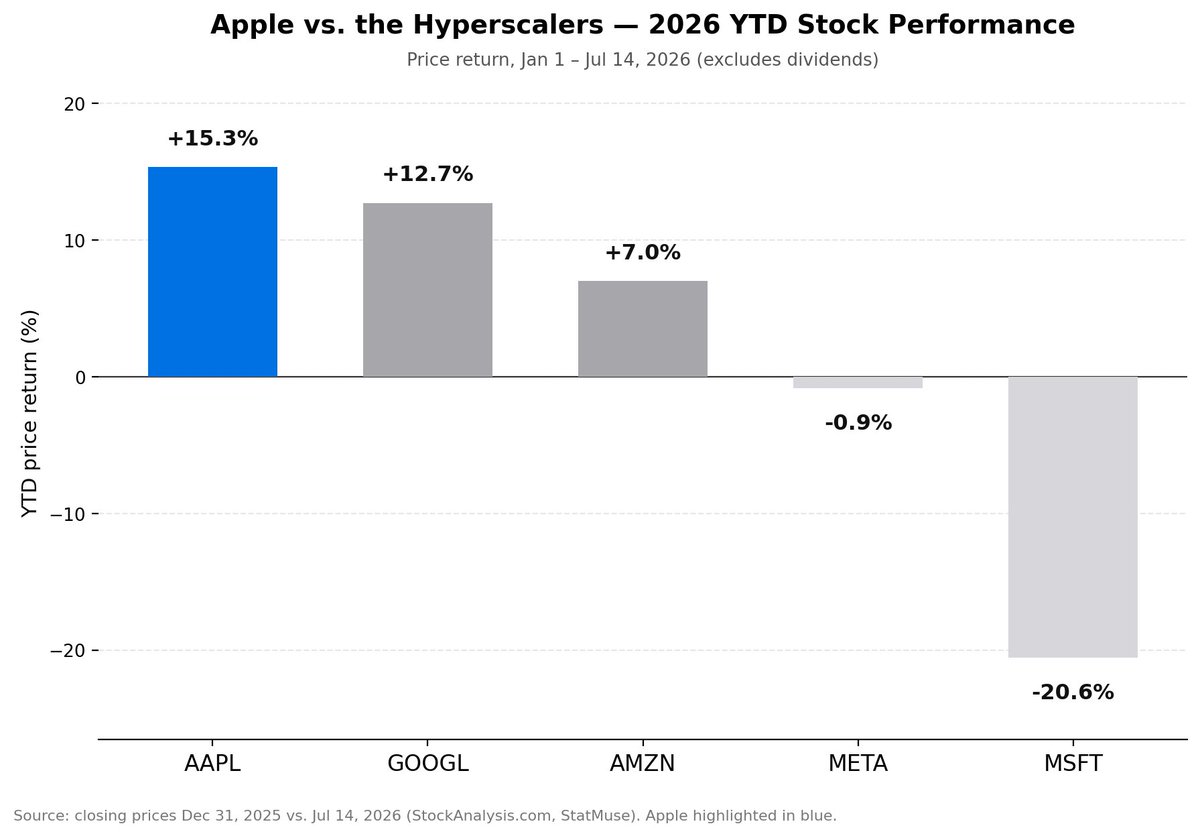
Everyone thinks Apple is losing the AI race because it skipped the AI capex But I think they are positioned perfectly to dominate AI (Save this) In fact, Apple is the best performer of the Mag 7 YTD, so the market is starting to figure it out I bought $AAPL earlier this year for the AI-demand device upgrade cycle, but I'm realizing they are positioned to dominate in something much bigger: Consumer Agents Apple just shipped App Intents, the framework that lets Siri take real actions inside any app, book something, buy something, complete a task, not just answer a question. My bet is that consumers will want to just talk to their agents without actually touching their phone "hey Siri" rather than picking up their phone, opening it, clicking on chatGPT app and then talking/typing Apple has a moat on devices with iPhone, Macbook and iPods. This is where consumer agents will be used. And because Apple doesn't have their own AI, they can become an aggregator of AI's, similar to Openrouter. Routing to the cheapest/most efficient models depending on the task plus, it can live locally on the device for privacy and speed. So Apple has spent no money on AI, yet is sitting in the perfect position to be the winner of how consumers use AI agents on daily basis. If Apple owns that layer, it gives them yet another (and likely one of their biggest) revenue streams. they become a platform that taxes the entire agentic economy, monetizing through tiered subscriptions and/or taking a cut of every transaction an agent completes inside the apps. And not only that, if the Agentic economy takes off through Apple, it will force the largest device refresh in Apple's history. Morgan Stanley says roughly 850 million iPhones can't run Apple Intelligence, and 1.3 billion can't run the new agentic Siri, out of about 1.4 billion active iPhones worldwide. Now of course, Siri is still dumb, so they have not achieved this yet. But the potential and roadmap is there. This is why I bought $APPL months ago and shared this with the members inside Milk Road PRO. I just shared a detailed update on my position inside the platform too. You can track my real-time portfolio and get all my live updates for just $1 (see link in bio)
Kyle Reidhead | Milk Road tweet media
English
10
6
25
3K
m0xt
m0xt@m0xt_·
FIGR is going to beat Q2 revenue estimates by 22%. And the EBITDA beat will be even bigger. Here is why: Revenue consensus is at $183M My estimate is $223M Figure pre-released Q2 marketplace volume: $4.26B Up 47% in a single quarter. That's $160M above the top end of their own guidance, and $300M above the midpoint Wall Street built its models on. Apply management's own guided net take rate (3.75%) to that volume, and you get $223M in revenue. At a 51% adjusted EBITDA margin, that's ~$114M in EBITDA vs. $92M consensus. A 22% revenue beat compounding into a 24% EBITDA beat. And here's the part most investors will read exactly backwards: The take rate is falling. The margins are rising. Take rate tells you what Figure earns per dollar of volume. It says nothing about what it costs to earn it. Contribution margin does. As Figure Connect (using external partners) grows from 56% to ~60% of volume, the take rate compresses. Maybe even below 3.75%. But Connect borrowers cost Figure almost nothing to acquire. The institutional partners do the marketing. So the mix shift looks like yield compression from the outside. From the inside, it's margin expansion in disguise. A business growing volume 47% QoQ. Not YoY, quarter over quarter. Running 50% EBITDA margins, guiding toward 60%. At $29.73, the stock trades at 7.4 times annualized revenue and 14.4 times annualized EBITDA on our Q2 estimates. Seven analysts cover it. The average price target is $52.86, 78% above where it trades today. The market is not pricing the earnings power this business is demonstrating right now. I've been adding FIGR to the Milk Road PRO portfolio ahead of the print. Full position and real-time moves inside ($1, link in bio).
m0xt tweet media
m0xt@m0xt_

.$FIGR dropped 9% yesterday. No bad news. The stock had ripped 20%+ the prior week, including a 13% pop on June 30 when the IPO lock-up expired without heavy insider selling. Yesterday was light volume profit-taking on an extended name. Then, after the bell, they released unofficial Q2 marketplace volume numbers. $4.26B . Up 47% from the prior quarter. Q1 was $2.9B in volume at a 49.6% adjusted EBITDA margin. A year ago that margin was 32.6%. The platform is getting more profitable as it scales, not less. They beat the high end of their own Q2 guidance by $160M! In the quarter they also closed a $300M fully prefunded securitization. Institutional capital was locked in before the loans even closed. Figure built on blockchain rails from the ground up. If you think blockchain is dead, this is the inconvenient data point. Real volume, real margins, real institutional demand. No speculative token attached to it. The market sold off on nothing. The business printed a record quarter. I have been building a position in FIGR in my Milk Road PRO portfolio over the last few months. You can track my real-time moves (link in bio).

English
7
1
12
5.5K
m0xt
m0xt@m0xt_·
Here is the Uber's CTO post: x.com/praveenTweets/…
Praveen Neppalli@praveenTweets

Agentic AI adoption is on fire at @Uber, and it's changing the way we build, not just in engineering, but across the entire company. Today, 99% of our engineers use AI tools. More than 70% of pull requests are attributed to local or cloud agents. And our engineers have built 2,500+ agent skills across the software development lifecycle. Those numbers are exciting, but they led us to a much bigger question: How do we bring agentic AI beyond engineering? Finance. Legal. Operations. Marketing. Customer Support. HR. Procurement. These functions run on complex workflows that are often manual, highly nuanced, and spread across dozens of systems. You can't automate them effectively by looking at process diagrams or documentation. You have to understand how the work actually gets done. So we created something called Agentic Pods. The idea is simple. We handpicked ~30 of our most AI-proficient engineers (people with deep knowledge of Uber's systems) and paired each of them with a domain expert from a business function. Then we gave every pod just two weeks. • Days 1 – 2: Shadow the expert. Observe every step. Document workflows. Ask questions. Build intuition. • Day 3: Prioritize opportunities based on scale, repetition, business impact, and data availability. • Days 4 – 5: Build a working agent alongside the person doing the job. • Days 6 – 9: Validate with several others performing the same work. Does it generalize? Does it actually make their job better? • Day 10: Ship. In just the past two months, we've run 16 Agentic Pods across 16 different business functions. • Capital allocation across 150 cities: 15 hours → 30 minutes. • Financial pacing reports: 2 days → 10 minutes. • Marketing web quality assurance: 2 weeks → 50 minutes. • Support workflow creation: 9,000 manual workflows → self-service automation. The productivity gains are impressive, but what surprised us most wasn't the speed. • It was how quickly engineers embedded in unfamiliar domains uncovered opportunities that had been hiding in plain sight. • The biggest wins rarely come from automating one task. They come from rethinking an entire workflow. Once you redesign the workflow around AI, you often eliminate handoffs, remove unnecessary approvals, replace legacy tooling, reduce vendor spend, and dramatically accelerate decision-making. • The workflow becomes the unit of automation - not the individual task. • The most impactful agent skills cut across teams, orgs, functions, tools, and systems. The biggest lesson? The best AI opportunities are rarely visible from the outside. You discover them by sitting next to the people doing the work, understanding every friction point, and building with them, not for them. We're now forming a dedicated team to scale this further and go deeper. They'll deeply understand the work, redesign it from the ground up, and use AI to fundamentally change how the business operates. It's exciting times!

English
0
0
0
378
m0xt
m0xt@m0xt_·
Uber's CTO posted the live proof: "We handpicked ~30 of our most AI-proficient engineers and paired each of them with a domain expert from a business function. - Days 1–2: shadow the expert, observe every step, document workflows. - Days 4–5: build a working agent alongside the person doing the job. - Day 10: ship. Capital allocation across 150 cities: 15 hours → 30 minutes. Financial pacing reports: 2 days → 10 minutes." That is not vendor software. That is Uber encoding institutional judgment into systems they own. The market punished them in Q1 for burning the AI budget. That was the experimentation phase every company has to go through before the "gains" appear. This is what the other side looks like. What the CTO just described fits exactly into the thesis below: the companies that win this decade will be the ones rebuilding around AI, division by division. That is the signal I care about as an investor. I hold UBER. You can follow my portfolio (link in bio).
m0xt@m0xt_

Starbucks is replacing Microsoft and IBM to cut $400 million in software spend. That is what the headline says. Here is what it actually means. Starbucks is not just cutting costs. It is replacing rented intelligence with proprietary AI platforms the company owns and controls. That is a different decision. And it is about to become the most important strategic choice every large company makes this decade. Let me explain why. The most valuable thing inside most companies today is invisible on the balance sheet. You can see the patent portfolio. You can see the brand. What you cannot see is the distributed know-how: how your inventory team spots a shortage before the system flags it, how your maintenance crew knows which equipment is about to fail before the sensor does, how your store managers make a hundred small judgment calls every day that no manual captures. That knowledge lives in people's heads, in workflows, in ten thousand decisions accumulated over years. That is what a business actually is in 2026. Human capital is not an HR metric. It is the operating system behind every competitive advantage that matters. Here is what changes. In five to ten years, the businesses that win will not be the ones with the best people. They will be the ones that learned how to convert their people's judgment into something that compounds without them. Not by replacing people, but by encoding what makes them good into systems the company owns and controls. Satya Nadella calls this "Token Capital." The concept is not new. The name is. The model itself is a commodity. What is not a commodity is the institutional context, the decision patterns, the corrections and overrides and failure modes that teach a system how your organization specifically thinks. That asset has the properties of land: finite, appreciating, impossible to replicate at cost. Using AI for trivial tasks is not a strategy. It is the minimum. Every serious company should already be there. The question that actually separates winners from losers is what comes next: are you on a deliberate trajectory to rebuild the company around AI, or are you using AI to make last decade's company run a little faster? Starbucks just answered that question. The $400 million is not the story. The story is that they are choosing to own the learning curve instead of renting it from Microsoft and IBM. The companies that win this decade will not have adopted AI. They will have used the first wave to learn how their own organization thinks, encoded that judgment into systems they own, and then rebuilt their operating model around those systems. The moat is not which tools you bought. It is whether you captured the learning before it walked out the door or leaked into someone else's model. Markets still price companies as if talent, brand, and registered IP are the durable advantages. They are not underwriting the new moat yet. The investment question is not which companies are using AI. It is which companies are rebuilding around it. I am on the lookout for those companies. Follow my research at Milk Road (link in bio).

English
2
0
1
745
m0xt
m0xt@m0xt_·
My edge in AI investing is simple. I do not just write about AI. I have built an entire operating system on it called Portfolio OS, which I use to run my portfolio, do research, analyze news, and a lot more, every single day. Without a corporate approval chain above me, I can use any model I want, switch tools overnight, and feel every dollar of inference cost directly. No committee to convince, no vendor contract to renegotiate, no security review blocking the next experiment. That is why I hit the cost wall before enterprises do, and why I can see exactly what is coming for them. I have already crossed from the building phase into the operating phase. That crossing changes everything. You stop asking what AI can do and you start asking what it costs to run every single day. Some large companies are already hitting this wall. Entire annual AI budgets burned, minimal efficiency gains to show for it. But that is still the minority. Most enterprises are running pilots, treating AI spend as an R&D experiment nobody is accountable for yet. The real reckoning is early innings. When the crossing from experiment to operate happens at scale, there is only one metric left. Performance per dollar. I wrote about exactly this a week ago. Now Gavin Baker just laid out why it is structurally inevitable from the infrastructure side, which tells me the market is starting to catch up. Market share is moving from expensive closed frontier labs toward cheaper open-source models. More competition means sustained price pressure at the model layer. Intelligence per dollar keeps rising and it is not going to stop. This is the Jevons paradox applied to AI. Cheaper intelligence does not shrink demand. It explodes it. Total token volume goes up, not down. Jensen Huang, CEO of NVIDIA, has been loudly championing open source AI. Most people read that as idealism. It is pure business logic. When margins compress at the frontier model layer, those dollars do not evaporate. They flow down into the infrastructure running all of those models. Lower model margins equal more infra margin. So where does the value actually go? Two places. Infrastructure first: as adoption scales up, demand for compute, networking, and storage does not compress with model prices. It expands. Second, AI applications: cheaper intelligence is cheaper input cost. For any company built on top of AI models, falling inference prices mean expanding margins, lower prices to capture more users, or both. The businesses that already cracked distribution are about to see their economics look dramatically better. The model layer gets commoditized. The infra layer and the application layer get more valuable. I have been here before. Being a user, not just an investor, is what made me early to DeFi. I am doing the same thing with AI. Use what you invest in. I share my learnings and insights at MilkRoad. Link in bio.
Gavin Baker@GavinSBaker

The mega bull case for AI infrastructure would be *if* market share shifted away from certain frontier labs with 90%+ inference margins toward cheaper models, whether open-source or closed. It would increase the ROI on AI spend for end customers by increasing intelligence per dollar, which would drive incremental token demand. Margin dollars would effectively get redistributed from the frontier labs to AI infrastructure providers. The infra winners would be those with the lowest per token cost and the winners at the model layer would be those with the highest token efficiency. There are many reasons Jensen is so focused on open source, but this is likely the most important one as I think he is probably less worried about a monopsony these days. Lower margin % at the model layer = more margin $ at the infra layer all else equal. With SpaceX and Meta being vertically integrated and possessing the #3 and #4 models respectively it is more possible than ever. Note that Grok 4.5 is ahead of Fable for some useful tasks at a much lower cost, so ranking them #3 is conservative. This is not happening yet. Cheap, mostly open source tokens are likely the majority of volume today but the majority of economic value is still accruing to the most intelligent models. Might change though. We will see.

English
1
1
7
1.5K
m0xt
m0xt@m0xt_·
Starbucks is replacing Microsoft and IBM to cut $400 million in software spend. That is what the headline says. Here is what it actually means. Starbucks is not just cutting costs. It is replacing rented intelligence with proprietary AI platforms the company owns and controls. That is a different decision. And it is about to become the most important strategic choice every large company makes this decade. Let me explain why. The most valuable thing inside most companies today is invisible on the balance sheet. You can see the patent portfolio. You can see the brand. What you cannot see is the distributed know-how: how your inventory team spots a shortage before the system flags it, how your maintenance crew knows which equipment is about to fail before the sensor does, how your store managers make a hundred small judgment calls every day that no manual captures. That knowledge lives in people's heads, in workflows, in ten thousand decisions accumulated over years. That is what a business actually is in 2026. Human capital is not an HR metric. It is the operating system behind every competitive advantage that matters. Here is what changes. In five to ten years, the businesses that win will not be the ones with the best people. They will be the ones that learned how to convert their people's judgment into something that compounds without them. Not by replacing people, but by encoding what makes them good into systems the company owns and controls. Satya Nadella calls this "Token Capital." The concept is not new. The name is. The model itself is a commodity. What is not a commodity is the institutional context, the decision patterns, the corrections and overrides and failure modes that teach a system how your organization specifically thinks. That asset has the properties of land: finite, appreciating, impossible to replicate at cost. Using AI for trivial tasks is not a strategy. It is the minimum. Every serious company should already be there. The question that actually separates winners from losers is what comes next: are you on a deliberate trajectory to rebuild the company around AI, or are you using AI to make last decade's company run a little faster? Starbucks just answered that question. The $400 million is not the story. The story is that they are choosing to own the learning curve instead of renting it from Microsoft and IBM. The companies that win this decade will not have adopted AI. They will have used the first wave to learn how their own organization thinks, encoded that judgment into systems they own, and then rebuilt their operating model around those systems. The moat is not which tools you bought. It is whether you captured the learning before it walked out the door or leaked into someone else's model. Markets still price companies as if talent, brand, and registered IP are the durable advantages. They are not underwriting the new moat yet. The investment question is not which companies are using AI. It is which companies are rebuilding around it. I am on the lookout for those companies. Follow my research at Milk Road (link in bio).
English
0
0
5
1.3K
m0xt
m0xt@m0xt_·
I added a speculative position last week betting on SK Hynix's Nasdaq debut. Last night, SK Hynix was down 15%. Here is what I am doing about it. SK Hynix listed on Nasdaq at $149 per ADR last Friday and price jumped 16% that day. 7x oversubscribed. One of the biggest US listings in years. I was not buying Hynix directly. I was buying SK Square, which owns roughly 20.5% of Hynix and trades at a deep discount to what that stake is worth. The thesis was a dual discount closure. First, a Korea discount on Hynix itself as dollar-denominated Western capital finally gets access. Second, the holdco discount on SK Square narrowing as the underlying value becomes undeniable. The US listing was the catalyst that could trigger both. I had already held SK Square as a long-term position. But ahead of the Nasdaq debut, I added more. That add was speculative: I was betting on a short-term re-rating as the listing closed the discount fast. I wanted exposure to that move specifically. Then over the weekend, US-Iran tensions escalated. Korean retail investors were already sitting at extreme leverage levels. When macro fear hit markets, there was forced selling. Hynix fell 15% in Seoul. SK Square fell 17%. The short-term trade I added for did not play out. Now I have two options. I can cut the speculative portion, take the loss, and free up the capital. Or I can convert that tranche into the long-term thesis and hold alongside my original position. I am doing the latter. The long-term Hynix thesis did not break over the weekend. The holdco discount, the Western capital access story: none of that was touched by Iran. What changed was Korean retail sentiment and leverage, a flush I could not have predicted. The setup I entered on is still there. The real cost is that my capital is locked longer than planned and my available cash is already low. That limits my ability to act elsewhere. That is the honest tradeoff I am accepting. What I am watching: whether SK Hynix continues to compound as a business. And at current prices, I think the probability is quite high. Hynix is expected to generate roughly 150 billion in profits this year, priced at around 7x earnings. Memory demand is structurally tied to AI infrastructure spending, and supply shortages are likely to persist through 2030 as demand is already outpacing supply before robotics even becomes a meaningful driver. That wave is starting. If Hynix executes into that backdrop, the share price follows on both exchanges and SK Square's discount closes on its own. That is the long-term thesis. The premium spread was the short-term trade. I am no longer in the short-term trade. I have been building SK Square in my Milk Road PRO portfolio. You can track my real-time positions for just $1 (link in bio).
English
0
1
4
1.3K
m0xt
m0xt@m0xt_·
@PopcornIMAX You are if you have Interactive Brokers.
English
0
0
0
17
Popcorn
Popcorn@PopcornIMAX·
@m0xt_ but we not able to buy SK square in US
English
1
0
1
54
m0xt
m0xt@m0xt_·
SK Hynix IPOs on the Nasdaq this Friday. Largest ADR listing in US history. $28 billion. Leopold Aschenbrenner's Situational Awareness fund, Baillie Gifford, and Coatue committed $7 billion as cornerstone investors. The guy whose AI thesis the entire industry reads, and one of the sharpest tech funds on the planet all want this in their portfolio. The IPO reference price is based on SK Hynix's July 3rd Korean close at 242,500 won, which works out to ~$158 per ADS. The expected pricing? $166. A 5% premium before it even starts trading. Meanwhile SK Hynix has traded down in Korea since July 3rd. US investors are paying more than the current Korean price to get in. That's not speculation. That's real demand. Now here's what makes this interesting for me. I don't own SKHY. I own SK Square, the holding company that owns 20.5% of SK Hynix. And right now there are three discounts stacked in my favor. Let me walk you through them: Discount 1: SK Square trades at a 49% discount to the value of what it owns. Its stake in SK Hynix alone is worth almost double SK Square's entire market cap. So for every $1 you put into SK Square, you're getting roughly $2 worth of SK Hynix exposure. Discount 2: SK Hynix has traded down in Korea since July 3rd. The stock is currently below the reference price that the US IPO is based on. Discount 3: The US IPO is expected to price at $166 per ADS, a 5% premium to that already-higher reference price. Aschenbrenner and Baillie Gifford are paying $166. Through SK Square, I'm getting that same exposure at roughly half price. So the smartest AI investors on the planet are paying a premium to buy SK Hynix at the US IPO. I'm buying the same company through its holding company at a 49% discount to the Korean price, which is already below what the US IPO is charging. I added more yesterday. I might be adding more today. Friday the US listing goes live. When a trillion-dollar AI monopoly gets real US price discovery, that 49% holdco discount has nowhere to hide. SK Square is my second biggest position. You can see exactly how I'm sizing it and every other position in my Milk Road PRO portfolio. Real-time portfolio access for $1 (link in bio).
m0xt tweet media
English
1
1
8
3.4K
m0xt
m0xt@m0xt_·
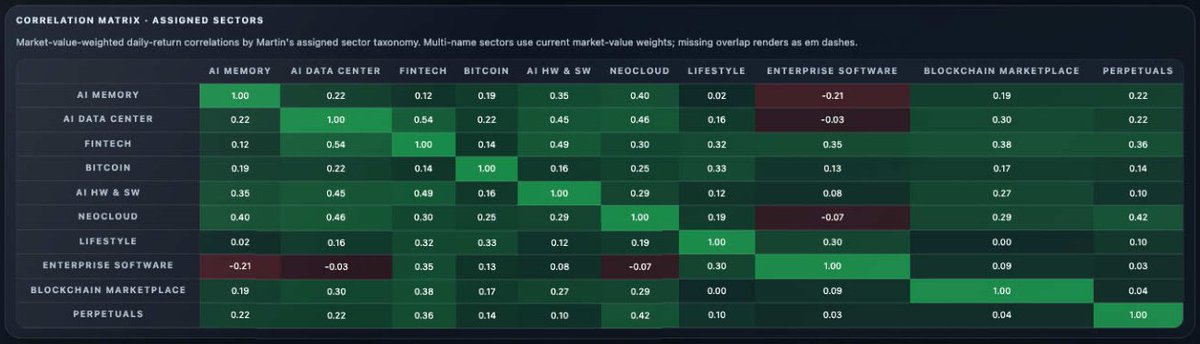
When I look at my portfolio correlation matrix, one row stands out immediately. Enterprise software. Dark red correlations against my two largest sectors. Negative 0.21 against AI Memory. Negative 0.03 against AI Data Center. That's not a red flag. That's exactly what I want to own more of. Real diversification isn't about owning more tickers. It's about owning positions that answer different questions. When one thesis breaks, a truly diversified book doesn't all fall the same direction, because not everything was riding the same driver. The red cells mean enterprise software moves independently from most of what I own. Adding it doesn't pile onto existing risk. It actually smooths the book. I recently wrote a full report arguing AI isn't killing enterprise software. It's bifurcating it. Platforms that orchestrate workflows across the enterprise get stronger because AI agents need somewhere to plug in, trigger actions, and coordinate across systems. Commodity seat tools get disrupted. The market priced them together. That's the mispricing. NOW is already in my book as the clearest expression of this. I want more. These are quality businesses at prices that have reset significantly this year, and they bring a driver my portfolio appreciates. That's what real portfolio construction looks like. Not just finding the best stock. Finding the right next position.
m0xt tweet media
English
1
2
5
692
m0xt
m0xt@m0xt_·
.$FIGR dropped 9% yesterday. No bad news. The stock had ripped 20%+ the prior week, including a 13% pop on June 30 when the IPO lock-up expired without heavy insider selling. Yesterday was light volume profit-taking on an extended name. Then, after the bell, they released unofficial Q2 marketplace volume numbers. $4.26B . Up 47% from the prior quarter. Q1 was $2.9B in volume at a 49.6% adjusted EBITDA margin. A year ago that margin was 32.6%. The platform is getting more profitable as it scales, not less. They beat the high end of their own Q2 guidance by $160M! In the quarter they also closed a $300M fully prefunded securitization. Institutional capital was locked in before the loans even closed. Figure built on blockchain rails from the ground up. If you think blockchain is dead, this is the inconvenient data point. Real volume, real margins, real institutional demand. No speculative token attached to it. The market sold off on nothing. The business printed a record quarter. I have been building a position in FIGR in my Milk Road PRO portfolio over the last few months. You can track my real-time moves (link in bio).
m0xt tweet media
English
0
0
10
3K
m0xt
m0xt@m0xt_·
@Mikafors1 Yeah they are gonna announce next tenant by the end of the summer. On top Coreweave is backed by Nvidia who commited to buy any unused chips by 2032, so I am pretty confident about them as tenant.
English
0
0
1
88
Mikafors
Mikafors@Mikafors1·
@m0xt_ there is a high dependancy on Coreweave, isn't it? that blocks me currently from adding more ...@m0xt_
English
2
0
2
133
m0xt
m0xt@m0xt_·
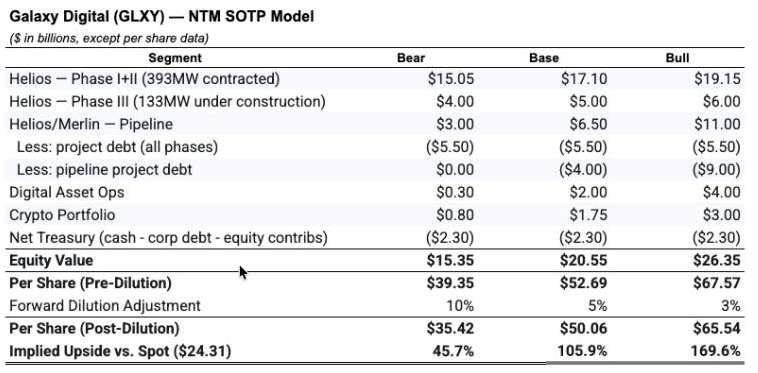
GLXY is my largest position. I think it hits $50 within 12 months. I built a full sum-of-the-parts (SOTP) model across three scenarios: bear $34, base $50, bull $66. Every assumption is below so you can stress test it yourself. The stock trades at $24. Here's why I think the market is wrong. Helios Phase I+II (393MW contracted) I value this segment at $15.1B in the bear case and $19.2B in the bull case. These are enterprise values, meaning what this business would be worth as a standalone company before subtracting debt. Tenants signed (CoreWeave), power secured, revenue locked on 15-year contracts. I value this at a multiple of its annual EBITDA (earnings before interest, taxes, depreciation, and amortization, essentially the cash profit the business generates each year). I use 22x in the bear (multiple compression from higher rates), 25x in the base (current peer range for contracted AI infrastructure like CoreWeave and Applied Digital), and 28x in the bull (AI demand premium, rate cuts). In other words, in the base case I'm saying this business is worth 25 times its annual cash profit. The cash flows don't change across scenarios because they're contracted. The multiple the market assigns to them does. Phase III (133MW under construction) Valued at $3.3B (bear) to $6.3B (bull). Same approach: annual EBITDA times a multiple, but with a wider range because this isn't generating cash yet. I use 14x in the bear (construction delays, cost overruns, pre-revenue assets get punished hardest in downturns), 20x in the base (on-track construction, reasonable discount to operating peers), and 27x in the bull (delivered on time, multiple nearly converges with Phase I+II as risk disappears). Pipeline (Helios + Merlin Ranch) Valued at $3.0B (bear) to $11.0B (bull). This is future buildout optionality. Construction hasn't started and won't until Phase III is done. But Galaxy owns permitted, grid-connected sites where new power interconnections take 3-5 years to secure. That land and those permits have real value today even before a shovel hits the ground. - Bear: $3.0B Development rights value plus modest buildout probability. - Base: $6.5B Majority buildout over 3-5 years, second tenant on similar terms. - Bull: $11B Full buildout, strong demand. Still a 50% discount to what the pipeline would be worth fully built and contracted. Over a 12-month horizon, Phase III construction progress and the second tenant announcement are the primary catalysts that close the gap to fair value. Digital Asset Operations Valued at $0.3B (bear) to $4.0B (bull). Galaxy has built the most complete institutional crypto platform on a public exchange: $5B in assets under management, 1,700+ counterparties, full-service OTC trading, derivatives, structured products, lending, and advisory. - Bear: $0.3B Liquidation value in a crypto winter. - Base: $2.0B About 6x net revenue in a typical year for a healthy crypto market. - Bull: $4.0B Peak cycle volumes and AUM growth. Crypto Portfolio Valued at $0.8B (bear) to $3.0B (bull). Galaxy holds $1.3B in digital assets today, primarily BTC and ETH plus venture positions. Bear: $0.8B About 40% drawdown from current, venture marks compress. - Base: $1.75B Continued cycle, BTC toward $120-$130K. Only 35% appreciation from current marks. Bull: $3.0B Full cycle plays out, venture positions reprice. What I subtract: Project Debt + Net Treasury I add up all the segment values above, then subtract what Galaxy owes. Project debt is non-recourse (meaning it's tied to the data center assets, not Galaxy as a company): $5.5B for Phase I-III. Pipeline debt scales with buildout ($0 bear, $4B base, $9B bull). Net treasury after corporate debt and cash: negative $2.3B Dilution: 10% bear, 5% base, 3% bull Galaxy has diluted shareholders aggressively in the past, nearly doubling share count since 2021. In the bear, I assume they tap equity markets again. In the bull, strong cash generation limits the need. I divide the total equity value by the diluted share count to get the per-share price target. Here's the base case math all the way through: $17.1B + $4.7B + $6.5B + $2.0B + $1.75B = $32.05B in total segment value. Subtract $5.5B Phase I-III debt, $4.0B pipeline debt, and $2.3B net treasury. That leaves about $20.3B in equity value. Divide by diluted shares after 5% dilution and you get $50/share. After dilution: bear $34, base $50, bull $66. Here's what's wild. Helios Phase I+II contracted value alone, after subtracting all project debt and treasury, covers most of the current stock price. At $24, you're paying almost nothing for Phase III under construction, the entire pipeline, an institutional crypto platform with $5B AUM, and $1.3B in digital assets. The market prices Galaxy as a crypto proxy. The SOTP says it's contracted power infrastructure with crypto upside attached for free. The next catalyst: Galaxy is expected to announce a second contracted tenant this summer. If the terms match CoreWeave's, this model gets repriced overnight. I share all my positions and thesis updates in real-time at Milk Road PRO. You can join today at 33% discount (link in bio).
m0xt tweet media
English
16
25
127
13.8K
m0xt
m0xt@m0xt_·
@madridraptor Love that. We are getting pretty close. Well done.
English
1
0
3
183
m0xt
m0xt@m0xt_·
@wallstengine There is great arbitrague opportunity:
m0xt@m0xt_

SK Hynix IPOs on the Nasdaq this Friday. Largest ADR listing in US history. $28 billion. Leopold Aschenbrenner's Situational Awareness fund, Baillie Gifford, and Coatue committed $7 billion as cornerstone investors. The guy whose AI thesis the entire industry reads, and one of the sharpest tech funds on the planet all want this in their portfolio. The IPO reference price is based on SK Hynix's July 3rd Korean close at 242,500 won, which works out to ~$158 per ADS. The expected pricing? $166. A 5% premium before it even starts trading. Meanwhile SK Hynix has traded down in Korea since July 3rd. US investors are paying more than the current Korean price to get in. That's not speculation. That's real demand. Now here's what makes this interesting for me. I don't own SKHY. I own SK Square, the holding company that owns 20.5% of SK Hynix. And right now there are three discounts stacked in my favor. Let me walk you through them: Discount 1: SK Square trades at a 49% discount to the value of what it owns. Its stake in SK Hynix alone is worth almost double SK Square's entire market cap. So for every $1 you put into SK Square, you're getting roughly $2 worth of SK Hynix exposure. Discount 2: SK Hynix has traded down in Korea since July 3rd. The stock is currently below the reference price that the US IPO is based on. Discount 3: The US IPO is expected to price at $166 per ADS, a 5% premium to that already-higher reference price. Aschenbrenner and Baillie Gifford are paying $166. Through SK Square, I'm getting that same exposure at roughly half price. So the smartest AI investors on the planet are paying a premium to buy SK Hynix at the US IPO. I'm buying the same company through its holding company at a 49% discount to the Korean price, which is already below what the US IPO is charging. I added more yesterday. I might be adding more today. Friday the US listing goes live. When a trillion-dollar AI monopoly gets real US price discovery, that 49% holdco discount has nowhere to hide. SK Square is my second biggest position. You can see exactly how I'm sizing it and every other position in my Milk Road PRO portfolio. Real-time portfolio access for $1 (link in bio).

English
0
1
4
1.6K
Wall St Engine
Wall St Engine@wallstengine·
SK HYNIX’S U.S. IPO IS REPORTEDLY MULTIPLE TIMES OVERSUBSCRIBED.
English
30
53
911
332.1K
m0xt
m0xt@m0xt_·
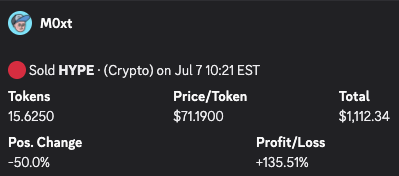
@milkroaddaily Well I actually sold another portion of my HYPE position at +135% profit today. You are underselling our gains ser!🤣
m0xt tweet media
English
2
0
2
206
Milk Road
Milk Road@milkroaddaily·
Bull markets pay people who do the work. And over the last 3 months, our analysts did the work. They called: - Micron +217% - SK Square +203% - Hyperliquid +56%. (With every trade sent to PRO members the moment it went live.) A snippet of the leaderboard is below. None of it was assembled after the fact - every one of these positions hit PRO inboxes with an entry price, a position size, and the full thesis behind it. We can't promise every call will be a winner. Nobody can. But here's what a PRO membership gets you: Five full-time analysts running real portfolios right in front of you. When one of them makes a move, you get notified in real time. (Last month @KyleReidhead opened three new positions in four days, and PRO members saw all three as they happened.) Got questions about our positions, or about assets you found on your own? Ask the analysts directly inside the PRO platform or in our private Discord. ... and the buying hasn't stopped. This past month alone: two new biotech positions were opened, a neocloud dip was scooped up, and more crypto exposure was added. You don't have to do this bull market alone. For the next 7 days, Milk Road PRO is 33% off, on both monthly and annual plans. Come see what our analysts are buying next. Link in the first comment. 👇
Milk Road tweet media
English
9
6
20
8.2K