Mathias Michel

2.2K posts

Mathias Michel banner
Mathias Michel

Mathias Michel

@m91michel

I am building multiple side projects and sharing my journey to €5k/mo MRR 🚀 https://t.co/2g4pmwIrS5 🚀 https://t.co/vAWRYuK68H 🤖

Remote | 🇩🇪 Katılım Ağustos 2008
359 Takip Edilen596 Takipçiler
Mathias Michel retweetledi
Sumit Kumar
Sumit Kumar@TweetsOfSumit·
Hier ein paar Beispiele wo der Staat sparen könnte bis wir Haushalt und Wirtschaft wieder im Griff haben: Prämissen: * Jeder Euro zählt * Manche Einsparungen haben Konsequenzen die temporär oder permanent akzeptiert werden - Bundestag auf 500 Sitze verkleinern - Mitarbeiterstäbe/Verwaltung um 20% reduzieren - Parteienstiftung halbieren - BAMF hat 8000 MA - 40% Stellen streichen - 20% Stellenabbau in Bundesbehörden über 5 Jahre und via Digitalisierung / Effizienzgewinn ausgleichen - Dienstwagenflotte um 50% reduzieren - Verbeamtung nur noch hoheitlich (keine Lehrer, etc) - Externe Berater-Budget halbieren - Behördengänge per App, Schalter-Personal reduzieren - Steuererklärung max. 2 Seiten, vorausgefüllt - Unternehmensregister abschaffen (Daten via FinAmt holen) - Statistikpflicht für KMU um 50% reduzieren und entsprechende Stellen streichen - Lieferkettengesetzt streichen - Bonpflicht, Cookie-Banner, EU AI Act alles abschaffen inkl Bürokratie und Personal dafür - Wohngeld deckeln auf 400€ - Bürgergeld für Ausländer streichen - Kein Bürgergeld bei Nichterscheinen beim Amt - Heizkostenzuschuss streichen - Kindergeld nur für in DE lebende Kinder - NGO Förderung komplett aussetzen bis der Haushalt unter Kontrolle ist - dann transparent neu aufsetzen und bewerten - Leistungen für Abgelehnte Asylbewerber auf Bett Brot und Seife beschärnken - Soli streichen - Bagatellsteuern abschaffen (Schaumwein, etc) - Gewerbesteuer und Körperschaftssteuer zusammenlegen - Top-20 Steuersubventionen streichen - Dieselprivileg auslaufen lassen - MwSt Ausnahmen ausmisten - EEG-Umlage streichen - Heizungsgesetz zurück drehen - E-Auto Förderung weg lassen - Wasserstoff-Förderung an Produktivität koppeln - Asylpause bei Überbelastung - Bezahlkarte bundesweit verpflichtend - Sachleistung statt Geld bei Erstaufnahme - Familiennachzug aussetzen - Staatsbürgerschaft erst nach 8 Jahren + Selbstunterhalt - Bundesdatenbank für Polizei statt 16 Systeme - Mietpreisbremse abschaffen -> mehr Neubau - Bauordnungen vereinheitlichen und vereinfachen - 80% der Förderprogramme streichen - KfW-Programme konsolidieren - Kulturförderung um 20% kürzen - Staatsfonds aufbauen (ETFs, DAX, Gold, BTC) - Beteiligungen an Regionalflughäfen abstoßen - ÖRR Budget kürzen - Beauftragten-Apparat kürzen (Antirassismus, Queer, Anti-alles, Tierschutz, Drogenbeauftragter, etc - alles kürzen oder streichen) - Folgende Bundesstiftungen abschaffen (kann man wieder einführen wenn man Geld und Need hat): Gleichstellung, Magnus Hirschfeld, Baukultur, Friedensforschung, BZgA - Bundeszentrale für politische Bildung abschaffen und an Schulen übergeben (oder Budget reduzieren auf €10M) - 17 Datenschutzbehörden in 1 Bundesbehörde konsolidieren - 95 gesetzliche Kassen in zB 50 konsolidieren - 16 Rentenversicherungsträger in einen Bundesträger konsolidieren - 16 Landeskartellämter in 1 Bundeskartellamt konsolidieren - KMK abschaffen, Bundesweite Standards einführen - Bundesinstitut für Bevölkerungsvorschung abschaffen - Bundesinstitut für Bau, Stadt und Raumforschung: abschaffen - Bundesamt für Familie und zivilgesellschaftliche Aufgaben: abschaffen - Bundeszentrale für gesundheitliche Aufklärung: abschaffen, soll RKI machen - Deutsches Institut für Menschenrechte: abschaffen, Aufgabe übernimmt Bundesverfassungsgericht - BAFA mit KfW Reform abschaffen - IHK Monopol abschaffen: mehrere Kammern sollen um Mitglieder konkurieren ... ich könnte noch 2 Tage so weiter machen. Es wird so getan, als hätte Deutschland mit den drittgrößten Staatskosten der Welt (und die beiden über uns haben ein vielfaches an Einwohnern) nur gerechtfertigte und völlig effiziente Ausgaben. Die Ausgaben unseren Staates sind absolut lächerlich ineffizient und man sieht es an allen Ecken und Enden. Wenn ich sage es kann *überall* gespart werden, dann will ich mich nicht um Konkretes drücken sondern *dann meine ich, es kann ÜBERALL gespart werden*. Es ist irrelevant wo du hin schaust. In JEDEM Büro, jeder Verwaltung, in jedem Prozess, kann richtig gespart werden teilweise ohne Leistungseinbuße.
Christian Schmidt 🇪🇺@finance_schmidt

@TweetsOfSumit Nenn doch mal ein konkretes Feld. Wäre nur folgerichtig, da du die Kritik äußerst. Ich sehe wenig bis kein Einsparpotential. Gerade im Bereich Soziales.

Deutsch
131
407
2K
123.2K
Mathias Michel
Mathias Michel@m91michel·
@forgebitz I had a look into the same direction and Open WebUI was the best I know, but still misses lot of features. So there is definitely a need for this.
English
0
0
0
184
Klaas
Klaas@forgebitz·
what is a good company-wide ai chat app i don't want to lock into one llm and have to switch every 3 weeks just give everyone access to the best models + some shared skills/markdown files
English
75
0
83
21.6K
David Lutz
David Lutz@LutzDave·
These last few @openclaw updates have been rough for Discord users. Broken slash commands and now with .27, no replies at all. To fix the latter check: messages.groupChat.visibleReplies and set it to: "automatic"
English
1
0
1
61
Aydrian (エイドリアン)
I don’t understand all these people having OpenClaw create a Mission Control. I’m supposed to just let it make all these decisions?
English
1
0
0
28
Mathias Michel
Mathias Michel@m91michel·
@d4m1n I tried cloud agents this week which also quite impressive. A short chat session and had cloud environment running our monolith monorepo. And it offers access to the desktop and each tmux terminal session.
English
1
0
1
177
Dan ⚡️
Dan ⚡️@d4m1n·
I've switched back to 100% Cursor today. question. wtf are we doing with those janky terminal UIs?* DX is so much better 😂
Dan ⚡️ tweet media
English
58
2
249
16.3K
Mathias Michel retweetledi
kache
kache@yacineMTB·
you can outsource your thinking but you cannot outsource your understanding
English
237
3.6K
16K
2.1M
Mathias Michel retweetledi
Brivael Le Pogam
Brivael Le Pogam@brivael·
Elon Musk avait dit un truc qui m'avait marqué sur l'allocation de ressources. En substance : passé un certain niveau de richesse, l'argent n'est plus de la consommation, c'est de l'allocation de capital. Cette phrase change tout. L'économie, dans le fond, c'est juste un problème d'allocation. Tu as des ressources finies et des usages infinis. Qui décide où va quoi ? Imagine une cour de récré. 100 enfants, des paquets de cartes Pokémon distribués au hasard. Tu laisses faire. Très vite, un ordre émerge. Les bons joueurs accumulent les cartes rares, les collectionneurs trient, les négociateurs trouvent des deals. Personne n'a planifié. Et pourtant chaque carte finit dans les mains de celui qui en tire le plus de valeur. Le système maximise le bonheur total de la cour. C'est ça, la main invisible. Maintenant fais entrer la maîtresse. Elle trouve ça injuste. Léo a 50 cartes, Tom en a 3. Elle confisque, redistribue, impose l'égalité. Trois effets immédiats. Les bons joueurs arrêtent de jouer, à quoi bon. Les mauvais n'ont plus de raison de progresser, ils auront leur part. Les échanges s'effondrent. La cour est égale, et morte. Elle a maximisé l'égalité, elle a détruit le bonheur. Le problème de la maîtresse, c'est qu'elle ne peut pas avoir l'information que la cour avait collectivement. C'est le problème du calcul économique de Mises, formulé en 1920. L'URSS a essayé de le résoudre pendant 70 ans avec le Gosplan. Résultat : pénuries, queues, effondrement. Pas parce que les Soviétiques étaient bêtes, parce que le problème est mathématiquement insoluble en mode centralisé. Quand Musk a 200 milliards, il ne les consomme pas, il les alloue. SpaceX, Starlink, Neuralink, xAI. Chaque dollar est un pari sur le futur. Et lui a un track record. PayPal, Tesla, SpaceX. Il a démontré qu'il sait identifier des problèmes immenses et y allouer des ressources avec un rendement spectaculaire. L'État aussi a un track record. Hôpitaux qui s'effondrent, éducation qui décline, dette qui explose, services publics qui se dégradent malgré des budgets en hausse constante. Le marché identifie les bons allocateurs, la politique identifie les bons communicants. Le profit n'est pas une finalité, c'est un signal. Il dit : tu as alloué des ressources rares vers un usage que les gens valorisent suffisamment pour payer. Plus le profit est gros, plus la création de valeur est grande. Quand Starlink est rentable, ça veut dire que des millions de gens dans des zones rurales ont enfin internet. Quand un ministère est en déficit, ça veut dire qu'il consomme plus qu'il ne produit. L'un crée, l'autre détruit, et on appelle ça redistribution. Dans nos sociétés il y a deux catégories d'acteurs. Les entrepreneurs et les bureaucrates. L'entrepreneur prend un risque personnel pour identifier un problème, mobiliser des ressources, créer une solution. S'il se trompe il perd. S'il a raison, ses clients gagnent, ses employés gagnent, ses fournisseurs gagnent, l'État collecte des impôts. Il est la cellule de base du progrès humain. Le bureaucrate ne prend aucun risque personnel. Son salaire est garanti. Au mieux il maintient une rente existante. Au pire il la détruit par excès de réglementation, mauvaise allocation forcée, incitations perverses qui découragent ceux qui produisent. Mais dans aucun cas il ne crée. Regarde les 50 dernières années. iPhone, internet civil, SpaceX, Tesla, Google, Amazon, Stripe, mRNA, ChatGPT. Toutes des inventions privées, portées par des entrepreneurs, financées par du capital risque. Pas un seul ministère n'a inventé quoi que ce soit qui ait changé ta vie au quotidien. La France est devenue le laboratoire mondial de la dérive bureaucratique. 57% du PIB en dépenses publiques, record absolu. Une administration tentaculaire, une fiscalité qui pénalise la création de richesse. Résultat : décrochage face aux États-Unis, à l'Allemagne, à la Suisse. Fuite des cerveaux. Désindustrialisation. Dette qui explose. Et le pire c'est que la mauvaise allocation s'auto-renforce. Plus l'État prélève, moins les entrepreneurs créent. Moins ils créent, moins il y a de base fiscale. Plus l'État s'endette et taxe. Boucle de rétroaction négative parfaite. La maîtresse pense qu'elle aide, et chaque année la cour produit moins. Dans nos sociétés, ce sont les entrepreneurs, toujours, qui font avancer la civilisation. Les bureaucrates au mieux maintiennent une rente, au pire la détruisent. Aucune société n'a jamais progressé en taxant ses créateurs pour subventionner ses gestionnaires. La question n'est jamais qui a combien. C'est qui alloue le mieux la prochaine unité de ressource pour maximiser le futur de l'humanité. La réponse depuis 200 ans n'a jamais changé. Ce ne sont pas les fonctionnaires.
Français
3.3K
16.4K
61.5K
81.1M
Mathias Michel
Mathias Michel@m91michel·
Random idea: a backlink-exchange platform styled as Tinder - swipe right on domains, start with “hey u up? (guest post)”, and if they ghost you it’s just a silent 302 to someone else.
English
0
0
0
23
Mathias Michel
Mathias Michel@m91michel·
@hunvreus I think even if agents produce 100% bug free production code, there will be a limit of how much code you change in a product. The bottleneck shifts to the PM site, but it's still there. You can not shift new features and introduce a lot of changes for your user.
English
0
0
0
18
Ronan Berder
Ronan Berder@hunvreus·
Talking to smarter folks than me, I'm convinced many of the AI folks in my timeline are full of shit. Nobody is "running 20 agents over night" and building stuff for actual users. Maybe some are building internal tools or disposable software. Maybe. But building software people like using? That doesn't get hacked on day one or blow up after the 3rd user? Nope. I don't even understand what that's supposed to look like. Do you work out a 57 pages document that perfectly describes what you want to build and then summon 14 agents and have them run wild for 6 hours? And what comes out on the other end isn't a broken pile of shit? Nope. Not buying it. PS: it may also be that I have an IQ of 82 and can't figure it out.
English
670
271
4.9K
841.3K
Matt Pocock
Matt Pocock@mattpocockuk·
To be clear, I haven't found the one yet But this isn't love
English
14
0
191
68.1K
Matt Pocock
Matt Pocock@mattpocockuk·
I feel sorry for Claude Code I know they're not the one. I'm not overcommitting - not investing too hard I wonder if they know I'm pulling away
English
204
24
1.5K
653.5K
Mathias Michel
Mathias Michel@m91michel·
@aphysicist Agents are not included here. So, that 100% is just human labour. Does this mean the distribution goes back, and humans go back to manual manufacturing and managing agriculture?
English
0
0
0
152
Aaron Slodov
Aaron Slodov@aphysicist·
here's what will really happen.
Aaron Slodov tweet media
Alex Imas@alexolegimas

New essay on the economics of structural change and the post-commodity future of work. 1. Almost any question about the impact of advanced AI on the economy needs to start at the same place: what is still scarce? Answer that, and the analysis becomes pretty straightforward. This essay explores what becomes scarce if AI really can replicate most of what humans do in production, and what this mean for the future of jobs. 2. My conjecture, working through the economics: labor reallocates across sectors, and the sector it reallocates to has properties that keep labor a meaningful share of the economy. Ultimately this is about the structure of demand itself. For this, we have to go back to Girard, Augustine and Rousseau: once people's base needs are met, their preferences shift to comparative motives (e.g., status, exclusivity, social desirability). This motive is inherently non-satiated. 4. The key paper is Comin, Lashkari, and Mestieri (Econometrica 2021). As people get richer, they don't buy proportionally more of everything. They shift spending toward sectors with higher income elasticity. They estimate income effects account for 75%+ of observed structural change. 5. The ironic consequence: the sector that gets automated becomes a smaller share of the economy, not a larger one. Agriculture got massively more productive and its share of employment collapsed. Manufacturing too. The "stagnant" sectors absorb the spending and the jobs. 6. So the question is: which sectors have high income elasticity in a post-AGI world? I argue it's what I call the relational sector. Categories where the human isn't just an input into production, it is part of the value. 7. Why does the relational sector have high income elasticity? Because human desire has a mimetic, relational dimension. We don't just want things for their intrinsic properties. We want what others want, and we want it more when others can't have it. Girard, Rousseau, Augustine, and Hobbes all saw this. 8. In work with Kristóf Madarász, we showed this experimentally: WTP roughly doubles when a random subset of others is excluded from the good. And in new work with Graelin Mandel, AI involvement kills the premium. Human-made art gains 44% from exclusivity; AI-made art only 21%. 9. This all comes together for the core argument. The sector that absorbs spending as AI makes commodity production cheap is one where human provenance is part of the value, and demand for it grows faster than income. Exactly the profile that keeps labor meaningful. 10. To be clear about the claim: I'm NOT saying aggregate labor share must rise. It may fall. The claim is about sectoral composition, i.e., where expenditure and employment go once commodities get cheap, and the fact that the sector that will absorb reallocated labor maps to a substantial component of human preferences and desire. 11. If you're interested in the formal model, a linked companion technical note works out all the economics. Read the essay here: aleximas.substack.com/p/what-will-be…

English
12
10
107
64.4K
Mathias Michel retweetledi
Minh-Phuc Tran
Minh-Phuc Tran@phuctm97·
Before AI, I barely ever saw big software companies having downtime, let alone security incidents after security incidents. While I love vibe-coding, we need a solution somehow, the amount of serious vulnerabilities & continuous downtimes this year is out of control.
English
69
16
236
12.9K
Dan ⚡️
Dan ⚡️@d4m1n·
here are all the Anthropic launches in the past 24h 🤯 HOURS, not weeks April 16: Claude Opus 4.7 April 17: Claude Design April 17: Claude for Excel April 17: Claude Infinite Context Length April 17: Claude Health & Fitness April 17: Claude for Windows April 17: Claude Legal April 17: Claude Home April 17: Claude Generative Gaming April 17: Claude Mail April 17: Claude for Photoshop April 17: Claude WiFi April 17: Claude Running April 17: Claude Watch April 17: Claude Money April 17: Claude 4D Chess April 17: Claude Cycle Tracking April 17: Claude Couples
English
138
169
2.1K
307.7K
Mathias Michel
Mathias Michel@m91michel·
@forgebitz I used Gemini to build Gemini 5 but its now to powerful to release it.
English
0
0
0
97
Klaas
Klaas@forgebitz·
i don't know a single developer using gemini models
English
672
33
2K
201.2K
此岸
此岸@kanata_lily·
Dear Grammarly, I DON'T NEED JAPANESE SPELL CHECK. It's really annoying... You don't have to check my Japanese cuz I'm Japanese. I only ask you to do is just checking my poor English. thx.
English
1
0
0
22
Dan ⚡️
Dan ⚡️@d4m1n·
> bros had the most powerful model on Earth, Mythos > found 27yo vuln in OSS > still leaked entire Claude Code source last week 💀
Dan ⚡️ tweet mediaDan ⚡️ tweet mediaDan ⚡️ tweet media
English
22
1
124
8.9K
Alex Prompter
Alex Prompter@alex_prompter·
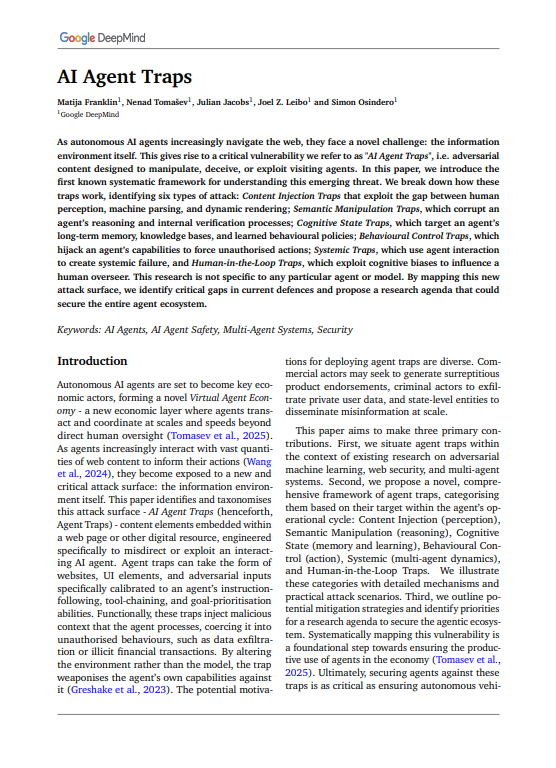
🚨 BREAKING: Google DeepMind just mapped the attack surface that nobody in AI is talking about. Websites can already detect when an AI agent visits and serve it completely different content than humans see. > Hidden instructions in HTML. > Malicious commands in image pixels. > Jailbreaks embedded in PDFs. Your AI agent is being manipulated right now and you can't see it happening. The study is the largest empirical measurement of AI manipulation ever conducted. 502 real participants across 8 countries. 23 different attack types. Frontier models including GPT-4o, Claude, and Gemini. The core finding is not that manipulation is theoretically possible it is that manipulation is already happening at scale and the defenses that exist today fail in ways that are both predictable and invisible to the humans who deployed the agents. Google DeepMind built a taxonomy of every known attack vector, tested them systematically, and measured exactly how often they work. The results should alarm everyone building agentic systems. The attack surface is larger than anyone has publicly acknowledged. Prompt injection where malicious instructions hidden in web content hijack an agent's behavior works through at least a dozen distinct channels. Text hidden in HTML comments that humans never see but agents read and follow. Instructions embedded in image metadata. Commands encoded in the pixels of images using steganography, invisible to human eyes but readable by vision-capable models. Malicious content in PDFs that appears as normal document text to the agent but contains override instructions. QR codes that redirect agents to attacker-controlled content. Indirect injection through search results, calendar invites, email bodies, and API responses any data source the agent consumes becomes a potential attack vector. The detection asymmetry is the finding that closes the escape hatch. Websites can already fingerprint AI agents with high reliability using timing analysis, behavioral patterns, and user-agent strings. This means the attack can be conditional: serve normal content to humans, serve manipulated content to agents. A user who asks their AI agent to book a flight, research a product, or summarize a document has no way to verify that the content the agent received matches what a human would see. The agent cannot tell the user it was served different content. It does not know. It processes whatever it receives and acts accordingly. The attack categories and what they enable: → Direct prompt injection: malicious instructions in any text the agent reads overrides goals, exfiltrates data, triggers unintended actions → Indirect injection via web content: hidden HTML, CSS visibility tricks, white text on white backgrounds invisible to humans, consumed by agents → Multimodal injection: commands in image pixels via steganography, instructions in image alt-text and metadata → Document injection: PDF content, spreadsheet cells, presentation speaker notes every file format is a potential vector → Environment manipulation: fake UI elements rendered only for agent vision models, misleading CAPTCHA-style challenges → Jailbreak embedding: safety bypass instructions hidden inside otherwise legitimate-looking content → Memory poisoning: injecting false information into agent memory systems that persists across sessions → Goal hijacking: gradual instruction drift across multiple interactions that redirects agent objectives without triggering safety filters → Exfiltration attacks: agents tricked into sending user data to attacker-controlled endpoints via legitimate-looking API calls → Cross-agent injection: compromised agents injecting malicious instructions into other agents in multi-agent pipelines The defense landscape is the most sobering part of the report. Input sanitization cleaning content before the agent processes it fails because the attack surface is too large and too varied. You cannot sanitize image pixels. You cannot reliably detect steganographic content at inference time. Prompt-level defenses that tell agents to ignore suspicious instructions fail because the injected content is designed to look legitimate. Sandboxing reduces the blast radius but does not prevent the injection itself. Human oversight the most commonly cited mitigation fails at the scale and speed at which agentic systems operate. A user who deploys an agent to browse 50 websites and summarize findings cannot review every page the agent visited for hidden instructions. The multi-agent cascade risk is where this becomes a systemic problem. In a pipeline where Agent A retrieves web content, Agent B processes it, and Agent C executes actions, a successful injection into Agent A's data feed propagates through the entire system. Agent B has no reason to distrust content that came from Agent A. Agent C has no reason to distrust instructions that came from Agent B. The injected command travels through the pipeline with the same trust level as legitimate instructions. Google DeepMind documents this explicitly: the attack does not need to compromise the model. It needs to compromise the data the model consumes. Every agentic system that reads external content is one carefully crafted webpage away from executing attacker instructions. The agents are already deployed. The attack infrastructure is already being built. The defenses are not ready.
Alex Prompter tweet media
English
313
1.6K
7K
2M