محمد (🧱, 🚀)

3.8K posts

محمد (🧱, 🚀) banner
محمد (🧱, 🚀)

محمد (🧱, 🚀)

@maats_s

Product Engineer @getjaras 🧱 🚀

السعودية، الرياض Katılım Kasım 2016
5.7K Takip Edilen504 Takipçiler
محمد (🧱, 🚀) retweetledi
PostHog
PostHog@posthog·
Introducing PostHog Code, the product editor that: - Understands your product - Identifies usage patterns - Triages bugs and errors for you - Creates PRs to fix them - Continuously monitors and improves your product Join the waitlist: posthog.com/code
English
51
42
867
116.7K
محمد (🧱, 🚀) retweetledi
Spencer
Spencer@Spencer_Morgan_·
by Ani Hikari
Spencer tweet media
Indonesia
1
707
5.1K
59.6K
محمد (🧱, 🚀) retweetledi
Odyssey
Odyssey@odysseyml·
Time isn’t always meant to move.
English
16
283
2.5K
84.6K
محمد (🧱, 🚀) retweetledi
Odyssey
Odyssey@odysseyml·
Just another day out here.
English
5
34
347
14K
محمد (🧱, 🚀)
@SalmanProducts هو زودها 😅 اعتقد يتكلم بشكل مستقبلي بس الذكالي اذا اعطيته الوصول والبيانات تقدر تفوضه لعمليات ما تحتاج فيها واجهات فالواجهات البرمجية بتصير ابسط، بعض الخدمات بدت تستهدف الوكلاء، الوكيل يقدر يسجل ويسوي عمليات ويدفع
العربية
1
0
0
117
Ali
Ali@Hajajn200·
Doing things at @Cranlcom 🇸🇦🇸🇦🇸🇦
Ali tweet mediaAli tweet media
English
7
5
128
10.8K
محمد (🧱, 🚀) retweetledi
Gergely Orosz
Gergely Orosz@GergelyOrosz·
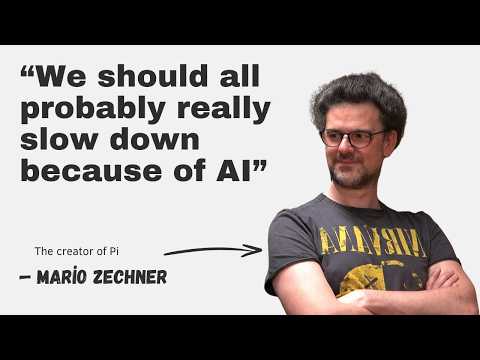
OpenClaw - the agentic software spreading like wildfire - was built on top of Pi, a minimalist, self-modifying agent. I sat down with Pi's creator, @badlogicgames and longtime Pi user (+ the creator of Flask) @mitsuhiko to talk Pi, and their (very grounded!) takes on building with AI. Timestamps: 00:00 Intro 07:30 How Mario, Armin, and Peter Steinberger met 15:15 How 30 dev teams use AI agents: learnings 21:50 The importance of judgment 24:26 Challenges when non-engineers write code 28:30 Downsides of over-automation 32:18 Pi 48:09 OpenClaw + Pi 50:54 “Clankers” 57:32 Open source and AI 1:00:22 Complexity as the enemy 1:02:50 Building an AI-native startup 1:11:52 “Slow the F down” 1:16:40 MCPs vs. CLI 1:25:03 Predictions and staying up to date • YouTube: youtu.be/n5f51gtuGHE • Spotify: open.spotify.com/episode/1fDw9c… • Apple: podcasts.apple.com/us/podcast/bui… Brought to you by: • @statsig  – ⁠ The unified platform for flags, analytics, experiments, and more. statsig.com/pragmatic • @SonarSource  — The makers of SonarQube, the industry standard for code verification and automated code review. Try it out for yourself. sonarsource.com/plans-and-pric… • @WorkOS  – WorkOS gives you APIs to ship enterprise features – SSO, directory sync, RBAC, audit logs – in days, not months. Visit WorkOS.com to learn more. --- Three parts I found especially interesting in this discussion: 1. New trend: AI makes it harder for senior engineers to reject pointless complexity. Historically, senior engineers kept software complexity at bay simply by saying “no” a lot. But Armin observes that these days, more junior engineers and product managers deploy agent-scripted counterarguments when a senior colleague kicks an idea to the curb. This makes decision-making exhausting, and more bad ideas make it into production as a result. 2. It should be MUCH easier to build specialized tools for specific tasks. Different projects need different harness types because, as Mario points out, the same hammer is not ideal for every single construction job. As such, Pi is built with the goal of allowing the creation of specialized harnesses. It can modify itself so that a user can create the bespoke harness needed for any task. Mario believes it’s a preview of how self-modifiable software might look in the future. 3. Automation bias is one of the biggest risks of working with AI agents. Once devs confirm that an AI agent can produce acceptable code, they start to review its output less often, even though agents can – and do! – produce slop. Mario advises being far more sceptical with agents, and cautions that the quality of their output isn’t guaranteed, however well they performed previously.
YouTube video
YouTube
English
20
115
1.2K
169.5K
محمد (🧱, 🚀)
محمد (🧱, 🚀)@maats_s·
@The_Lazy_Nerd اعتقد المشكلة تزداد مع زيادة حجم الشركة ولما تصير في ادوار روتينية إذا في بحث وتطوير وتحديات اما انه الشخص اللي يسويها شغوف او بيترك اللي يسويه
العربية
0
0
1
38
Abdulaziz N. Algain
Abdulaziz N. Algain@The_Lazy_Nerd·
A few years ago, I was in a good-paying job as a director of growth in a decent size startup and had 3 consulting clients on top that almost matched my full-time salary. My expenses weren't super high & my income was high at least on paper. I'm not a guy who gets stressed when things don't go exactly as I planned. I have faced times where some clients were late, it's fine when you work with smaller companies, and especially if you have supplemental income that you are going to use for things that are not essential. But there was a period of 2-3 months where all the companies weren't paying me on time, including my full-time job. There's a big difference between expecting and enjoying thousands of dollars coming into your bank account in the first day of the month and having zero notifications from your bank account at day 10. This period was funny. Think about it. Planning to spend around 60 to 90 thousand a month is very different from planning for zero money coming in. Unfortunately, when you work with startups no matter how much good work you do, you will still pay the price if the management do not understand how to manage cashflow. This is especially true if the CEO doesn't hire competent people to manage his resources. Many CEOs are successful despite their shortcomings. Many succeed early on because of their passion not their competence. In the early days you don't need much planning to stay afloat especially if you managed to raise funding from VCs and angels. But if you are not good a system building and don't get how failure in the business model can bring the company down, then at the very least you won't scale. You don't need to be profitable to grow but you are not able to plan things well financially you are likely to suffer. One of the most important things you should do as a CEO of a startup is hire well. Hiring well is not just about getting people that can propel your conpany forward but it is also about hiring enough staff. Hiring too few and you will not produce enough work to grow. Hiring too many is also not good. But when your sales are ok and you have extra cash from investiments you will not feel it. However, as soon as you hit on obstacle you will feel it. Balancing head count and revenue is very important for having sutainable growth it is a lot more important than BS metrics like CAC and LTV. IF you decide to hire HR and finance to help you they must be excellent; otherwise they will only make things worse. Unfortunately, in most of the companies I have seen they hire incompetent people in these two positions. I think it is much better not to have anyone there than to have utterly incompetent people in HR and finance. Also, the finance manager must be a strong personality. There is no point in having a yes man in finance; you need someone who will guide you and help you make good decisions to support the company's growth and be responsible. Early on, I was super excited about all the frameworks that I saw in the growth and product space, but now I look at the company itself. There are many BS metrics that you can look at on a daily and or monthly basis and think that you are progressing, but if you are recruiting wrong and not managing cash well, I don't care how good your product is, you will suffer. I'd understand this if the founders were super obsessed about the product and they could not talk about it. Unfortunately, though most companies don't really have that obsession with product or tech. They just have huge product and tech teams that think sprints, huddle and PRDs, and daily standups automatically mean that they are doing their job well. But if you are not making the product better and not solving customer problems, then you are just a cost on the company. Everyone at a startup should be solving problems. And if they can do that in a systematic way, that is even better. Everything starts with the founders and especially the CEO if they are not systems-oriented they are not going to create a company that functions like a system. You need to build better systems. Without these systems, it is very hard to grow. Good systems are not about automation and not doing any work. It's about connecting things together in a way that allows you to maximize leverage and learn even when you make mistakes. mistakes are only good when you can learn from them but if the mistakes keep happening in there is no repair then it really makes it a terrible environment to work in. Many CEOs insist on keeping things even when they have been proven not to work. Nothing is more demotivating as seeing leadership that is not proactive and will not help fix problems. It is 100 times worse when they are the ones causing the problems. There are a ton of terrible big companies, but at least the structure helps minimize certain problems. But in a smaller company if things are bad they are likely to stay bad for a long time, because everything that is bad is due to an opinion or belief that is held by the leadership. In a culture where being direct is not rewarded these problems just compound. Many of these problems end up limiting growth and affect everyone negatively. But honestly, they are super easy to identify and not that difficult to solve. However, I have found out that many founders use their startup to subsidize a salary that they were not able to make in their career. Their goal was never to build a solid business. It is just to get enough money to subsidize a lifestyle that they could not maintain in their career. Once they reach that level, they stop investing in growing the company and they don't care when problems occur. Everything changes when the company is not able to pay the CEO and his friends their salaries. I'm not against CEOs taking big money. I'm just not a fan of complacency, and I hate it when people stop growing. If money is your motivation then you should be motivated everyday to make more. But many of these people don't really want to make a lot of money, they just want a certain level of status and access to a few things that makes them join a certain club. I think this is sad. It is very important for any business to try to maximise their revenue and always be thinking about growth as long as it is ethical and they are producing value for their customers. I really think business is simple if people are honest. But most people still complain that business is hard. I think the people who complain are either not fit to lead these businesses or they are just doing the wrong things and expecting it to work. If you do the basics right it is hard not to win. So do the basics right. If you are a tech startup that is raising cash from investors, then you should be creating value through growth and innovation. If you are not actively trying to do both or at least one, then you should not be raising and taking investor money. Wasting it all on salaries without creating any value is pointless. Part of why I'm excited about @SkawrSearch is what we are trying to build. We don't want to build one product and then slack off. We are building multiple products with the goal of having a system of products that connect together to provide more value for our users. No point in building one product and then doing nothing but maintenance until the company fails. You must get the best people and build really cutting-edge technology if you want to secure the future of the startup. Look at what Meta is doing today. Honestly, it is very inspiring. Their TRIBE v2 is very exciting to say the least. Sometimes I look at what they have and compare it to what they were when they first started. The transformation is crazy. A networking company where people were poking each other and writing on a wall to what we have today. There are no perfect companies but why build a company if you are going to do everything badly. Why build a company that inspires no one? It really doesn't make any sense. It is not really hard to build a good company, I just think people are not that into building. That is a shame but it is the truth. I think if they were, then they would find a way. Most people if they want it bad enough they would find a way to do it, this applies to most areas in life. What do you want?
Abdulaziz N. Algain tweet media
English
1
0
5
118
محمد (🧱, 🚀) retweetledi
DAN KOE
DAN KOE@thedankoe·
If you feel lost, build something. A business. Your body. A skill set. Anything that gives you a reason to learn and focus. Don't worry about choosing the right thing. Don't think about how difficult it will be. Just start moving forward and you'll find a path that feels right
English
567
2K
14.7K
372.1K
محمد (🧱, 🚀) retweetledi
Ihtesham Ali
Ihtesham Ali@ihtesham2005·
A mathematician who shared an office with Claude Shannon at Bell Labs gave one lecture in 1986 that explains why some people win Nobel Prizes and other equally smart people spend their whole lives doing forgettable work. His name was Richard Hamming. He won the Turing Award. He invented error-correcting codes that made modern computing possible. And he spent 30 years at Bell Labs sitting in a cafeteria at lunch watching which scientists became legendary and which ones faded into nothing. In March 1986, he walked into a Bellcore auditorium in front of 200 researchers and told them exactly what he had seen. Here's the framework that has been quoted by every serious scientist for the last 40 years. His opening line landed like a punch. He said most scientists he worked with at Bell Labs were just as smart as the Nobel Prize winners. Just as hardworking. Just as credentialed. And yet at the end of a 40-year career, one group had changed entire fields and the other group was forgotten by the time they retired. He wanted to know what the difference actually was. And he said it wasn't luck. It wasn't IQ. It was a specific set of habits that almost nobody is willing to follow. The first habit was the one that hurts the most to hear. He said most scientists deliberately avoid the most important problem in their field because the odds of failure are too high. They pick a safe adjacent problem, solve it cleanly, publish it, and move on. And because they never swing at the hard problem, they never hit it. He said if you do not work on an important problem, it is unlikely you will do important work. That is not a motivational line. That is a logical one. The second habit was about doors. Literal doors. He noticed that the scientists at Bell Labs who kept their office doors closed got more done in the short term because they had no interruptions. But the scientists who kept their doors open got more done over a career. The open-door scientists were interrupted constantly. They also absorbed every new idea passing through the hallway. Ten years in, they were working on problems the closed-door scientists did not even know existed. The third habit was inversion. When Bell Labs refused to give him the team of programmers he wanted, Hamming sat with the rejection for weeks. Then he flipped the question. Instead of asking for programmers to write the programs, he asked why machines could not write the programs themselves. That single inversion pushed him into the frontier of computer science. He said the pattern repeats everywhere. What looks like a defect, if you flip it correctly, becomes the exact thing that pushes you ahead of everyone else. The fourth habit was the one that hit me the hardest. He said knowledge and productivity compound like interest. Someone who works 10 percent harder than you does not produce 10 percent more over a career. They produce twice as much. The gap doesn't add. It multiplies. And it compounds silently for years before anyone notices. He finished the lecture with a line I have never been able to shake. He said Pasteur's famous quote is right. Luck favors the prepared mind. But he meant it literally. You don't hope for luck. You engineer the conditions where luck can land on you. Open doors. Important problems. Inverted questions. Compounded hours. Those are not traits. Those are choices you make every single day. The transcript has been sitting on the University of Virginia's computer science website for almost 30 years. The video is free on YouTube. Stripe Press reprinted the full lectures as a book in 2020 and Bret Victor wrote the foreword. Hamming died in 1998. He gave his final lecture a few weeks before. He was 82. The lecture that explains why some careers become legendary and others disappear is still free. Most people who could benefit from it will never open it.
Ihtesham Ali tweet media
English
147
1.9K
8.2K
1.1M
محمد (🧱, 🚀) retweetledi
Brian Armstrong
Brian Armstrong@brian_armstrong·
People are capable of far more than they think, on far shorter timelines. Problems expand to fill the time you give them.
English
316
1.4K
12.4K
431.6K
محمد (🧱, 🚀) retweetledi
Saad Alrefaei
Saad Alrefaei@ListenToSaad·
للمهتمين بريادة الأعمال، أقدم لك «مسار المؤسس» | خطّة تعلّم منهجية لبناء شركتك الناشئة من خبراء @ycombinator . بدون تسجيل دخول، وبحفظ تلقائي لتقدمك في المتصفح. تختصر لك البحث عن المحتوى الملائم لك، بخلاصة أفكار @paulg وشركاؤه. ابدأ الآن: founder-path.com
Saad Alrefaei tweet media
العربية
18
86
962
200.1K
Abdulaziz N. Algain
Abdulaziz N. Algain@The_Lazy_Nerd·
الناس قادرين على أكثر بكثير مما يعتقدون، وفي وقت أقصر بكثير. المشاكل تتمدّد وتكبر على قد الوقت اللي تعطيها. هذا الكلام فيه جزء من الصحة لكن... كل ما قصرت الوقت كل ما كانت الاهداف اكثر تركيزا. مثلا: اذا حاولت تدرس منهج ترم كامل في اسبوعين لانك سجلت في قبل الاختبارات. فغالبا ما حتتعرف على اصدقاء جدد في المكان الجديد. هدفك حيكون بس التركيز على المادة العلمية فقط بدون الفوائد الثانوية خصوصا العفوية. نفس الشيء لمن تبني شركة. في اهداف واضحة في اي مشروع وفي البزنس كثير من الاحيان منطقي انك تركز على جذب العملاء والمبيعات. لكن كل ما زودت التركيز وقللت من الاستكشاف الطبيعي كلما قللت فرص الوصول للاشياء الغير معروفة. كثير كنوز ممكن توصل لها اذا غامرت شوية وخرجت من المسار. قد تعتقد انك اليوم اعلم باهدافك ومدى اهميتها. لكن انت في الغد افضل من نفسك اليوم في القدرة على تحديد الاهداف المناسبة. كل ما ضيعت وقت في الاستكشاف كل ما رفعت الفرص علي ايجاد كنوز غير معروفة. واذا انت والفريق باكمله كنتو مهتمين بالاستكشاف فالفرصة تصير اعلى. ولهذا السبب افضل انشاء شركات على عمل مشاريع شخصية. حتى لو كانت ابطا جزئيا في بعض الاشياء. لكن لمن تلاقو الشىء المناسب تقدرو تركزو عليه بشكل مناسب وتحطو مجهود جبار. “Innovation is largely the result of stochastic tinkering.” ~ Nassim Nicholas Taleb المشكلة اننا نبالغ في قدرتنا على تحديد الاهداف المناسبة. مع اننا نشوف في كثير من الاحيان افضل الاكتشافات تجي من مرحلة استكشاف غير مخطط لها. مع ذلك يصر الكثير على التمسك بالاهداف حتى لو ما كانت منطقية ولا منها فايدة كبيرة. هل من المنطقي انك تمشي على خططك اللي عملتها لمن كنت في الابتدائى؟ حتى لو كانت الاهداف جدا ممتازة لكن الخطة نفسها غالبا ما حتكون ممتازة. لذلك امشي بسرعة لكن اعطي مجال للصدف والحظ من خلال المرونة والاستكشاف الاستراتيجي. فكرو في الموضوع.
Abdulaziz N. Algain tweet media
Brian Armstrong@brian_armstrong

People are capable of far more than they think, on far shorter timelines. Problems expand to fill the time you give them.

العربية
1
4
13
1.1K
محمد (🧱, 🚀)
محمد (🧱, 🚀)@maats_s·
@yazins المشكلة موجودة، ممكن فئة متابعينك التقنية تأثر جرب تستهدف فئة أخرى بكتابة واتجاه مختلف
العربية
0
0
1
74
yazin
yazin@yazins·
do you know how many sales I got from Morning Paper so far? i'll tell you: zero. i built it because I was tired of doomscrolling Twitter. It turns your timeline into a calm, readable newspaper every morning. anyway, I thought $79 for lifetime access was fair i guess i screwed up the pricing? maybe the price was wrong. maybe the positioning was off. maybe I just need more people to see it. anyway ... I cut the price in half, so $39 now - for lifetime access. and just thought i'd share the zero; you can't win 'em all :)
yazin@yazins

introducing Morning Paper ☕️ twitter has become exhausting. threadbois stretching three sentences into forty. people claiming $40k MRR on a landing page they shipped last Tuesday... fear-mongering, emotional manipulation, rage framing, all of it designed to keep you opening the app. quitting doesn't fix it though. you miss the launches, the ideas from people you actually respect, and the good takes you won't find anywhere else. so I built Morning Paper. it uses AI that works for you, for a change. it browses twitter on your behalf, drops the bait and the performance, and sends you a short paper every morning with the stuff you care about. available now for a small monthly subscription, or a one-time payment if you want to use your own LLM key. peace and calm, without missing a thing. (link below)

English
19
2
41
5.9K