Sabitlenmiş Tweet
Chase
2.1K posts

Chase
@Madmodes
Bitcoiner | Optimist | MBA | B.S in Finance | 🎧 | 👾 | 👨🏾🍳
Cyber Space Katılım Eylül 2021
198 Takip Edilen276 Takipçiler

@BitStrategy21 @ChrisMMillas Once STRC holds par due to bi-weekly payments, Strategy could buy ~100k coins on a monthly basis at current prices.
Sellers aren’t looking two months out.
English

@ChrisMMillas Interested to hear how you interpret Saylor’s comments at Bitcoin Mena:
x.com/bitstrategy21/…
BitStrategy@BitStrategy21
MUST WATCH. This is the most important 27 seconds in Bitcoin history. Saylor explains that "we can buy more Bitcoin than the sellers can sell, and we're going to take it all." Full video in comments.
English

There are people — the “Terminal Accumulation” theorists — who believe that one day you will never be able to buy Bitcoin on the open market.
Their reasoning is that over a “long enough time horizon”, all the Bitcoin gets bought by $MSTR.
What they don’t understand is that markets exist because holders have different time horizons, liquidity needs, risk tolerances and incentives.
Bitcoin will not disappear because one entity keeps buying.
The price will simply keep moving until marginal sellers are willing to sell.
This is how markets work.
But just for the sake of argument, let’s assume they are right.
So what?
If Bitcoin becomes impossible to buy in 500 or 1,000 years, that has no practical bearing on investors today.
And besides, no-one wants to live in a world where Strategy owns all of the Bitcoin.
Fortunately that won’t happen.
These people are completely detached from reality.
For context, I've had a position in $MSTR since 2020.
English

@Werkman @BitcoinPierre @Strive ~61.6% of Bitcoin's daily supply is significant, and the product is still maturing.
Strive has a clear path to becoming one of the top 3 treasury companies.
Keep on climbing!
English

It was a busy week at @Strive last week! In the 4 days from our prior reporting we captured ~61.6% of the daily natural supply of Bitcoin. With these purchases, we have now passed RIOT and Coinbase to become the 7th largest pubco holder of Bitcoin.
Matt Cole@ColeMacro
Strive acquired an additional 1,109 $BTC for ~$85.4 million at an average cost of ~$76,988 per bitcoin. STRIVE SNAPSHOT Bitcoin holdings: 16,500 QTD BTC Yield: 11.0% YTD BTC Yield: 23.4% Amplification ratio: 45.2% $ASST $SATA

English

Strategy has completed the repurchase of $1.5 billion of its 2029 Convertible Notes at an ~8% discount to par, generating an incremental 0.7% BTC Yield and lowering aggregate debt to $6.7 billion. $MSTR $STRC strategy.com/press/strategy…
English

The Mirantis acquisition provides IREN the optionality to delay signing a deal. Controlling Layer 1 and 2 while their neo-cloud competitors are constrained by lack of infrastructure control is a distinct competitive advantage. What is the point of signing a contract if you can't obtain power to serve customers?
Additionally, the cost of compute is expanding as new AI use cases are unlocked, just like the example mentioned in the post. Mirantis gives IREN direct access to support customers dynamically, empowering the company to monetize compute demand along the AI growth curve.
English

𝐖𝐡𝐲 𝐖𝐞 𝐀𝐜𝐪𝐮𝐢𝐫𝐞𝐝 𝐌𝐢𝐫𝐚𝐧𝐭𝐢𝐬 - 𝐀𝐧𝐝 𝐖𝐡𝐚𝐭 𝐋𝐚𝐲𝐞𝐫 𝟑 𝐑𝐞𝐚𝐥𝐥𝐲 𝐌𝐞𝐚𝐧𝐬
Layers 1 and 2 are where the majority of value is created today. Layer 3 is how we further compound both into something harder and harder to displace over time.
Mirantis has spent more than a decade helping enterprises deploy and manage cloud infrastructure. They are a founding Independent Software Vendor partner of the NVIDIA AI Cloud Ready Initiative. Their k0rdent AI platform is designed to manage AI infrastructure across bare metal, virtual machines and Kubernetes environments - exactly the operational complexity that emerges as GPU deployments scale into production. The acquisition strengthens IREN's platform across four areas: deployment capability, operational visibility, customer support, and market access.
The software commoditization process is well underway. Operationalizing AI infrastructure reliably at scale - provisioning, monitoring, performance visibility, enterprise support across demanding production environments - is much harder. That is what Mirantis strengthens.
There is a longer-term opportunity here too. As the enterprise AI market matures, we see real potential to serve a much broader and more diverse customer base. Large anchor contracts - hyperscalers, frontier labs, model trainers, demand aggregators - are foundational. But the rest of the world increasingly wants compute too. Enterprises standing up AI environments. Mid-market companies that need managed infrastructure without the complexity of building it themselves. Customers who want orchestration, support and reliability wrapped around the compute - not just bare metal. Mirantis's decade of enterprise relationships with over 1,500 enterprise customers globally is directly relevant to that opportunity.
The downstream expansion will still be available in two years. In three years. In five years. Serving a more diverse customer base. Offering higher-value managed environments. Capturing more of the value chain. First movers will have an advantage there too, but nothing like the advantage of owning the infrastructure layer that everything else runs on. The window to get hundreds of thousands or even millions of GPUs online and establish IREN as a globally significant compute platform? That closes. So we know what we are doing first.
English
Chase retweetledi

𝐓𝐡𝐫𝐞𝐞 𝐋𝐚𝐲𝐞𝐫𝐬. 𝐎𝐧𝐞 𝐂𝐨𝐦𝐩𝐨𝐮𝐧𝐝𝐢𝐧𝐠 𝐀𝐝𝐯𝐚𝐧𝐭𝐚𝐠𝐞. 𝐓𝐡𝐞 𝐈𝐑𝐄𝐍 𝐓𝐡𝐞𝐬𝐢𝐬.
There's been a lot happening at IREN recently.
Expansion across North America, Europe and Asia-Pacific.
The NVIDIA partnership.
The Mirantis acquisition.
New GPU deployments.
New customer discussions.
A growing global footprint.
Underneath all of it is a fairly simple view of where the world is heading, and a deliberate strategy for how we position IREN within it.
That strategy is built on three layers. Together, they compound into a structural advantage that gets harder to replicate every quarter we execute.
Layer 1: Physical infrastructure. Power, land, substations, data centers, cooling. The foundation that everything else sits on.
Layer 2: Compute infrastructure. The GPUs, servers and networking that go inside those buildings. Deployed at scale. Generating revenue. Building execution track record.
Layer 3: Software and operational capability. The orchestration, deployment tooling and enterprise expertise that makes the first two layers work harder for customers, and opens the door to a broader, higher-value market over time.
Layers 1 and 2 are where the overwhelming majority of IREN's value is being created today. Layer 3 is where that advantage compounds further over time, but only because Layers 1 and 2 are built, owned and controlled at scale by IREN, not subscale nor contracted from a third party.
Think of Amazon. They didn't win e-commerce by building a great website. They won it by controlling the fulfilment infrastructure at a scale nobody else could replicate. The foundation you don't control becomes the ceiling on your business.
That is exactly how we think about IREN. The physical infrastructure - the land, the power, the substations, the data centers - is owned and controlled by us. The compute deployed into it generates the revenue and execution track record. And the software, orchestration and enterprise capability we are more methodically building on top is what turns the total product into a vertically integrated AI Cloud platform that compounds over time and deepens into a competitive moat.
AI is still early. The bottleneck is increasingly physical. And we have spent eight years building the foundations.
English

@danroberts0101 Eloquently stated. Three layers compounding over the next decade is a robust business model. Layer 1 is the toughest, and competitors are still asleep in bed.
Thanks for your perspective!
English

Roughly 60-70% of Bitcoin's supply is currently owned by retail. Historically, retail ownership was higher. Through your lens, that’s not good.
Retail owning 80% of STRC is not objectively bad. It displays the growth opportunity for when traditional investors are finally comfortable with the product.
English

80% of $STRC is held by retail investors. This amendment is for you. Vote for STRC to pay semi-monthly dividends. Your vote matters. Make it count. Visit strategy.com/strc/vote to learn how to vote through your broker.

English

@mouath_h54 @saylor @BitcoinADUK @Strategy He lived through the 2022 bear market. I think he’s good.
English

@dcd_tweets @Strategy Why? Voting Yes should allow STRC to trade at par for a longer period of time. This will allow Strategy to buy more bitcoin.
English

@BitcoinTheMaxi @Strategy Strategy will probably monitor SATA’s trading performance. If it trades a par for longer period of time, STRC will most likely transition to daily dividends.
English

@MaksimXBT @Strategy It should technically decelerate selling pressure. Two ex dividend date within a month will reduce capital flowing out of the instrument.
English

@sithetrader @Strategy So you're saying ASST represents 20% of institutional ownership? That's clearly not true based on their purchase and the size of STRC.
English

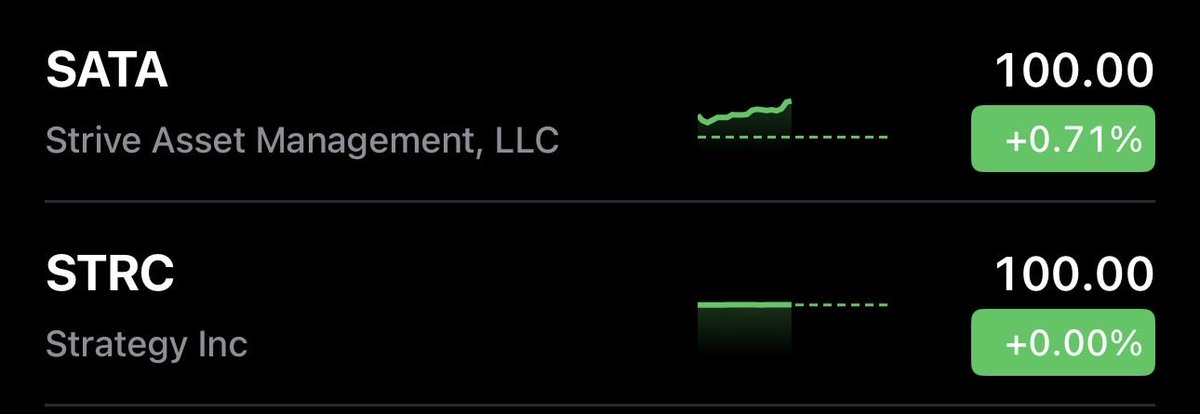
@Strategy 100% of STRC would be held by retail investors if not for SATA backing their copycat (ponzi) project with STRC.
No serious institution within their right mind would touch this, given the risks.
English
Chase retweetledi

Strategy to repurchase $1.5 billion principal amount of 2029 convertible notes. $MSTR $STRC strategy.com/press/strategy…
English