Iacopo Vagliano

1.3K posts

Iacopo Vagliano banner
Iacopo Vagliano

Iacopo Vagliano

@maponaso

Assistant professor of #health #datascience at @amsterdamumc, location @UvA_Amsterdam

Amsterdam, The Netherlands Katılım Mayıs 2014
669 Takip Edilen314 Takipçiler
Iacopo Vagliano retweetledi
elvis
elvis@omarsar0·
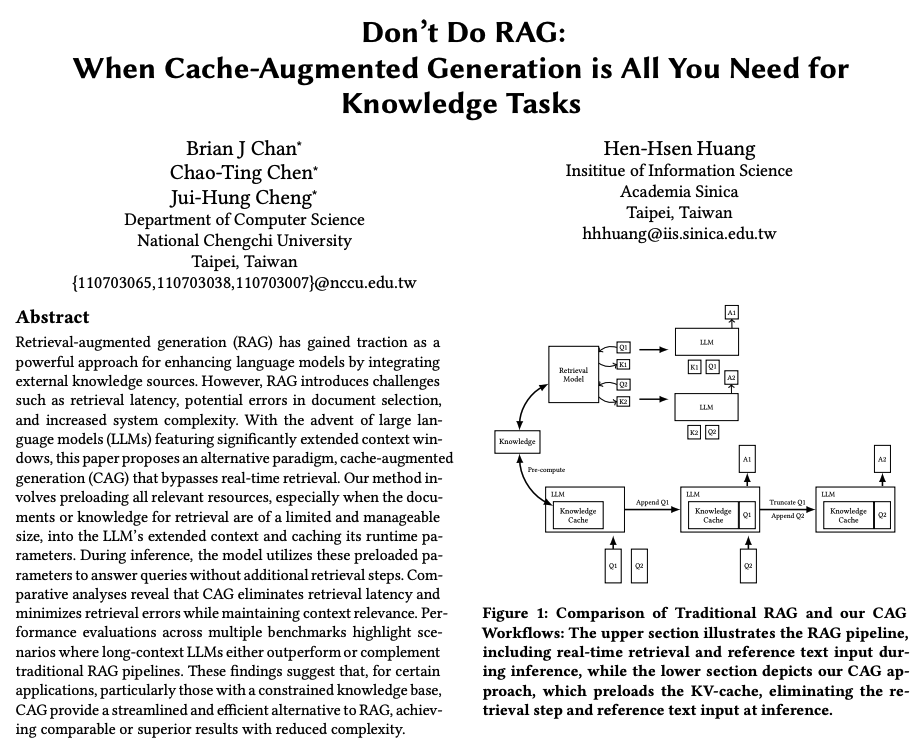
Don't do RAG Proposes cache-augmented generation (CAG) to eliminate retrieval latency and minimize retrieval errors. What is CAG? CAG aims to leverage the capabilities of long-context LLMs by preloading the LLM with all relevant docs in advance and precomputing the key-value (KV) cache. The preloaded context helps the model to provide contextually accurate answers without the need for additional retrieval during runtime. When to apply CAG? It's a useful alternative to RAG for cases where the documents/knowledge for retrieval are of limited, manageable size. My thoughts: As LLMs advance in capabilities, I suspect that what we know as RAG today could change significantly either architecturally or how it's optimized. CAG is one in a growing list of developments and new ideas that have emerged recently to address limitations like poor retrieval relevancy and latency. There could also be hybrid methods that combine preloading with selective retrieval. Don't sleep on long-context LLMs. They are here to stay.
elvis tweet media
English
52
296
2K
169.8K
Iacopo Vagliano retweetledi
Frank Hutter
Frank Hutter@FrankRHutter·
The data science revolution is getting closer. TabPFN v2 is published in Nature: nature.com/articles/s4158… On tabular classification with up to 10k data points & 500 features, in 2.8s TabPFN on average outperforms all other methods, even when tuning them for up to 4 hours🧵1/19
Frank Hutter tweet media
English
35
243
1.4K
263.3K
Iacopo Vagliano retweetledi
LeibnizPostDocs
LeibnizPostDocs@LeibnizPostDocs·
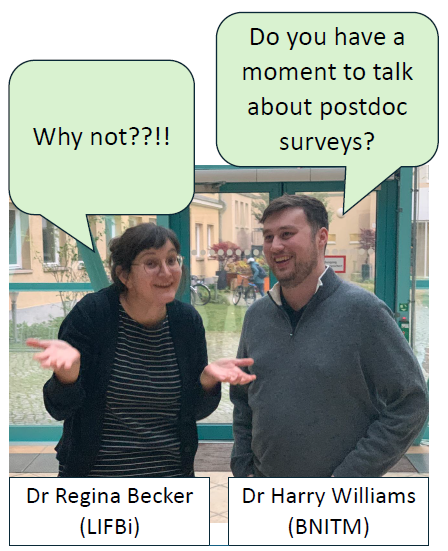
🚨 Are PostDocs Alright? 🚨 Join us on 27.11.2024, for a joint event by @LeibnizPostDocs & German Postdoc Network as we discuss the latest findings from the Leibniz PostDoc survey! 🕛12:00-13:00 CET Register now: bit.ly/40SQ6GA #postdocs #IchBinHanna
LeibnizPostDocs tweet media
English
1
4
11
1.8K
Iacopo Vagliano retweetledi
Ai2
Ai2@allen_ai·
Meet Tülu 3 -- a set of state-of-the-art instruct models with fully open data, eval code, and training algorithms. We invented new methods for fine-tuning language models with RL and built upon best practices in the community to scale synthetic instruction and preference data. Demo, GitHub, technical report, and models below 👇
Ai2 tweet media
English
14
132
526
218.3K
Iacopo Vagliano
Iacopo Vagliano@maponaso·
📢 25 november komen we in actie tegen de bezuinigingen op onderwijs en onderzoek. Laat ook je stem horen voor toegankelijk onderwijs, tegen ontslagen en tegen de langstudeerboete. Teken de petitie een kom in actie! campagnes.degoedezaak.org/campaigns/stop…
Nederlands
0
0
0
38
Iacopo Vagliano retweetledi
Rohan Paul
Rohan Paul@rohanpaul_ai·
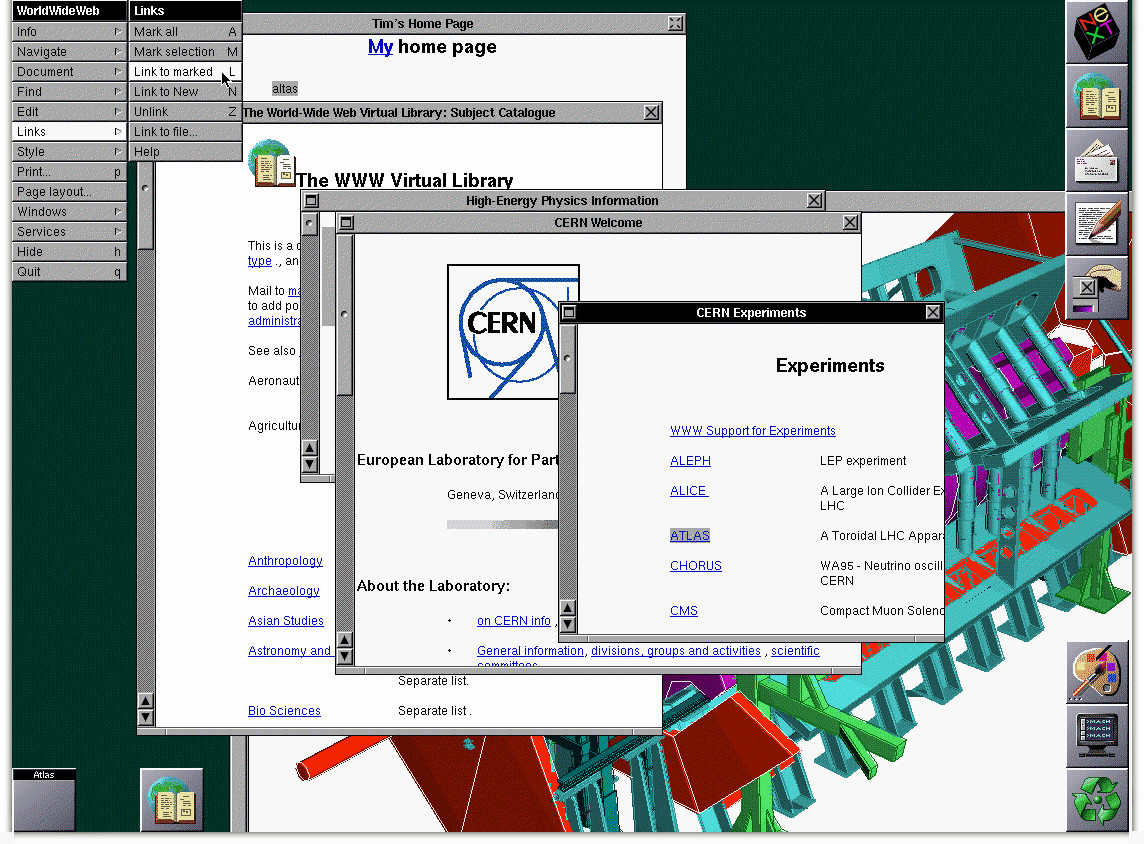
Incredible LLM Creation Visualization in this Site. Click on each section, like Embedding, LayerNorm, Self Attention, and it will show you the mechanics of that section . (link in comment)
English
8
195
984
70.6K
Iacopo Vagliano retweetledi
Matthew Berman
Matthew Berman@MatthewBerman·
.@MistralAI launched a ton of new AI features/models today! The best part? It's all absolutely free. Here's everything you need to know: 👇
English
35
201
1.8K
392.8K
Iacopo Vagliano retweetledi
Rohan Paul
Rohan Paul@rohanpaul_ai·
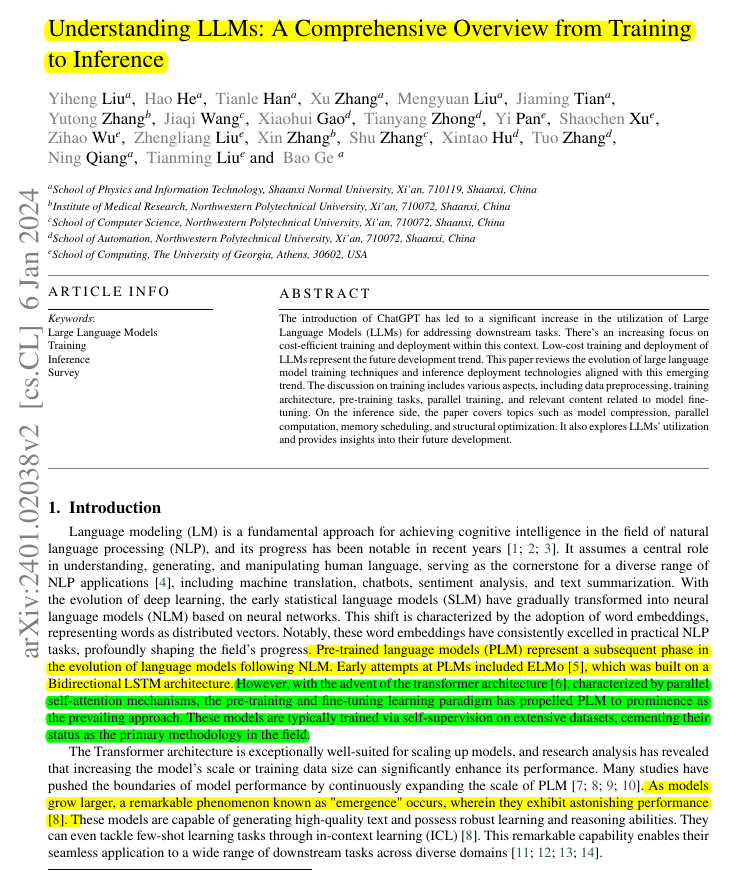
Great read - "Understanding LLMs: A Comprehensive Overview from Training to Inference" The journey from self-attention mechanism to the final LLMs. This paper reviews the evolution of large language model training techniques and inference deployment technologies. -------- → The evolution of LLMs and current training paradigm Training approaches have evolved from supervised learning to pre-training and fine-tuning, now focusing on cost-efficient deployment. Current focus is on achieving high performance through minimal computational resources. → Core architectural components enabling LLMs' success The Transformer architecture with its self-attention mechanism forms the backbone. Key elements include encoder-decoder or decoder-only designs, enabling parallel processing and handling long-range dependencies. → Key challenges in training and deployment Main challenges include massive computational requirements, extensive data preparation needs, and hardware limitations. Solutions involve parallel training strategies and memory optimization techniques. → The role of data and preprocessing in LLM development High-quality data curation and preprocessing are crucial. Steps include filtering low-quality content, deduplication, privacy protection, and bias mitigation. 🔍 Critical Analysis & Key Points: → Data preparation strategies drive model quality Processing raw data through sophisticated filtering, deduplication and cleaning pipelines directly impacts model performance. → Parallel training techniques enable massive scale Using data parallelism, model parallelism and pipeline parallelism allows training billion-parameter models efficiently. → Memory optimization is crucial for inference Techniques like quantization, pruning and knowledge distillation help deploy large models with limited resources.
Rohan Paul tweet media
English
12
158
852
73.4K