Marcos

4.4K posts

Marcos

Marcos

@marbarod

Katılım Nisan 2014
620 Takip Edilen93 Takipçiler
Marcos retweetledi
Arseny Kapoulkine 🇺🇦
New blog post! In "Quantizing tangent frames", we look at various established methods to represent tangent frames in the vertex data, squeeze a few variants into 32 bits per vertex and look at the resulting precision. zeux.io/2026/04/30/qua… Retweet, like and subscribe!
English

2
43
184
8.9K
Marcos retweetledi
Martin Mittring
Martin Mittring@MittringMartin·
github.com/iamgio/quarkdo… A modern Markdown-based typesetting system designed for versatility. It allows a single project to compile seamlessly into a print-ready book, academic paper, knowledge base, or interactive presentation.
English
4
9
122
9.2K
Marcos retweetledi
NVIDIA AI Developer
NVIDIA AI Developer@NVIDIAAIDev·
Today, we released Lyra 2.0, a framework for generating persistent, explorable 3D worlds at scale, from NVIDIA Research. Generating large-scale, complex environments is difficult for AI models. Current models often “forget” what spaces look like and lose track of movement over time, causing objects to shift, blur, or appear inconsistent. This prevents them from creating the reliable 3D environments required for downstream simulations. Lyra 2.0 solves these issues by: ✅ Maintaining per-frame 3D geometry to retrieve past frames and establish spatial correspondences ✅ Using self-augmented training to correct its own temporal drifting. Lyra 2.0 turns an image into a 3D world you can walk through, look back, and drop a robot into for real-time rendering, simulation, and immersive applications. ➡️ Learn more: research.nvidia.com/labs/sil/proje… 📄 Read the paper: arxiv.org/abs/2604.13036
English
103
463
2.9K
428K
Marcos retweetledi
Andrea Tagliasacchi 🇨🇦
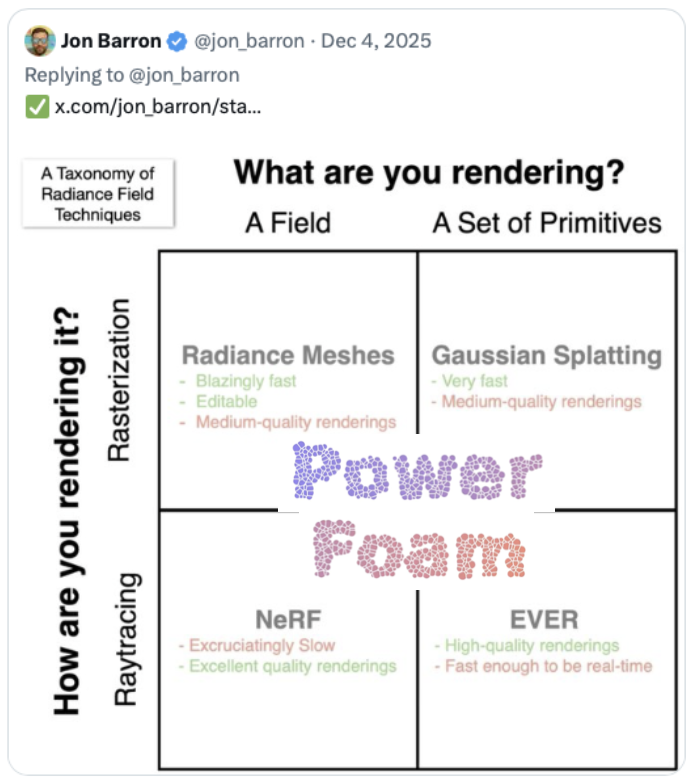
And to conclude, this is the first model that hits the four requirements @jon_barron listed in diagram **simultaneously** No choices to make. One model to rule them all.
Andrea Tagliasacchi 🇨🇦 tweet media
English
4
4
53
3.8K
Marcos retweetledi
Dmitry Karpukhin
Dmitry Karpukhin@skx_doom·
I've recently released the Light Propagation Volumes (custom GI plugin) for #UE5 LPV is an algorithm of resolving the diffuse light bounce from the perspective of the sun in world space (firstly introduced in 2009 by Crytek). It's non-temporal, performant and lightweight.
English
19
83
1K
39K
Marcos retweetledi
Yining Karl Li
Yining Karl Li@yiningkarlli·
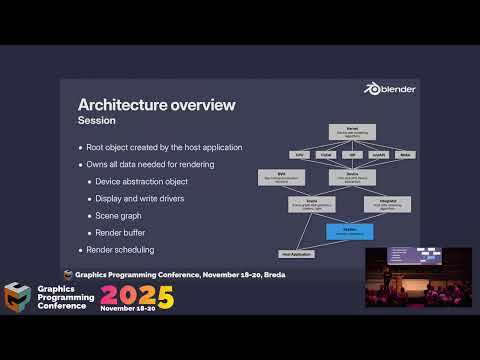
Here’s a cool talk from GPC 2025 on the architecture of Blender’s Cycles renderer. There is no one right answer to designing a renderer; as a rendering engineer, I really like seeing how different renderers choose different tradeoffs to meet user needs: youtu.be/etGMk9wYwNs
YouTube video
YouTube
English
0
18
83
5.8K
Marcos retweetledi
Phosphen
Phosphen@phosphenq·
This 2 hour lecture by Yann LeCun (Turing Award winner) will teach you why the next trillion dollar AI company won't be built on LLMs. He trashes the $100 Billion LLM race, attacks Musk and Amodei, declares scaling dead. Bookmark & watch tonight after work, skip to 7:00.
English
40
392
2.5K
255.6K
Marcos retweetledi
Ignacio Castaño
Ignacio Castaño@castano·
I spent some time reverse-engineering Apple's Lossy texture format. It wasn't as simple as I originally thought, and some of the details surprised me. Check it out! ludicon.com/castano/blog/2…
English
0
27
192
10.6K
Marcos retweetledi
Markus Schütz
Markus Schütz@m_schuetz·
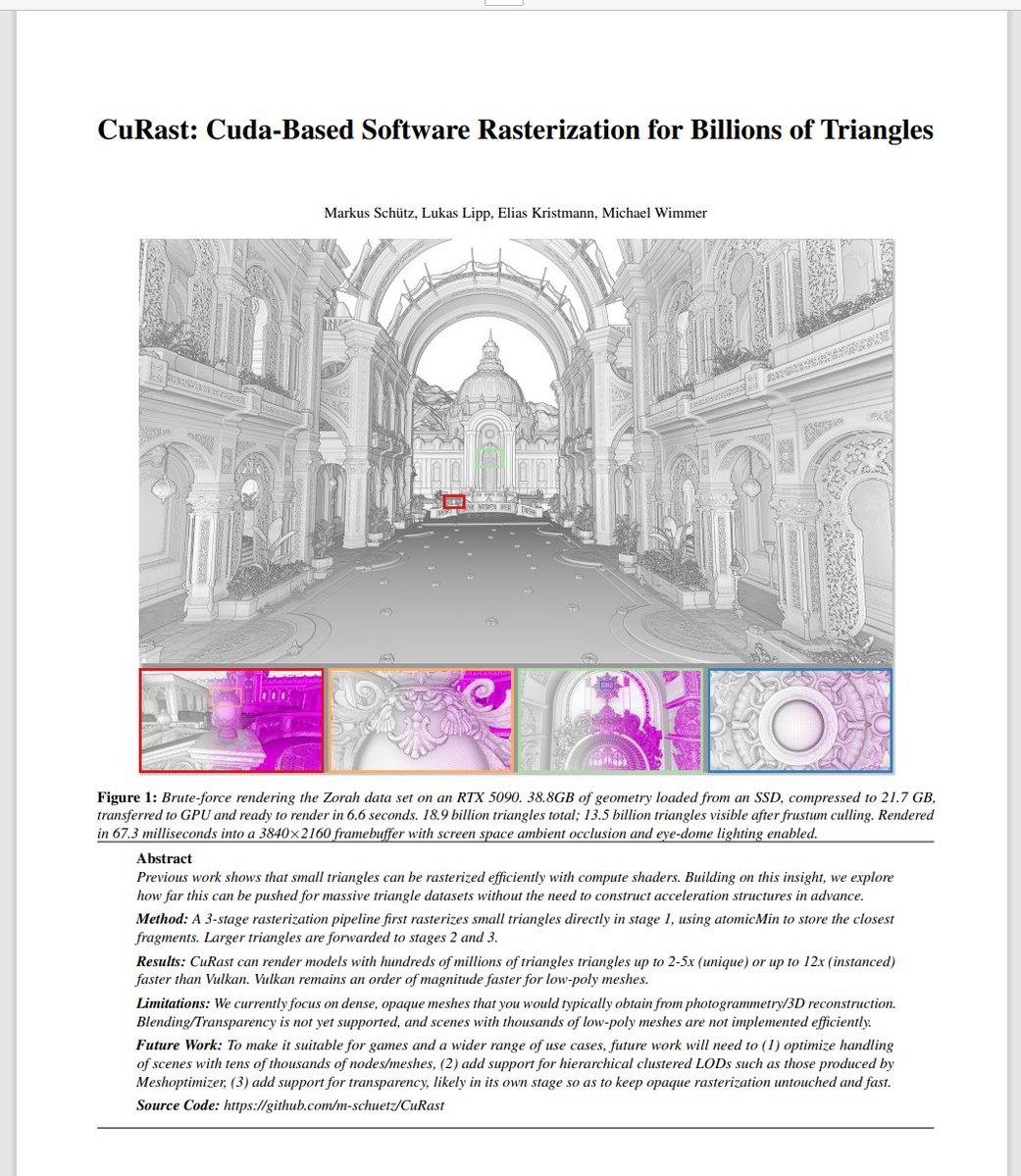
New Paper🙂 Nanite has shown that small triangles can be rendered fast in compute, we're exploring how fast for large meshes with up to 18.9 billion triangles, without the need to precompute LOD structures. Paper: github.com/m-schuetz/CuRa… Source: github.com/m-schuetz/CuRa…
Markus Schütz tweet media
English
9
127
871
66.6K
Marcos retweetledi
Aakash Gupta
Aakash Gupta@aakashgupta·
Earlier this year Yann LeCun left Meta because Mark Zuckerberg wouldn't bet the company on JEPA. Last week his group dropped the first JEPA that actually trains end-to-end from raw pixels. 15 million parameters. Single GPU. A few hours. The timing is not a coincidence. For four years Meta has been the house that JEPA built. LeCun published the original paper from FAIR in 2022. I-JEPA and V-JEPA came out of his lab. The architecture was supposed to be the escape hatch from LLMs, the path to robots that actually learn physics instead of hallucinating about it. Every version shipped fragile. Stop-gradients. Exponential moving averages. Frozen pretrained encoders. Six or seven loss terms that had to be hand-tuned or the model collapsed into garbage representations. Meta kept funding LLMs. Llama shipped. Llama scaled. Llama got beat by Qwen and DeepSeek. Zuck spent $14 billion to buy ScaleAI and install Alexandr Wang. The FAIR robotics group was dissolved. LeCun's research kept winning papers and losing the product roadmap. He left, started AMI Labs, and said publicly that LLMs were a dead end. Now the paper. LeWorldModel. One regularizer replaces the entire pile of heuristics. Project the latent embeddings onto random directions, run a normality test, penalize deviation from Gaussian. The model cannot collapse because collapsed embeddings fail the test by construction. Hyperparameter search went from O(n^6) polynomial to O(log n) logarithmic. Six tunable knobs became one. The downstream numbers are what should scare the robotics capex class. 200 times fewer tokens per observation than DINO-WM. Planning time drops from 47 seconds to 0.98 seconds per cycle. 48x faster at matching or beating foundation-model performance on Push-T and 3D cube control. The latent space probes cleanly for agent position, block velocity, end-effector pose. It correctly flags physically impossible events as surprising. It learned physics without being told physics existed. Figure AI is valued at $39 billion. Tesla Optimus is mass-producing. World Labs raised $230 million to sell generative world models. Everyone in humanoid robotics is burning capital on foundation-model pipelines that plan in 47 seconds per cycle. LeCun's group just showed you can do it with 15 million parameters on a single GPU in a few hours. This is the Xerox PARC pattern running again. Meta had the next architecture. Meta had the scientist. Meta dissolved the robotics team, passed on the productization, and watched the exit. Three months later the lab that was supposed to be Meta's publishes the result that resets the robotics cost structure. The paper is worth more than Alexandr Wang.
Aakash Gupta tweet media
English
64
378
3.3K
1.1M
Marcos retweetledi
sasaki@engineer
sasaki@engineer@rsasaki0109·
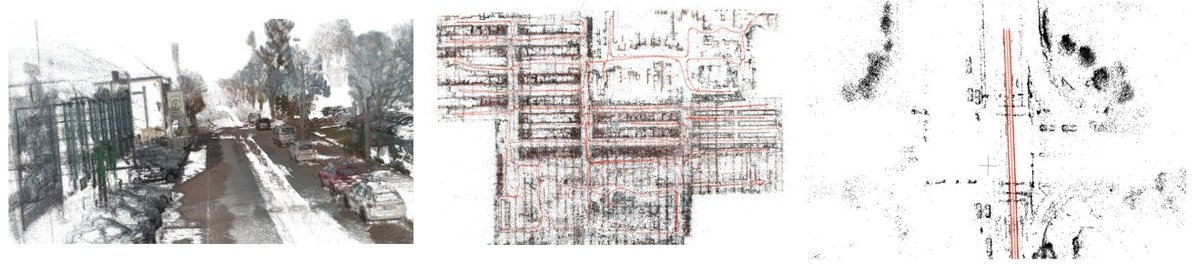
PyCuSFM: Cuda Accelerated Structure from Motion This repository provides the official python implementation of cuSFM, a novel CUDA-accelerated Structure-from-Motion framework for reconstructing 3D environmental models from images. Key features include: -CUDA-accelerated feature extraction, matching, and graph optimization for superior speed and scalability -Precise and robust camera pose estimation -Accurate and consistent 3D environment reconstruction with COLMAP-compatible outputs -Support for any number and type of camera inputs -Reliable extrinsic calibration for multi-camera setups -Localization mode for integrating new data into pre-built map
sasaki@engineer tweet media
English
2
23
182
9.3K
Marcos retweetledi
Vlad Erium 🇯🇵
Vlad Erium 🇯🇵@ssh4net·
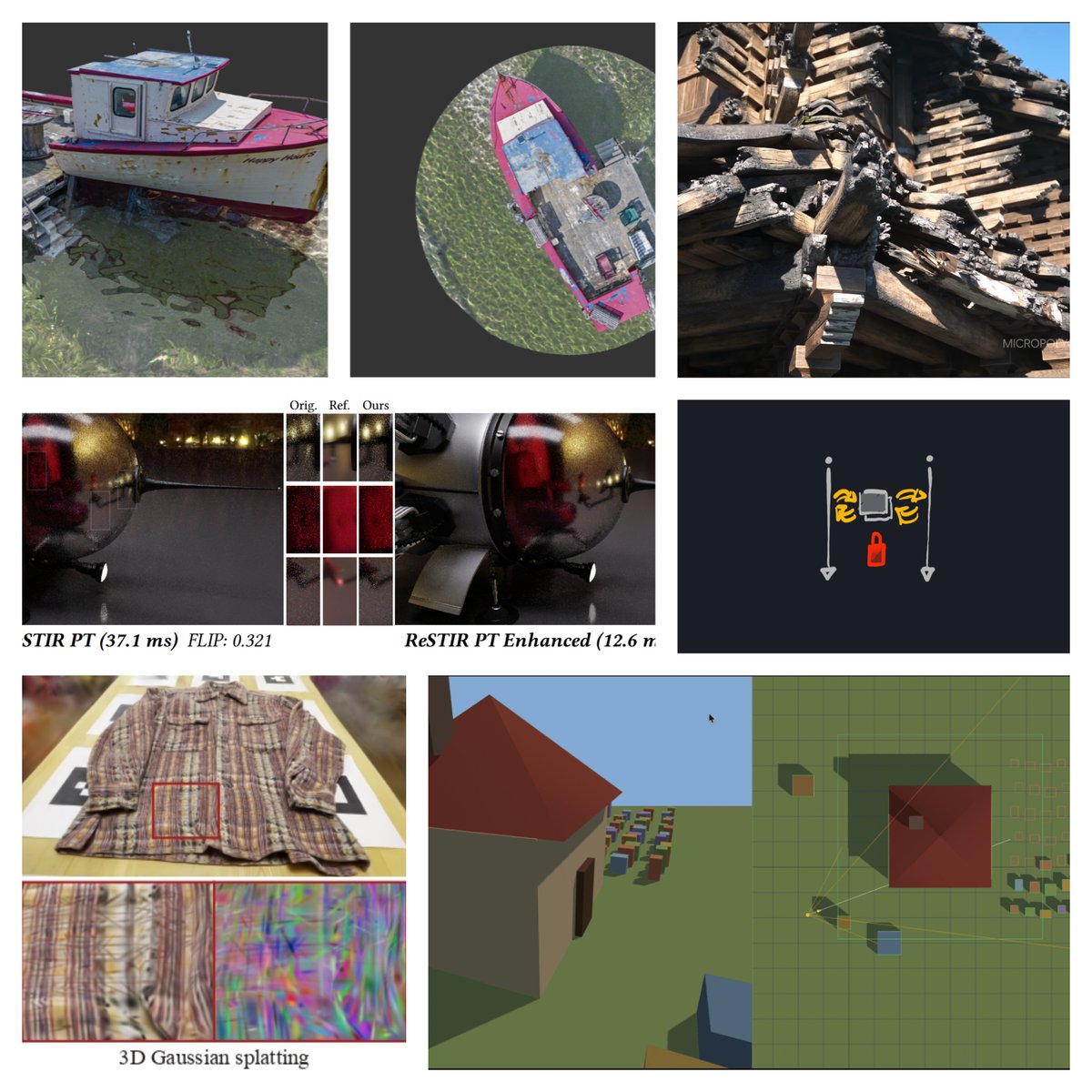
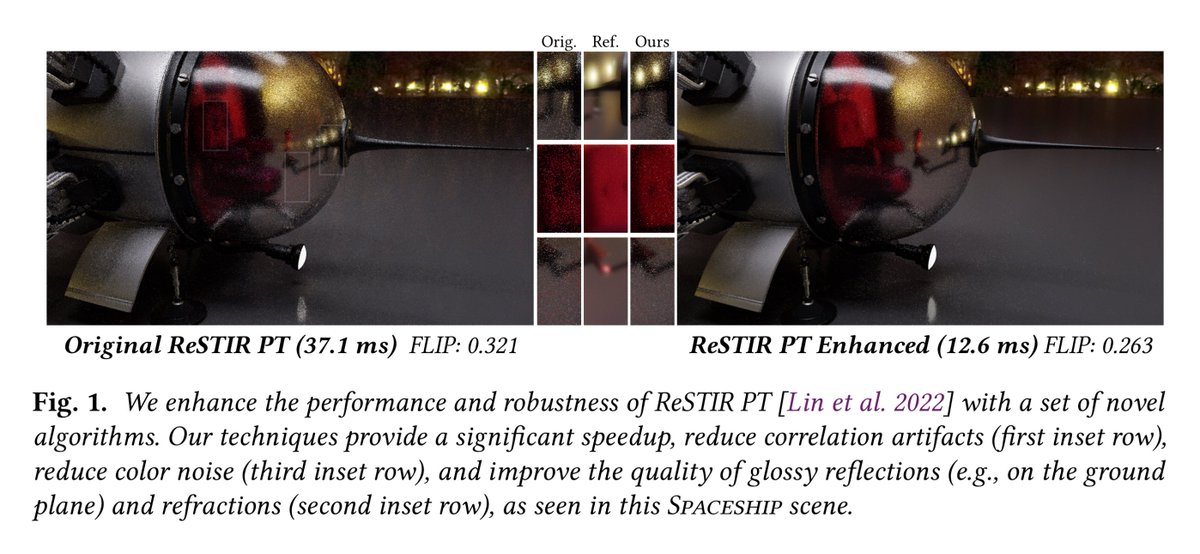
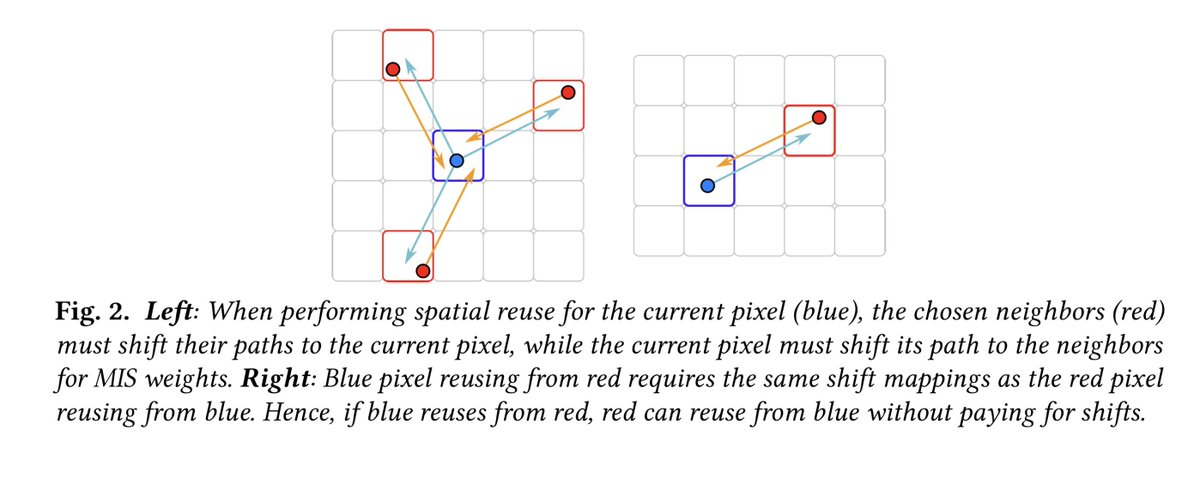
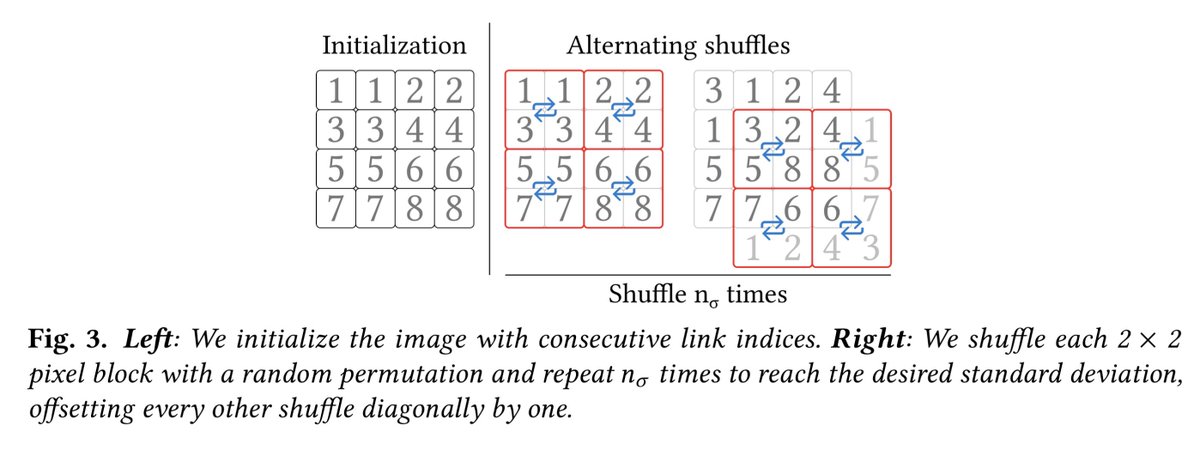
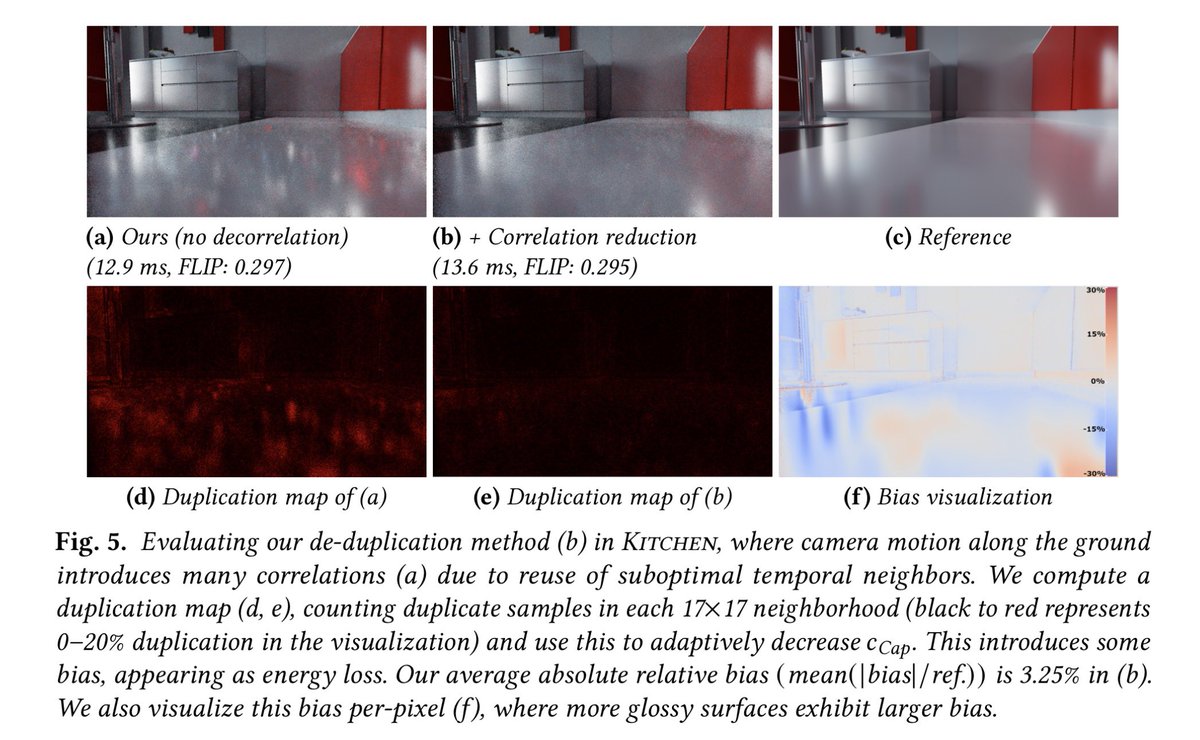
ReSTIR PT Enhanced: Algorithmic Advances for Faster and More Robust ReSTIR Path Tracing Daqi Lin, Markus Kettunen, Chris Wyman (Nvidia) Paper: research.nvidia.com/labs/rtr/publi… Page: research.nvidia.com/labs/rtr/publi… Video: research.nvidia.com/labs/rtr/publi… Supplementary: research.nvidia.com/labs/rtr/publi…  Abstract Algorithms leveraging ReSTIR-style spatiotemporal reuse have recently proliferated, hugely increasing effective sample count for light transport in real-time ray and path tracers. Many papers have explored novel theoretical improvements, but algorithmic improvements and engineering insights toward optimal implementation have largely been neglected. We demonstrate enhancements to ReSTIR PT that make it 2–3x faster, decrease both visual and numerical error, and improve its robustness, making it closer to production-ready. We halve the spatial reuse cost by reciprocal neighbor selection, robustify shift mappings with new footprint-based reconnection criteria, and reduce spatiotemporal correlation with duplication maps. We further improve both performance and quality by extensive optimization, unifying direct and global illumination into the same reservoirs, and utilizing existing techniques for color noise and disocclusion noise reduction.
Vlad Erium 🇯🇵 tweet mediaVlad Erium 🇯🇵 tweet mediaVlad Erium 🇯🇵 tweet mediaVlad Erium 🇯🇵 tweet media
English
1
17
103
7.3K
Marcos retweetledi
Will Eastcott
Will Eastcott@willeastcott·
The @playcanvas team has solved collision for 3D Gaussian splats. Install splat-transform via NPM to get a CLI tool + library that can output high quality voxel-based collision. Here you can see a splat navigated in first person mode with voxel rendering toggled on/off. 🧵
English
15
78
630
28.4K
Marcos retweetledi
Haato Watanabe
Haato Watanabe@HeartWatanabe20·
Gaussian Splatting struggles with high-frequency details. Our #CVPR2026 paper “Neural Gabor Splatting” is out! By augmenting each Gaussian with an MLP that models high-frequency signals, we significantly improve reconstruction quality with fewer primitives.
English
9
85
702
71.3K