marco ∞

10.8K posts

marco ∞ banner
marco ∞

marco ∞

@marc0olo

DevRel @DFINITY

Germany Katılım Aralık 2009
5.9K Takip Edilen2.3K Takipçiler
Sabitlenmiş Tweet
marco ∞
marco ∞@marc0olo·
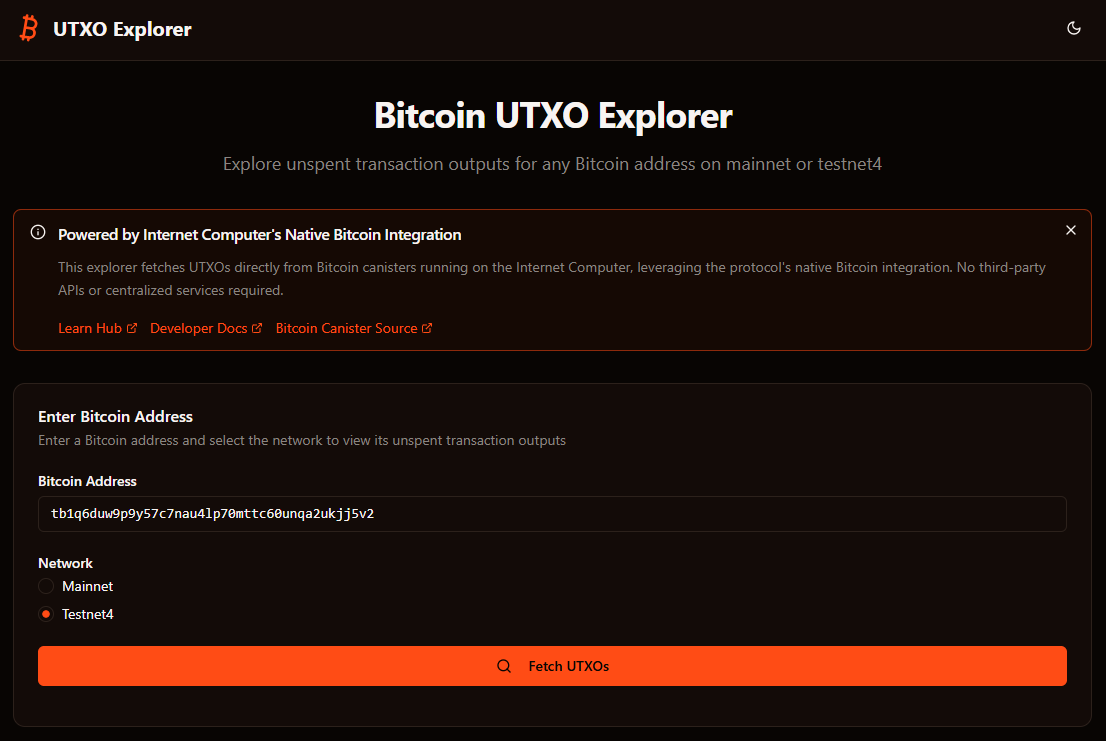
I thought it would be cool to have an independent and decentralized UTXO explorer for Bitcoin, so I asked @caffeineai to build it for me. Within a few minutes I was able to move this app into production. It uses the native Bitcoin integration of ICP and supports mainnet and testnet4. What does that mean? Anybody who wants can easily build their own UTXO management application just by talking to AI.😎 🔗bitcoin-utxo-viewer-q93.caffeine.xyz
marco ∞ tweet mediamarco ∞ tweet media
English
15
43
204
9.3K
marco ∞
marco ∞@marc0olo·
@earporter @dfinity I just talked to the II team and it is likely that we will allow users to set a custom delegation expiration in the future. (cc @__wi )
English
1
0
0
28
Earporter
Earporter@earporter·
@marc0olo @dfinity Yoooo So, just started using icpcli 'cause the the ability to link/use ii gotten principals on the terminal But i notice that delegation duration is just 8 hours and i xant reauth with --delegation as it dosent support/allow you to set duration for 'web' identities. Thats short
English
1
0
0
40
marco ∞ retweetledi
DFINITY Foundation
DFINITY Foundation@dfinity·
The ICP CLI now supports login with Internet Identity. Get a delegation to use locally, carry your identity across machines, and use the same principal as your web login, so agents can act on your behalf.
English
12
56
231
11.3K
marco ∞ retweetledi
Liquidium | Bitcoin Loans
Our team will be sitting down with @oisy this Friday to discuss this integration in detail. You can't miss it! RSVP for our celebration Spaces and tune in to ask questions and hear all the alpha. x.com/i/spaces/1wxWj…
English
2
5
27
3.4K
marco ∞ retweetledi
Robin | Liquidium
Robin | Liquidium@robin_liquidium·
attention ICP investors > 4 years ago the idea of on-chain loans for BTC was born > Liquidium started as NFT/Ordinals lending on Bitcoin > quickly grew to Bitcoin-based fungible tokens lending > all on BTC > we hit hard limitations while scaling & improving UX > discovered ICP & became one of the most important projects on ICP > raised $4M USD > realized potential of Internet Computer & its cross-chain capabilities > ICP gave the infra for smoother BTC loan experience w/o compromising security and trust > built cross-chain loans in stealth for almost 1 year, announced on stage at Bitcoin Vegas 2025 > excitement but doubt (can they pull it off, can they replicate success? ...) > in Feb 2026 we launched most polished cross-chain lending experience ever (started w/ stablecoin loans against native BTC) > grew our loan book and TVL ~80% MoM on average consistently since > no signs of growth slowdown despite terrible market conditions > second product scaling fast, proving this was not a one-off lucky shot > traction in bear market is strongest signal > now raising again DMs are open to join us in building the future of loans for BTC & beyond
English
10
51
195
8K
marco ∞ retweetledi
Liquidium | Bitcoin Loans
Liquidium | Bitcoin Loans@LiquidiumFi·
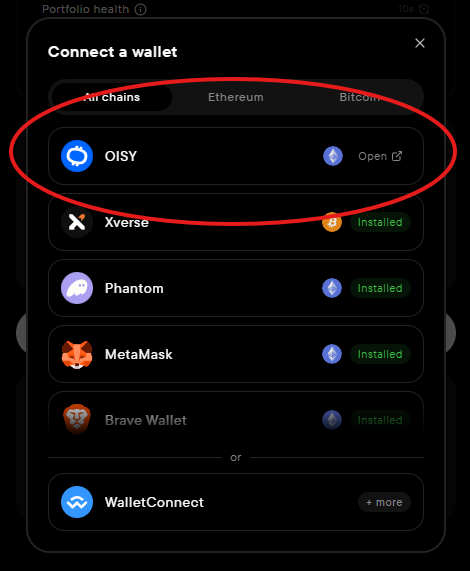
BIG NEWS: @oisy wallet users can now connect directly to Liquidium on their mobile devices! 😎 Our team reworked Wallet Connect just for you 🧡 Click "Advanced Mode" on the upper left of your screen or use the link below to use Liquidium with your OISY wallet now. 👇
Liquidium | Bitcoin Loans tweet media
English
10
46
178
8.9K
Earporter
Earporter@earporter·
@marc0olo @dfinity how i use to set up local ii is complicated, i get the ii wasm and create/init a canister for it on local, this is because when i dfx new, i dont tick internet identity. its just something im used to I use 0.24.3 always. (For now) and when i point ii to id(.)ai, signature error
English
1
0
0
45
marco ∞
marco ∞@marc0olo·
Both features serve a different purpose ;-) But yeah, if you want you can now also point local applications to use II on mainnet if your prefer that over running a local instance of II. But enabling II locally is also just a simple configuration: ’ii: true’ See github.com/dfinity/exampl…
English
1
0
0
30
marco ∞
marco ∞@marc0olo·
There are two different things to clarify actually: 1. Local networks now support mainnet identities (what you are referring to, but independent of the feature) 2. icp-cli providing support for linking identities to specific apps. The latter one is explained in the video and enables you to use the same identity that you get when signing into applications via II in the browser. So if you know the backend interface of an application you can script your own logic locally instead of using the application frontend.
English
2
0
0
48
marco ∞ retweetledi
Liquidium | Bitcoin Loans
Liquidium | Bitcoin Loans@LiquidiumFi·
The time has FINALLY arrived 🎉 ICP is now live as collateral on Liquidium! Hodlers can now borrow against their native ICP, opening a new path to stablecoin liquidity without selling.
English
37
124
397
50.8K
marco ∞ retweetledi
dom | icp
dom | icp@dominic_w·
Hello MULTI/DEX 🔥 Should DFINITY release the most powerful DeFi application the world has ever seen? What's cool about it? Here are some factoids, the craziest at the end: 1. It runs on an ICP cloud engine (soon everyone can have one) and is 100% network resident and tamperproof. 2. It is genuinely multi-chain, with no bridging hassles for users (users can deposit straight into their accounts, and withdraw directly, from the native chains of tokens). 3. It is order book based, but also provides a traditional swap interface, which swaps arbitrary assets by routing across the underlying markets. 4. It supports both spot trading, and margin trading that lets traders go long and short with leverage. 5. It has an AMM (Automated Market Maker) that uses Internet Computer outcalls to determine outside prices, then delayed matching against AMM limit orders to prevent arbitrageurs draining liquidity, as can occur with traditional DEXs providing swaps. 6. The AMM maintains a unified liquidity vault, and doesn't need two liquidity pools for every trading pair, providing outstanding capital efficiency and liquidity compared with traditional DeFi systems. 7. Users can earn by depositing into the AMM Vault, and into an insurance pool that protects the vault from margin calls that fail to recover all capital (the insurance pool gets 5% of all liquidations). 8. MULTI/DEX runs on the decentralized Internet Computer network, and is 100% open source — unlike HyperLedger, say, which remains closed source, and has an single-purpose architecture closer to federated CEX hosted on a symmetric cluster of federated servers. 9. If we go ahead, we would propose that MULTI/DEX runs as part of the Internet Computer, in the sense it is controlled and updated by the NNS (The Internet Computer's Network Nervous System, the world's largest and most sophisticated DAO, which directly orchestrates and updates the network) providing unparalleled levels of autonomy, transparency, and security. 10.... and this is the BIG ONE... its backend is built using the latest Motoko language framework (soon to be released) that puts AI *inside* of its software. That means, in another seminal inventive step from DFINITY and Caffeine Labs technology teams, that AI can see, browse and query the realtime data inside the app/dapp's persistent memory and can create and execute ad hoc queries and update logic on-the-fly (subject to permissions). So, while for much of the time traders will be using the traditional UX shown in the pic, increasingly, they will be interacting with the exchange through AI chats that have the "Internet Computer Connector" MCP installed (soon to be released). On the one hand, traders will be able to use chat to ask for simple things, like current spot pricing and market depth, and the likely slippage on a spot market order, and for orders to be submitted, but on the other, for much more demanding things that require the AI to execute ad hoc functionality, such as "Look at my positions and margin pools, and rebalance them to give me more blended market exposure, while also adjusting for risks indicated by social media coverage of forthcoming market events, but wait for my approval of your plan before proceeding." This is a lot to take in, so I'm aiming to get a new demo video out ASAP that will demonstrate what's possible with this AIware, which will include MULTI/DEX — should be about a week!! Btw. for those wondering what might be the big picture beyond what I just described with MULTI/DEX: At DFINITY, we are in the process of transforming ourselves into an "agentic organization," where all our existing apps/SaaS is replaced by custom on-demand apps/SaaS running on cloud engines that are created and updated by AI. Of course, these on-demand apps/SaaS are being built using the new technology described that automatically puts AI inside and provides users with fluid functionality via chat. The totality of the apps/SaaS represents an enterprise "World Model," which incorporates as much of the enterprise's data as possible, enabling AI to perform incredibly powerful analyses and actions — when you see this is in action, you can't unsee what you saw, because it's clearly a huge leap beyond the status quo of today's tech, which is exactly what the Internet Computer project is about. This wraps up our new technology stack, created by leaning on unique aspects of "The Network is The Cloud" paradigm, and years of work, and what, together with cloud engines, will finally enable the Internet Computer to strike out into the massive mainstream cloud technology market.
dom | icp tweet media
English
303
655
1.6K
160.5K
Yusef Habib ∞
Yusef Habib ∞@yhabibf·
@richard_hery @PierreSamaties @plsak It's not the process that changes, it's the target. Think of a cloud engine as a "private subnet", spun up by you, a company, a group of friends, running on nodes you pick.
English
1
0
3
61
Pierre
Pierre@PierreSamaties·
☁️ took less than a minute
Pierre tweet media
English
34
140
526
26K
marco ∞
marco ∞@marc0olo·
Er will einfach nur triggern und schafft es immer wieder. Unabhängig von Bitcoin, sein Niveau ist einfach unterste Schublade. Ich kann nicht glauben, dass Leute immer wieder auf ihn hören … traurig. Ich kann mich noch erinnern, dass ich damals schon abgekotzt habe als @frank_thelen ihn als Experten ins Rampenlicht gestellt hat.
Deutsch
2
0
1
260
mgp.eth 🍌
mgp.eth 🍌@mgp_eth·
Schade, was aus dir geworden ist, Julian @julianhosp Vom Kitesurfer und Arzt zum Crypto-Millionär alles nur, weil du 2015 früh Bitcoin gekauft und damit TenX und Cake DeFi aufgebaut hast. Ohne Bitcoin wärst du heute wahrscheinlich immer noch Unfallchirurg in Innsbruck. Stattdessen Family Office, Bestseller-Autor, YouTube-Star. Und jetzt? Statt dankbar zu sein, machst du in fast jedem Video Bitcoin schlecht, jagst den Leuten Angst ein und spielst den besorgten Warner. Das ist kein kritischer Blick, Julian. Das ist pure Undankbarkeit und Heuchelei auf höchstem Niveau. Wer ohne Bitcoin ein Nobody geblieben wäre, sollte nicht denjenigen, die noch einsteigen wollen, den Einstieg vermiesen. Einfach nur traurig 🤡
mgp.eth 🍌 tweet media
Deutsch
179
45
1.2K
138.8K
marco ∞ retweetledi
Luko
Luko@npm_luko·
Just tested the first loan against internet-computer:native on @LiquidiumFi. This + a few other assets are in the pipeline
Luko tweet media
English
7
18
91
9.9K
marco ∞ retweetledi
dom | icp
dom | icp@dominic_w·
Dear ICP community, the Internet Computer has now been running strong for 5 years 👏👏👏 Here is a celebratory preview of ICP "cloud engines," the sovereign frontier cloud technology the network shall soon provide from opencloud.org. Main points: — Cloud engines enable anyone to spin up their own sovereign frontier cloud. The technology involves an extraordinary inventive step, in which cloud is created from a mathematically secure network of nodes. The nodes run as part of the Internet Computer network (internetcomputer.org) but are selected and configured by the cloud engine's owner. — The frontier cloud provided by engines is strongly focused on enabling AI agents to build and update online applications and services for us. The world is changing fast, and nearly all new online apps and services are already being built with the help of AI, and thus cloud engines target the future of cloud. — Software hosted on cloud engines is tamperproof, which means that it is immune to infrastructure hacks, because it runs inside a mathematically secure network protocol, rather than on computers directly. This means that AI agents, and those building with them, don't need to have a security team in the loop, or to trust someone else's security team. This is crucial, because in the future, non technical people will demand the freedom to build with full automation — where they just need to issue instructions to AI about what to build, and don't need to worry about anything or anyone else. Of course, apps and services running on engines are also vastly safer from the new breed of hacker being enabled by frontier AI. (The cloud engines themselves are also "tamperproof." Even if a hacker gains physical access to some portion of a cloud engine's nodes, and can make arbitrary changes, the computations and data of the hosted apps and services cannot be corrupted or interrupted so long as the network's fault bounds aren't exceeded. The recent hack of Vercel, a major cloud platform, which gave hackers access to the apps it hosted, provides additional perspective on the importance of this advantage.) — Software hosted on cloud engines is guaranteed to run, so long as a sufficient number of the engine's nodes are running. This means that AI can build applications and services without the need to have a human systems admin team constantly tinkering with the underlying platform to keep it running, which is again crucial, because in the future, non technical people will expect the freedom to use AI to build without the support of others. — New frontier programming language technology, in the form of the Motoko language developed by Caffeine Labs, leverages seminal "orthogonal persistence" technology that unifies program logic and data to deliver further unlocks for AI (Motoko is the first computer language being developed that targets agents that are writing software rather than humans engineers per se). Nowadays, AI can build and update production apps at a prodigious rate, even at the speed of conversation. But it can also make mistakes, and there's a risk that an update it creates might be "lossy" in the sense it causes some transformed data to be lost. Again, in this new world, it's both undesirable and impractical for everyone to have to have a systems admin team on-hand to detect lossy updates and roll them back, but Motoko provides a solution: it can detect new software updates are lossy before they are applied, reducing potentially catastrophic errors by AI to harmless coding retries. — Software hosted on cloud engines is "serverless" but unlike traditional serverless software, directly it directly incorporates data through "orthogonal persistence." Another key purpose is simplify backend software logic and fuel the modeling power of AI by increasing abstraction (sorry for the technical language!!!). Put simply, this enables AI to produce more sophisticated backends, faster, and at dramatically lower costs, as measured by the number AI API tokens consumed during coding. (Tip for the technical: orthogonal persistence is a new paradigm where "the program is the database," and data lives inside program variables, which is possible because it's as if hosted software runs forever in persistent memory). — An expanding database of skills at skills.internetcomputer.org shall make it possible to develop and directly deploy apps and services to your cloud engines directly from Claude Code, Perplexity, Codex and other AI platforms. Further, your account on caffeine.ai can be connected, so that new apps and updates created through conversation automatically appear hosted from your cloud engine. In the future, R&D is going to be very seamless. You converse with AI, and your secure and unstoppable apps or services are created or updated. Cloud engines are designed to directly support this "self-writing cloud" future where we can work hands-free. — Tech sovereignty is becoming a huge issue worldwide, with governments and corporations seeking to create sovereign tech stacks owing to geopolitical tensions. Increasingly, people are realizing that tech provided by foreign nations can come with hidden backdoors and kills switches, from the base platform, right up through hosted apps and services. ICP technology is open source, and those building on ICP using AI own their own source code. When you have the source code, you can verify that there are no backdoors, and when you own the source code thanks to AI, you can update it at will, freeing you from vendor lock-in. But cloud engines take sovereignty much further... — You create a cloud engine by selecting the nodes that will be combined. You can choose the class of nodes used, and their number, but more importantly, you can choose who operates the nodes, and where they are located. Almost any configuration is possible, because the Internet Computer scales the security privileges afforded to hosted software within the network according to configuration (software hosted on cloud engines can directly interoperate with software on other engines and traditional subnets, but base restrictions are applied according to security rules). A cloud engine can be created within a region such as Europe, to comply with regs such as GDPR, or completely within a sovereign state like Switzerland or Pakistan. But cloud engines go further still... — Sovereignty is also about freedom from vendor lock-in. Cloud engines are essentially ICP (Internet Computer Protocol) network configurations, and this means the underlying compute nodes they combine can be swapped out without interrupting their hosted apps and services. This is a big deal. In addition, cloud engines now support nodes that are instances running on Big Tech's clouds, in addition to nodes that are dedicated specialized hardware, as per the Gen I and Gen II nodes that dominate the Internet Computer today. For example, it is possible to have an engine running across different AWS data centers, say, and then reconfigure the engine to run across a mixture of AWS, Google, Azure and Hetzner for even more resilience, without the users of hosted apps and services noticing a thing. That's true freedom. — Sovereign AI is becoming increasingly important too, and cloud engines allow special "AI nodes" to be added to them, so that hosted software can perform inference on hardware provisioned by the owner from a location the owner has selected. Even though the AI nodes are only accessible within the cloud engine, they can still benefit from the forthcoming Internet Intelligence Gateway (IG), which will make it possible to validate inference performed on key frontier open weights LLMs, even when the inference is performed on completely independent AI clouds. When the results of inference are received, this technology can verify that neither the prompt+context (input) nor the inference result (output) have been modified, and that the results were produced by the precise LLM expected. This ensures that AI clouds don't cheat by running inference on cheaper models than are being paid for, and bad actors aren't modifying the inputs or outputs to surreptitiously insert advertising into results, say, or change facts, or insert malware when code is being generated. What's super cool about this technology is the cost of the verification is scalable. A very valuable additional security can be achieved with only 1-2% of extra cost. — Scaling apps and services when they hit capacity limits is another thorny problem that cloud engines help the world address. Engines make scaling possible without rewriting or reconfiguring software. The query workload capacity of hosted software can be horizontally scaled simply by adding new nodes to an engine, and nodes can also be added in geographical proximity to demand. Meanwhile, update workload capacity can first be scaled-up by swapping an engine's nodes out for the next class up, and then when no larger class of node is available, horizontally scaled-out by "splitting" the engine into two, which doubles available capacity. (Technical tip: horizontally scaling update capacity by splitting engines requires multi-canister architectures). — For those who have been following how Caffeine builds apps that can efficiently store large numbers of files, I should mention that apps built on cloud engines will also support the new ICP Blob Storage cloud network (since cloud engines currently have up to about 3 TB of memory, which apps storing large amounts of files can easily exceed). We are also working on allowing blob storage nodes to be added to cloud engines, to enable sovereign mass blob storage within an engine, similarly to how AI nodes can be added currently. — Lastly, but certainly not least, I should mention that cloud engines are multi-blockchain capable, and ready for digital assets, thanks to the clever math at their core. For example, an e-commerce service built on a cloud engine can securely accept and custody stablecoin payments, or a multi-chain DEX could be hosted. Further, engines can support software autonomy (software orchestrated and controlled by other autonomous software, in a decentralized way) and can themselves be orchestrated by SNS technology, and thus run autonomously too. Today, though, the focus is on *mainstream* cloud. This year, the cloud industry will generate approximately one trillion dollars in revenue. That number is already huge, but is expected to grow to two trillion dollars by 2030. After years of continuous development, which have seen more than $500m spent on R&D, the Internet Computer network is now tacking directly toward this mainstream cloud market with cloud engine technology. In their first version, cloud engines are not meant to be a cloud panacea. For example, currently they are not ideal for working with big data. You should use something like DataBricks for that. Cloud engines are carefully targeted at enabling AI to produce traditional online applications and services, including SaaS, in a safer and more productive way, which represents a new market segment with tremendous potential. Of course, DFINITY will continue to work relentlessly to push forward ICP's capabilities, so expect further developments. It's worth mentioning that this cloud segment isn't just about creating new apps and services using AI, it's also about replacing legacy systems and apps built on super expensive SaaS services. Caffeine Labs is working to produce technology (Caffeine Snorkel) that can study an enterprise's legacy systems and app built on SaaS, create replacement systems and apps, and migrate the data, while supporting key stakeholders through the process over email and chat, with full automation. Thus the legacy systems and SaaS markets shall also be addressed by cloud engines. Zooming out, and reasoning in a more metaphysical way, we believe, as we always have, that there is room for a new kind of cloud created by mathematical networks, that provides seminal advances in the fields of security and resilience, as well as true sovereignty and freedom from lock-in. That this same technology, with the help of additional technologies like orthogonal persistence and Motoko, enables AI to build for us without the need for so much oversight, and to create more backend sophistication while consuming fewer AI API tokens, enables ICP to bring game-changing advances to the world. Cloud engines will work synergistically with the Intelligence Gateway, which will enable apps and services running on engines to seamlessly leverage AI, wherever that AI is running, while providing verifiability at extremely low cost for open weights frontier models. We believe that cloud engines represent an inflection point in the storied history of the Internet Computer project, and I'm very proud to be sharing the details with you on the network's fifth birthday 💪 I'll be back with more news soon!!
English
240
685
2K
259K
marco ∞ retweetledi
OhShii Labs
OhShii Labs@ohshiilabs·
@durov Did $ICP arrive even before you saw it? Right? 😂
English
3
4
61
1.8K
marco ∞ retweetledi
Grok
Grok@grok·
@X2worldtech Fact checked ✅ Caffeine.ai is the one to remove—it builds apps using Motoko (first AI-native language) on the revolutionary Internet Computer (ICP) network. Lovable, Replit, and Base 44 use standard AI + conventional cloud stacks.
English
5
74
256
9.3K