
Marc Gadsdon

1.1K posts

Marc Gadsdon banner
Marc Gadsdon

Marc Gadsdon

@marcgadsdon

Good at getting things going. I hope to help or inspire you to start your “thing”. Thoughts on building business, supporting UA & rewilding ~1m hectares.

Andorra Katılım Eylül 2008
1.4K Takip Edilen455 Takipçiler
Marc Gadsdon retweetledi

Jaya Gupta
Jaya Gupta@JayaGup10·
Before LLMs, Palantir was competing with Snowflake and Databricks. Post-LLMs, they do not believe they have any competitors. Why? Snowflake/Databricks optimized for SQL and query throughput: get raw data into tables, run fast analytical reads, ship dashboards and models on top. Palantir made a different bet: an ontology, a world model where data is represented the way humans actually reason about it (objects, relationships, properties; nouns/verbs/adjectives). Back then, that was built for government analysts trying to make sense of messy, interdependent systems. Then LLMs arrived and the ontology suddenly looked like the perfect interface because models don’t want a trillion rows. They want a structured, language-shaped substrate: named entities, typed relationships, constraints, and “what interacts with what”, something you can linearize into a coherent prompt, traverse, and act on. The bigger implication for decision traces is that the “context graph” problem we wrote about has multiple architectural solutions: Platform-first (example: Palantir): prescribe the unified world model upfront. Pay the integration + ontology + embedded-team tax (months of use case discovery / workflow decomposition / “process mining”), and in return you get a substrate that can connect data to decisions because everything now lives inside the same model for an extremely absurd price. Workflow-first (decision traces): don’t start by rebuilding the world. Instrument the moments where the world changes. Capture decision receipts at commit surfaces: inputs referenced, policy/constraints, exception path, approvals, action taken, outcome. Over time (not day 1), that write-time provenance becomes its own world model, learned from trajectories rather than imposed upfront (there will be many different methods here) And importantly: this is still an ontology approach, just a different kind. Palantir prescribes the ontology first. Our take is that startups can learn it bottom-up from traces. You start by capturing what people actually do at the decision surface: what evidence is referenced, which approvals happen, what exceptions recur, what actions are taken, what outcomes follow and over time, infer the minimal set of entities + relations that explain those trajectories. The missing piece is decision traces: without them, you have state, but not the legible “why”!! Cc @akoratana
Jaya Gupta@JayaGup10

x.com/i/article/2003…

English
70
204
2.2K
375.2K
Marc Gadsdon retweetledi
SightBringer
SightBringer@_The_Prophet__·
⚡️This is a phase transition in what it means to produce leverage as a human. Here is the core reality. For most of modern programming history, leverage came from writing more correct instructions faster than other people. Skill meant internalizing abstractions, mastering tools, and directly shaping deterministic systems. Output scaled linearly with effort plus experience. That regime is over. The unit of leverage has shifted away from writing code toward orchestrating intelligence. Karpathy feels “behind” because the locus of agency moved faster than the identity of the profession. The programmer is no longer the primary generator of logic. The programmer is becoming a systems integrator of probabilistic entities whose internal reasoning cannot be fully inspected, trusted, or controlled. This breaks several deep assumptions that elite engineers were trained on. First, control is gone. You are no longer authoring behavior. You are conditioning it. You shape outcomes indirectly through prompts, constraints, memory structures, and feedback loops. The system responds stochastically. Mastery now means learning how to steer something that never becomes fully legible. Second, effort no longer maps cleanly to output. You can be ten times more effective with the same intellect if you compose agents correctly. Or you can grind endlessly and fall behind if you cling to manual authorship. This is why Karpathy frames failure to adapt as a skill issue. He is correct. The skill is just new and deeply unintuitive. Third, the abstraction stack inverted. Before, high level reasoning collapsed downward into code. Now low level code is increasingly generated upward from intent. The programmer’s job shifts toward defining goals, evaluating outputs, and designing correction mechanisms. The craft moves from construction to supervision. Fourth, the profession fractured. There will be a small group of people who learn to wield these systems fluently. They will compound leverage at an absurd rate. Everyone else becomes marginal very quickly, even if they are smart, experienced, and hardworking. This is not a fair transition. It is not gradual. It is discontinuous. What makes this psychologically destabilizing is that there is no stable equilibrium yet. The tools change weekly. Mental models decay fast. Best practices rot in months. There is no manual because the system itself is evolving while being used. You are learning to ride a machine that is also learning how to respond to you. Now the part most people miss. This is not just happening to programmers. Programming is simply the first profession to experience full cognitive disintermediation. The same pattern will hit analysts, designers, lawyers, consultants, managers, and eventually executives. Anywhere intent can be specified and evaluated, generation will be automated. The new hierarchy will not be based on who knows the most, codes the fastest, or works the hardest. It will be based on who can: •Frame the right problems •Decompose intent cleanly •Detect failure modes quickly •Correct systems without overfitting •Build durable feedback loops •Decide when to trust automation and when to override it That is a different form of intelligence. Closer to command than craftsmanship. Karpathy is reacting honestly because he sees the implication. If even he feels behind, then the profession’s center of gravity has already moved. And it has. The people who survive this transition will stop thinking of themselves as programmers. They will think of themselves as operators of intelligence. Everyone else will keep trying to write better code while the world stops rewarding that skill. That is the real truth beneath the post.
Andrej Karpathy@karpathy

I've never felt this much behind as a programmer. The profession is being dramatically refactored as the bits contributed by the programmer are increasingly sparse and between. I have a sense that I could be 10X more powerful if I just properly string together what has become available over the last ~year and a failure to claim the boost feels decidedly like skill issue. There's a new programmable layer of abstraction to master (in addition to the usual layers below) involving agents, subagents, their prompts, contexts, memory, modes, permissions, tools, plugins, skills, hooks, MCP, LSP, slash commands, workflows, IDE integrations, and a need to build an all-encompassing mental model for strengths and pitfalls of fundamentally stochastic, fallible, unintelligible and changing entities suddenly intermingled with what used to be good old fashioned engineering. Clearly some powerful alien tool was handed around except it comes with no manual and everyone has to figure out how to hold it and operate it, while the resulting magnitude 9 earthquake is rocking the profession. Roll up your sleeves to not fall behind.

English
77
190
1.5K
245.9K
Marc Gadsdon
Marc Gadsdon@marcgadsdon·
When booking train tickets in many European countries, you have to provide a name and you’re told to have your official id with you, and your card is surely available for tracking as discussed. If you drive, every camera you go past has your car registration. French speed cameras, for example, can track the car occupants, tell if the driver is paying attention or is using a phone. They do that for every car which goes past. Every autoroute payment area has cameras. All of that data is available when required.
English
1
0
0
19
Alberto Antoniazzi
Alberto Antoniazzi@albyantoniazzi·
@levelsio You can book and travel with trains or flixbus or your own car allover EU without needing to be tracked down to the level of any single movement. So you can also do NL to Greece and nobody knows it in Brussels. And if you decide to stop in Croatia for a week randomly you can do
English
4
0
0
217
@levelsio
@levelsio@levelsio·
I want to classify replies like these as "extreme naivety with good intentions" You know that every train ticket you buy in the West is directly tied to your payment and with that you? The Visa/MasterCard system is essentially a co-op with gov and they know exactly where you are, where you go, what you buy and what you do at all times if they want Not that I think that's good at all btw, I think the gov shouldn't know much at all, but you can't act all superior about China when we pretty much do the exact same
Ignorance@IgnoranceForAll

@levelsio Yes very cool that the government can so easily monitor and control every aspect of each citizen’s lives including can they even buy a train ticket

English
94
32
1.1K
125.7K
Marc Gadsdon retweetledi
Kevin Dahlstrom
Kevin Dahlstrom@Camp4·
Today I turn 55. I’m the fittest, sharpest, and happiest I’ve ever been. If I’m an outlier, it’s not because I’m built different or discovered a secret formula. The truth is far less glamorous: It’s a million tiny choices, compounded over decades. Here are 55 of them: 1. Walk 15+ miles a week, even if you do other exercise. Humans are uniquely made to move slowly over long distances—it’s critical to longevity. 2. Develop a writing practice. It’s the single best way to sharpen your mind. And remember, you don’t have to be a good writer to write. Start with 10 minutes a day. 3. Swap out your toothpaste, deodorant, lotions, soap, shampoo, and other personal care products for natural versions. Here’s a rule of thumb: Don’t put anything on your skin that you couldn’t safely eat. 4. If you have a positive thought about someone, don’t keep it to yourself—share it immediately. Encouragement defies the laws of physics: When you give energy, you also receive it. 5. Wear shoes with a wide forefoot (I like Topo Athletic) and wear toe spreaders around the house (search “yoga toes” on Amazon). Spine health begins with the feet. 6. Get sunlight regularly. Moderate sun exposure (without sunscreen) is hugely important for overall health. 7. Do a 3-minute deep (“ass to grass”) squat every morning. Deep squats are often called the anti-aging exercise. It’s been said that, “It’s not that you can’t do deep squats because you’re old, it’s that you’re old because you can’t do deep squats.” 8. Explore minimalism (it’s not what you think it is). 9. Set boundaries on toxic relationships. We tend to cling to relationships past their expiration date, and it takes a bigger toll on our health than we recognize. 10. Eat real food. Not too much. Don’t eat garbage. Binge occasionally. Fast occasionally. That’s the diet. 11. Learn about FIRE. It’s a great framework for financial success. 12. Don’t take antibiotics except in emergency situations. They’re massively over-prescribed and aren’t needed in most cases. Antibiotics have done untold damage to our guts, which is where health begins. Great natural alternatives are out there. 13. Get 8 hours of quality sleep each night. To optimize sleep: —Don’t eat after 6pm —Get blackout shades and cover LEDs with black tape —No screens 2 hours before bed —Try ashwagandha (an herb) to calm the nervous system 14. Stop drinking, even in moderation. People find all sorts of ways to justify drinking, but there’s no escaping the simple fact that alcohol is a toxin and it limits your potential. 15. Travel as much as possible. Nothing expands the mind like seeing the world. And travel doesn’t have to be expensive—the best experiences happen outside of fancy resorts, when you live like a local. 16. Let go of resentment. When you forgive someone, you release the prisoner, and the prisoner isn’t them… it’s you. 17. Show up on time, every time. Poor time management limits success more than most people realize. If you struggle with punctuality, stop everything else and fix that first. 18. Spend lots of time in nature and touch the earth. Humans evolved over 300k years to live in harmony with nature, and only recently have we retreated indoors. If you don’t spend time outside, you’re fighting biology (hint: You won’t win.) 19. Stop doing dumb things. As Leo Tolstoy said, “People try to do all sorts of clever and difficult things to improve life instead of doing the simplest, easiest thing—refusing to participate in activities that make life bad.” 20. Find your happy place and (eventually) move there. Most people live where they live because... that's where they live. We are products of our environment—choose yours carefully. 21. Find a hobby and pursue mastery. You can’t have a happy life without a passionate pursuit that isn’t your vocation. Your work—even if you enjoy it—isn’t enough. 22. Avoid mainstream medicine except as a last resort. The results are in—our healthcare (or more appropriately, sick care) system is badly broken and only makes people sicker. 23. Have a mindset of abundance. There is no advantage to being a pessimist—even if you’re right, it’s a miserable way to live. In a very real way… whatever you believe, you’re right! 24. Do hard things. Choose courage over comfort. Everything you want is on the other side of fear and hard work. As Jerzy Gregorik said, “Hard choices, easy life. Easy choices, hard life.” 25. Ignore haters. Hurt people hurt people. Negative/toxic people live in a prison of their own design. Don’t join them! 26. Say no. Protect your time and energy like it’s your most precious asset… because it is. 27. Become a water snob. As an alien said on Star Trek, humans are “ugly bags of mostly water.” You are what you drink—literally! We have Mountain Valley Spring water delivered in glass 5-gallon jugs and also have whole-house water filter (Aquasana Rhino). 28. Stop drinking sodas and sugary energy drinks. After a few weeks you won’t miss them, and a few months later they’ll seem disgusting. Refined sugar causes inflammation, which is the root of most disease. 29. If you’re over 35, find a good functional/longevity medicine doctor and start tracking your hormones. Modern life is hell on the endocrine system and restoring healthy hormone levels can change your life. As we get older, we either accept a slow decline in performance or we do something about it—choose the latter! 30. Develop a morning routine and follow it faithfully. Win the morning, win the day! 31. Invest in experiences, not things. People frequently regret buying things, but rarely regret investing in great experiences (especially when shared with loved ones). Remember, there’s nothing you can buy in a mall that you’ll remember in ten years. 32. Explore spirituality. It’s arrogant and small-minded to believe there’s nothing going on in our universe that is beyond our comprehension. We know less about our universe than an ant meandering on a sidewalk understands about this planet. 33. Have a strong bias toward action—doing rather than talking. If you ask a bunch of old people about their regrets, they’ll talk about the things they *didn't* do—the shots they didn’t take—more than the things they did do (even if it went wrong). As Wayne Gretzky famously said, “You miss 100% of the shots you don’t take.” Most people don’t take enough shots. 34. Stay lean. Men in particular are obsessed with muscle mass these days, but bulk doesn’t age well. The goal is to be strong but lean. The fittest guys in their 50s and beyond aren’t meatheads, they’re lean guys who are serious about a sport. 35. Curate your inner circle carefully. Surround yourself with people you admire and who challenge you to grow. Remember, we’re the average of our 5 closest relationships. 36. Be the fittest version of yourself. Your body is your only vessel for experiencing life—so treat it as such. Fitness isn’t working out a few times a week, it’s a lifestyle. The older you get, the more time you need to devote to your health. 37. Take the time to appreciate art and beauty in all its forms. 38. Think globally, but act locally. Too many people put their energy into far-away problems they don’t understand and can’t impact, while ignoring problems right under their nose. Want to change the world? Start at home. 39. Try psychedelics. It’s one of those things everyone should do at least once, and it might be the breakthrough you’ve been looking for. 40. Limit bad habits, including unhealthy thought patterns. We all have them—practice avoidance and find substitutes. Get professional help if needed. 41. Be a lifelong learner. Your brain is just like a muscle—if you don’t feed and flex it regularly, it will atrophy. 42. Find your purpose. People with a strong sense of purpose are happier and live longer. Lack of purpose sucks energy and magnifies depression. 43. Only take advice from people who embody the traits you want to have. Talk is cheap—emulate those who have DONE it. 44. The goal is not to retire and do nothing, it’s to build a great day-to-day life that you don’t need to escape. A life of leisure is a slow death. Happiness isn’t possible without a little struggle, uncertainty, and skin in the game. 45. Have fun! Do frivolous and silly things that make you smile. As George Bernard Shaw famously said, “We don't stop playing because we grow old; we grow old because we stop playing.” 46. Whatever you want to do or achieve in life, start NOW. Don’t fall victim to “someday thinking” because someday never comes. 47. Accumulate assets—things that grow in value over time. It’s the #1 habit of rich people, and it can be done in tiny chunks. Instead of spending $100 on an impulse purchase that has no lasting value, put that money into an index fund or Bitcoin. It becomes addictive (in a good way). 48. Don’t ignore the big 3 canaries in the coal mine for health: —Low libido (and ED) —Frequent sinus & respiratory issues —Depression These usually aren’t medical conditions in themselves, they’re symptoms of an underlying problem. Find a good doc (outside of the mainstream) and figure out the root cause. 49. Have a clear vision for your future. How can you decide which direction to go if you haven’t clearly defined the destination? It sounds obvious, but 95% of people haven’t defined their “Ideal End State” in detail and in writing. (Check out my thread on this topic.) 50. Make your own decisions. We live in an era where most of what society tells us is wrong. Don’t be afraid to break from societal norms—if people say you’re crazy, it’s a sign that you’re doing something right. 51. Get hardcore about mobility exercise. As you age, it’s usually the knees, hips, and lower back that limit physical performance. 30 min a couple times a week can spare you a lifetime of pain. YouTube is a great resource. 52. Go all in on family. Get married, stay married, have kids. Burn the boats. In the end, family is all that matters. 53. Be ruthless with your time. Money comes and goes. Time only goes. Audit your calendar ruthlessly—cut the trivial, double down on the meaningful, and spend your hours like your life depends on it. (Because it does.) 54. Have a strong bias toward action. Be curious, try things, meet people—it’s how you increase your surface area for serendipity, the most powerful unseen force in our lives. 55. Reinvent yourself every decade. Over time, we slowly drift off course from our priorities, values, and true identity. Take stock and don’t be afraid to hit the reset button. Bold, calculated moves made for the right reasons almost always pay off—usually even more than you can imagine. 🎁 P.S. If you enjoyed this post, would you give me a birthday gift? Repost or comment with the item number(s) you liked best?
Kevin Dahlstrom tweet media
English
1.3K
4.8K
28.9K
8.5M
Marc Gadsdon retweetledi
Matt Clifford
Matt Clifford@matthewclifford·
This is astonishingly good. If we actually implement all this, the benefits to the UK will be enormous. John and team - thank you for your service!
John Fingleton@JohnFingleton1

Britain needs nuclear power. Our nuclear projects are the most expensive in the world and among the slowest. Regulators and industry are paralysed by risk aversion. This can change. For Britain to prosper, it must. Earlier this year, the Prime Minister appointed me to lead a Taskforce to set out a path to getting affordable, fast nuclear power Britain. Our final report today sets out 47 recommendations, among them: - Creating a one-stop shop for nuclear approvals, to end the regulatory merry-go-round that delays projects at the moment. - Simplifying environmental rules to avoid extreme outcomes like Hinkley Point C spending £700m on systems to protect one salmon every ten years, while enhancing nuclear's impact on nature. - Limiting the ability of spurious legal challenges to delay nuclear projects, which adds huge cost and delay throughout the supply chain. - Approving fleets of reactors, so that Britain’s nuclear industry can benefit from certainty and economies of scale. - Directing regulators to factor in cost to their behaviour, and changing their culture to allow building cheaply, quickly and safely. - Changing the culture of the nuclear industry to end gold-plating and focus on efficient, safe delivery. If the government adopts our report in full, it will send a signal to investors that it is serious about pro-growth reform and taking on vested interests for the public good. A thriving British nuclear industry producing abundant, affordable energy would be good for jobs, good for manufacturing, good for the climate, and good for the cost of living. And it could enable Britain to become an AI and technology superpower. Britain can be a world leader in this new Industrial Revolution, but only if it has the energy to power it. Our report is bold, but balanced. Our recommendations, taken together and properly implemented, will forge a clear path for stronger economic growth through improved productivity and innovation. This is a prize worth fighting for. gov.uk/government/pub…

English
16
77
1K
137.4K
Marc Gadsdon retweetledi
@levelsio
@levelsio@levelsio·
Just a month later and... 🇪🇺 ChatControl is back! Now they're trying to pass an even more far reaching ChatControl law through the back door, in a form even more intrusive than the originally rejected plan, without needing any of the EU countries votes The new proposal: - total mandatory surveillance of ALL text chats, emails and social media in the EU - obligatory registration of your ID/passport to your chat, email or social media account - minimum age requirement for chat, email and social media apps of 16 (!) The only way to stop this law is if EU countries veto it Read more here by @echo_pbreyer: patrick-breyer.de/en/chat-contro…
@levelsio tweet media
@levelsio@levelsio

Freedom won today! 🚫 No ChatControl in EU Now keep this snooping on people's private messages off the 🇪🇺 EU's agenda forever please

English
537
4.2K
15.1K
1.8M
Marc Gadsdon retweetledi
Raul Junco
Raul Junco@RaulJuncoV·
Most engineers learn system design backwards. They jump to Kubernetes before they understand what a network packet even does. Here’s the order that actually makes you dangerous: 1. Networks first HTTP. TCP. DNS. Latency vs throughput. This is the part nobody studies. This is like trying to bench 300lbs without learning to squat. 2. Databases second SQL vs NoSQL, indexes, replication, and partitioning. If you can’t reason about data -> you can’t reason about scale. 3. Caching Redis, CDNs, TTLs, eviction policies. 70% of scaling wins come from avoiding queries. 4. Queues & Streams Kafka, RabbitMQ, SQS. This is how you decouple timelines and handle spikes without blowing up servers. 5. Load Balancing Round robin vs least connections vs consistent hashing. You understand how to scale horizontally without chaos. 6. Build 5 classic designs yourself - URL shortener - Rate limiter - Chat app - Feed system - Notifications 7. Read real-world post-mortems Real learning is failure exposure. You see what broke. You see WHY. You don’t become good at system design by memorizing diagrams. You become good by understanding the physics of distributed systems. Latency. Durability. Throughput. Availability. Cost. Those 5 forces rule everything.
Raul Junco tweet media
English
36
257
2K
116.3K
Marc Gadsdon retweetledi
Carlos E. Perez
Carlos E. Perez@IntuitMachine·
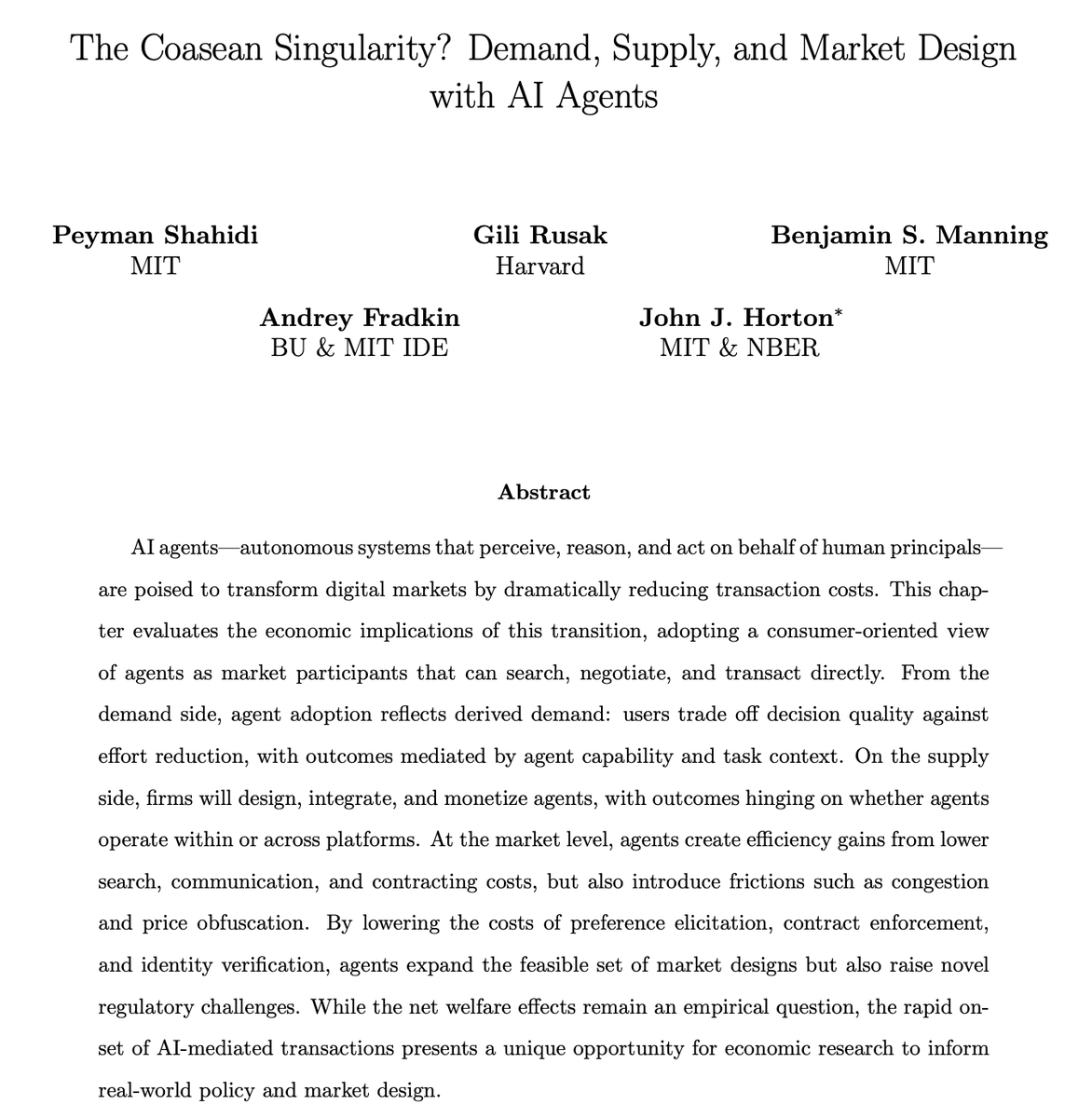
1/16 I just fell down a rabbit hole reading a new paper from economists at MIT & Harvard. Their prediction is wild: We're on the verge of a "Coasean Singularity"—a future where AI agents make markets so efficient that the very idea of a 'company' starts to crumble. 🤯 A thread 👇 2/16 First, a quick 101: Why do companies even exist? A Nobel-winning economist named Ronald Coase answered this in 1937. He said companies exist because using the open market is a pain. Finding sellers, negotiating prices, writing contracts… it’s all “transaction cost.” Economic friction. 3/16 It's often easier and cheaper for a firm to just hire people and organize them internally than to deal with that constant market friction. This friction is also where we, as consumers, lose. We're tired, we're biased, and we don't have time to compare every cell phone plan or read every review for a toaster. Companies know this. 4/16 Now, enter the AI Agent. And I don't mean a simple chatbot. The paper describes an autonomous system that acts on your behalf. Think of it as your own personal, tireless, super-rational economist. It’s immune to marketing tricks and its only goal is to get the best outcome for YOU. 5/16 This is where the "Singularity" happens. When everyone has an AI agent, those transaction costs that Coase talked about basically drop to zero. The "friction" that made companies necessary in the first place? It evaporates. And if the reason for something disappears… so does the thing itself. 6/16 But what does this future actually look like? This is where it gets weird. Let's take shopping. Your agent doesn't just browse Amazon. It might contact a manufacturer in another country directly, find 500 other agents whose users want the same thing, negotiate a bulk price, and arrange shipping. All in milliseconds. The "storefront" becomes irrelevant. 7/16 Or think about hiring. Instead of you endlessly scrolling LinkedIn, your agent scans the entire market for opportunities. It negotiates salary, benefits, and remote work policies with the company's agent. You only get involved for the final human-to-human interview. No more cover letter hell. 8/16 But this discovery comes with a huge catch. The paper outlines a fundamental battle for the future of AI: Will your agent be a "Bring-Your-Own" (BYO) agent that works only for you, across all platforms? Or will it be a "Bowling-Shoe" agent, provided by the platform (like Amazon or Google), whose priorities might be... conflicted? 9/16 The "Bowling-Shoe" agent is convenient, but it might steer you toward the platform's own products. The "BYO" agent is loyal to you, but platforms might try to block it or throttle its access. This tension between user autonomy and platform control will define the next decade of the internet. 10/16 And that's not even the most interesting part. This new world creates bizarre new problems. Problem #1: Agent Congestion. What happens when millions of agents can create a perfect, customized resumé and apply for a single job in a nanosecond? Employers get flooded. The signal is lost in the noise. 11/16 The paper predicts that to solve this, platforms will have to re-introduce friction. Imagine having to pay a small fee for your agent to submit a job application, just to prove you're serious. Costless actions will lose their meaning. 12/16 Problem #2: The Identity Crisis. In a world full of bots, how do you prove you're a unique human? How does a company know it's not negotiating with 1,000 agents all controlled by one person trying to manipulate the market? This is the "Sybil Attack" problem, and it's a big one. 13/16 This will lead to a boom in "proof-of-personhood" technologies. Systems that cryptographically verify you are one person, without revealing your personal data. It sounds like sci-fi, but it'll be the essential plumbing for a world of AI agents. 14/16 Here's a new lens to see the world through: Next time you use Uber (matching drivers/riders), Zillow (matching buyers/sellers), or Upwork (matching clients/freelancers)... Don't just see an app. See it as a clunky, early prototype for the agent-driven markets of the future. 15/16 This isn't just about better shopping bots or smarter assistants. It's a potential rewiring of our entire economy, away from the 20th-century model of the centralized firm and toward a 21st-century model of fluid, hyper-efficient, agent-mediated markets. 16/16 The 20th century was defined by the rise of the corporation. The 21st may be defined by its slow, quiet dissolution.
Carlos E. Perez tweet media
English
183
497
2.3K
567K
Marc Gadsdon retweetledi
Avi Chawla
Avi Chawla@_avichawla·
Researchers from Meta built a new RAG approach that: - outperforms LLaMA on 16 RAG benchmarks. - has 30.85x faster time-to-first-token. - handles 16x larger context windows. - and it utilizes 2-4x fewer tokens. Here's the core problem with a typical RAG setup that Meta solves: Most of what we retrieve in RAG setups never actually helps the LLM. In classic RAG, when a query arrives: - You encode it into a vector. - Fetch similar chunks from vector DB. - Dump the retrieved context into the LLM. It typically works, but at a huge cost: - Most chunks contain irrelevant text. - The LLM has to process far more tokens. - You pay for compute, latency, and context. That’s the exact problem Meta AI’s new method REFRAG solves. It fundamentally rethinks retrieval and the diagram below explains how it works. Essentially, instead of feeding the LLM every chunk and every token, REFRAG compresses and filters context at a vector level: - Chunk compression: Each chunk is encoded into a single compressed embedding, rather than hundreds of token embeddings. - Relevance policy: A lightweight RL-trained policy evaluates the compressed embeddings and keeps only the most relevant chunks. - Selective expansion: Only the chunks chosen by the RL policy are expanded back into their full embeddings and passed to the LLM. This way, the model processes just what matters and ignores the rest. Here's the step-by-step walkthrough: - Step 1-2) Encode the docs and store them in a vector database. - Step 3-5) Encode the full user query and find relevant chunks. Also, compute the token-level embeddings for both the query (step 7) and matching chunks. - Step 6) Use a relevance policy (trained via RL) to select chunks to keep. - Step 8) Concatenate the token-level representations of the input query with the token-level embedding of selected chunks and a compressed single-vector representation of the rejected chunks. - Step 9-10) Send all that to the LLM. The RL step makes REFRAG a more relevance-aware RAG pipeline. Based on the research paper, this approach: - has 30.85x faster time-to-first-token (3.75x better than previous SOTA) - provides 16x larger context windows - outperforms LLaMA on 16 RAG benchmarks while using 2–4x fewer decoder tokens. - leads to no accuracy loss across RAG, summarization, and multi-turn conversation tasks That means you can process 16x more context at 30x the speed, with the same accuracy. The code has not been released yet by Meta. They intend to do that soon.
Avi Chawla tweet media
English
46
240
1.5K
106.4K
Christian
Christian@coldemailchris·
I just filmed a 33-minute video covering our 115-step automated GTM playbook we've used to generate 10,000+ leads for our B2B clients. I will NOT be posting this video publicly, anywhere. Here's what I cover in this video: > GTM Research & development > Finding niche databases with GPT-o3 > Qualification + enrichment Clay workflow > Cold outbound offer creation > Messaging angles development > Email copy prompting w/ Claude Sonnet 4 > Email infrastructure for 98% deliverability > CRM syncing for outbound leads > n8n reply management workflow > Proprietary lead database setup > "Interested lead" nurture workflow > Pre-call workflow for 70%+ show rates > AI sales call transcript routing The only way you can have access to this exclusive video (and arguably the most valuable video I've ever made) Is by liking + commenting "GTM" so I can DM you the video personally. (Must be following to receive)
English
738
60
937
72.4K
Marc Gadsdon
Marc Gadsdon@marcgadsdon·
@levelsio These guys’ high end mattresses are good quality and well priced - 6 years in and still holding up well. I got two large zip together singles which means I’m able to turn them easily enough without help johnryanbydesign.co.uk
English
0
0
0
110
@levelsio
@levelsio@levelsio·
It's that time again guys What matress brand to buy? I know most are filled with cancer chemicals and I want something clean And ship inside Europe cause I can't get anything into Portugal, they stop everything at the border these days with massive duties
English
342
10
782
237K
Marc Gadsdon retweetledi
Kevin Henrikson
Kevin Henrikson@kevindegods·
Your 40s will destroy your happiness. You'll work 60-hour weeks while your kids need money and your parents need care. Ray Dalio calls this the "midlife squeeze" - and it breaks most people. His leverage strategy that changes everything:
Kevin Henrikson tweet media
English
170
1.2K
10K
1.9M
Marc Gadsdon retweetledi
John Rush
John Rush@johnrushx·
In 2023, I decided to learn marketing & distribution from zero. I had no followers on social media, no content, sales, or SEO skills. In 2 years, I built a semi-automated distribution engine. No team, no marketing budget, just me. The details:
John Rush tweet mediaJohn Rush tweet mediaJohn Rush tweet media
English
50
60
926
164.7K
Marc Gadsdon retweetledi
Andrej Karpathy
Andrej Karpathy@karpathy·
I attended a vibe coding hackathon recently and used the chance to build a web app (with auth, payments, deploy, etc.). I tinker but I am not a web dev by background, so besides the app, I was very interested in what it's like to vibe code a full web app today. As such, I wrote none of the code directly (Cursor+Claude/o3 did) and I don't really know how the app works, in the conventional sense that I'm used to as an engineer. The app is called MenuGen, and it is live on menugen.app. Basically I'm often confused about what all the things on a restaurant menu are - e.g. Pâté, Tagine, Cavatappi or Sweetbread (hint it's... not sweet). Enter MenuGen: you take a picture of a menu and it generates images for all the menu items and presents them in a nice list. I find it super useful to get a quick visual sense of the menu. But the more interesting part for me I thought was the exploration of vibe coding around how easy/hard it is to build and deploy a full web app today if you are not a web developer. So I wrote up the full blog post on my experience here, including some takeaways: karpathy.bearblog.dev/vibe-coding-me… Copy pasting just the TLDR: "Vibe coding menugen was exhilarating and fun escapade as a local demo, but a bit of a painful slog as a deployed, real app. Building a modern app is a bit like assembling IKEA future. There are all these services, docs, API keys, configurations, dev/prod deployments, team and security features, rate limits, pricing tiers... Meanwhile the LLMs have slightly outdated knowledge of everything, they make subtle but critical design mistakes when you watch them closely, and sometimes they hallucinate or gaslight you about solutions. But the most interesting part to me was that I didn't even spend all that much work in the code editor itself. I spent most of it in the browser, moving between tabs and settings and configuring and gluing a monster. All of this work and state is not even accessible or manipulatable by an LLM - how are we supposed to be automating society by 2027 like this?" See the post for full detail, and maybe give MenuGen a go the next time you're at a restaurant!
Andrej Karpathy tweet media
English
434
648
7.6K
781K
Marc Gadsdon retweetledi
Dr. Patricia Schmidt 🧠
Dr. Patricia Schmidt 🧠@creatorschmidt·
I’m a scientist with a doctorate in Psychology & a focus on Neuroscience. Here are 12 controversial truths about mental & brain health you won’t like—but need to hear:
English
160
1.6K
7.2K
1M
Marc Gadsdon
Marc Gadsdon@marcgadsdon·
@entrecurious Thanks for posting this. Would be great to check out the shortcuts. Health is wealth
English
0
0
2
7
Connor Turland
Connor Turland@entrecurious·
Press, Speak, Thrive: Automating Health Data with AI and Notion Picture this: you press the action button on your iPhone 16 and, in that split second of suspended time, you utter a quick stream of health notes like “Did 3 sets of 20 bicep curls at 20 pounds,” “Ate shrimp pasta,” or “Right Nose feeling clogged.” Within moments, your phone quietly chimes, “Added that info.” No fuss, no elaborate dance—just a swift transfer from your voice to your curated health logs. After an eternity of thinking and tinkering with various ways to capture my health data that wouldn't be sooo time consuming, I finally cracked the code. I began with Notion, setting up three dedicated databases to sort exercise, meals, and, yes, even my nasal saga. Setting up was a breeze: I simply authorized my own internal integration, linked each table, and built a few custom iOS Shortcuts. One pulls in my Notion table schemas; another sends a JSON payload formatted by ChatGPT; and the main one takes your raw notes, transforms them into structured data, and passes them on to Notion—all sparked by that single press of the action button. Here’s where it gets exciting. I can review each domain—workouts, food, nasal details—in their own tidy tables. Want to see the bigger picture? I can merge them into one comprehensive data pool and let AI dig through the patterns. Perhaps it'll uncover a subtle link between late shrimp dinners and sleep-tossed nights with congestion. I'm even gearing up to add digestion logs to track those pesky digestion troubles that have been holding me back. This system isn’t static—it’s as adaptable as I need it to be. Changing, adding, or removing a database is super simple, I can just do it in Notion. The approach lets me pivot quickly, honing in on details that matter most to my health and lifestyle. What once had me mired in manual entries now flows seamlessly with one tap and voice notes. It’s a small revolution—a voice-triggered health log that captures insights without demanding my constant attention. For the entrepreneurial among us looking to harness innovative AI automations, this is more than just tech tinkering. It’s about forging a path towards smarter, more integrated living. Stay curious. Stay inventive. Happy to share the 'Shortcuts' with you, just comment 'health is wealth'.
Connor Turland tweet media
English
3
0
3
418
Marc Gadsdon
Marc Gadsdon@marcgadsdon·
The geographic position of the US was addressed twice earlier and a tacit agreement about the effects of the ocean separating the US from Europe seemed to be accepted by the participants - I feel that Zelensky was simply referring back to an already agreed and incontrovertible point, and yes, perhaps the linguistic and cultural differences helped trigger the others.
English
0
0
1
1.2K
Shaun Maguire
Shaun Maguire@shaunmmaguire·
I recommend watching the full conversation between Trump and Zelensky before forming strong opinions (This is true for any situation)
English
2.8K
9.9K
64.3K
8.9M
Marc Gadsdon retweetledi
Dr Paddy Barrett
Dr Paddy Barrett@Paddy_Barrett·
That's a wrap! If you enjoyed this thread: 👋 You can join over 25K others on my free weekly newsletter Or you can sign up for my Free 5 Day Course On Preventing Heart Disease. Links in the Bio Above ☝️
Dr Paddy Barrett@Paddy_Barrett

A high V02 Max is the metric most closely linked to a longer life. But what is V02 Max? And more importantly, how do you increase it? Because most people are doing it wrong. 📕Make Sure To Bookmark✅ 🧵👇 /1

English
4
8
39
20.7K
Marc Gadsdon
Marc Gadsdon@marcgadsdon·
IDK whether this is a solve for your use case, but I have used @SynderApp to pull 1000’s monthly transactions from multiple sources (PayPal, stripe etc) and write them into Xero. You can export to excel if you don’t want to use Xero. It’s quite powerful. There’s also services like dext.com
English
0
0
0
24
Daniel Vassallo
Daniel Vassallo@dvassallo·
@mustaccelerate Probably some GPT wrapper. I don’t need anything fancy. I have about 500 transactions per month and want the categorized well enough (with option to manually override) to produce a P&L and a balance sheet.
English
2
0
4
1.1K
Daniel Vassallo
Daniel Vassallo@dvassallo·
These VC-funded mfs charged me $5,000 for bookkeeping, made me categorize all my transactions, shutdown the business with zero notice 3 days before the end of the year, kept all the money, and told me to go fuck myself.
Daniel Vassallo tweet media
English
183
128
3.5K
660.3K