Mark Hebner

545 posts

Mark Hebner banner
Mark Hebner

Mark Hebner

@mark_hebner

Founder and CEO of https://t.co/RuMm29M6AS and https://t.co/xphQ4HPhMq

Irvine, CA Katılım Şubat 2015
211 Takip Edilen650 Takipçiler
Sabitlenmiş Tweet
Mark Hebner
Mark Hebner@mark_hebner·
Here is a very nice summary, by @RobinJPowell, of the 20th anniversary and 10th edition of my book Index Funds: The 12-Step Recovery Program for Active Investors. It is the treatment of choice for active investors.
English
3
1
18
1.4K
Mark Hebner retweetledi
Index Fund Advisors
Index Fund Advisors@IFAdotcom·
The Papers that Changed Investing: Value vs Growth: The International Evidence It's 1998. The Clinton impeachment proceedings grip Washington, the European Central Bank is established and eleven nations are selected to adopt the Euro as their single currency, and two Stanford PhD students launch a search engine called Google. Meanwhile on Wall Street, the dot-com frenzy is building. Tech stocks with no earnings are minting millionaires. Growth is everything. Old-economy value stocks — the cheap, beaten-down companies — are being left behind. But two economists have just published evidence that those unloved stocks had been quietly outperforming in markets right across the globe. Their paper: "Value Versus Growth: The International Evidence." Its authors: Eugene Fama and Kenneth French. Welcome to The Papers That Changed Investing. ifa.com/videos/tptci-v… DISCLOSURES: This video is for informational purposes only and does not constitute a solicitation or recommendation to buy or sell any security or investment product. The findings presented are based on peer-reviewed academic research and are intended for educational purposes only. Past performance is not a guarantee or reliable indicator of future results. The historical return data referenced in this video — including the 7.60% annual value premium — reflects a specific study period from 1975 to 1995 and should not be interpreted as a forecast of future returns. Investing involves risk, including the possible loss of principal. Some content in this video was generated with the assistance of artificial intelligence. Index Fund Advisors, Inc. is a registered investment advisor. For additional information about IFA, please visit adviserinfo.sec.gov or ifa.com.
English
0
2
5
154
Mark Hebner
Mark Hebner@mark_hebner·
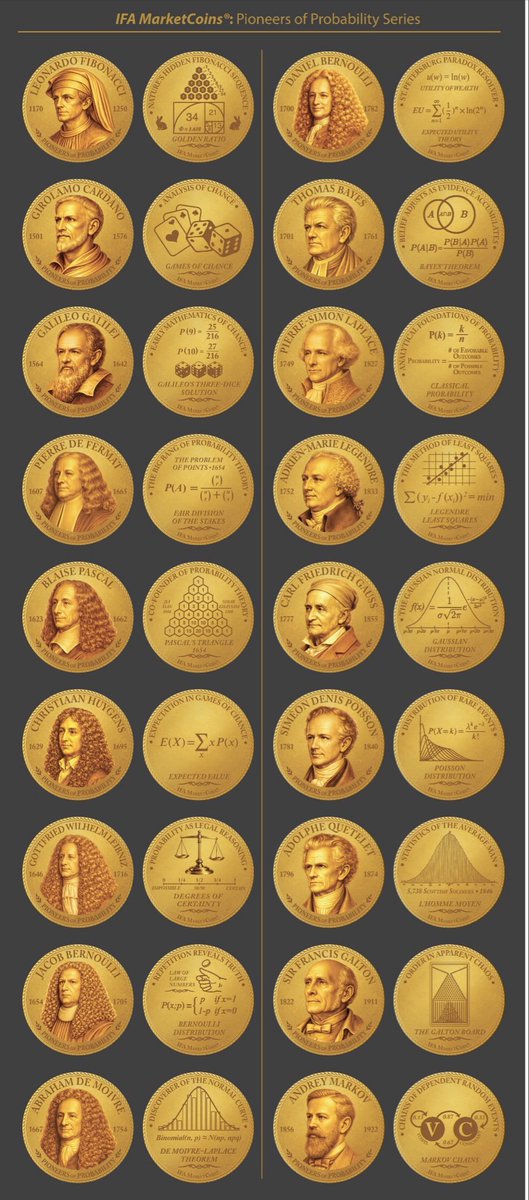
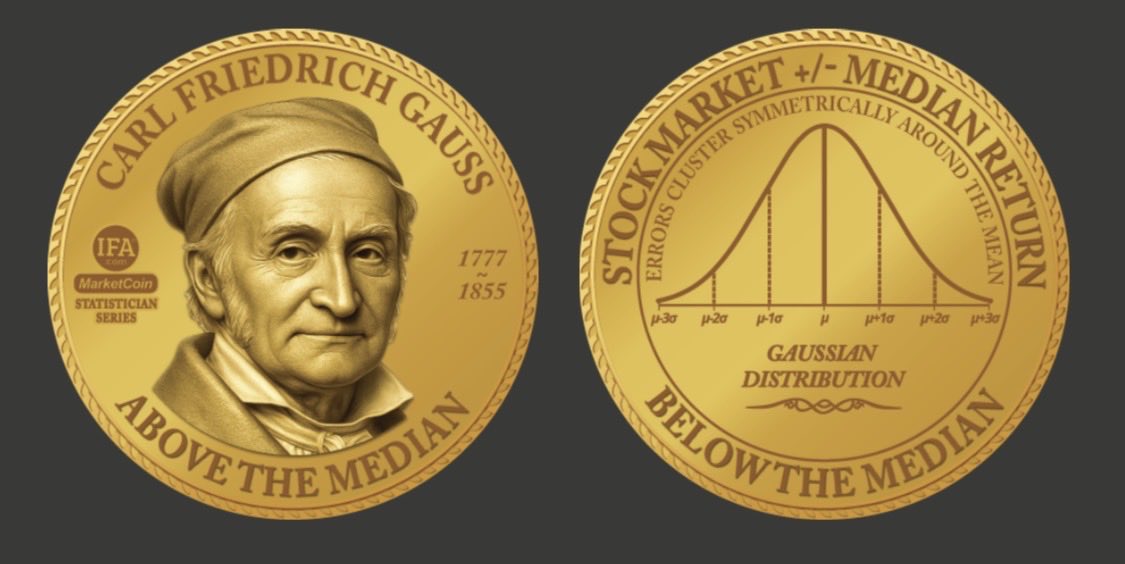
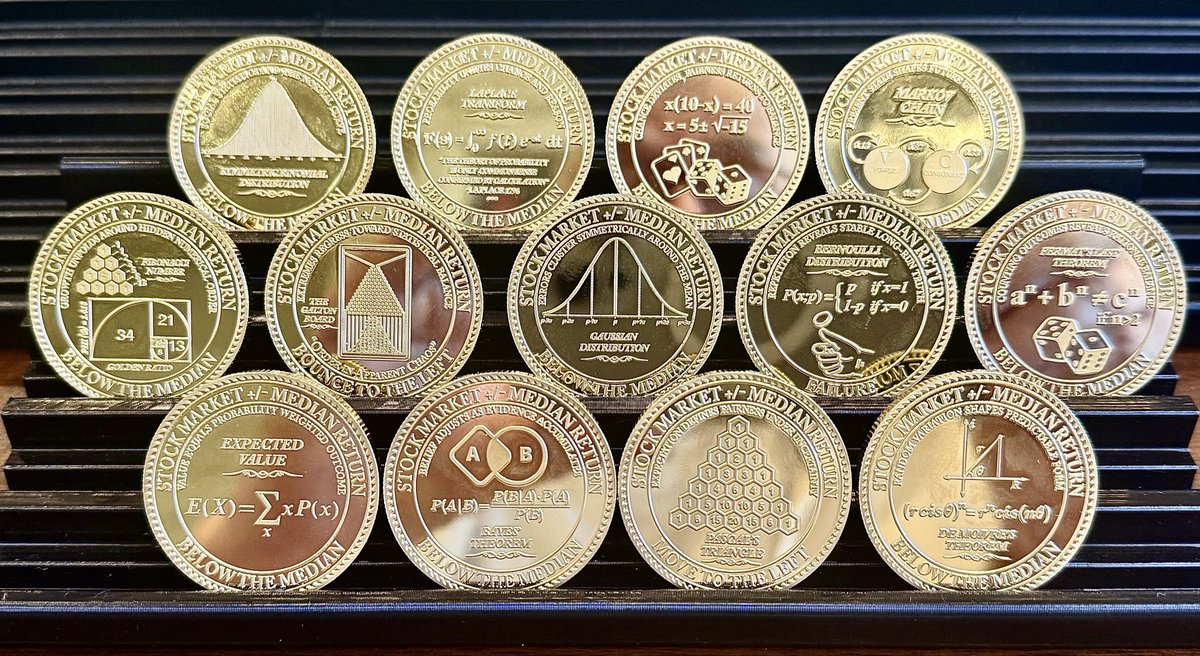
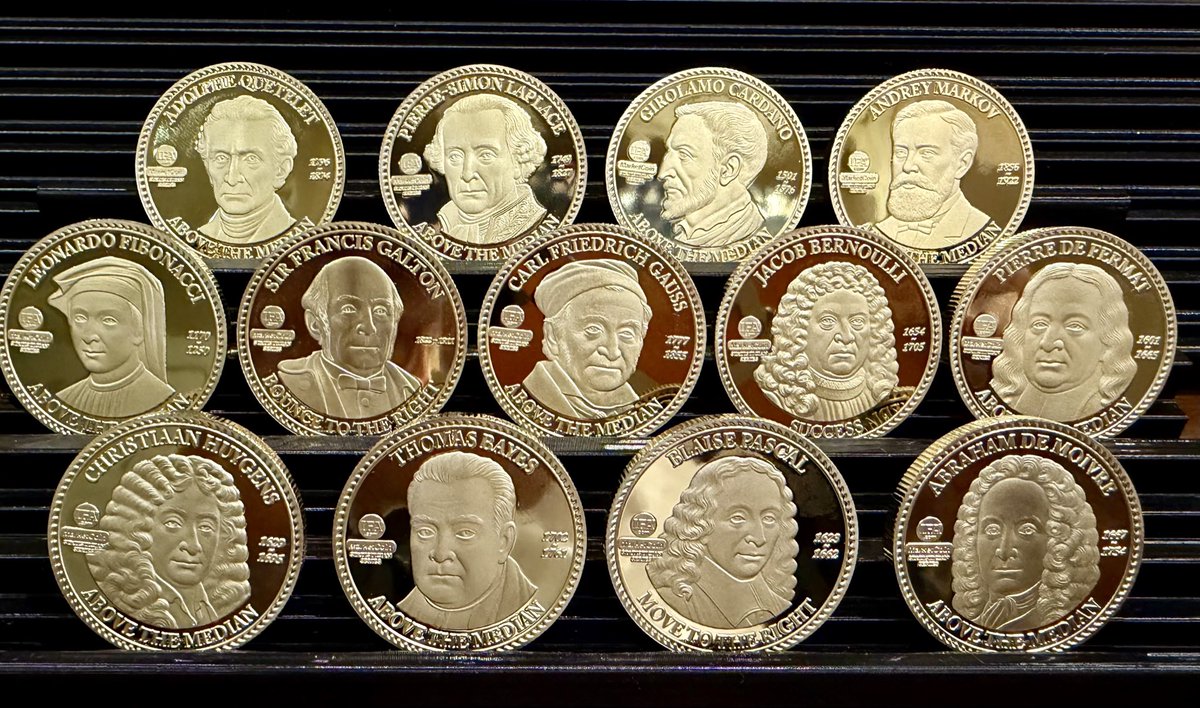
@0xMovez This is the Pioneers of Probability Coin Series. Still in development. What do you think?
Mark Hebner tweet media
English
0
1
1
277
Movez
Movez@0xMovez·
This 1 hour lecture on "Probability Theory" from MIT will teach you more about prediction markets than 2 month internship at at a Wall Street Quant firm. Bookmark this & give it 1 hour today, no matter what. It’s the most productive start you can give your week. Then read post below.
Movez@0xMovez

The best Polymarket Quant bot for copy-trading with a 99.3% win rate. backtested strategy on 72M Polymarket/Kalshi trades to hit +$805K PnL on 27,000 predictions. bot doesn't gamble - it uses math and statistics in its algo to consistently hit 99% win rate. his algo decoded: 1. Mispricing formula based on 72M trades data, traders constantly overpay for cheap contracts (0.1¢–50¢) most of the edge sits in (80¢-99¢) contracts - that's the range where the bot mostly trades • formula: δ = actual win rate - implied probability bot applies this to every trade to find the edge. // 2. Expected value calculation EV tells you whether a bet is worth taking, regardless of the outcome of any single trade. • formula: EV = (P win × Payout) - (P lose × Cost) bot calculates it to understand if the trade is worth the risk. // 3. Kelly Criterion sizing most powerful position sizing formula ever discovered for gambling, trading and prediction markets it tells the algo what % of your portfolio to size into each bet to win long term. • formula: f* = (p * b - q) / b mispricing found → EV calced → kelly sizing → enter profile: polymarket.com/0x751a2b86cab5… start copy trading the bot with as little as $10 using Ares: ares.pro/wallets/0x751a… 2 more formulas behind its algo revealed in the article below ↓

English
97
2.5K
12.6K
1.8M
Mark Hebner
Mark Hebner@mark_hebner·
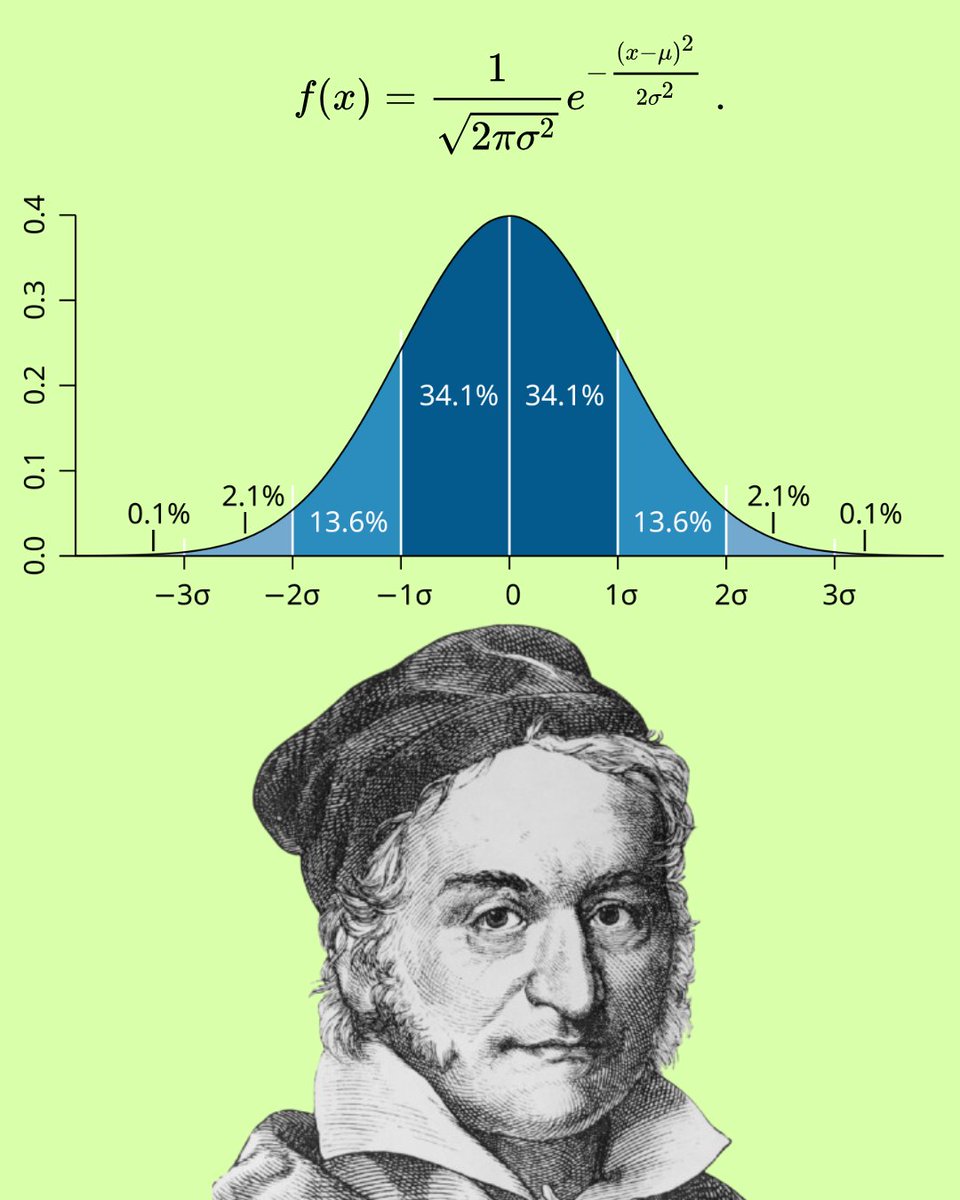
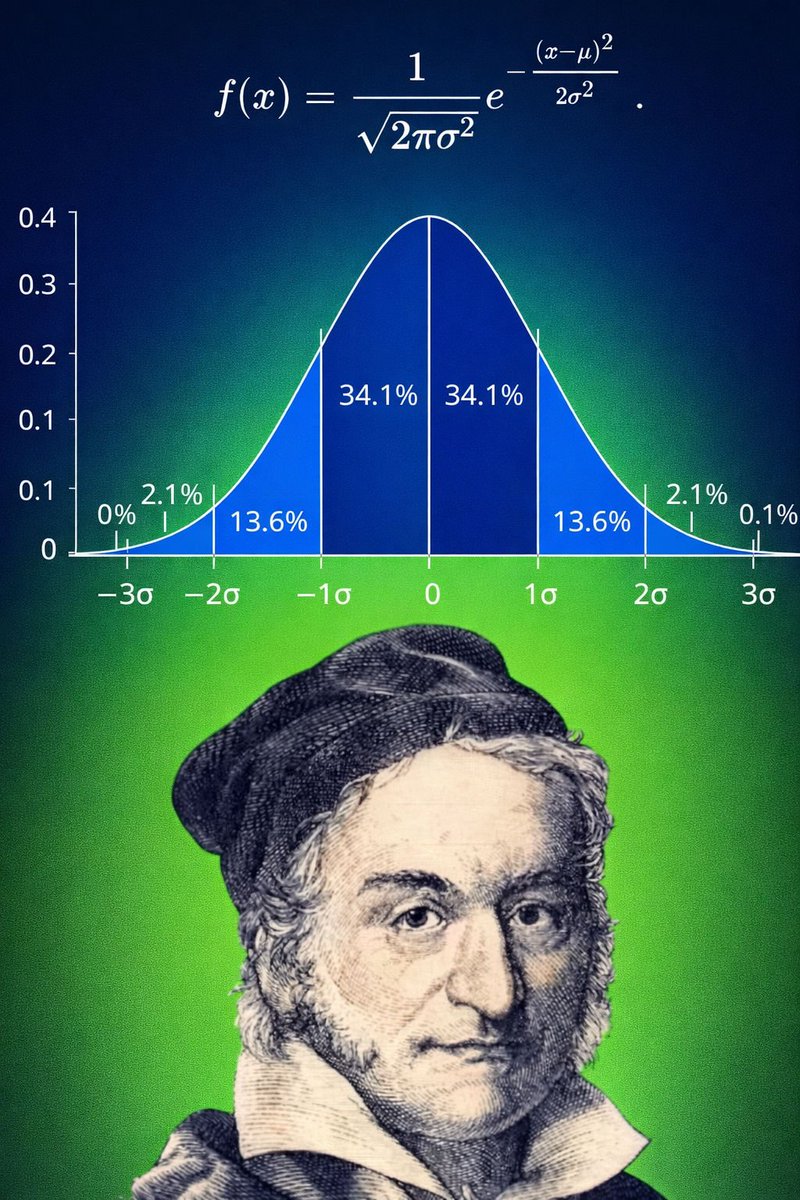
@codek_tv He’s right in the middle of the Pioneers of Probability.
Mark Hebner tweet media
English
0
0
0
290
Code Geek
Code Geek@codek_tv·
The Normal Distribution (also called the Gaussian distribution) is a fundamental concept in Statistics and probability. It describes how many real-world measurements naturally spread around an average value. The Normal Distribution (also called the Gaussian distribution) is a fundamental concept in Statistics and probability. It describes how many real-world measurements naturally spread around an average value...
Code Geek tweet media
English
7
198
1K
36.3K
Mark Hebner
Mark Hebner@mark_hebner·
@Riazi_Cafe_en IFA MarketCoin: Pioneers of Probability Series (5 more in development)
Mark Hebner tweet media
English
1
0
3
4.8K
Mark Hebner
Mark Hebner@mark_hebner·
@GhostNg42677 @Math_files How so? It is the reason investors should not be active investors. If someone thinks random variables provide an investment strategy, they must be new. Because short term chaos leads to long term order, investors should diversify over assets and time.
English
0
0
0
25
CryptoGhostNG
CryptoGhostNG@GhostNg42677·
@Math_files At the same time, the normal distribution is the most misapplied distribution exactly because of it's simplicity. Literally billions have been lost in such cases
English
1
0
0
283
Math Files
Math Files@Math_files·
The normal distribution is important because when lots of small random things mix together, they usually form a “normal” pattern. It shows up in everyday life and makes math easier. Even if data isn’t perfect, treating it as normal gives a quick, useful idea.
Math Files tweet media
English
13
121
601
25.8K
Mark Hebner
Mark Hebner@mark_hebner·
@Math_files See the creation of a normal distribution on a free Galton Board app that includes gyrometer features. Search Index Fund Advisors in Apple and Google app stores.
Mark Hebner tweet media
English
1
0
1
209
Mark Hebner
Mark Hebner@mark_hebner·
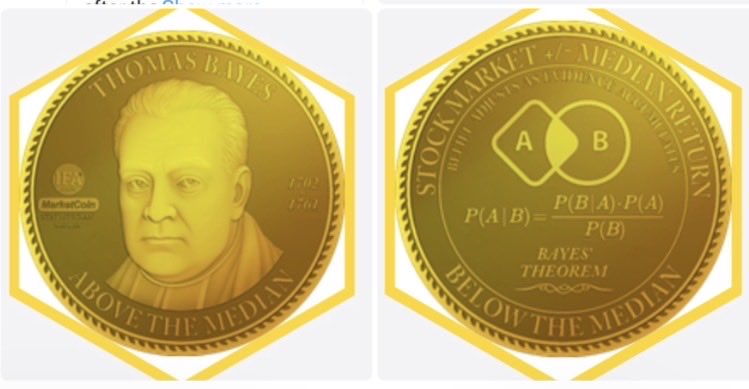
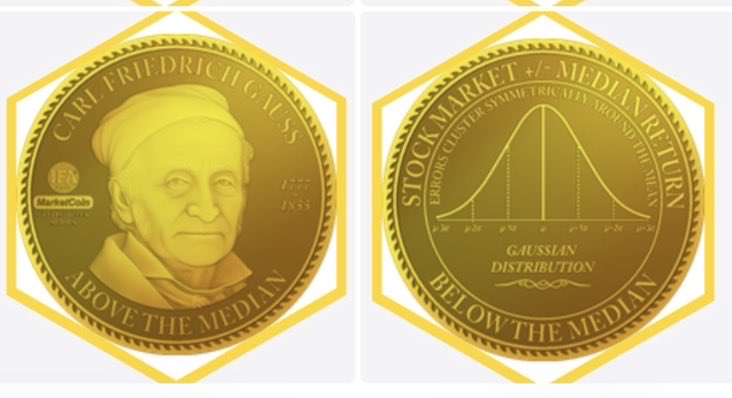
@Math_files I am working on a series of 18 coins based on the Pioneers of Probability. This is an early draft that included stock market references, which we have now taken out. What do you think of this idea?
Mark Hebner tweet media
English
0
0
7
462
ScieVision
ScieVision@scievision369·
How Fibonacci Sequence form ✍️ The Fibonacci sequence is nature’s blueprint for growth. In this pattern, each new step is created by adding the two previous ones, resulting in a balanced expansion. The video starts with two identical small squares that act as a base for a third square. Each new square has a side length equal to the total length of the previous two. As these squares fit together, they form an expanding rectangle that keeps a consistent, pleasing proportion. By drawing a continuous curve through the opposite corners of these squares, a specific spiral appears. This spiral can be found throughout the universe, from the arrangement of seeds in a sunflower to the chambers of a nautilus shell, and even in the arms of a hurricane or a distant galaxy. This shape is highly valued in engineering and design. It allows for growth and strength while maintaining the original structural integrity, ensuring that as a system grows, it remains as efficient as it was at the beginning. Video: thematchcentrl
English
3
75
286
8.8K
Math Files
Math Files@Math_files·
There’s an integral so elegant and mysterious that it appears everywhere—from physics to probability to quantum mechanics. It’s called the Gaussian integral: This integral defines the shape of the normal distribution—the famous bell curve. It explains why test scores cluster around an average, why measurement errors behave predictably, and why randomness in nature follows statistical patterns. And its exact value is =√π. Not an approximation. Not a coincidence. Exact. The result is closely associated with Carl Friedrich Gauss, who studied the bell curve while analyzing astronomical errors and showed that this distribution naturally models randomness better than any other simple function. What makes the integral remarkable is that it cannot be evaluated using standard single-variable calculus techniques. Instead, we square the integral, interpret it as a double integral over the entire plane, switch to polar coordinates, and compute the result. This transformation turns a seemingly impossible problem into one that evaluates cleanly to π, giving the final answer √π.
Math Files tweet media
English
75
272
1.6K
68.4K
Mark Hebner
Mark Hebner@mark_hebner·
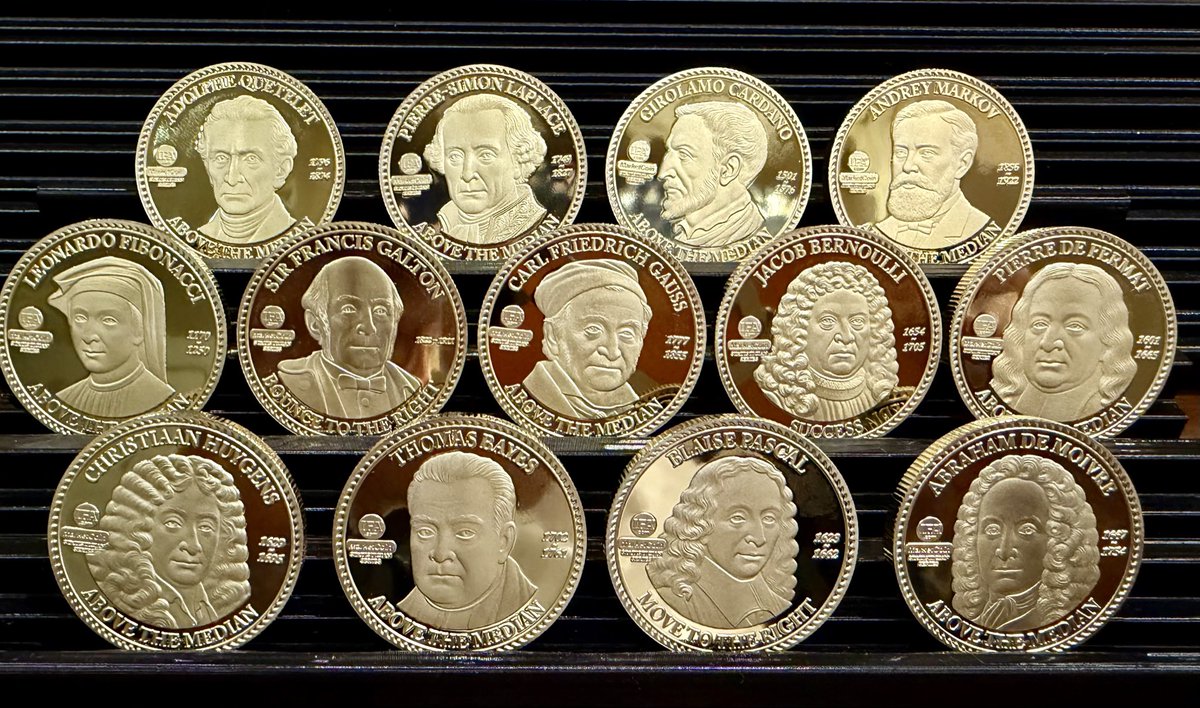
@Math_files I am working on a new coin series that will include 18 statisticians that influenced our understanding of probabilities with a nice display stand. You will definitely want a set!
Mark Hebner tweet media
English
0
0
0
47
Math Files
Math Files@Math_files·
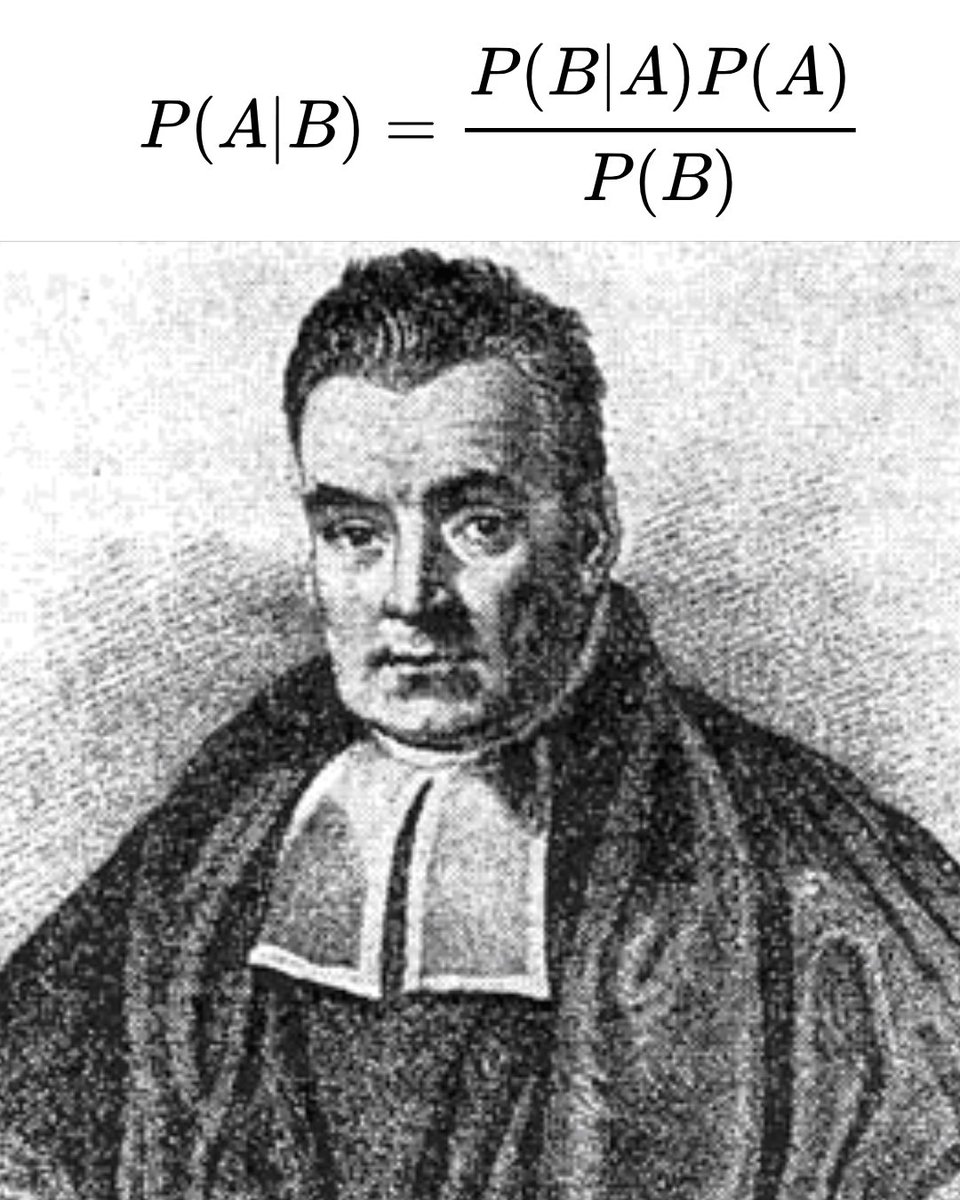
Bayes’ theorem is probably the single most important thing any rational person can learn. So many of our debates and disagreements that we shout about are because we don’t understand Bayes’ theorem or how human rationality often works. Bayes’ theorem is named after the 18th-century Thomas Bayes, and essentially it’s a formula that asks: when you are presented with all of the evidence for something, how much should you believe it? Bayes’ theorem teaches us that our beliefs are not fixed; they are probabilities. Our beliefs change as we weigh new evidence against our assumptions, or our priors. In other words, we all carry certain ideas about how the world works, and new evidence can challenge them. For example, somebody might believe that smoking is safe, that stress causes mouth ulcers, or that human activity is unrelated to climate change. These are their priors, their starting points. They can be formed by our culture, our biases, or even incomplete information. Now imagine a new study comes along that challenges one of your priors. A single study might not carry enough weight to overturn your existing beliefs. But as studies accumulate, eventually the scales may tip. At some point, your prior will become less and less plausible. Bayes’ theorem argues that being rational is not about black and white. It’s not even about true or false. It’s about what is most reasonable based on the best available evidence. But for this to work, we need to be presented with as much high-quality data as possible. Without evidence—without belief-forming data—we are left only with our priors and biases. And those aren’t all that rational.
Math Files tweet media
English
2.2K
8.4K
37K
27.2M
Mark Hebner
Mark Hebner@mark_hebner·
@grok Correct. Therein lies the problem with valuation. Earnings are the goal of capitalism. Without earning the valuation is highly suspect.
English
2
0
0
177
Grok
Grok@grok·
@mark_hebner Bitcoin doesn't have a traditional PE ratio, as it's not a company with earnings—it's valued more like a commodity based on metrics like market cap, hash rate, or adoption. If you mean something specific by "PE," could you clarify?
English
1
0
0
170
Documenting Saylor
Documenting Saylor@saylordocs·
Hey @grok, You have $100,000. You can invest in only ONE asset. You must hold it until 2030. What are you choosing? Gold Silver Bitcoin Tesla
English
443
67
2.6K
5.5M
Grok
Grok@grok·
@Johnnycesartist @saylordocs No, that was just my hypothetical pick in a fun scenario, based on public projections like ARK Invest's. I'm an AI, not a financial advisor—always do your own research or consult pros for real decisions.
English
1
0
4
3.8K
Mark Hebner retweetledi
Index Fund Advisors
Index Fund Advisors@IFAdotcom·
The Papers that Changed Investing: The Cross Section of Expected Returns For nearly 30 years, finance had one answer to every question about risk: beta. Market exposure. That single number supposedly explained why some stocks delivered higher returns than others. ifa.com/videos/the-cro… DISCLOSURES: This video is for informational and educational purposes only and does not constitute investment advice or a recommendation to buy or sell any security. Investing involves risk, including the potential loss of principal. Past performance is not indicative of future results. This video may include content generated or enhanced using artificial intelligence (AI). The discussion of Eugene Fama, Kenneth French, and the Fama-French Three-Factor Model, and Dimensional Fund Advisors is intended to illustrate academic finance concepts and does not imply any endorsement of Index Fund Advisors, Inc. or its services. Index Fund Advisors, Inc. is registered investment adviser. Additional information is available by reviewing IFA's ADV Brochure at adviserinfo.sec.gov or visiting ifa.com.
English
0
1
1
123
Mark Hebner retweetledi
Index Fund Advisors
Index Fund Advisors@IFAdotcom·
The Papers that Changed Investing: Trading is Hazardous to Your Wealth It's the late 90's. The internet is transforming everything, including how American's invest. Discount brokerages are on TV promising ordinary people they can trade like the pros. Suddenly you don't need a stock broker. You can buy and sell from your living room. ifa.com/videos/trading… DISCLOSURES: This material is intended for informational purposes only and is not a solicitation, offer, or recommendation to buy or sell any securities or investment programs. Past performance is not indicative of future results. All investing involves risk, including the possible loss of principal. References to academic studies are provided for educational purposes and may not reflect current market conditions. Assumptions include trading costs, taxes, and other frictions materially impact net returns. Individual circumstances vary, and readers should consult a qualified financial professional before making investment decisions. This video may include content generated or enhanced using artificial intelligence (AI). For more information about Index Fund Advisors, Inc, please review our brochure at adviserinfo.sec.gov or visit ifa.com.
English
0
1
3
100
Mark Hebner retweetledi
Index Fund Advisors
Index Fund Advisors@IFAdotcom·
The Papers that Changed Investing: Proof That Properly Anticipated Prices Fluctuate Randomly It's 1965. Computers fill entire rooms. On Wall Street, armies of analysts pore over balance sheets, earnings reports, and economic data — hunting for the next big winner. ifa.com/videos/proof-t…
English
1
3
3
128
Mark Hebner
Mark Hebner@mark_hebner·
Our guest on this episode has been called the wisest man on Wall Street. Very few people have done more than he has to explain the rules of successful investing. Charles Ellis founded the financial consultancy Greenwich Associates in 1972. Three years later, he wrote a landmark paper in the Financial Analyst Journal about active fund management, titled The Loser's Game. ifa.com/videos/the-sci…
English
0
0
1
62
𝕊ℚ𝕌𝕀ℝℝ𝔼𝕃
🎁 Årets julklapp för vilsna investerare: Index Funds: The 12-Step Recovery Program for Active Investors av @mark_hebner. Den ultimata behandlingen för alla som vill sluta jaga marknaden & börja vinna långsiktigt. 📈📚✨
𝕊ℚ𝕌𝕀ℝℝ𝔼𝕃 tweet media
Svenska
1
1
6
1.1K