yep

113 posts

yep

yep

@marrkyss

Investing

Katılım Mayıs 2025
29 Takip Edilen14 Takipçiler
yep
yep@marrkyss·
@BryzonX Will $veco be the next one?
English
0
0
1
145
bryan
bryan@BryzonX·
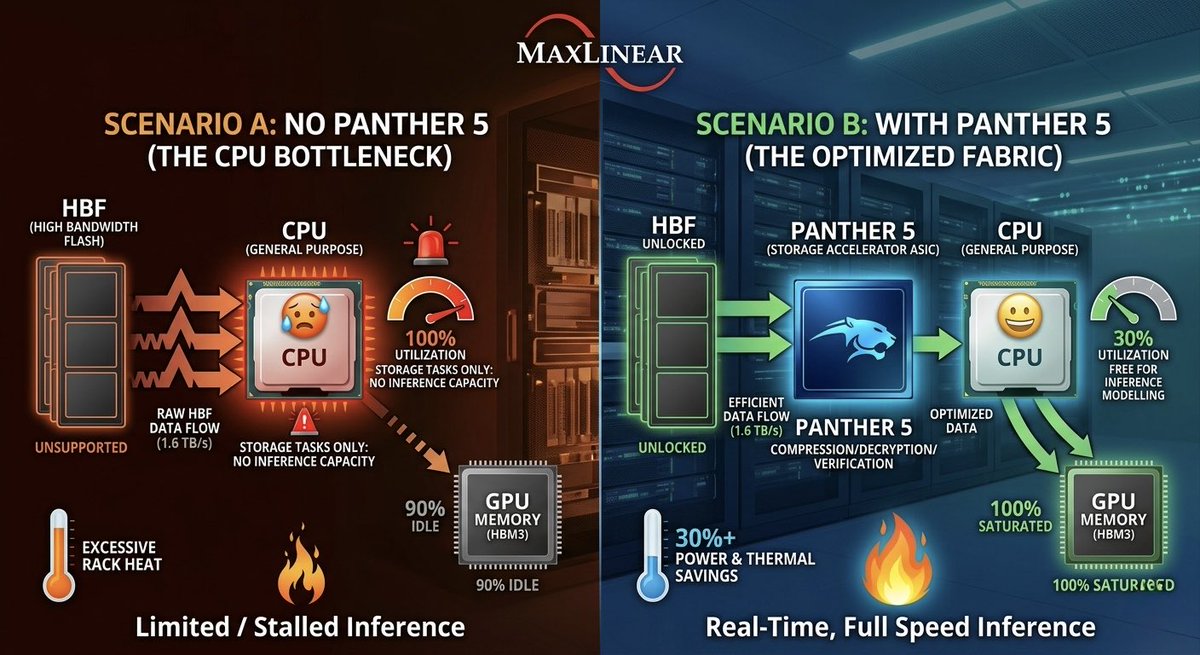
$MXL is a HUGE beneficiary in the adoption of HBF The infra for regular SSDs in data centers are currently not equipped to handle DRAM like speeds with NAND like capacity in which HBF provides If a CPU has to manage data reduction for a HBF drive, it spends 100% of its power just moving data, leaving zero capacity to actually run the inference model Panther 5 acts as the CPU’s assistant to offload these power intensive tasks It allows the data center to actually use the full speed of HBF allowing the CPU to provide max efficiency for the model As of TODAY, there is no other viable way to run HBF at full speed using only a CPU without Panther 5 Running HBF without Panther 5 requires buying 3x more CPUs to handle the same workload Hence why $AMD is piloting Panther 5 to have in their server racks DPU’s are powerful but very expensive and power hungry They are designed for networking, not specialized storage compression I’m telling you folks, $MXL was rerated for a reason
bryan tweet media
Jukan@jukan05

"The Next Bottleneck After HBM Is HBF"... A Computing Pioneer's Prediction "I have been consistently paying close attention to High Bandwidth Flash (HBF). I'm also collaborating with semiconductor companies on this. HBF is highly likely to stand at the center of the next bottleneck — a surge in demand." David Patterson, professor at UC Berkeley, Turing Award laureate, and widely recognized as the architect of RISC (Reduced Instruction Set Computing — an approach that simplifies instructions to improve processing efficiency), made these remarks on April 30 (local time) when he met with reporters in San Francisco immediately after delivering a keynote at the Dreamy Next event. Asked about what comes after HBM (High Bandwidth Memory), which is currently in a supply-constrained bottleneck, Professor Patterson answered that HBF will emerge as the next focus. Specifically, he said, "Although a number of technical challenges still remain, the HBF being developed by companies such as SK hynix and SanDisk is a meaningful alternative in that it can deliver large capacity with low power consumption," adding, "Going forward, how efficiently data can be stored and delivered will become the critical variable." This past March, SK hynix announced that it had joined hands with U.S. flash memory company SanDisk to drive the global standardization of HBF. Unlike HBM, which stacks DRAM, HBF is built by stacking NAND flash — a non-volatile memory. Their roles are also distinct. While HBM serves as a fast computation aid, HBF is focused on storing the vast amounts of data that AI processes at high capacity. HBF is drawing attention as the AI inference market grows. The AI market is broadly divided into learning (training) and inference. Training is the process of feeding massive amounts of data to teach an AI model. Inference is the stage in which results are derived based on the trained data. In inference AI, the ability to continuously store and retrieve vast amounts of intermediate data — such as prior conversations, judgment outcomes, and task context — is crucial. This is because AI carries out reasoning by remembering context and building upon it. The problem is that all of this data is difficult to fit into HBM. Since HBM is optimized for handling data used immediately, its capacity itself is inherently limited. Moreover, given its high price, processing the enormous amounts of context data generated during inference using HBM alone would impose significant cost burdens. As a result, an environment has formed in which both HBM and HBF are needed simultaneously — a kind of division of labor. Domestic experts in Korea also anticipate that the importance of HBF will grow going forward. At an HBF research and technology development strategy briefing held this past February, Kim Jung-ho, professor in the School of Electrical and Electronic Engineering at KAIST, stated, "If the central processing unit (CPU) was the core in the PC era and low-power technology was the core in the smartphone era, memory will be the core of the AI era," adding, "What determines speed is HBM, and what determines capacity is HBF." He further predicted, "From 2038 onward, demand for HBF will surpass that of HBM."

English
3
1
15
3.2K
yep
yep@marrkyss·
@BryzonX Which earnings do you like the most from this week?
English
1
0
0
1.3K
bryan
bryan@BryzonX·
We are going to see a huge shortage of 1.6T DSP chips soon
English
6
1
92
25.2K
yep
yep@marrkyss·
@HedgebergCom Technically how is $nbis? When would you enter?
English
1
0
0
260
yep
yep@marrkyss·
@cvel317 Which is the distribution of your portfolio rn?
English
1
0
0
36
Unknown
Unknown@cvel317·
Sounds like software is not as “simple” after all. That you can achieve higher efficiency looking at the entire system - from software to physical layers. Lots of unique value can still be created leading to higher margins. And you’ll need the right team for that which $NBIS have
Daniel Koss@daniel_koss

Interview with Nebius Co-Founder Roman Chernin Please like & share this video so that all $NBIS investors on X will see it! :) If you prefer watching on YouTube: youtu.be/ZSo4tWCw4NU Timestamps: 00:00 - Why AI Infrastructure Is So Hard to Understand 00:24 - Market Fragmentation and What Actually Differentiates Providers 01:30 - Consolidation, Segmentation, and the Future AI Cloud Landscape 02:56 - What Analysts and VCs Still Get Wrong About AI Infrastructure 05:34 - Nebius Cloud: Product Readiness and Customer Proof Points 07:42 - Why Inference Workloads Are Exploding 09:11 - Training vs. Inference: How AI Models Actually Reach Production 10:10 - Why Inference Market Share May Concentrate Around a Few Winners 12:36 - Customer Use Cases: Coding, Enterprise AI, and Real-World Adoption 14:01 - Why Integrated Training and Inference Matter Strategically 16:01 - Building Scalable AI Infrastructure With High Utilization 18:24 - Token Factory: Inference as a Managed Service 20:24 - Revolut Case Study: AI-Driven Product Enhancements 22:56 - Token Factory Performance Optimization and Competitive Advantage 25:07 - Scale, Capacity, and Efficiency as Growth Drivers 28:36 - Why Inference Capacity Could Become the Next Major Bottleneck 30:10 - How Nebius Benchmarks Performance Across Providers 33:14 - The Future Size and Shape of the Inference Market 36:38 - Value-Based Pricing: Moving Beyond Cost per GPU Hour 40:55 - How Nebius Wins Deals: Quality, Performance, and Customer Experience 44:53 - Autonomous AI Platforms and the Rise of Agent-Based Models 47:28 - Tavily, Agentic Applications, and the Next Layer of the AI Stack 50:45 - Strategic Trade-Offs: Scaling, Product Roadmap, and Customer Relevance 55:40 - Final Thoughts: Adapting to the Next Shift in AI Workloads @nebiusai @romanchernin

English
1
0
0
465
Babyfolio
Babyfolio@babyfolio·
I have sold $LPK, after 60% run on my first entry, this has been quick, R/R not as enticing at current valuations. Hopefully I won't get bashed here, just trying to be transparent 🙏🏼
English
24
0
85
22.5K
Hedgeberg | Technical Precision. Fundamental Depth
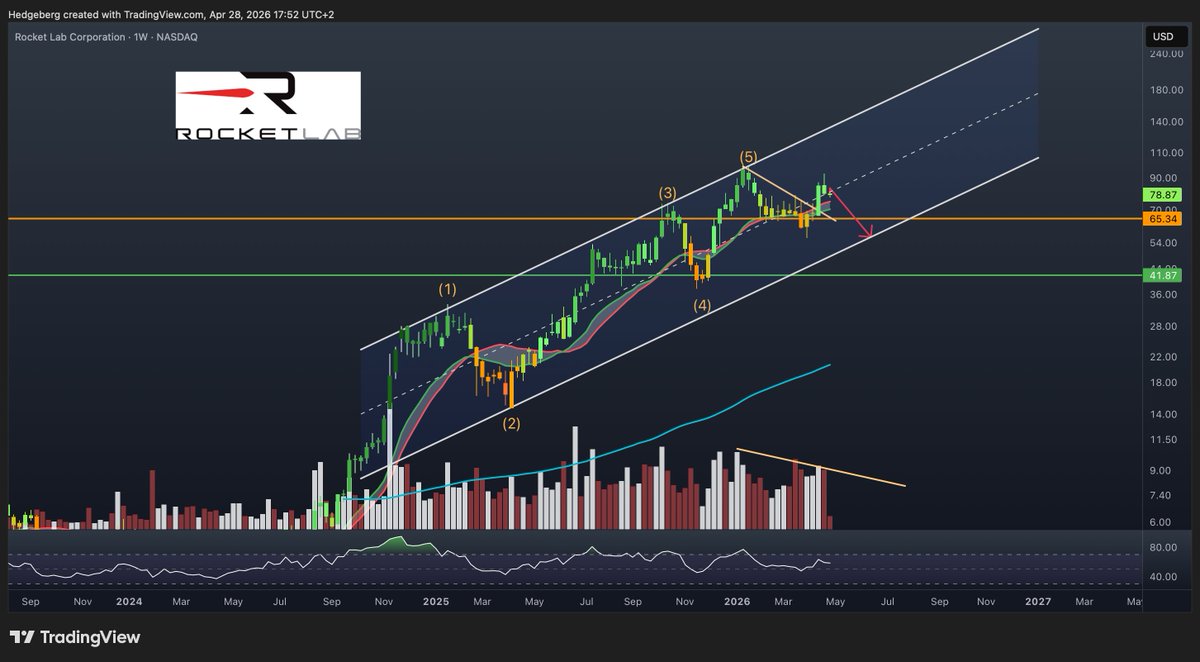
$RKLB is a sell currently. It could bounce to roughly $83 the next days caused by a technical reaction and oversold situation on lower timeframes. It didn't had the power to break the ATH with decreasing volume and buy interest. I expect it though to correct towards $55 as an orientation. We need to update the PT once we are getting closer to it. It depends on speed and volume as well as market situation.
Hedgeberg | Technical Precision. Fundamental Depth tweet media
English
4
0
11
4.2K
yep
yep@marrkyss·
@vlmkapital @PrettyNoice What’s the logic behind them not releasing everything in the $LPK $LPKF results? I think they’ve never been in this position with so much focus and I wouldn’t see any sense in not taking advantage of this opportunity with so many eyes on them.
English
0
0
0
282
vlmk
vlmk@vlmkapital·
@PrettyNoice Zero clue, I remain cautiously optimistic but I'm not sure how much they're willing to disclose. And I'm sure all the attention on X has been a bit much for them, expectations are high
English
1
0
1
83
yep
yep@marrkyss·
@ParadisLabs Which is your largest position right now?
English
1
0
1
515
Paradis Labs
Paradis Labs@ParadisLabs·
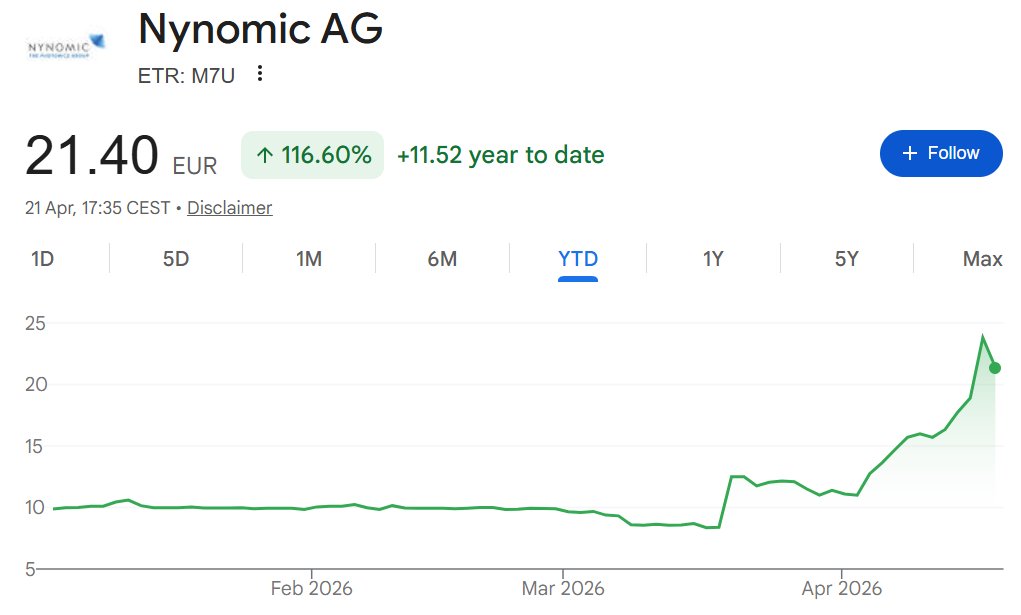
Thoughts on Nynomic ($M7U) at €145M MC: Caution: this is a numbers-heavy post where I walk through some of my modelling. No one’s really covered this on X since Nynomic doesn’t disclose subsidiary rev/margins. TLDR: Nynomic is very cheap at current 1.3x multiples vs metrology peers like $ONTO (10.7x) & $CAMT (13.8x). For a v. quick summary of the bull thesis: - Asymmetric exposure to photonics supercycle via their LayTec subsidiary - chokepoint in InP/GaN MOCVD via $AIXA ramp - $AIXA is 80–90% of global MOCVD Onto financials… -> By triangulating data points, I get to ~€15M revenue for LayTec in FY25: LayTec has ~800 installed reactors globally (based on customer list + historical $AIXA shipments + 25 years of sales) - New-reactor ASP: €95k / reactor - New reactors attached/yr (global MOCVD share, $AIXA + part of $VECO): ~100 units - New sensor revenue: 100 × €95k = ~€9.5M/yr - Service/software renewals: ~10–12% of installed base annually at €20–30k each = ~€1.5–3M/yr - Etch endpoint: ~€1–3M/yr -> Looking fwd to 2026: $AIXA Q126 orders were €171M at >65% opto mix. Call it €111M of opto equipment orders in a single quarter. If $AIXA’s FY26 opto revenue runs at ~€350M (conservative 62.5% of the €560M guide), and LayTec attaches at conservative 3–4% of reactor value on new orders: - That implies €10–14M of incremental LayTec revenue over the 2027–2028 recognition window. - So LayTec could reach €22–28M in FY27 layered on top of the ~€15M base I walked through above. Imo, the stock is starting to price in that inflection now. And consequently gives Nynomic a 1.3x EV/Sales multiple. That is very cheap against metrology pure-plays but fair against companies like Jenoptik who deal w/ photonics in Europe also. Imo, Metrology names would be a better/conservative comparison since the Nynomic group is ~80% photonics + ~20% metrology which acts as a drag on the financials. So I ultimately see Nynomic re-rating towards metrology names at least, like $ONTO/ $CAMT who have multiples of 10.7x & 13.8x. Especially if LayTec proves materially higher-growth and higher-margin than the wider Nynomic group. -> I currently hold a position in Nynomic.
Paradis Labs tweet media
English
24
20
320
187.4K
yep
yep@marrkyss·
@FavoryCar @vlmkapital @ParadisLabs @17Reazy I'm a big fan of both and I agree with you. However, I can understand vlmk's anger at the information paradislabs gave and how viral it was, asking for a tweet of apology or rectification.
English
0
0
1
65
favory car
favory car@FavoryCar·
@vlmkapital @ParadisLabs @17Reazy 1/ Guys, I don't understand, sorry to butt in. You're both very competent, transparent, and above all, you generously share your information. Clearly, neither of you is a scammer or anything like that. So why can't someone change their mind without being attacked?
English
2
0
1
59
Paradis Labs
Paradis Labs@ParadisLabs·
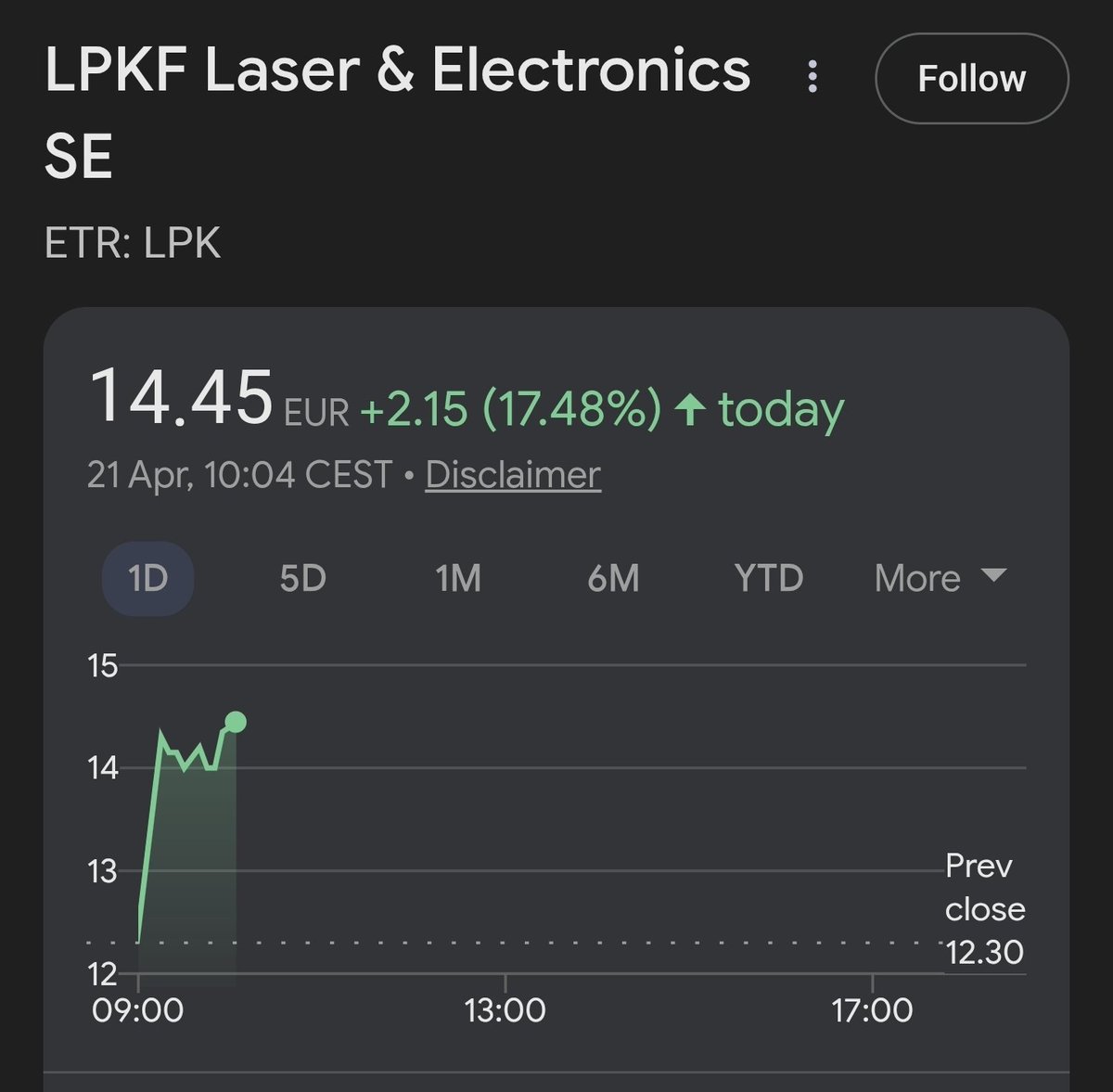
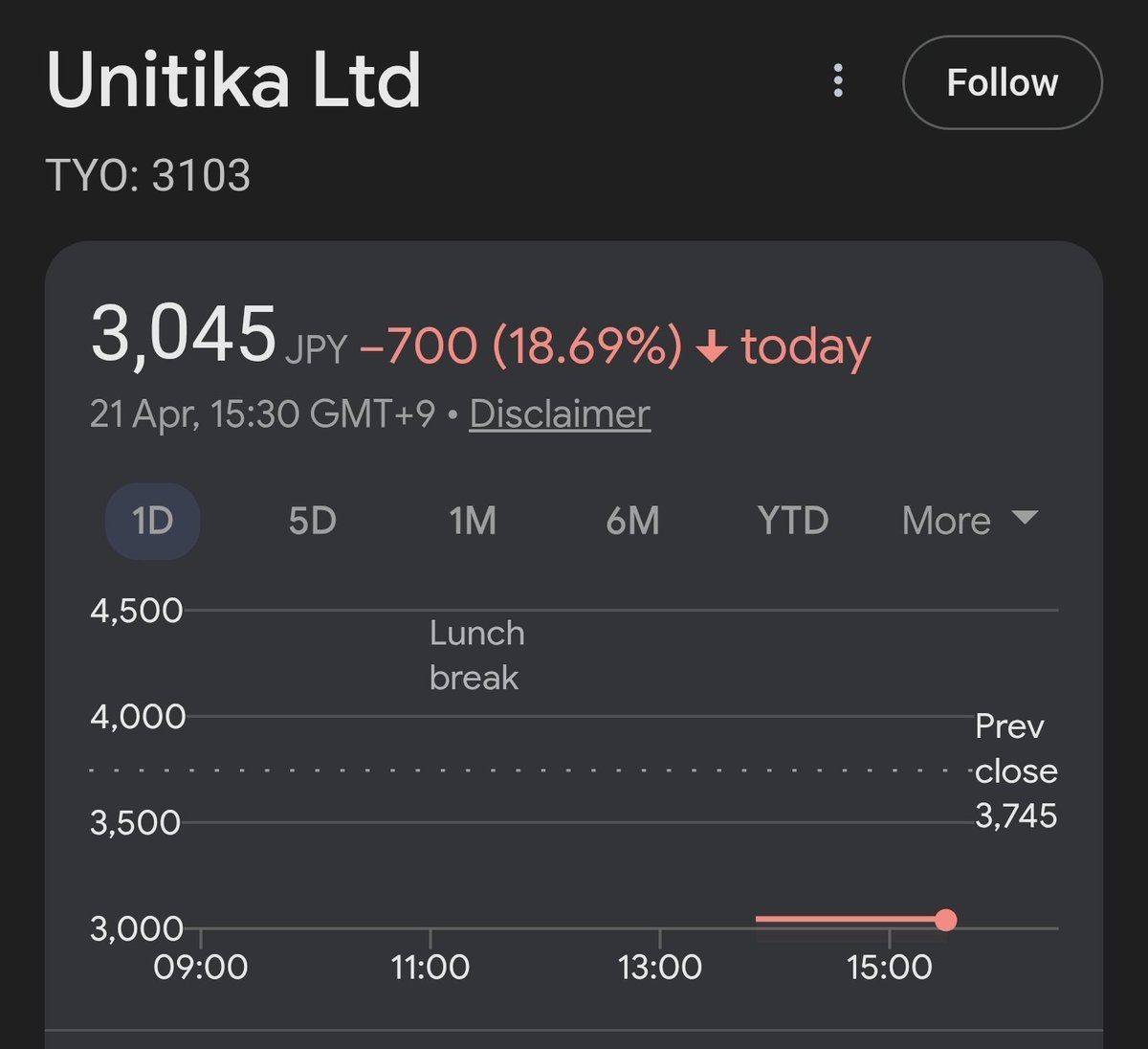
I started 2 relatively small positions on $LPK and Unitika last week. Why small? 1. $LPK up 17% so far today 2. Unitika down 18% today I am building my positions slowly on both via DCA. (Like with any stock). You're never going to have the best avg. price with this method, but it helps smooth out short term volatities. And it stops me checking my account 72 times a day. Also yes, I did buy more $LPK following my "bear" thesis the other day lol.
Paradis Labs tweet mediaParadis Labs tweet media
English
19
5
203
48.8K
yep
yep@marrkyss·
@aleabitoreddit Serenity I think we all want a dd of $LPKF
English
5
0
9
3.2K
Serenity
Serenity@aleabitoreddit·
CPO / 1.6T. Substrates (Glass Core, InP, SoI). CPUs / ASICs. Transformers.
English
60
34
801
132.3K
vlmk
vlmk@vlmkapital·
$LPK I don't even know what to say at this point man. Just wait until these people figure out that LPKF is actually supplying to JWMT and that it is actually bullish that Samsung bought a stake in JWMT, for example. It is of no use for me to try to correct the mainstream narrative against accounts 20x larger than mine, the damage has already been done. But hopefully those who have actually done their research will be able to see through things like this
English
11
2
88
24.6K
yep
yep@marrkyss·
@00000sol0 @babyfolio I also think is positive but lets see. All european stock have finished +8% and we have finished red. However obviously I’m bullish
English
0
0
2
25
Babyfolio
Babyfolio@babyfolio·
This was a great thesis, I'm now long $LPK / $LPKFF Huge upside
Gen Z Investor@genZinvest0r

It's pretty interesting that the whole glass substrate supercycle essentially hinges on $LPK/ $LPKFF –a <€200M market cap company from Germany Glass is hitting an inflection point and the supply-chain is gearing up. Intel spent $1B+ on it. Samsung is sampling Apple. Absolics built a $600M fab in Georgia. LG Innotek is building pilot lines. Corning, AGC, SCHOTT are all supplying the glass Capex is ramping and glass looks imminent (it is) to become the base material for the next generation of leading edge semi packaging–however if you dive deeper down the rabbit hole, you’ll quickly notice that glass substrates are useless without Through-Glass-Vias, tiny microscopic holes that carry electrical signals through the glass. No TGVs, no glass substrate, no party. It's literally just a piece of overengineered glass without them That leads us to $LPK. Let me give you the surface level overview of the thesis: TGV is hard. Glass is brittle. Traditional drilling can leave micro-cracks, rough edges and stress on the glass. This can hurt reliability and lower yield which directly leads to reduced margins $LPK does things a little different. They invented a two step process which uses a laser to modify the internal structure of the glass–then a wet chemical etching process which dissolves the modified regions. No micro-cracks, defect-free holes and sub-micron precision. This process is called LIDE (Laser-Induced Deep Etching) and is currently being adopted by ~80% of the glass substrate market for their qualifications Here is the overview: - $INTC: glass substrate packaging for 18A/14A, Clearwater Forest - Samsung Electro-Mechanics: sampling Apple and Broadcom, 2027 mass production - Absolics: first CHIPS Act recipient for glass, ramping production in Georgia - $011070/LG Innotek: pilot line, partnered with UTI, targeting 2028 - $GLW: supplying substrate-grade glass compositions - AGC, SCHOTT, Nippon Electric Glass: same All of these companies are betting their next-gen packaging roadmaps on glass. $LPK holds 80% market share in qualification with a long-term goal of maintaining 70% market share once HVM starts. Based on the list above, I'll let you take a guess who will, and won't depend on $LPK moving forward

English
5
2
57
9.6K
Serenity
Serenity@aleabitoreddit·
Digitimes: $GLW leads glass core substrate vs. KCC and LX Glass "Glass core substrates ... are key to next-generation advanced semiconductor packaging". On top of its structural importance, the commercialization timeline for glass core packaging seems to be accelerating as well. We're close to H2 and 2027 is probably the inflection point. I do have positions in the glass core names upstream, but recent news confirms the importance.
Serenity tweet media
English
44
37
546
114.9K
yep
yep@marrkyss·
@Craaazy1231 I also have a position it seems a good play
English
0
0
2
38
Crazy
Crazy@Craaazy1231·
@marrkyss Yes. Actually 100% in. There is no way going back, and I believe my conviction.
English
1
0
0
110
Crazy
Crazy@Craaazy1231·
I'm officially in $HIMS. I'm actually full porting this. I'll come back to this, once it hits $50.
English
5
0
23
7.5K
Dheeraj
Dheeraj@DheerajNam·
@marrkyss @aleabitoreddit @babyfolio Writing a thesis takes time. I’d hop in before the news rather than after esp since there is confirmation of having a position.
English
2
0
3
86
KawzInvests 🦑
KawzInvests 🦑@KawzInvests·
The most interesting photonics companies in the world right now are not in America. $AIXA has >90% share of MOCVD tools for InP lasers. Germany. $LPK.DE owns the laser process enabling glass substrates for CPO. Germany. $P4O makes the structured glass wafers those tools pattern. Germany. $M7U owns the in-situ metrology integrated inside every $AIXA reactor. Germany. And $SOI, the leader in Photonics-SOI wafers that every silicon photonics foundry runs on, is French. European semicap trades at 40-70% discounts to U.S. peers on the exact same AI trade.
KawzInvests 🦑@KawzInvests

Been digging through European photonics the last few weeks. Most of you already know $AIXA and $SOI. Both still have room. Getting a lot of questions about $LPK.DE lately so I want to address it directly. LPKF is the laser process pioneer for glass substrates. Intel, Samsung, and TSMC are all piloting glass as the next-generation AI packaging material. Glass handles heat, density, and integrated optics better than anything else on the roadmap. The bottleneck is simple. Glass cracks when you drill it. LPKF's LIDE process is one of a very small number of technologies that can structure glass at production scale without cracking. No glass substrate ecosystem gets built without a tool like theirs in the line. Management's own words on the recent call: the question is no longer whether glass breakthrough in advanced packaging happens, but when the ramp-up begins. There are two more names attached to this supply chain that I am still researching and not ready to publish on yet. One is the integrated metrology sitting inside $AIXA's reactors. Trades like a sleepy industrial despite the direct AI attachment. One is the micro-cap making the actual glass wafers. Up 200% already and still small enough that real revenue ramps break it wide open. Besi trades at 77x EBITDA on the advanced packaging theme. These trade at fractions of that one layer upstream. H/T to @AlmaCap114204 who found this one early. More to come.

English
21
20
295
99K