
Martha Shear⚡️

48 posts

Martha Shear⚡️ banner
Martha Shear⚡️

Martha Shear⚡️

@martha_shear

building at https://t.co/yyGonAO8Ed. opinions are my own.

San Francisco Katılım Mart 2010
251 Takip Edilen1K Takipçiler
Martha Shear⚡️
Martha Shear⚡️@martha_shear·
See below for the Electric team member accounts. There has been an increase of impersonations across the team — look for the blue lightning logo!
Electric Capital ⚡️@ElectricCapital

Electric team accounts always have a blue lightning logo in the profile. There has been a recent increase in impersonators. Only follow and engage with the official accounts listed below! This is the complete list of @ElectricCapital team members active on X: @0x9e0ff - Geoffrey @0xren_cf - Ren @avichal - Avichal @CBazlamit - Baz @elizlaraki - Elizabeth @EmilyMMeyers - Emily @FinnLowden - Finn @fiveoutofnine - ⁵⁄₉ @garythung - Gary @curtis0x - Curtis @kateli_nyc - Kate @koolwal - Aditya @leafpurple13861 - Yezi @MicoKleidi - Kleidi @martha_shear - Martha @MariaShen - Maria @mitchelljhammer - Mitchell @mishafrolov - Misha @n4motto - Emre @puntium - Ken @sanjaypshah - Sanjay @sarawampler - Sara @scinocco_a - Tony @sheatgm - Mark @sidmvenkat - Sid @swatimardia - Swati @thuanlee - Thuan


English
0
0
3
416
Martha Shear⚡️
Martha Shear⚡️@martha_shear·
Asia is the #1 continent for crypto devs The US needs clear crypto policy to maintain its #1 country lead & decrease innovation drain. Crypto is non-partisan—crypto devs are in 50 states & 2/3 are outside of trad tech hubs Dive into the data & get ready for the 2024 Dev Report
Maria 🐸@MariaShen

We @electriccapital analyzed 110k+ developer profiles to understand crypto devs geographically. Asia is now #1 for crypto devs. The US is losing market share. Crypto impacts every state in the US -- crypto should be non-partisan. Here’s what the data shows & why it matters:

English
2
2
12
1.6K
Martha Shear⚡️
Martha Shear⚡️@martha_shear·
Crypto has grown a lot since @ElectricCapital’s first Crypto Market Map in 2019. Dive into the 1,500+ major projects across the ecosystem. ⬇️
Maria 🐸@MariaShen

1/ We are excited to introduce the @ElectricCapital Crypto Market Map! The Crypto Market Map tracks 1,500+ projects in crypto. It contextualizes every major project in crypto by organizing projects into 6 tech layers & 137 categories. cryptomarketmap.org Let's explore 👇🏽

English
3
0
7
559
Martha Shear⚡️ retweetledi
Avichal - Electric ϟ Capital
Exciting to see @NEARProtocol expand its DeFi ecosystem and @fraxfinance to expand beyond EVM chains! @samkazemian 🤝 @ilblackdragon
NEAR Protocol@NEARProtocol

The NEAR Ecosystem welcomes @fraxfinance on NEAR as it takes its first major leap into a non-EVM environment. This move increases diversity in the stablecoin landscape on NEAR, among other novel unlocks for DeFi and yield-bearing assets on NEAR. Let's. Fraxin. Go. Read more: bit.ly/3IzNpzt

English
4
17
125
13.6K
Martha Shear⚡️ retweetledi
Maria 🐸
Maria 🐸@MariaShen·
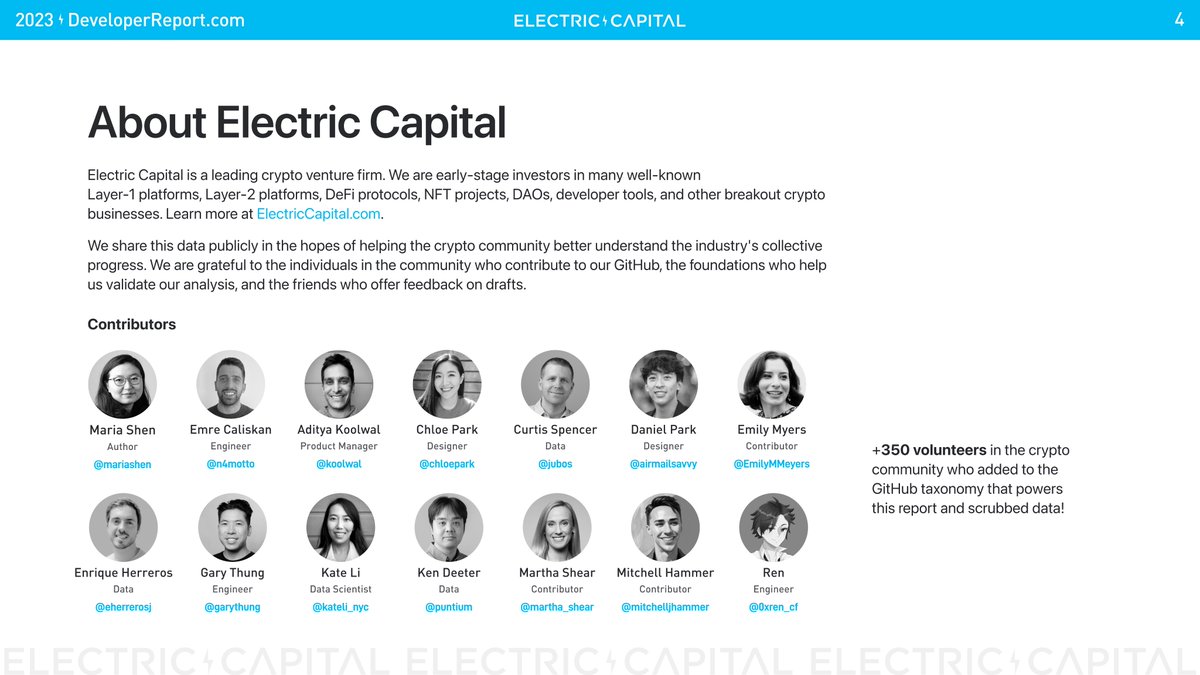
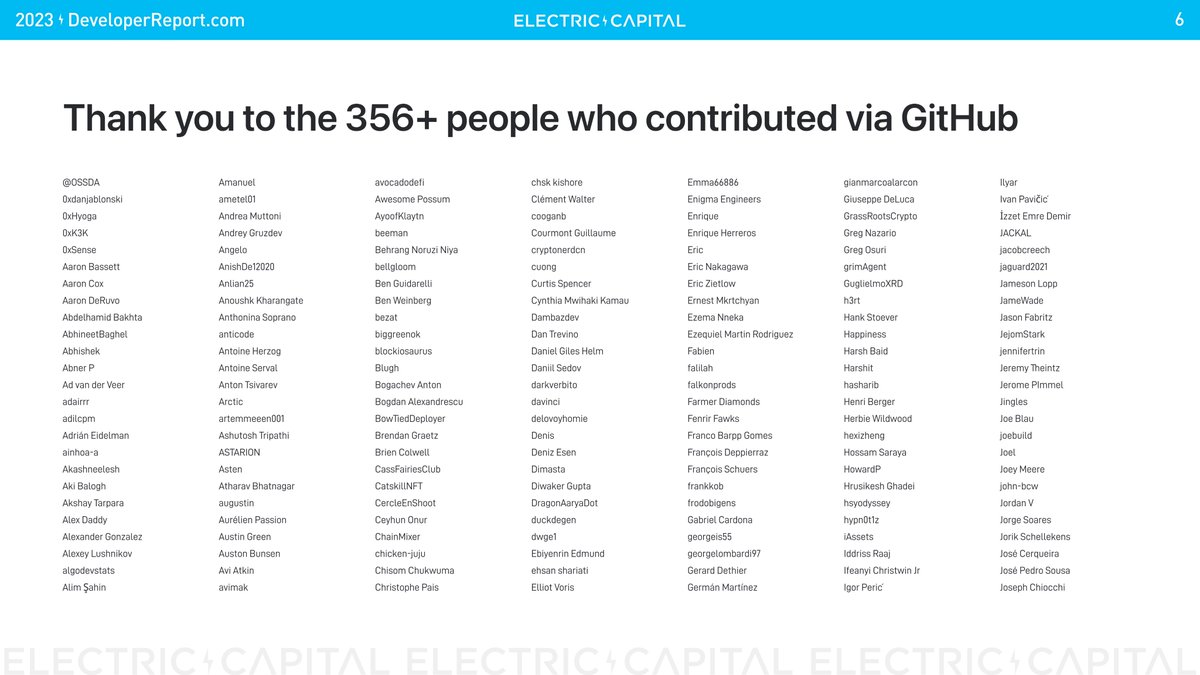
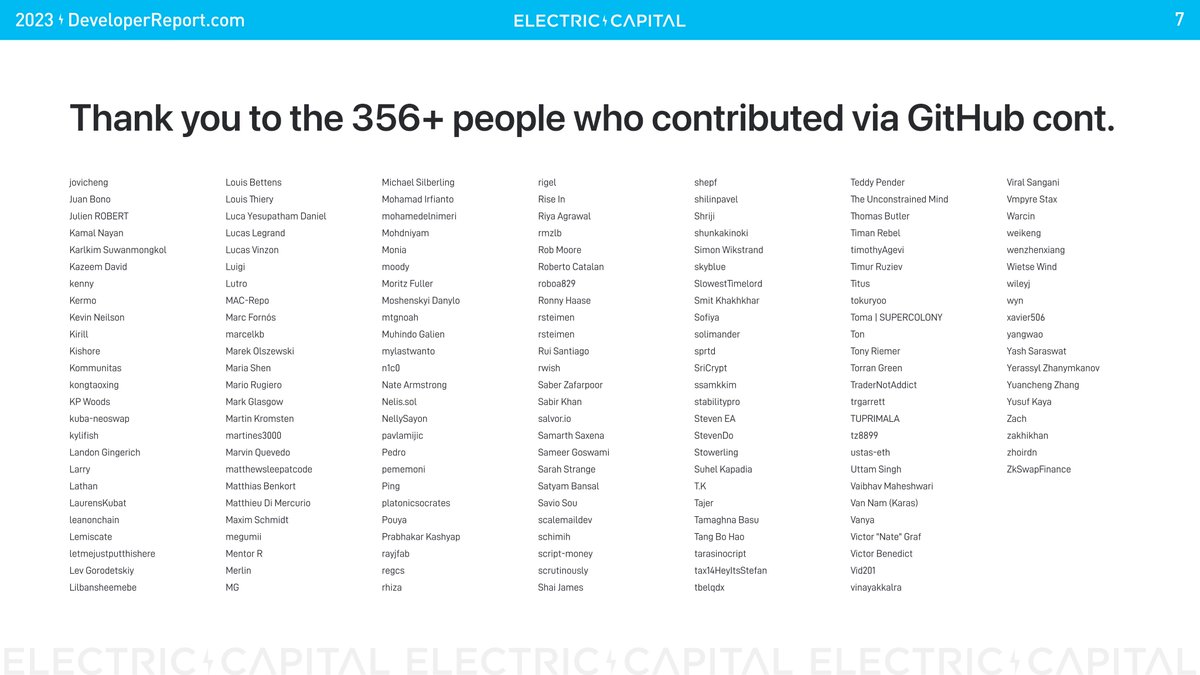
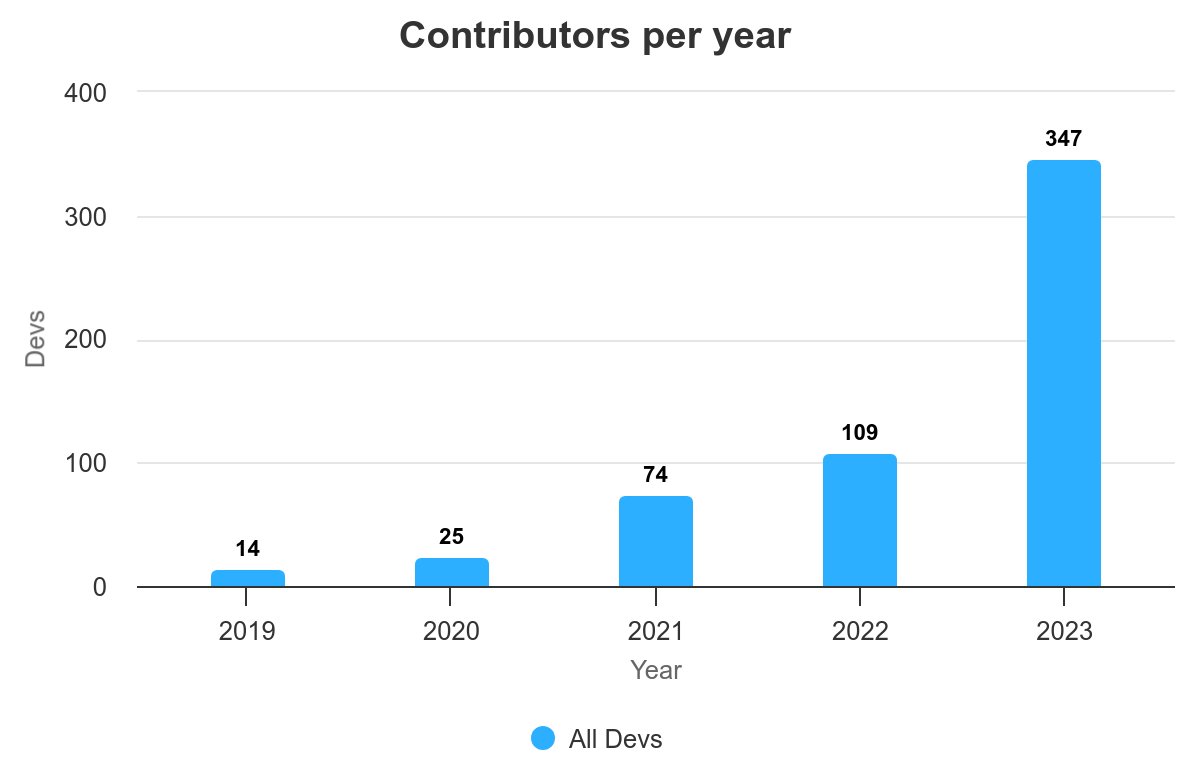
0/ We are delighted to release the 5th annual @ElectricCapital Developer Report We analyzed a record 485 million code commits across 818k repositories—20x more code than our first report from 2019! 356+ people across the community contributed to making this report. Long, data-filled thread below! 👇 Read it here: developerreport.com/developer-repo…
Maria 🐸 tweet mediaMaria 🐸 tweet mediaMaria 🐸 tweet mediaMaria 🐸 tweet media
English
86
415
1.3K
576.8K
Martha Shear⚡️ retweetledi
Hunter Horsley
Hunter Horsley@HHorsley·
Today, we rang the closing bell on behalf of #bitcoin Everyone in this community carries the torch — We took this pic for you.
Hunter Horsley tweet media
English
107
153
1.9K
152.2K
Martha Shear⚡️ retweetledi
Enrique
Enrique@eherrerosj·
1/8 @electriccapital's 2023 Developer Report is coming soon! This will be the year with the highest number of community contributors. Some stats: 1. 347 yearly more contributors: 3x vs 2022 2. 225 monthly active contributors: 4x vs 2022 3. Tracking 350k repos: 2.5x vs 2022
Enrique tweet media
English
7
16
91
19.4K
Martha Shear⚡️ retweetledi
Hunter Horsley
Hunter Horsley@HHorsley·
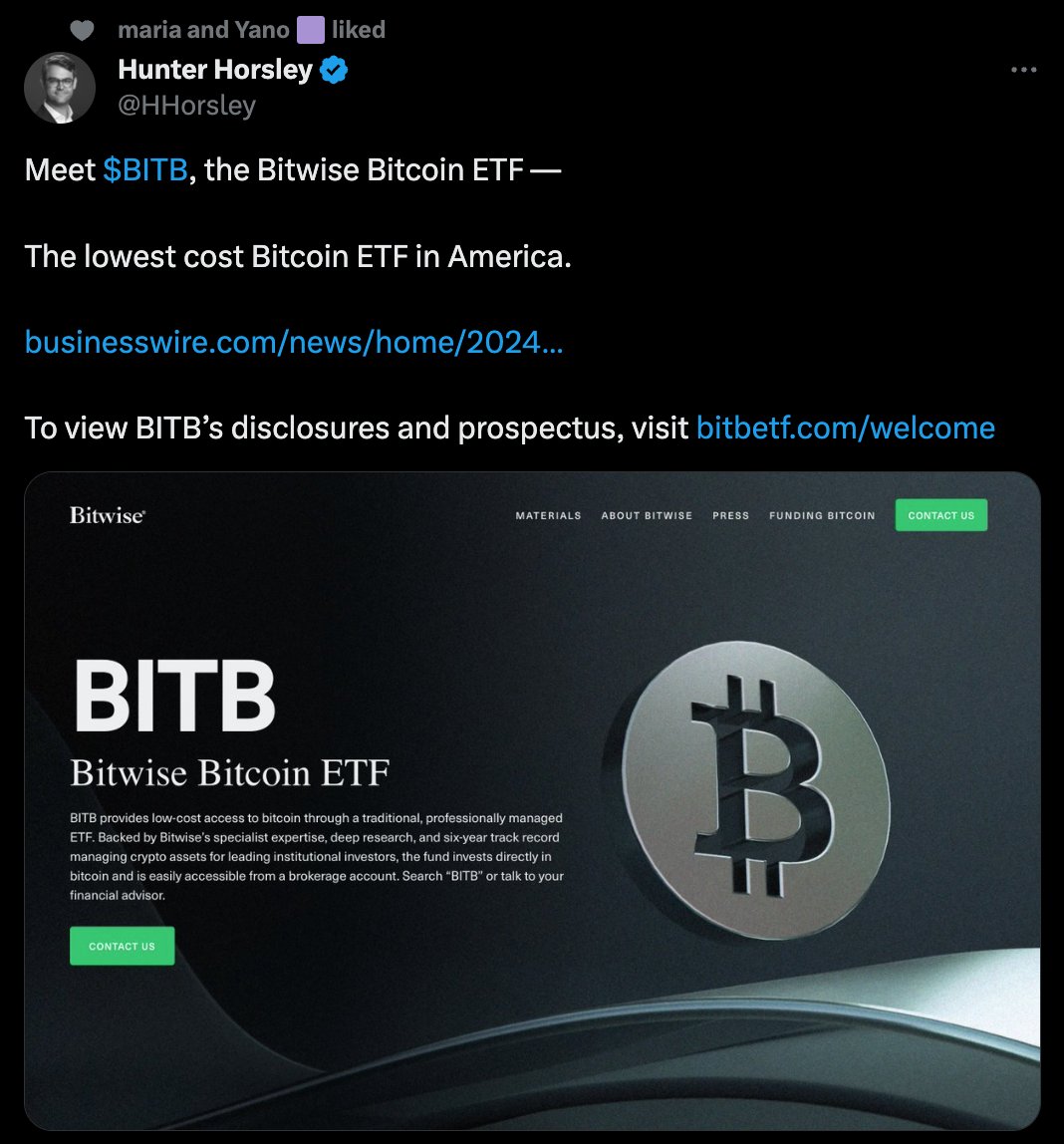
$BITB - the Bitwise Bitcoin ETF #1 by inflows day 1: $240M AUM Feel immense gratitude. Each dollar represents is a decision by investors to trust @bitwise to be their steward. Delivering on that is our singular focus. Thank you — [View BITB disclosures & prospectus here: bitbetf.com/welcome]
Eric Balchunas@EricBalchunas

Congrats to $BITB for winning Day One of the Cointucky Derby w/ $238m in flows. $FBTC was a close second while $IBIT a distant third (an exact box bet would have massive payout). All told $721m for gp, amazing but still incomplete picture, flow data slow, tonight know more.

English
27
40
299
77K
Martha Shear⚡️ retweetledi
Avichal - Electric ϟ Capital
The Bitcoin ETF is not the only big market shift @CFTC just granted @Bitnomial the 3rd and final key license to run a fully regulated Bitcoin derivatives market in the US, with leverage, and crypto collateral. This is a BIG unlock for onshore, US-regulated crypto derivatives
Curtis Spencer@curtis0x

Congrats to @LukeHoersten and the @Bitnomial team on the milestone hearing today with the CFTC! Bitnomial now has acquired the infinity stones of licenses needed to enable regulated crypto derivatives access in the US. This paves the way for the following: - Miners / Stakers locking in prices against their future crypto production - Options strategies like covered calls or put buying for treasury management - Leveraged futures buying/selling with physical delivery of actual crypto, not just a synthetic instrument. Very happy to see the trend of regulators putting in the work to understand the industry. More info about the hearing here: prnewswire.com/news-releases/…

English
1
12
75
17.3K
Martha Shear⚡️ retweetledi
Elizabeth Laraki
Elizabeth Laraki@elizlaraki·
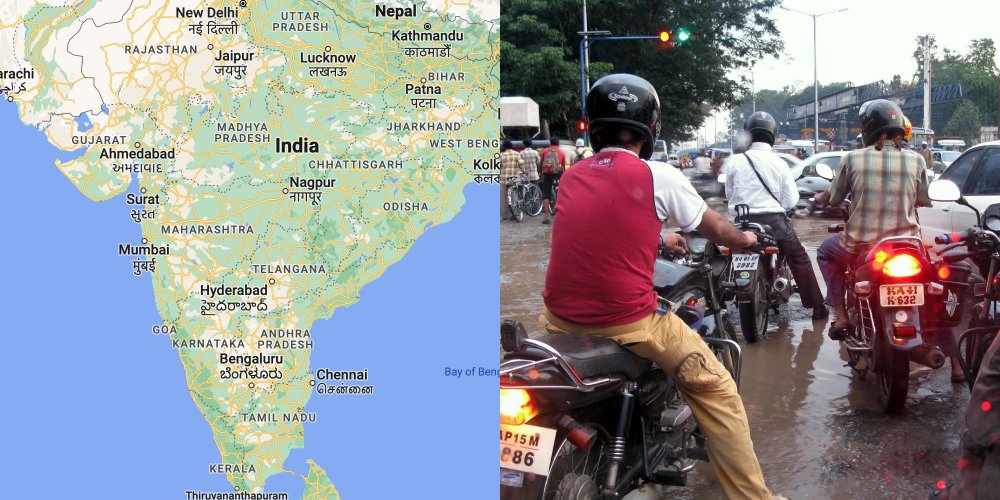
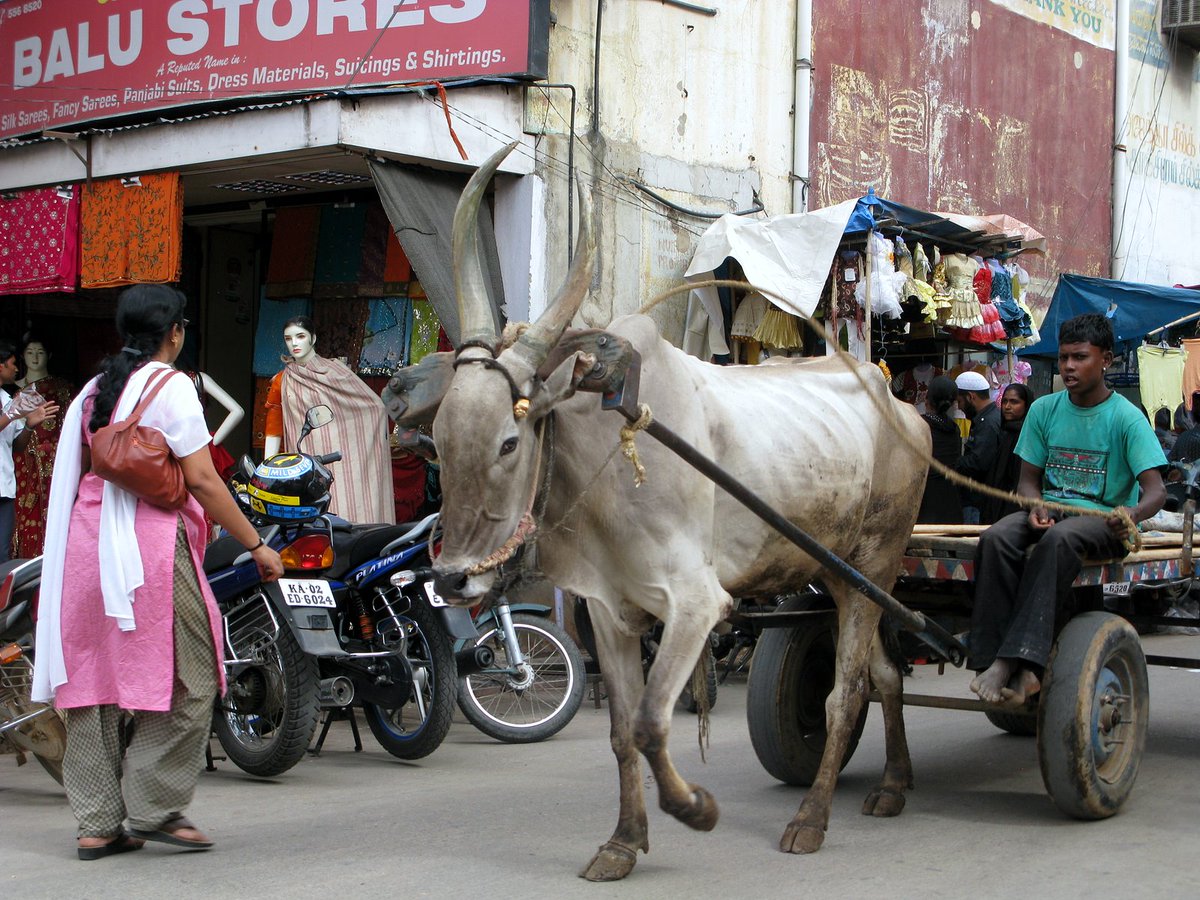
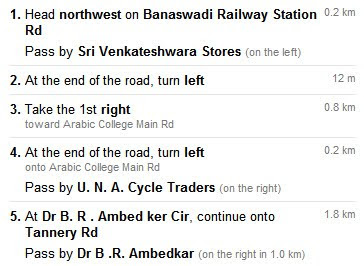
In 2008, Google Maps launched in India. But we quickly ran into a problem: Nobody used street names. And street names were the foundation of Google Maps. The team had to make some big adaptations. 15 years later, the changes have stood the test of time. Here's how the team came up with creative solutions to adapt Google Maps to work in India: ––– When Google Maps launched in India, turn by turn directions were unusable. Because there were no road names, directions looked like this: This was before real time, accurate GPS in phones had become mainstream. In short, directions were pretty much useless in India. ––– We could have left the product as it was. We could have assumed it was good enough, would get better over time, or that eventually people would adapt. But India was a massive potential market and we wanted the product to thrive. The solution wasn’t just a case of acquiring and cataloging street names. Many streets either didn’t have names, had multiple names, or weren’t known by their official names. So we had to find an alternative. We already knew that many communities around the world relied on landmarks (rather than street names) for navigating. e.g. “Turn left at the park, head towards the water” We knew this was also true in India. But we had to confirm landmark based navigation would work. And if it did, how we could make it work. ––– So we dove in. We started to explore how Google Maps could work if it oriented around landmarks. But we needed to understand 2 key questions: 1. How did people use landmarks to navigate in India? 2. What types of landmarks were good for navigating? This is where user research came in. At the time, Google had robust support for user research. There were research labs on campus with eye tracking technology and one-way mirrors. There was a team dedicated to recruiting research participants. But in this case, my friend and researcher extraordinaire, Olga (@okhroust) simply focused on how she could best answer these key questions. She put together a creative and scrappy research plan. And then she and Janet, the designer, hopped on a plane to India. ––– What followed was nimble, on the ground field research to understand, first-hand, the answers to these questions. They creatively explored various approaches including: • Calling businesses and asking them for directions to their stores • Asking people to draw diagrams of routes to familiar places • Following people around as they navigated unfamiliar places • Recruiting people to keep track of directions they gave or received + later interviewing them on their experiences • Sharing early designs of landmark based directions and asking for feedback Rather than relying on sophisticated technologies or being bounded by formal research methods, they creatively tried several different tactics to understand how locals navigated their way through India. Olga and Janet found that people used landmarks to navigate in a few key ways: • Orientation: “Head towards the water” • Description of a turn: “Turn just past the Big Bazaar” • Confirmation of the right path: “You'll see a petrol station on the right” • Error correction: “If you get to the roundabout, you've gone too far” Landmarks that were used for navigating included parks, monuments, shopping centers, notable buildings, stores, petrol stations, roundabouts, etc — basically anything that anyone would notice while on the road. And so the team reworked turn-by-turn street directions to include navigational landmarks to help orient people, signal turns, confirm direction, and error correct. The team worked through several iterations before landing on a final solution that emphasized landmarks, but also subtly included road names (when available): ––– The research drove the product changes that helped transform Google Maps into the dominant navigational product for India. A lot has changed in the last 15 years with the pervasiveness of location-enabled mobile phones, cheap mobile data, and generally how locals navigate in India. But the use of landmarks to help people navigate through India has stood the test of time. ––– What I love about this story and my 2 biggest takeaways are: 1. Research is a critical tool for ensuring you’re building a good product 2. Research can be as simple as just talking to people to answer your questions tl;dr: If you are looking for answers, go talk to people. For more on design + tips for early stage founders, follow @elizlaraki
Elizabeth Laraki tweet mediaElizabeth Laraki tweet mediaElizabeth Laraki tweet mediaElizabeth Laraki tweet media
English
109
1K
4.5K
655K
Martha Shear⚡️ retweetledi
Enrique
Enrique@eherrerosj·
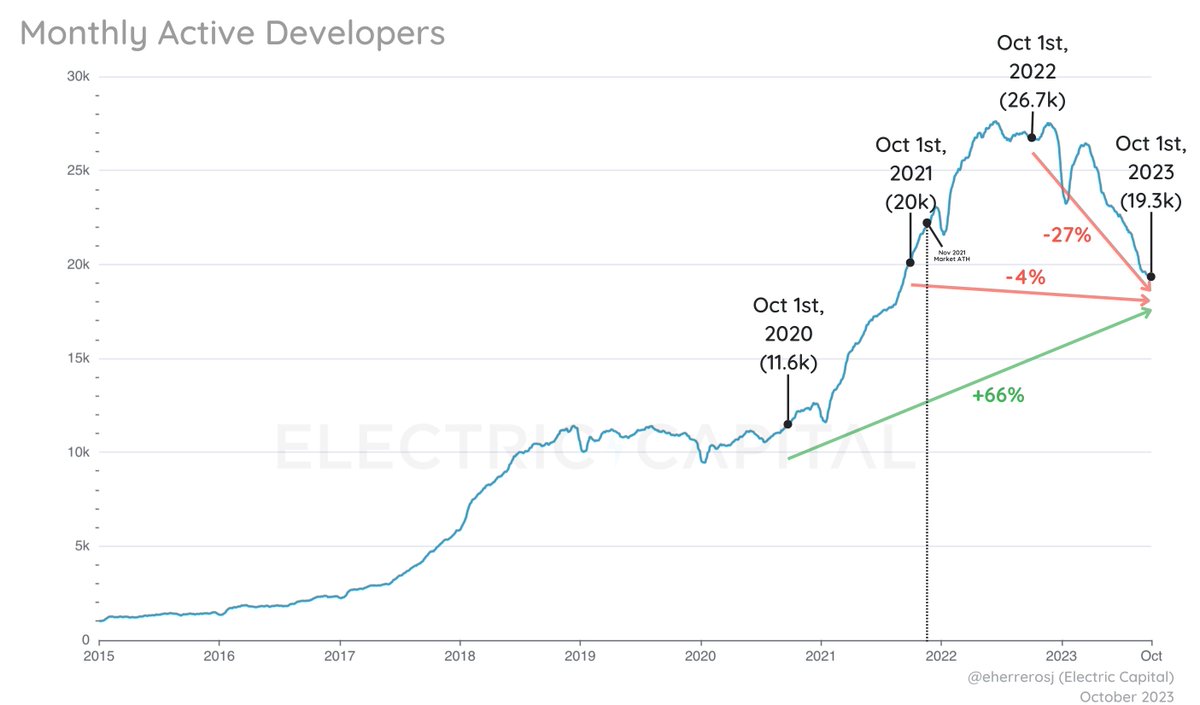
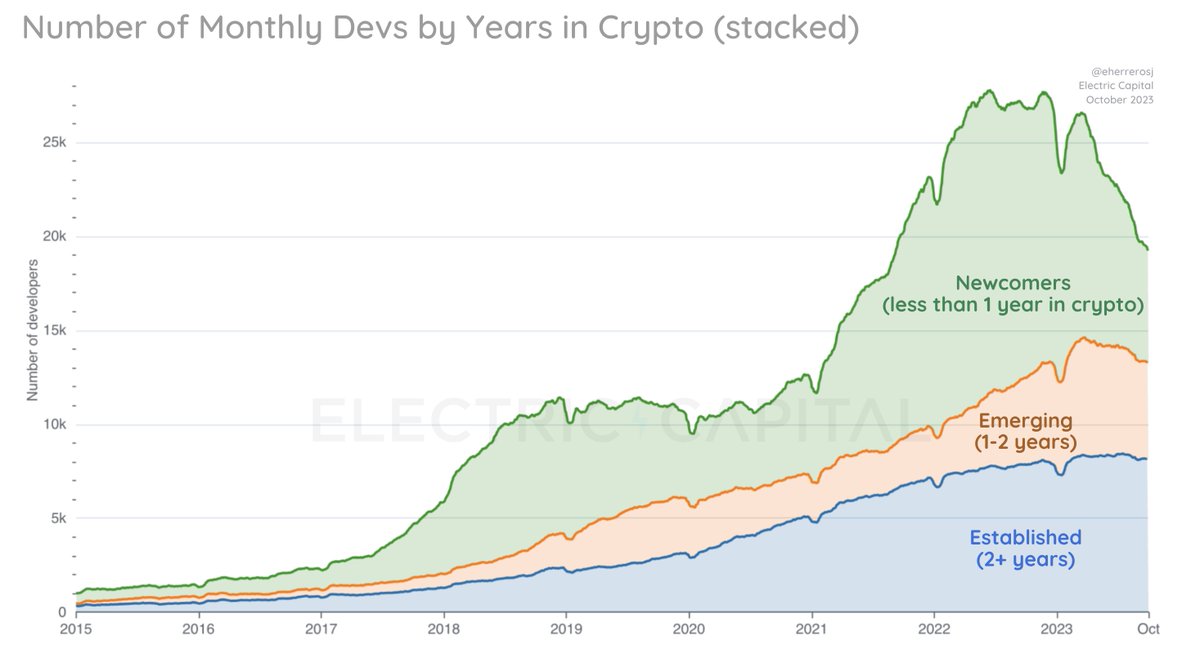
.@electriccapital’s Developer October Update is here! This is a lighter weight update as we prepare for our annual report. We inspected 164M+ crypto commits to find: • 19.3K monthly active open source developers as of October 1, 2023 • Developers have decreased -27% YoY • Developers who left crypto recently were Newcomers who worked in crypto fewer than 12 months and were responsible for around 25% of all code commits. This is consistent with our findings in July 2023 and the trend continues today Developers Increased +66% Since the Last Bear Market 3 Years Ago Developers increased +66% compared to the previous bear market, but developers decreased over 2023: -27% from October 2022, -4% from October 2021 Despite long-term growth, what happened since October 2022? Developers in Crypto 1+ Years Continue to Contribute While Many Newcomers Left We can segment monthly active developers by how long they have worked in crypto by comparing the time between their first and last commits. • Newcomers: developers who worked in crypto less than 1 year • Emerging: developers who worked in crypto 1 to 2 years • Established: developers who worked in crypto 2+ years The decline in monthly active developers in the last year came from Newcomers. We can see a decrease of -58% in Newcomers, a moderate increase of +11% Emerging Developers and a slight increase of +5% Established Developers. Why did Newcomers decrease? Fewer New Developers Exploring Crypto in 2023 First, Newcomer developers have decreased because fewer new developers are exploring crypto. 1,721 new developers entered crypto in October 2023: • 40% fewer new developers entering crypto since June 2023 • 64% decrease since October 2022 • 67% decrease since November 2021 market peak [thread continues below]
Enrique tweet mediaEnrique tweet mediaEnrique tweet mediaEnrique tweet media
English
22
99
368
122K
Martha Shear⚡️ retweetledi
Emre ⚡
Emre ⚡@n4motto·
Our latest update for developerreport.com is here! Noticed the 27% YoY drop in devs? It turns out these are primarily Newcomers that are leaving. Both Emerging and Established developers are keeping pace (up 11% and 5% YoY respectively). Dive into @eherrerosj’s breakdown for the full picture 👀
Enrique@eherrerosj

.@electriccapital’s Developer October Update is here! This is a lighter weight update as we prepare for our annual report. We inspected 164M+ crypto commits to find: • 19.3K monthly active open source developers as of October 1, 2023 • Developers have decreased -27% YoY • Developers who left crypto recently were Newcomers who worked in crypto fewer than 12 months and were responsible for around 25% of all code commits. This is consistent with our findings in July 2023 and the trend continues today Developers Increased +66% Since the Last Bear Market 3 Years Ago Developers increased +66% compared to the previous bear market, but developers decreased over 2023: -27% from October 2022, -4% from October 2021 Despite long-term growth, what happened since October 2022? Developers in Crypto 1+ Years Continue to Contribute While Many Newcomers Left We can segment monthly active developers by how long they have worked in crypto by comparing the time between their first and last commits. • Newcomers: developers who worked in crypto less than 1 year • Emerging: developers who worked in crypto 1 to 2 years • Established: developers who worked in crypto 2+ years The decline in monthly active developers in the last year came from Newcomers. We can see a decrease of -58% in Newcomers, a moderate increase of +11% Emerging Developers and a slight increase of +5% Established Developers. Why did Newcomers decrease? Fewer New Developers Exploring Crypto in 2023 First, Newcomer developers have decreased because fewer new developers are exploring crypto. 1,721 new developers entered crypto in October 2023: • 40% fewer new developers entering crypto since June 2023 • 64% decrease since October 2022 • 67% decrease since November 2021 market peak [thread continues below]

English
14
7
46
9.1K
Martha Shear⚡️ retweetledi
Ken Deeter (puntium.eth) 🦇🔊
Your periodic reminder that your cryptospeak isn't convincing anyone. We all like to throw around words like decentralized, permissionless, immutable, smart contracts, etc. Maybe we all do this to show that we are in the know or part of the group. But to normies, these words are foreign, confusing, and make it harder to understand why crypto is valuable. Behind each of these words, there are real values and value propositions that speak to things that everyone cares about. Instead of being "permissionless", talk about enabling open access, regardless of who you are, what country you live in, or whatever a small group of people in some country deemed safe for you. Talk about being able to freely build on others work. To be able to combine multiple services with a little bit of code if you're so inclined. Talk about all the times which you said, I wish my bank and this other company could just figure it out and work together, and how open systems enable that kind of innovation. Talk about how billions of people around the world don't have access to basic, reliable financial services that DeFi can provide. Instead of being "decentralized", talk about resilience and reliability. Talk about how no single party can cancel you or take away your assets. Talk about how even if other people decide to stop running the service, in the worst case you can still pick it up and run it yourself. Talk about all the annoying times that Google or Apple or Facebook shut off your favorite feature, and how terrible it is that you can be financially deplatformed. Instead of being "immutable", talk about predictability and reliability. Talk about how the tech behind these services makes it so that literally nobody can take them down or change them. Instead of saying "smart contracts", talk about automation and taking humans out of the loop. Point out how email and messaging made the mailman irrelevant. Talk about how a new kind of code is doing the same thing to a lot of what bankers, and some lawyers, and some courts do. Talk about how the code spells out exactly what can and can't happen, for everyone to see, and how there's no more humans involved. Humans that can arbitrarily try to lie to you and steal your money. Humans that subjectively interpret ambiguous laws to create outcomes that you didn't expect. For better or worse, the main stream narrative around crypto is one of fear, uncertainty, and doubt. Throwing a bunch of abstract jargon on top will not help cut through the noise. But tell someone who trusts you how a DeFi lending protocol can be more reliable and predictable than a bank? That is much more likely to trigger interest, questions, and real understanding.
English
25
58
267
49.7K
Martha Shear⚡️ retweetledi
Elizabeth Laraki
Elizabeth Laraki@elizlaraki·
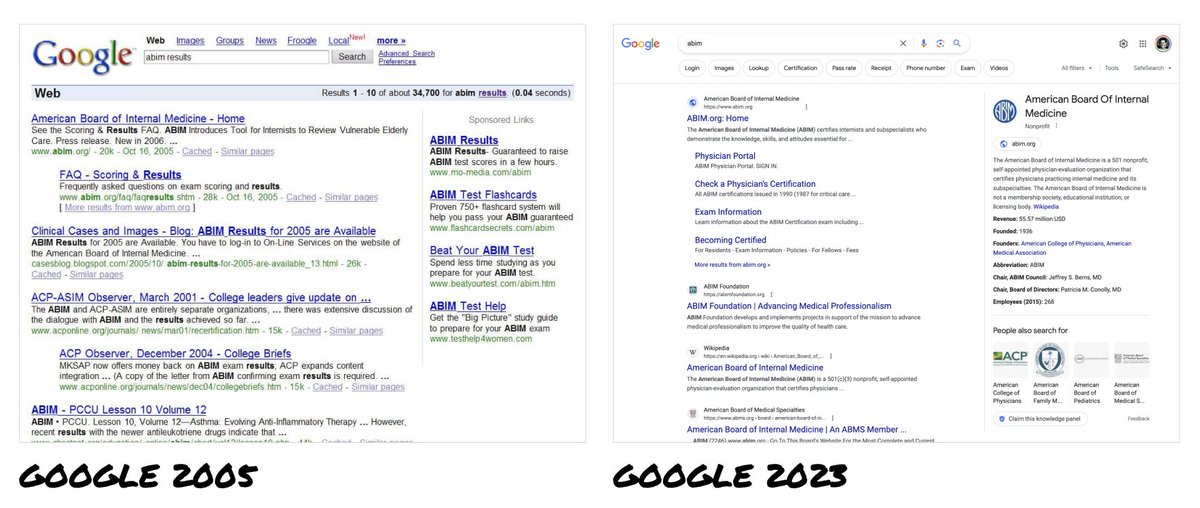
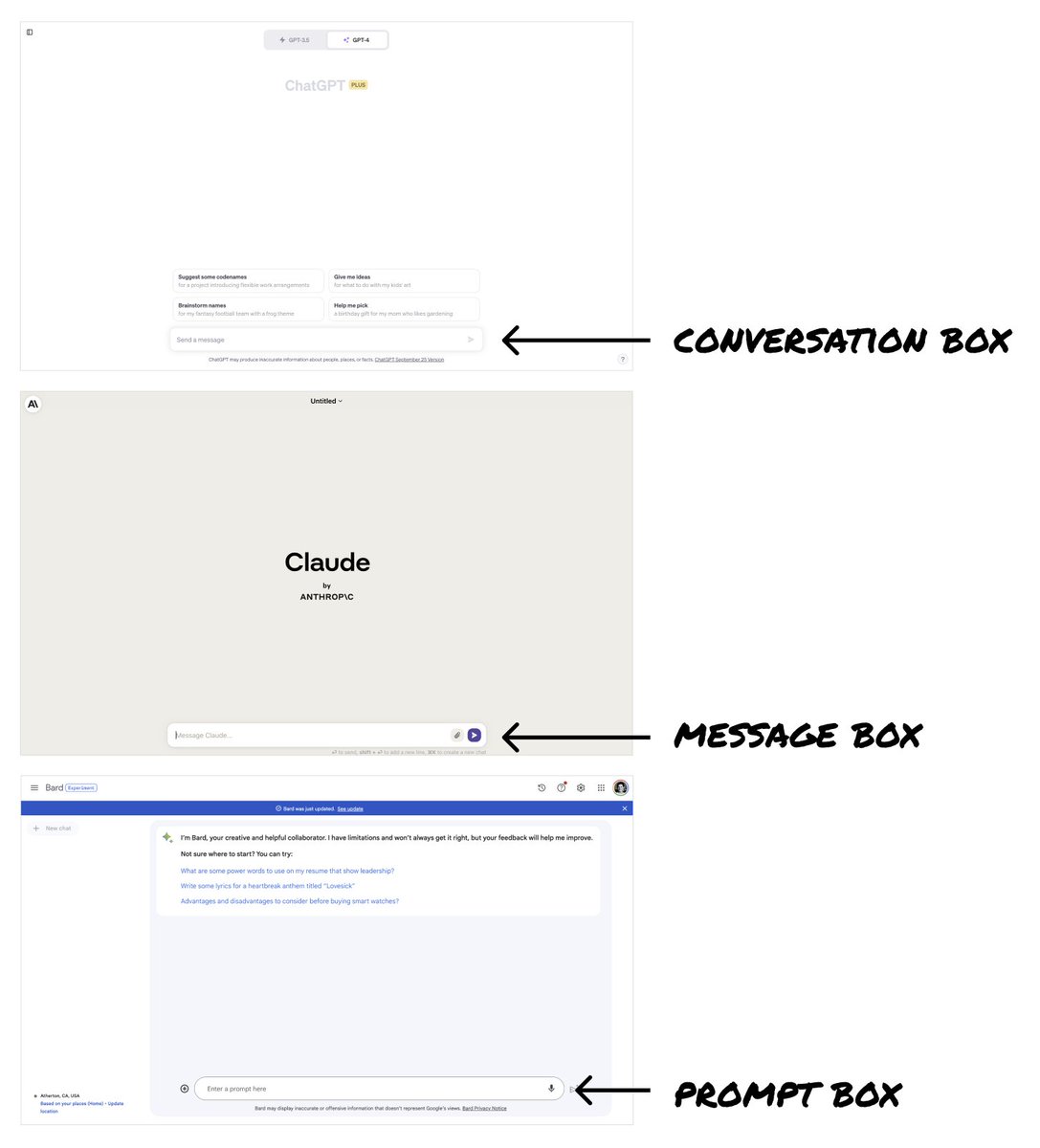
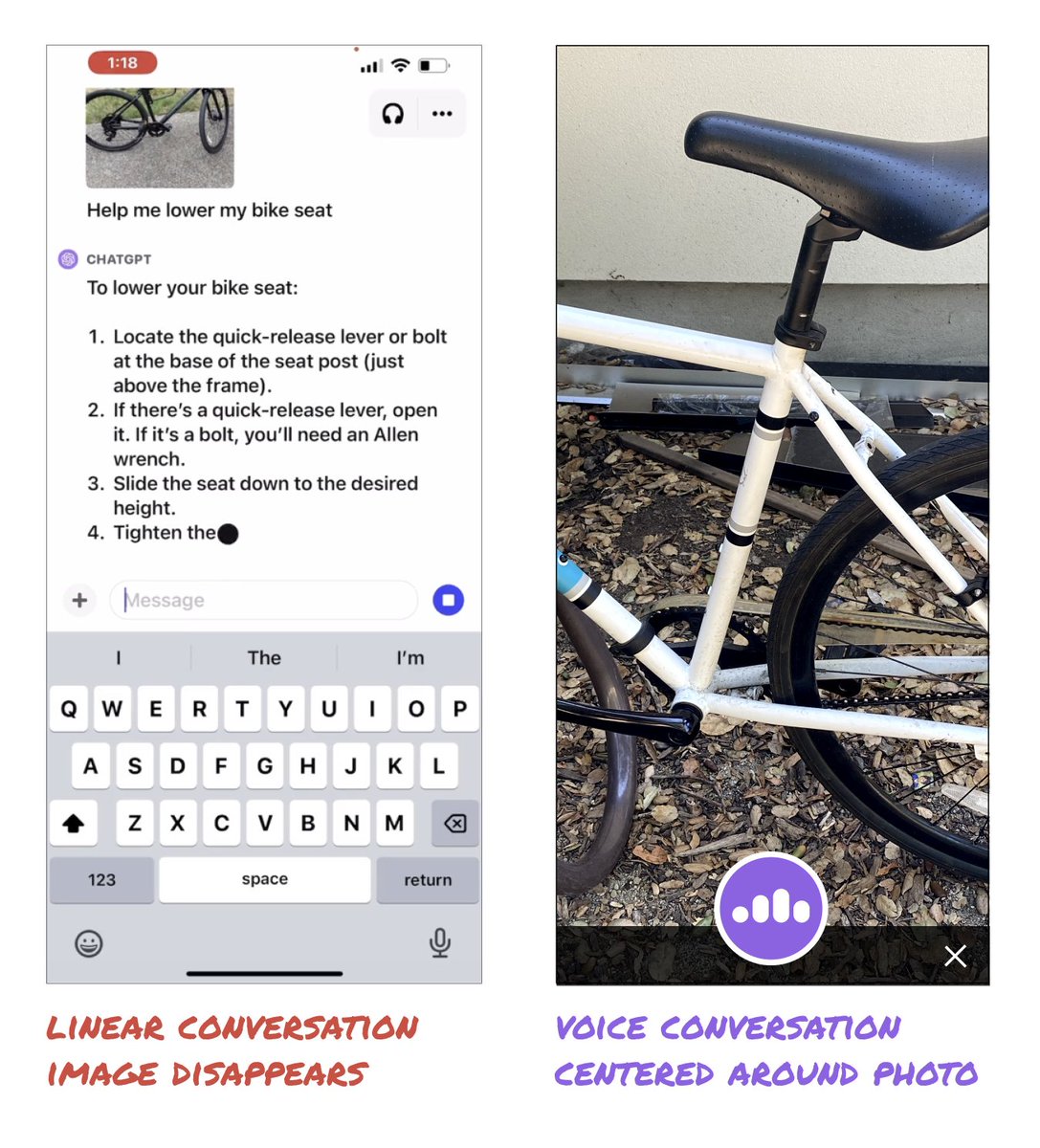
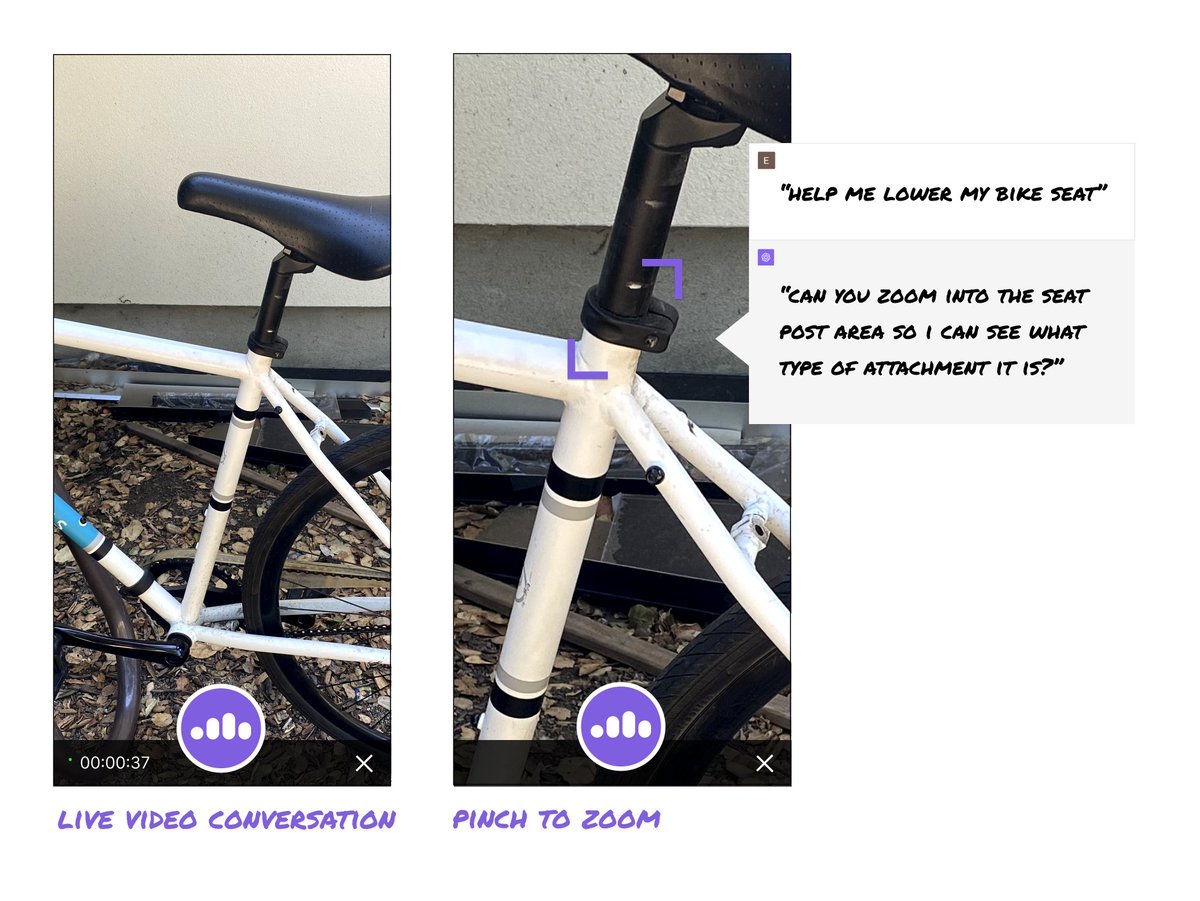
In 2006, I was 1 of 4 designers on Google Search. For 20 years, every search engine has copied Google. Now ChatGPT, Bard + Claude look like Google's offspring - "better” search engines. But last week signaled we're on the brink of a design revolution. ChatGPT unveiled incredible new features. These could give us the opportunity to completely shift how we interface with AI. Here's the full story: ––– When I was a designer on Google Search, all major search engines looked the same – Google, Yahoo, MSN Bing. Google was the market leader with a heavily optimized UI that supported billions of dollars in ad revenue. Naturally, it became THE way to show search results. Its success made it illogical for Google to consider big UI changes. And any changes they did make were just mirrored by everyone else. So 20 years later, we’ve only seen incremental changes to search engine UIs. ––– Today, we have consumer-ready LLMs (Large Language Models) freshly in our hands. As consumer products, these are in their infancy. We’re very early in understanding their capabilities and defining how people interact with them. These are uncharted waters. And yet ChatGPT, Bard, Claude etc. all chose a text-based input box — just like Google’s search box — as the core interface. Why? The input box is simple, versatile, and familiar. - It’s simple to understand → you type your questions into the box. - It’s versatile → the box can handle all sorts of questions/queries. - The paradigm is super familiar → people immediately know how to use it. Because of this, LLMs have essentially become “a better Google.” ––– But last week’s ChatGPT announcements thrust open the doors to new possibilities. ChatGPT is now multi-modal — it can see, hear, and speak. These are the recent announcements from @OpenAI : Voice: x.com/openai/status/… Photos: x.com/openai/status/… The example of ChatGPT explaining how to lower a bike seat was incredible. But, it could be so much better! The video showed you'll have to post multiple new photos to keep adding new information and to progress the conversation. It was still a linear conversation centered around the text box. But what if we rethought the interface to center around the image? What if ChatGPT supported both images AND voice simultaneously? Could we end up with a more immersive experience? ––– How else could interacting with LLMs mimic IRL conversations? Could we (or the AI) pinch to zoom or rotate the image? Could we interact in real time with video? What new possibilities open up with context being preserved over time? ––– There is so much energy and excitement around what AI can do. But we are limiting the potential by assuming the conversation box is the best interface. Right now, designers have the chance to create truly novel interactions and bust through the 20+ year old search UI paradigm. The ideas above are just to illustrate some potential options. But they are also intended to spark a flame. Now is the opportunity to be creative and explore divergent UIs. What are the craziest, coolest, most creative UI ideas we can unleash? LFG 🚀
Elizabeth Laraki tweet mediaElizabeth Laraki tweet mediaElizabeth Laraki tweet mediaElizabeth Laraki tweet media
English
177
998
6.4K
1.8M
Martha Shear⚡️ retweetledi
Stuti
Stuti@stutireal·
4/ The pulse of any crypto ecosystem can be gauged by Developer Activity. @MariaShen of @ElectricCapital shed light on the surprising dynamics of developers in the crypto space We are only down to ~21K MAU devs (vs ~26k at the peak). Those who left had been in crypto <12 months and contributed 20% of the code. The devs who have been here for >12 months, contributed 80% of the code, and are still here. More insights:
English
2
7
40
7.8K
Martha Shear⚡️ retweetledi
Mitchell
Mitchell@mitchelljhammer·
1/ The US is still on the fence wrt crypto. But the rest of the world isn’t waiting on the sidelines anymore. Non US policymakers are embracing crypto Non US consumers are using crypto Let's dig in 🧵
Mitchell tweet media
English
49
152
649
319.6K
Martha Shear⚡️ retweetledi
Financial Services GOP
Financial Services GOP@FinancialCmte·
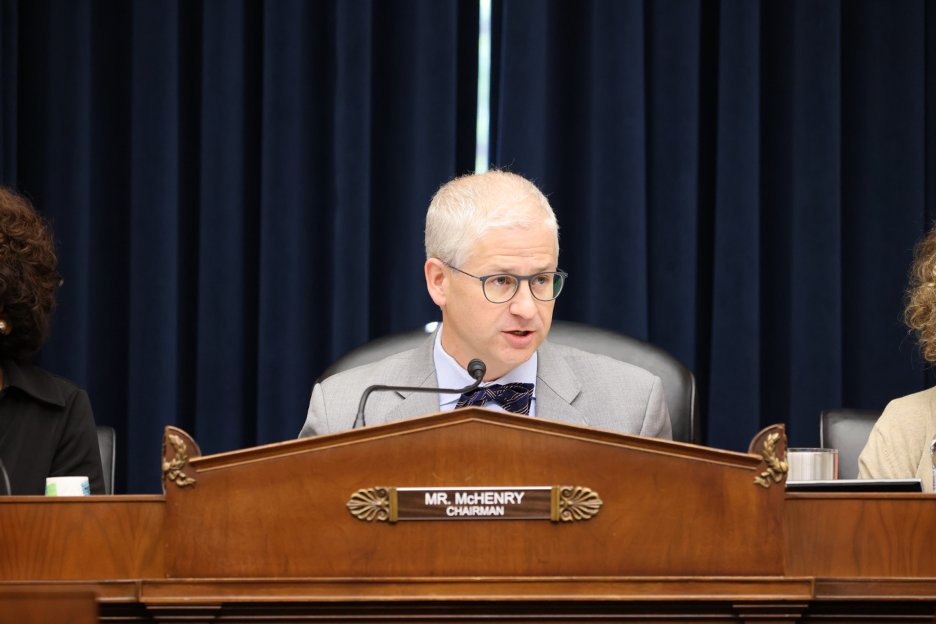
#BREAKING: Chairman @PatrickMcHenry's Clarity for Payment Stablecoins Act passes the Financial Services Committee with BIPARTISAN support. After fifteen months of bipartisan collaboration, this landmark legislation is one step closer to becoming law.
Financial Services GOP tweet media
English
87
421
1.7K
455.8K