

Mathias Boe
2.8K posts
Mathias Boe
@mathiasboe
I used to play badminton, now my passion lie within real estate and stock market. Twitter used mainly for that. Følg min Podcast @aktieuniverset
All over Katılım Mart 2010
182 Takip Edilen19.1K Takipçiler

@aktieuniverset
Er det for blødt at tage en position udelukkende fordi CEO har en god humor 😄
All-In afsnittet med Marc Benioff fra salesforce havde nær fået mig til at hoppe på din vogn @mathiasboe. Manden er fandme sjov altså 😀
Ps: Han er bullish på egen butik 😉
Dansk
@FilipSalling @Claus_D_R Yes, kommer til at rulle rundt i sådan en her😛😛🌪
Dansk

@Claus_D_R Og @mathiasboe har nævnt at han må overgive sig 😉
Bedste produkt til en god pris 🤷
Dansk

Check out my new YouTube channel where I will post videos, so you can learn and become World No. 1 (like I was 😜🏎️).
Don’t forget to subscribe🙏🏻
DOUBLES ROTATION - Why, When and How To Rotate! (ft. Mathias Boe) youtu.be/4e43Zyy4R_0?si… via @YouTube

YouTube
English

@mathiasboe Is this not a massive overreaction and a great buying opportunity?
English

Completely true.
Dubai on fire is a MASSIVE problem for the US.
Shanaka Anslem Perera ⚡@shanaka86
The most important sentence from the Gulf this weekend was not the UAE Defense Ministry announcing it had intercepted 132 of 137 Iranian ballistic missiles and 195 of 209 drones. It was not the confirmation of three dead and 58 injured. It was a single line buried in the UAE Foreign Ministry statement: the UAE voices its firm rejection of the use of the territories of countries in the region as arenas for settling scores or expanding the scope of conflict. Read that again. That sentence is not addressed to Iran. It is addressed to everyone. It is addressed to the United States. The grand bargain of the Gulf has operated on a simple formula for decades. Host American military bases. Receive a security umbrella. Prosper under the perception of invulnerability. Build the tallest buildings, the busiest airports, the most expensive hotels, on the understanding that the American presence deters anyone from attacking you. That bargain just failed in real time on the most expensive real estate on earth. Iran did not fire 137 ballistic missiles at the UAE because it has a dispute with the UAE. It fired them because the UAE hosts Al Dhafra Air Base, where the US Air Force’s 380th Expeditionary Wing operates reconnaissance, refueling, and combat support aircraft. Because the THAAD missile defense system deployed on Emirati soil exists to protect American force projection, not Emirati shopping malls. Because when the United States launched Operation Epic Fury from bases scattered across the Gulf, every host nation became a co-belligerent whether it consented or not. The proof of concept is sitting right there in the data. Al Jazeera confirmed that the only GCC country Iran did not strike was Oman. Oman has no American bases. Oman served as mediator between Iran and the United States. Oman’s foreign minister said on Friday that peace was within reach. Oman was spared. Every country that hosted US military infrastructure was hit. The correlation is perfect and the lesson is devastating. The UAE’s air defense performed extraordinarily. A 96 percent intercept rate against ballistic missiles is among the highest ever recorded in live combat. But the Defense Ministry’s own numbers reveal the problem. Fourteen drones landed within the country. Debris fell across Saadiyat Island, Khalifa City, Bani Yas, and Mohamed bin Zayed City. A Pakistani worker died in Abu Dhabi. Fires broke out at Jebel Ali Port and on the facade of the Burj Al Arab. The world’s busiest international airport shut down. When your economic model depends on absolute safety, 96 percent is not enough. The UAE Foreign Ministry added that it retains its full and legitimate right to respond. But the response that matters most is not military. It is strategic. The question the UAE is now asking itself, and that every Gulf capital is asking alongside it, is whether the grand bargain still holds. Whether hosting American bases provides net security or net risk. Whether the umbrella protects you or paints a target on you. Iran just demonstrated that the answer depends on which end of the missile you are standing on. Dubai did not build itself into the crossroads of global commerce by taking sides. It built itself by being the place where all sides could do business. That positioning is now incompatible with hosting the infrastructure of someone else’s war. The UAE knows this. That single sentence about rejecting the use of Gulf territories as arenas for settling scores is not a complaint. It is the beginning of a renegotiation. And if the Gulf states conclude that American bases create more risk than they prevent, the security architecture of the Middle East that has held since 1991 will have to be rebuilt from scratch. open.substack.com/pub/shanakaans…
English

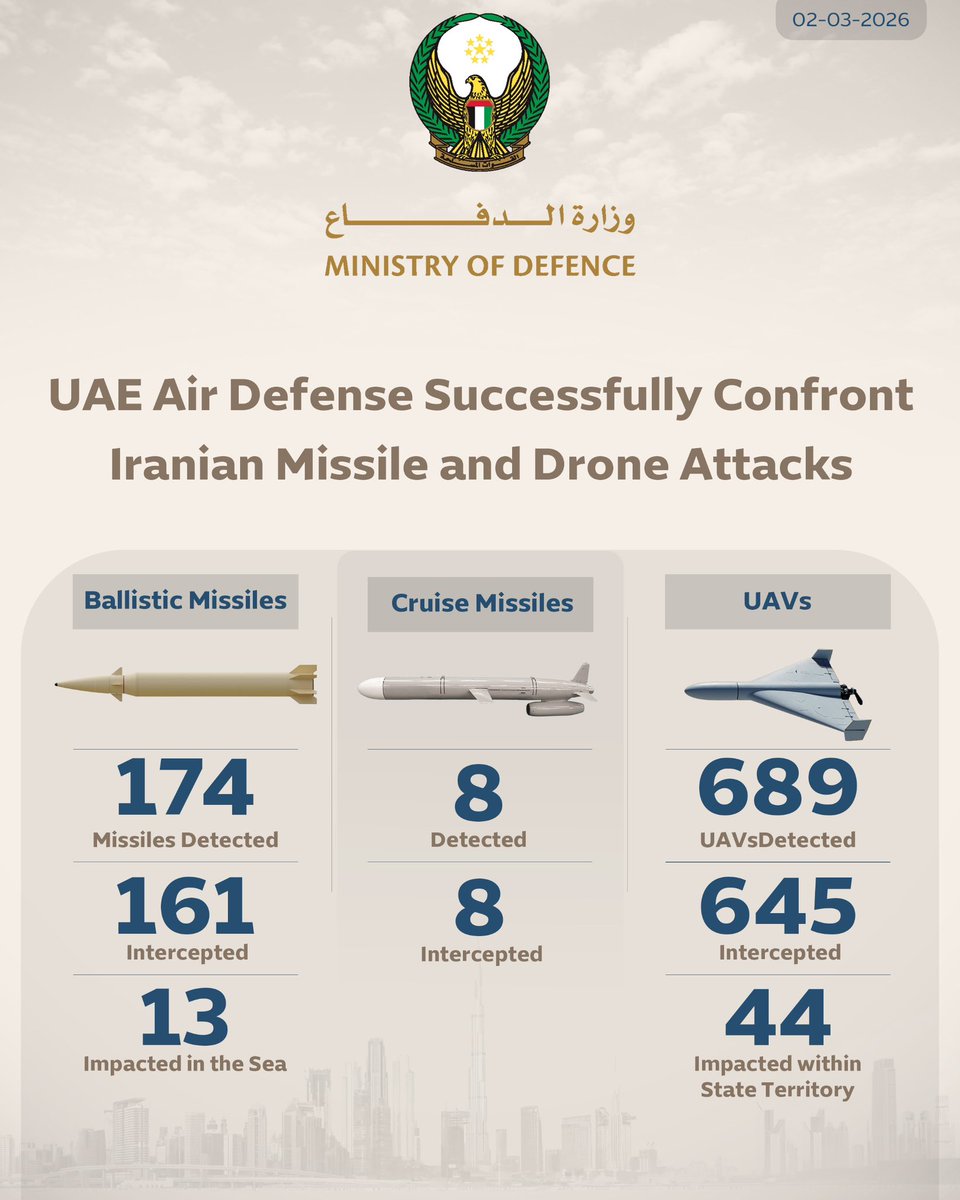
UAE Air Defense Successfully Confront Iranian Missile and Drone Attacks.
#وزارة_الدفاع
#وزارة_الدفاع_الإماراتية
#MOD
#UAEMinistryOfDefence
English
The Ministry of Defence has announced that the UAE air force and air defence forces have so far dealt with 165 ballistic missiles, two cruise missiles and 541 Iranian drones since the start of the Iranian attack.
The ministry said that on the morning of the second day of the attack, UAE air force and air defence forces destroyed 20 ballistic missiles, while eight missiles fell into the sea. They also destroyed two cruise missiles and 311 drones. However, 21 drones struck civilian targets. The ministry affirmed the capability of the UAE air force and air defence to address various threats.
It explained that since the beginning of the Iranian attack on 28th February, 2026, 165 ballistic missiles launched from Iran towards the UAE have been detected. Of these, 152 were destroyed, while 13 fell into sea waters. Two cruise missiles were also detected and destroyed.
A total of 541 Iranian drones were detected, of which 506 were intercepted and destroyed, while 35 fell within the country, causing material damage. The incidents resulted in three fatalities of Pakistani, Nepali and Bangladeshi nationalities, and 58 minor injuries among Emirati, Egyptian, Ethiopian, Filipino, Pakistani, Iranian, Indian, Bangladeshi, Sri Lankan, Azerbaijani, Yemeni, Ugandan, Eritrean, Lebanese and Afghan nationals.
The ministry indicated that some debris fell in various areas of the country as a result of air defence systems intercepting ballistic missiles and drones, leading to minor to moderate material damage to a number of civilian properties.
The ministry expressed its full readiness to address any threats and stressed that the safety of citizens, residents and visitors remains a top priority that cannot be compromised.
#وزارة_الدفاع
#وزارة_الدفاع_الإماراتية
#MOD
#UAEMinistryOfDefence
English
@RosenvoldGeo Politikerne forestår desværre ikke det helt basale, som du nævner her, så tror ikke det hjælper at råbe dem op. Men fint du forsøger😂😂
Dansk
Europas største sikkerhedsproblem er Rusland.
USAs største sikkerhedsproblem er Kina.
Derfor giver det mening for Trump at forhandle med Rusland for at isolere Kina. Så må Europa finde ud af om vi vil bekæmpe Rusland eller finde en måde at leve med dem på.
Trump forsøger helt overordnet at drive en kile ind mellem Kina og Rusland og gøre Rusland til en medspiller i forsøget på at gøre USA og Europa mindre afhængige af det kinesiske monopol på sjældne jordarter. Det giver mening geostrategisk og er for USA (og Europa) langt vigtigere end hvorvidt Ukraine kan beholde en del af Zaporizhzhie-provinsen osv.
Mikkel Rosenvold@RosenvoldGeo
Kritikken af Trumps “28-punkts-plan” er massiv. Spørgsmålet er bare - hvem og hvad skal ellers løse denne konflikt? Biden havde ingen ideer og Europa har efter snart fire års konflikt ikke skyggen af en plan for hvad der ellers skal gøres. Vi kan ikke finde en million unge europæiske mænd, der har lyst til at tage over og sparke russerne ud af Donbass. Det er tragisk, men uundgåeligt at Ukraine skal deles - spørgsmålet er nu hvad “rest-Ukraine” bliver for et land. Nøglen til en fred er sikkerhedsgarantier, hvilket Trump-administrationen langt om længe har forstået. 28-punkts-planen indeholder nogle bud på sagen, herunder en direkte, men uklar amerikansk garanti og så muligheden for at Ukraine kan blive medlem af EU med tiden. Det er et hæderligt kompromis situationen taget i betragtning. Fra europæisk side skal vi spørge os selv om vi har viljen til at fremtvinge en bedre situation på landjorden eller om vi skal hjælpe Trump med at få afsluttet krigen nu. Uddybning i tråd 👇
Dansk
De modsatte dage findes også, der er bare ikke samme glæde ved at reklamere med 😆
I dag er reglen i porteføljen at jo mere tvivlsom indtjeningen er, jo større fald.
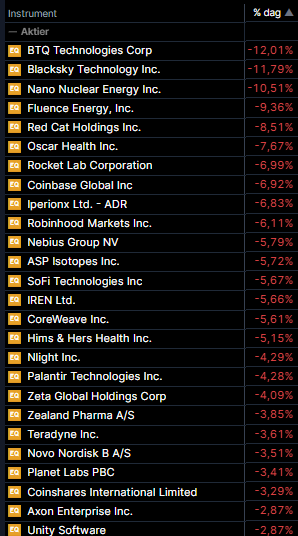
Dansk
@AndreasSteno godt brølet på EB i dag🔥💯. Mainstream medierne har endnu ikke forstået hvad Trumperen prøver på. Vores emne til at innoverer (hurtigt nok), er ikke tilstede dette gælder også ressourcerne i Grønland, som man for længst skulle have investeret i.
Dansk
Had the huge pleasure of doing an interview with @ericjackson on my Podcast. Eric is currently one of the talked about investors in the world,🔥🏎️. Interview starts at 40:38. Thx again Eric for joining us 🙏🏻😍: aktieuniverset.simplecast.com/episodes/261-e…
English

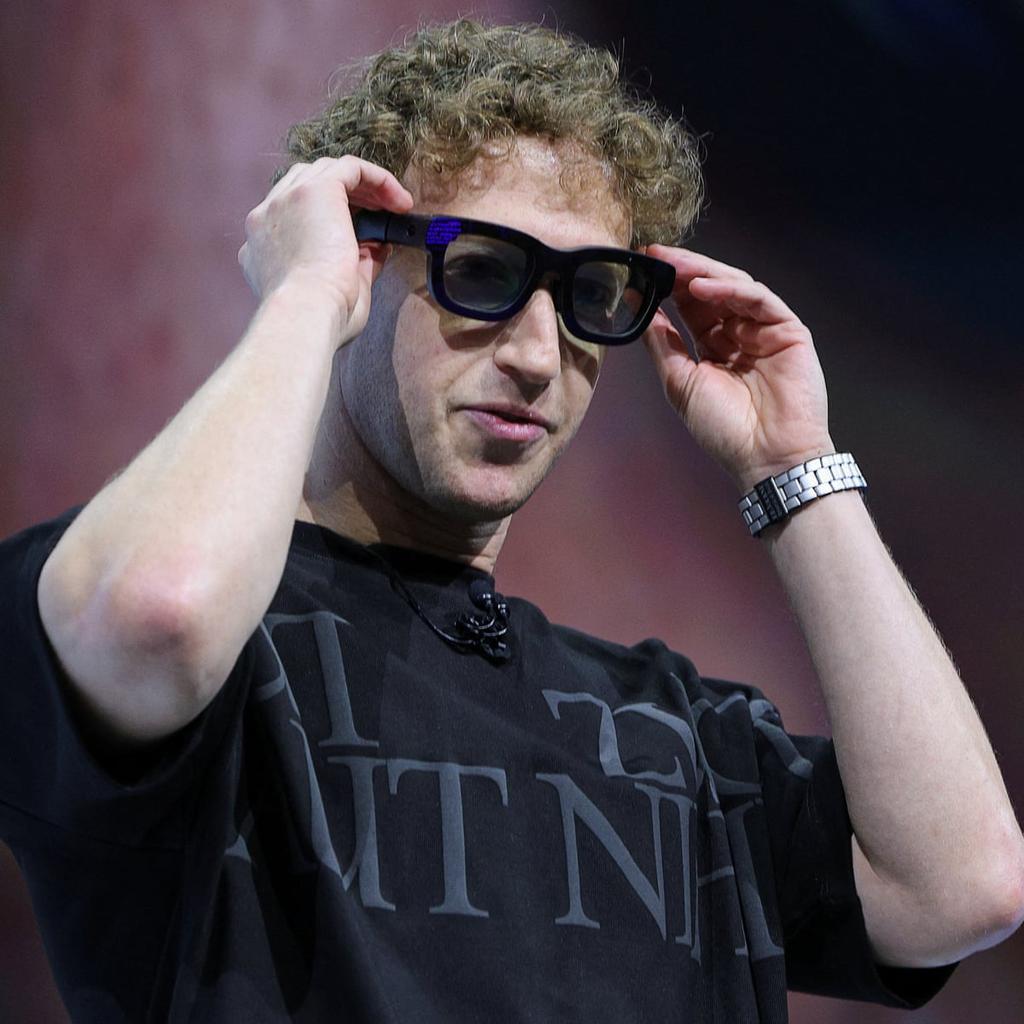
I'm so hyped for today’s $META event... for reasons I can't fully explain... that I finally went ahead and bought the stock. Don't really know what to expect, just excited for the product category.
If the event disappoints (obviously not me), I’ll double my position tomorrow!
English
$PMINDI
NewDeal Invest kl n is best PTM amongst danish funds last 12 months with 61,1% performance.
Link to report in danish in thread.

English
@FilipSalling @aktieuniverset Det er jo folks frie valg om de vil være rige eller ej.
Dansk
Europæisk- og særligt dansk idealisme blindfolder borgerne i forhold til investeringscasen i $TSLA.
Med MINE realist briller er Elon en kæmpe del af Bull casen i $TSLA.
NFA
@aktieuniverset
Za@ZaStocks
Personally I’m viewing Elon buying $TSLA as essentially a bat signal. I see people saying “it’s only $1B” but he could’ve bought “only $1B” months or years ago. Instead he chose right now. No matter what the amount is, he’s telling the market that he’s fully committed and finally ready to send this stock to the stratosphere after years of dormancy. He does not get his full compensation package unless Tesla hits an $8.5T valuation. Tesla is *the* AI stock outside of $NVDA in my opinion. The entire company future hinges on robotics and autonomous vehicles coming to fruition. Physical AI is the pinnacle of AI to me and Tesla is betting the company on it. It’s not just about him buying $1B, it’s about him showing Wall Street, retail investors, etc. a level of commitment that he hasn’t in years. I’m expecting some major physical AI developments in the coming months.
Dansk
Svenska
JEG synes det er NU der skal tales RISIKOSTYRING i diverse podcast! 🙏@aktieuniverset @BodilGantzel
Det er farligt at time markedet og jeg har personligt ikke en intention om at gå 100% kontant.
Men vores strategi indebære risikostyring.
Det betyder for os:
1. Sikre at vi ikke er overinvesteret i forhold til vores økonomiske ståsted og kortsigtede (12-24 mdr) ønsker for vores “rige” liv.
2. Stille skarpt på om porteføljefordelingen matcher conviction - vi skal ideelt altid få lyst til at supplere alle vores positioner på fald.
Jeg kan anbefale at supplere disse mere “doom” orientere bear case på X med Jens Schjernings (AgroCura) seneste Sunday Market skriv “De 4 faser i økonomiens cyklus …”.
Kort opsummering: vi er i “slowdown” forud for “contraction”. Men ingen umiddelbar panik nu og her, citat “… aktierne i den kommende tid dvs. i hvert fald 3-6 måneder med stor sandsynlighed vil bevæge sig positivt”.
Henrik Zeberg@HenrikZeberg
Dansk