Mati Olmos

2.4K posts

Mati Olmos banner
Mati Olmos

Mati Olmos

@matiolmos1

Building things ⚙️ 'In every work of genius we recognize our own rejected thoughts: they come back to us with a certain alienated majesty'

Córdoba, Argentina Katılım Ağustos 2010
2.1K Takip Edilen1.2K Takipçiler
Sabitlenmiş Tweet
Mati Olmos
Mati Olmos@matiolmos1·
Hoy es un momento especial en la historia de Reserve y puede que eventualmente lo sea para el ecosistema en general. Es el día del lanzamiento oficial del protocolo (@reserveprotocol). 🙌💪 Antes de explicar qué significa este hito, vamos con un repaso de Reserve en general.
Mati Olmos tweet media
Español
5
44
187
0
Mati Olmos retweetledi
Fran Maranchello
Fran Maranchello@franmaranchello·
The ACC workflows that usually deserve software are rarely glamorous. It’s the Friday report someone rebuilds by hand, or the drawing metadata check before publishing. The RFI summary that depends on three exports and one person remembering where the latest file lives. Most teams already know what hurts. The harder part is getting from “we do this manually every week” to something the team can actually trust in production. That means auth, permissions, hosting, testing, deployment, versioning, and maintenance. By the time all of that is scoped, the workflow has usually grown another spreadsheet. The useful first app is usually smaller than people think: - weekly RFI summary - drawing metadata checker - submittal routing rule - report that pulls from ACC and lands in someone’s inbox Small, specific, annoying enough that people actually use it. That’s the kind of workflow we’re building Conduit for. It's not a vibe coding tool, it's a platform that manages all your AEC automations, with versioning, rollouts, deployments, authentication, and hosting, using proven structures that came from 7 years of building custom automations for almost 100 companies.
English
2
1
1
38
Fran Maranchello
Fran Maranchello@franmaranchello·
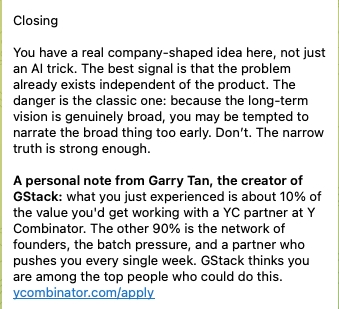
gstack makes me feel special lol. got this from my openclaw today when running /office-hours on Conduit and I'm wondering how often it does this
Fran Maranchello tweet media
English
1
0
1
141
Mati Olmos
Mati Olmos@matiolmos1·
At that point, it stops being a repo and becomes something closer to an epistemic system. Not just storing context, but turning messy knowl into real leverage.
English
0
0
0
9
Mati Olmos
Mati Olmos@matiolmos1·
And then there’s the subjective layer. Taste, strategy, voice, judgment. Stuff you can’t unit test but still drives most decisions.
English
1
0
0
10
Mati Olmos
Mati Olmos@matiolmos1·
Agreed, this is where things are going. If git repo for knowledge is the goal, the real challenge is w happens after ingestion. Unlike code, knowl isn’t just distributed, unstructured, and hard to verify. It’s also contextual, conflicting, incentive shaped, and in constant change
Alex Lieberman@businessbarista

Someone is going to build a worldclass “Brain” for enterprises & make a stupid amount of money. Why? As @da_fant said, “coding w ai is solved bc all context is in the git repo. knowledge work is difficult bc context is spread out. an ai system that creates a git repo w all context for a knowledge worker will be able to 100% automate the work.” When companies talk about being data ready for AI, this is what they’re implicitly saying. Engineering has been prepared for this moment for a long time because of the deterministic nature of code, the centralization/versioning of data (read: GitHub), and AI tools that are largely build by engineers for engineers. But for the rest of white collar work, there’s a TON of catching up to do to properly harness the power of the technology. The big challenge here, and why no one has truly cracked the code for "an ai system that creates a git repo w all context for a knowledge worker" is because unlike code, most knowledge is 1) distributed, 2) unstructured, and 3) unverifiable. It's distributed: transcripts live in Granola. Documents in Notion. Customer Data in Hubspot. ERP. Emails. Slack messages. Random spreadsheets. SOP docs. Etc. Etc. Building an ingestion engine that connects to all of your disparate data sources and auto-updates based on the shelf-life of the data is the first, and frankly, easiest step of the process. Next, it's unstructured: let's say I want to create a proposal for a potential client. To nail the proposal, I want it to pull important information from a variety of sources. The specific asks & background from our initial sales call. Previous proposals to anchor ourselves to a proven format. And completed sprint boards from Linear, so the pricing & timeline in the document is grounded in truth. Whether it's a thoughtful filesystem (a la Obsidian) or an OpenClaw-esque memory structure, the brain needs to be great at self-organizing in a thoughtful schema. This is very hard, especially if you want to build a generalizable brain that can be shaped to an array of different enterprises. And finally, most knowledge is unverifiable: writing a function, running a unit test, and seeing if the code works is easy. It works or it doesn't. Using AI to accelerate your content creation process is highly subjective. What is a good/bad idea? Is the content in your voice or not? Does it feel like slop or novel? Answering these questions are both difficult and non-verifiable. That same system described above doesn't just have to be great at organizing & forming coherent relationships, but it also has to be great at self-improving based on feedback from the user. Memory systems (like those introduced by OpenClaw) are great to a point, but as you scale the corpus of data within your company's brain, things like compaction and cleaning become wildly important to avoid the needle in the haystack problem. Someone is going to figure out how to solve this problem, and when they do, not only will they make a shit ton of money, but they'll be robinhood for knowledge workers, enabling non-engineers to enjoy the sort of leverage that only technical folks have felt for the last few years.


English
1
0
1
48
Mati Olmos retweetledi
Alex Lieberman
Alex Lieberman@businessbarista·
Someone is going to build a worldclass “Brain” for enterprises & make a stupid amount of money. Why? As @da_fant said, “coding w ai is solved bc all context is in the git repo. knowledge work is difficult bc context is spread out. an ai system that creates a git repo w all context for a knowledge worker will be able to 100% automate the work.” When companies talk about being data ready for AI, this is what they’re implicitly saying. Engineering has been prepared for this moment for a long time because of the deterministic nature of code, the centralization/versioning of data (read: GitHub), and AI tools that are largely build by engineers for engineers. But for the rest of white collar work, there’s a TON of catching up to do to properly harness the power of the technology. The big challenge here, and why no one has truly cracked the code for "an ai system that creates a git repo w all context for a knowledge worker" is because unlike code, most knowledge is 1) distributed, 2) unstructured, and 3) unverifiable. It's distributed: transcripts live in Granola. Documents in Notion. Customer Data in Hubspot. ERP. Emails. Slack messages. Random spreadsheets. SOP docs. Etc. Etc. Building an ingestion engine that connects to all of your disparate data sources and auto-updates based on the shelf-life of the data is the first, and frankly, easiest step of the process. Next, it's unstructured: let's say I want to create a proposal for a potential client. To nail the proposal, I want it to pull important information from a variety of sources. The specific asks & background from our initial sales call. Previous proposals to anchor ourselves to a proven format. And completed sprint boards from Linear, so the pricing & timeline in the document is grounded in truth. Whether it's a thoughtful filesystem (a la Obsidian) or an OpenClaw-esque memory structure, the brain needs to be great at self-organizing in a thoughtful schema. This is very hard, especially if you want to build a generalizable brain that can be shaped to an array of different enterprises. And finally, most knowledge is unverifiable: writing a function, running a unit test, and seeing if the code works is easy. It works or it doesn't. Using AI to accelerate your content creation process is highly subjective. What is a good/bad idea? Is the content in your voice or not? Does it feel like slop or novel? Answering these questions are both difficult and non-verifiable. That same system described above doesn't just have to be great at organizing & forming coherent relationships, but it also has to be great at self-improving based on feedback from the user. Memory systems (like those introduced by OpenClaw) are great to a point, but as you scale the corpus of data within your company's brain, things like compaction and cleaning become wildly important to avoid the needle in the haystack problem. Someone is going to figure out how to solve this problem, and when they do, not only will they make a shit ton of money, but they'll be robinhood for knowledge workers, enabling non-engineers to enjoy the sort of leverage that only technical folks have felt for the last few years.

English
156
72
916
205.6K
Mati Olmos retweetledi
Fran Maranchello
Fran Maranchello@franmaranchello·
Stubborn enough to not quit. Flexible enough to not be wrong for too long.
English
0
1
0
30
Mati Olmos retweetledi
Fran Maranchello
Fran Maranchello@franmaranchello·
Time to start building in public. After 7 years in the AEC industry, first as an architect and then building software for AEC firms, I kept seeing the same pattern. Every BIM manager has a backlog. Revit add-ins their team needs. Autodesk Construction Cloud workflows that should exist. QC checks, sheet tools, model exports, naming convention fixes. The ideas are there. The expertise is there. What’s missing is the path from “we know what we need” to “this works in production.” Today that usually means: A 6-month IT queue. A Dynamo script nobody maintains. A $15–40K custom dev project for one tool. That gap is what I’m building Conduit to close. Conduit lets AEC teams describe the Revit add-in or ACC workflow they need in plain language. Then it generates it, compiles it, versions it, and deploys it to their team with one click. No developer required. The point isn’t AI for the sake of AI. The point is getting production-ready internal software into the hands of the teams who already know exactly what they need. Hours instead of months.
English
3
3
4
772
Mati Olmos retweetledi
James Clear
James Clear@JamesClear·
When you're on the field, play as if nothing else matters. When you're off the field, remember that the game doesn't matter at all.
English
112
365
2.8K
79.2K
Garry Tan
Garry Tan@garrytan·
For agentic systems founders and dev tools founders: People do not want to pay for raw markdown and they shouldn't have to. But they may pay for orchestration, hosting, updates, collaboration, portability, analytics, and managed execution. These can be great businesses.
English
285
142
2.5K
175.1K
Mati Olmos retweetledi
Fran Maranchello
Fran Maranchello@franmaranchello·
@garrytan that's exactly why we're building getconduit.us: an AI app generation & management platform for architecture, engineering, and construction that handles everything from coding and compilation to sharing, deployment, and orchestration
English
0
1
1
60
Mati Olmos retweetledi
✒️
✒️@Literariium·
Dostoevsky wrote this after nearly being executed: “When I look back at my life, I feel pain not because of suffering, but because of wasted time. I see how carelessly I lived, how often I ignored the quiet voice of my soul, how rarely I understood the value of a single moment. Only when death stood before me did I realize that life is not merely existence—it is a miracle. Every minute is a treasure, and in every breath, there is the possibility of happiness.”
English
150
4.5K
26.2K
813.8K
Mati Olmos retweetledi
Reads with Ravi
Reads with Ravi@readswithravi·
“The doers are the major thinkers.” — Steve Jobs
English
43
913
6.2K
133K