Ed Maunder

423 posts

Ed Maunder banner
Ed Maunder

Ed Maunder

@maunder_ed

Exercise Physiologist @SPRINZ_AUT | Senior Lecturer & Head of Postgraduate @AUTsportandrec (ask me about our programmes) | Consultant (DM for enquiries)

Auckland, New Zealand Katılım Kasım 2017
186 Takip Edilen717 Takipçiler
Ed Maunder retweetledi
Jeff Rothschild
Jeff Rothschild@EatsleepfitJeff·
Do carbs during exercise spare muscle glycogen? I used to say no, but our new meta-analysis shows a small but significant effect that has likely been masked by small sample sizes. journals.physiology.org/doi/abs/10.115…
Jeff Rothschild tweet media
English
3
14
60
10.5K
Ed Maunder
Ed Maunder@maunder_ed·
@AlpineCols @EatsleepfitJeff Hi - yes I think that’s a good interpretation of these data. How much you can allow it to drift up and stay in the moderate domain is a difficult. That’s why we think developing real-time predictions of VT1 power based on baseline characteristic and live wearable data is valuable
English
0
0
2
56
Alpine Cols
Alpine Cols@AlpineCols·
@EatsleepfitJeff Thanks for posting! So if HR at VT1 increases during prolonged rides, logically we should allow HR to drift up if our goal is to train at VT1? Up till now, I have been assuming HR to be constant at VT1, therefore we should reduce intensity to hold HR stable. Comments?
English
2
0
2
108
Ed Maunder retweetledi
Jeff Rothschild
Jeff Rothschild@EatsleepfitJeff·
🚴‍♂️ New open-access paper from our group out in EJAP! We show durability of the moderate-to-heavy intensity transition (VT1) during prolonged cycling can be predicted using simple, readily available markers of physiological decoupling. (1/7) 📄 doi.org/10.1007/s00421…
Jeff Rothschild tweet media
English
1
26
97
11.5K
Ed Maunder
Ed Maunder@maunder_ed·
These results suggest, at least in the protocol used, that adding eccentric load via downhill running did not exacerbate the reduction in running speed at the moderate-to-heavy intensity
English
0
0
2
130
Ed Maunder
Ed Maunder@maunder_ed·
Running speed at VT1 declined following prolonged running in both trials (~6-8%), with no differences between-trials
English
1
0
1
127
Ed Maunder
Ed Maunder@maunder_ed·
Congratulations Andrew Barrett on your first publication! Continuing our durability work... Prolonged running reduces speed at the moderate-to-heavy intensity transition without additional reductions due to increased eccentric load link.springer.com/article/10.100… @EJAP_official
English
1
2
19
924
Ed Maunder retweetledi
Alex Hutchinson
Alex Hutchinson@sweatscience·
A new review digs into the science of "lactic acidosis" and muscle fatigue. Key points: - we don't have "lactic acid" in the body, we have lactate and hydrogen ions, which have separate (and sometimes opposite) effects - lactate is a useful fuel and doesn't cause fatigue [...]
English
4
25
151
32.8K
Ed Maunder retweetledi
Ben Hunter - @benshunter.bsky.social
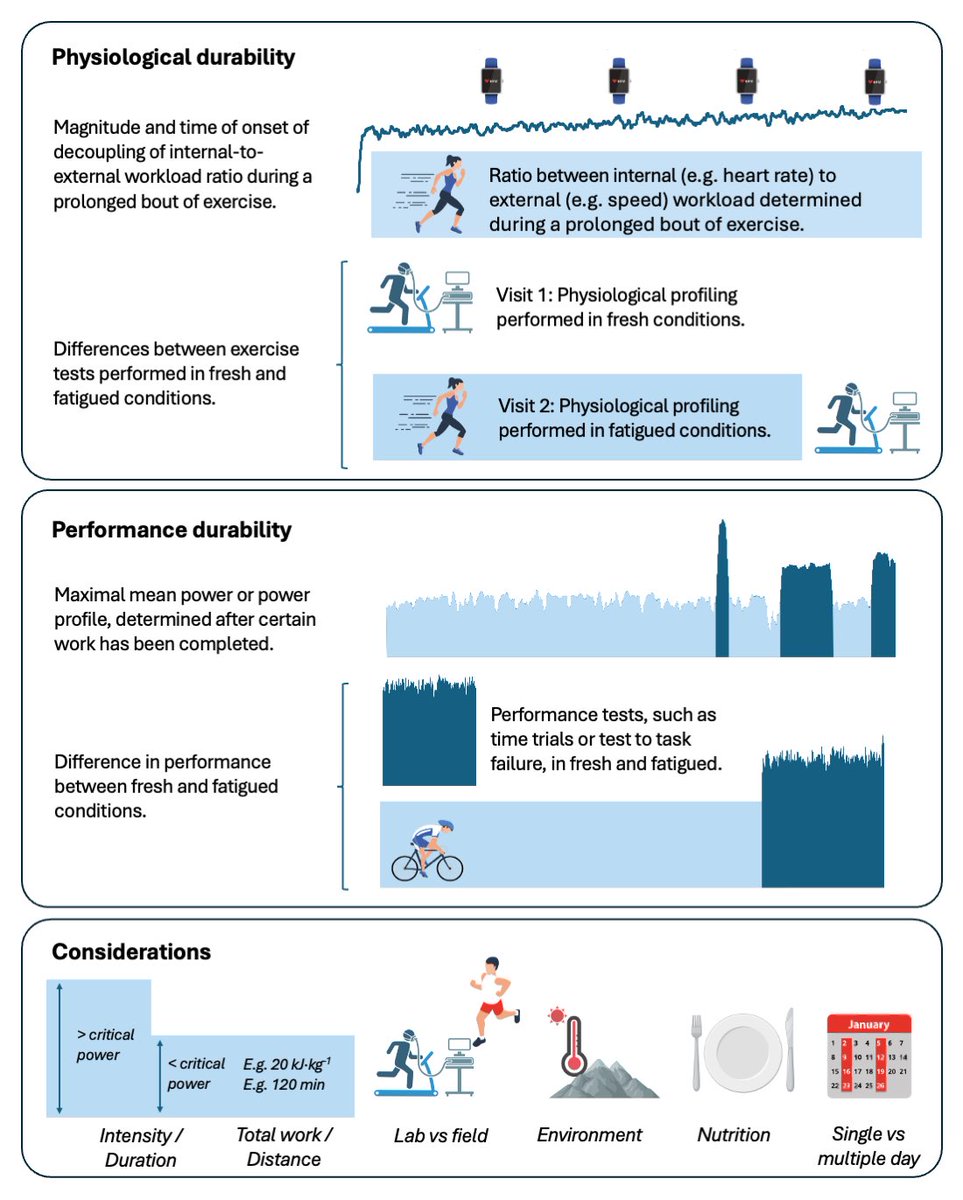
Recently there’s been plenty of good work in the (re?)emerging field of durability. Our review published in @ExpPhysiol explores key methodological approaches and considerations to be made when profiling durability in research and applied settings.
Ben Hunter - @benshunter.bsky.social tweet media
English
2
26
101
10K
Ed Maunder retweetledi
Alex Hutchinson
Alex Hutchinson@sweatscience·
Data from 120,000 runners shows that slow and fast marathoners do essentially the same amount of medium and hard training, but vastly different amounts of easy training. But does that really mean that slow marathoners would get faster by training easier? outsideonline.com/health/trainin…
English
33
54
358
68.4K
@LoreofRunning
@LoreofRunning@LoreofRunning1·
Prevents hypoglycaemia in this specific protocol. If there was no hypoglycaemia in the control group the carb ingestion would have been without effect. We show this in our upcoming publication in AJP:Cell Physiology. Thus the finding is protocol dependent- no hypoglycaemia; no benefit of carb ingestion. Our new paper extends that proof to the carbs you ingest before exercise. Watch this feed for more explanations. @PhilipPrins11 @AKoutnik @ProfTimNoakes
Ed Maunder@maunder_ed

We are thrilled to see this one published just in time for Christmas! Carbohydrate ingestion during prolonged exercise blunts the reduction in power output at the moderate-to-heavy intensity transition Congrats @Harrison7738800 @CarynZinn @theplews1 pubmed.ncbi.nlm.nih.gov/39709586/

English
2
3
7
985
Ed Maunder
Ed Maunder@maunder_ed·
To help with physiologically-based training programming and load monitoring, we need to develop tools that appreciate the reduction in power output at thresholds over time as exercise progresses, and account for the effects of nutrition
English
0
0
4
274
Ed Maunder
Ed Maunder@maunder_ed·
So, carbohydrate ingestion during prolonged cycling improved durability of the moderate-to-heavy transition Based on previous data, we think this effect is unlikely related to preservation of muscle glycogen, and instead may be related to better preservation of blood glucose
English
1
0
2
298