
Max Molden

330 posts

Max Molden banner
Max Molden

Max Molden

@maxcl_m

Mache was mit Interventionen | PhD Candidate in Hamburg | Research Associate @PrometheusInst | Young Affiliate @nous_network

Katılım Şubat 2023
208 Takip Edilen148 Takipçiler
Sabitlenmiş Tweet
Max Molden
Max Molden@maxcl_m·
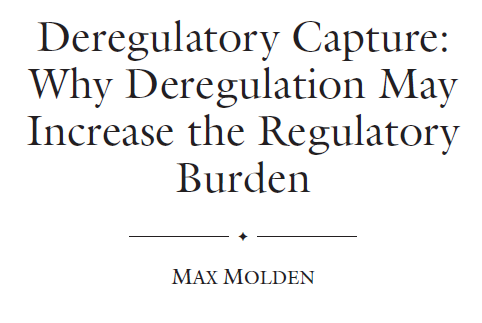
Government deregulation is usually taken to be a move toward laissez-faire and a lessening of the regulatory burden. But this need not be the case, as I demonstrate in the latest issue of the Independent Review: independent.org/publications/t… 1/3
Max Molden tweet media
English
4
8
47
3.3K
Max Molden retweetledi
John Horton
John Horton@johnjhorton·
Going to write a tweet that might be mercilessly dunked on later: I think concerns about job loss+AI are wildly overblown & the economy will be great for workers + consumers generally, including new workers, *especially* in a world where AI capabilities keep improving.
English
26
26
188
47.2K
Max Molden
Max Molden@maxcl_m·
Olson argued it takes a catastrophic shock to clear out entrenched distributional coalitions. AI might be that shock—but expect incumbents to try to regulate it out of existence before it can scale... My latest @EconLib econlib.org/econlog/ai-vs-…
English
0
1
1
472
Max Molden
Max Molden@maxcl_m·
@alexwadecraig Good question. To approach, I'd start with the basics: problems do not exist as such. Problems are always problems to someone (analogous to things vs. goods). From this it follows that, if there is an econ. calc. problem, it is a problem *to* someone—presum. the planner.
English
0
0
0
60
Alexander Wade Craig
Alexander Wade Craig@alexwadecraig·
So, what *is* the economic calculation problem? A lot of contemporary Austrian treatments of it get a little hand-wavy and say "you can't get all the information together in one place." I think that's true! But also, where does the dysfunction actually, concretely begin?
English
8
0
11
1.3K
Alex Imas
Alex Imas@alexolegimas·
I’ve now seen this paper posted by several “BREAKING” accounts (and we hopefully know what that means by now). But: 1) there is no mathematical “proof” and 2) the assumptions you need for this prediction don’t hold in practice. I wrote out the economic conditions you need for such demand collapse here: open.substack.com/pub/aleximas/p… There is a formal model linked in the post. TLDR: you need preferences to fully satiate (ie a person doesn’t want literally anything else) for demand collapse to happen, and even if that’s the case, there are many very simple policies can prevent it.
Priyanka Vergadia@pvergadia

🤯BREAKING: Researchers just mathematically proved that AI layoffs will collapse the economy: and every CEO already knows it. The AI Layoff Trap. A game theory paper from UPenn + Boston University is glaringly important! 100K+ tech layoffs in 2025. 80% of US workers exposed. And no market force can stop it. → Every company fires workers to cut costs → Every fired worker stops buying products → Revenue collapses across every sector → The companies that fired everyone go bankrupt It's a Prisoner's Dilemma with math behind it. Automate and you survive short-term. Don't automate and your competitor kills you. But everyone automating destroys the demand that makes all companies viable. UBI (universal basic income) won't fix it. Profit taxes won't fix it. The researchers found only one solution: a Pigouvian automation tax "robot tax" The AI trap on the economy is here!

English
16
54
300
79.6K
Max Molden
Max Molden@maxcl_m·
@zingales Isn't this recommendation nothing but a further move on the interventionist spiral, i.e., the manifestation of progressive interventionist dynamics? Isn't, then, the lifting of the complete government intervention more recommendable—even if, practically, perhaps more difficult?
English
0
0
0
19
Zingales
Zingales@zingales·
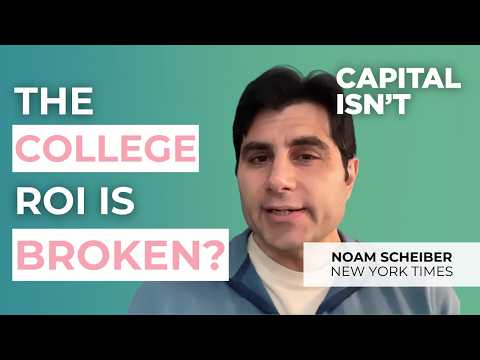
When a company offers securities to investors, it is required to disclose the future prospects of that investment and is held accountable for those promises. When universities solicit students to invest in their degrees, they are not required to disclose the financial return of those degrees, nor are they held accountable for their promises. Universities aggressively market degrees, allowing students to borrow even when studying in fields with possibly no return on investment. On the latest Capitalins’t podcast, I argue this is a catastrophic failure of incentives. Lenders have absolutely nothing at stake because borrowers cannot go bankrupt on college loans. To fix this, we must force universities to have skin in the game. If universities were at least partially financially liable for bad outcomes, they would stop pushing students into disastrous debt. Listen to the full podcast with @noamscheiber here: youtube.com/watch?v=KpZJmB…
YouTube video
YouTube
English
2
8
26
6.4K
Max Molden retweetledi
Stefan Kooths
Stefan Kooths@StefanKooths·
Die Politikoption, die in Reaktion auf höhere #Kraftstoffpreise am wenigsten diskutiert wird: Füße stillhalten. Die notwendige Nachfragereduktion gelingt am besten über den #Preismechanismus. Alle „Entlastungen“ schicken ebenso eine Rechnung – nur anders oder später. Je weitgehender der Eingriff, desto fragwürdiger die Wirkung. @welt welt.de/wirtschaft/vid…
Deutsch
25
27
162
10.1K
Max Molden retweetledi
Lynne Kiesling-Knowledge Problem
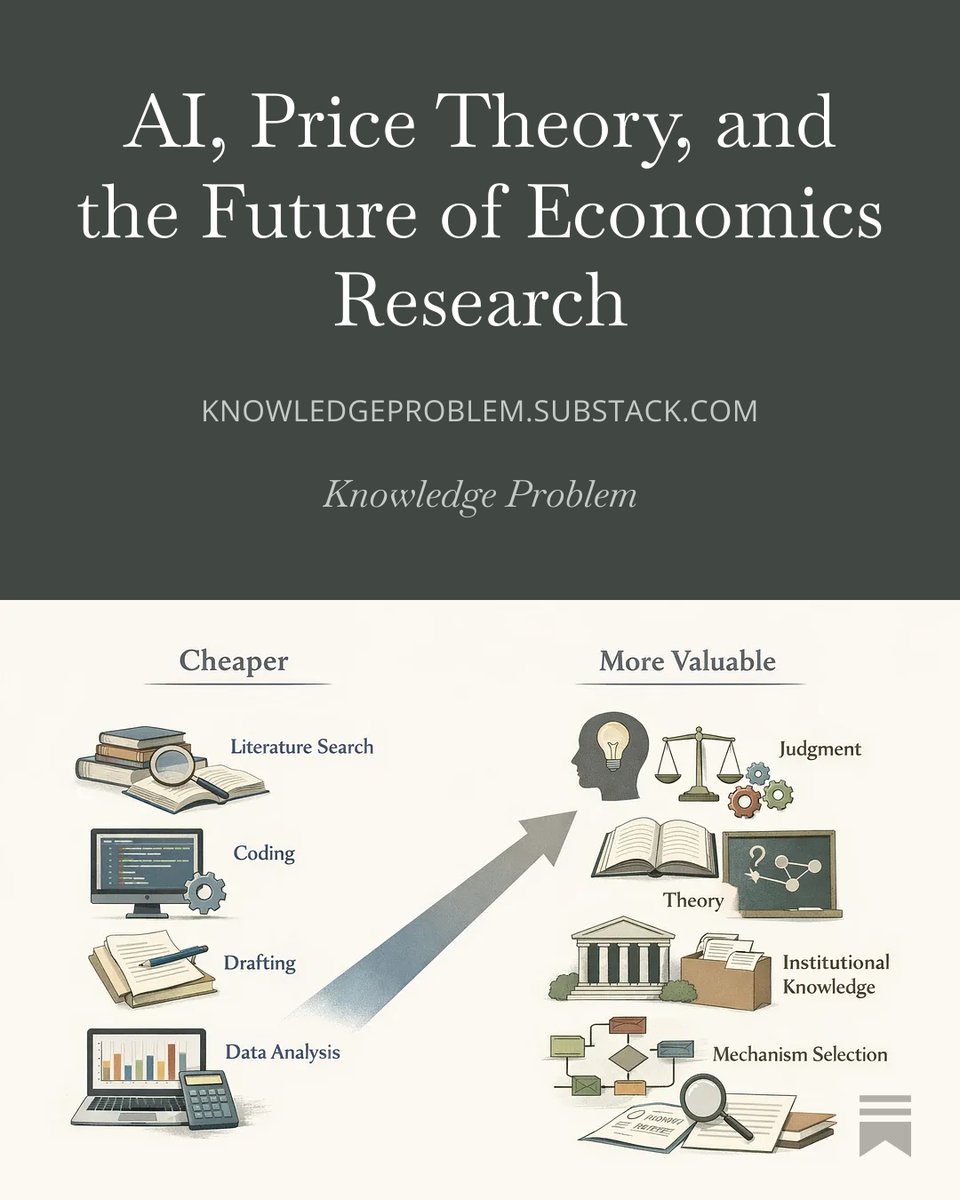
New essay: AI, Price Theory, and the Future of Economics Research My argument: AI is not just a new tool for economists. It is a shock to the relative prices inside the knowledge economy of research. 1/
Lynne Kiesling-Knowledge Problem tweet media
English
7
54
265
27.7K
Max Molden
Max Molden@maxcl_m·
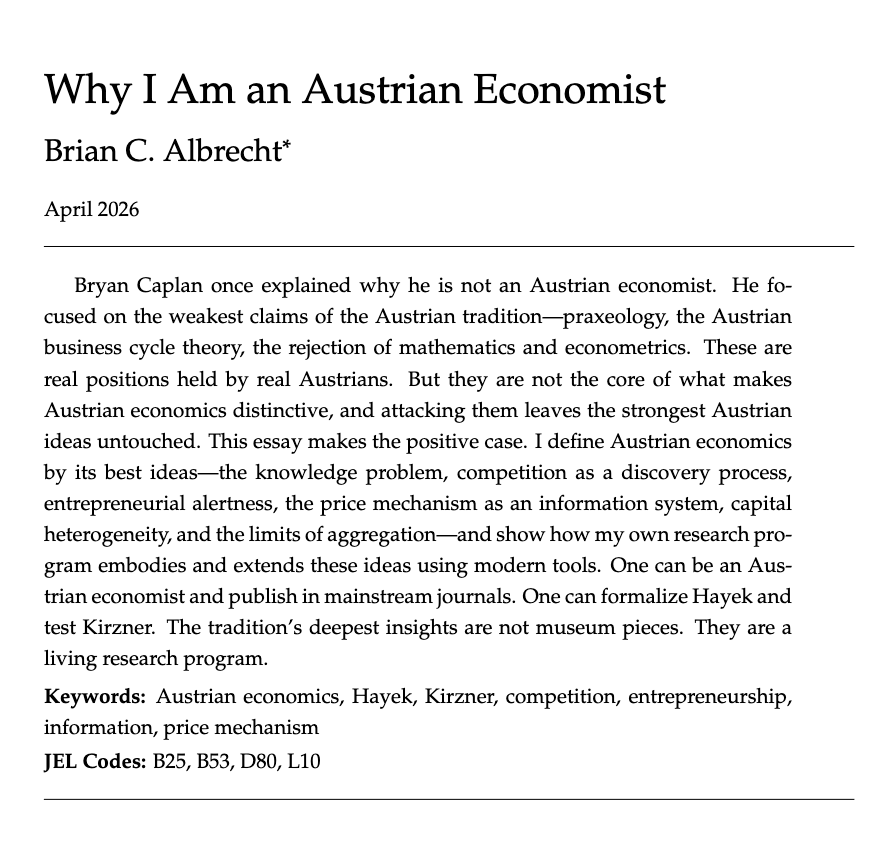
@BrianCAlbrecht I'm somewhat startled: is rejecting praxeology compatible with Austrian economics—or rather any social science at all? Praxeology and subjectivism seem to form the foundation for all that you are (rightly) praising. So, curious and looking forward to reading this.
English
0
0
0
562
Brian Albrecht
Brian Albrecht@BrianCAlbrecht·
Excited about this new, highly personal paper
Brian Albrecht tweet media
English
42
81
849
116.3K
Max Molden
Max Molden@maxcl_m·
@LeviHallo @zumWildschuetz Geld ist ein allgemein gebräuchliches Tauschmittel. Wenn es Deflation gibt, das Preisniveau also sinkt, dann wirst Du mit Geldhalten reicher bzw. kannst Dir davon mehr kaufen. Das trifft aber auf alle zu. Bei Inflation wirst Du ärmer.
Deutsch
0
0
0
79
Levi Penell
Levi Penell@LeviHallo·
@zumWildschuetz nein, ich finde es einfach nur nicht richtig, dass Menschen reicher werden können alleine aus dem Grund, dass sie ohnehin schon viel Geld haben
Deutsch
11
0
27
8.3K
Levi Penell
Levi Penell@LeviHallo·
Ich finde es nicht richtig, dass Menschen reicher werden können alleine aus dem Grund, dass sie ohnehin schon viel Geld haben
Deutsch
152
18
536
160K
Max Molden retweetledi
James Medlock
James Medlock@jdcmedlock·
Paul Ehrlich no longer a hypocrite
Deutsch
14
62
958
39.6K
Max Molden
Max Molden@maxcl_m·
@D_Langenmayr Nach welchen Standards beurteilen sie, ob eine Steuer "gerechtfertigt" ist? Warum ist ihr Urteil relevant, wenn es doch darum geht, dass jemand über andere herrscht (was die Legitimitätsfrage aufwirft)?
Deutsch
0
0
0
51
Dominika Langenmayr
Dominika Langenmayr@D_Langenmayr·
Die Steuerfreiheit für Krypto-Gewinne nach 1 Jahr ist eine völlig ungerechtfertigte Bevorzugung relativ zu anderen Vermögensgegenständen. Auch international völlig unüblich. Wäre sehr sinnvoll, wenn das wegfällt.
Deutsch
113
34
384
45K
Max Molden
Max Molden@maxcl_m·
@RMG_Neon @PerBylund Wieser's "The Austr. Sch. and the Theory of Value" remains authoritative: "We value comm. for the sake of their utility, yet we do not value utility when it is coupled with abundance." Now, utility and value are terms, but the concepts they usually refer to are both subjective.
English
0
0
0
7
Neon_Wolf
Neon_Wolf@RMG_Neon·
@PerBylund I have read Bohm Bawerk. The examples you gave are still just chemical processes.
English
1
0
0
25
Per Bylund
Per Bylund@PerBylund·
That value is subjective doesn't mean it is arbitrary or that it has no relationship to (objective) utility. It only means that the valuation, the particular ranking or urgency felt, is personal: we value things differently, contextually, and based on our own understanding.
English
8
27
103
5K
Max Molden
Max Molden@maxcl_m·
@JustinWitzeck @DerDanyal Würde immer noch nicht folgen, da ein Kartellamt den Wettbewerb ja komplett verhindern könnte. Aber: Monopole schließen Wettbewerb mitnichten aus: Wettbewerb ist ein bestimmtes Verhalten von Akteuren. Auch der Monopolist kann sich wettbewerblich verhalten.
Deutsch
0
0
0
50
Max Molden
Max Molden@maxcl_m·
@LinaJan02491152 @S_Surprenant Spot on. Assuming the goods change seems to me to be disingenuous: it means fundamentally changing the example. However, that preferences are stable is necessary: otherwise, there's nothing wrong with a money pump. But then stable preferences aren't covered by rationality.
English
1
0
0
12
Stéphane Surprenant
Stéphane Surprenant@S_Surprenant·
Rationality in economics 🧵 "Rationality" in economics doesn't mean what you think it means. In particular, it does not mean that someone is reasonable, that they are well informed, or even that they consciously thought through the consequences of their actions. We use the concept of rationality in two distinct, but specific ways. The first use refers to preference relations: rational preferences are complete, transitive and reflexive. This basically means that, given a list of options, you can order them with some possible ties. It rules out "cycles" such as prefering apples to pears, pears to bananas and bananas to apples. To go from there to modelling choices, you need to add constraints (budget, time, location, information, etc.). Constraints remove options from the feasible set and whatever agents prefer in the feasible set is what they do. To a certain extent, saying that agents "always do their best" doesn't say much until you define what best means (i.e., specify preferences) and what is feasible (i.e., add constraints). All of economic theory is finding useful specific ways to apply this idea. The second use of rationality refers to rational expectations and it means model-consistent expectations. What this rules out are systematic forecasting errors, given the information set available to agents when forming these forecasts. This idea was introduced by John Muth (1966) as an approximation. His argument was that forecasting errors are costly, so whether by learning, attrition (e.g., people exiting a market), or both, people should tend to make them "small." Formally, this should be considered the fixed point of an unspecified learning process (e.g., Lucas, 1986). Said differently, we're expecting that markets will approximately yield this kind of behavior at the level of a whole market or a whole economy, though not necessarily at the level of every individual. Now, this isn't a fundamental part of economic theory, it was never intended to be taken literally and it is therefore desirable to explore the consequences of relaxing this assumption. I hope this helps.
English
19
26
184
10.9K
Max Molden
Max Molden@maxcl_m·
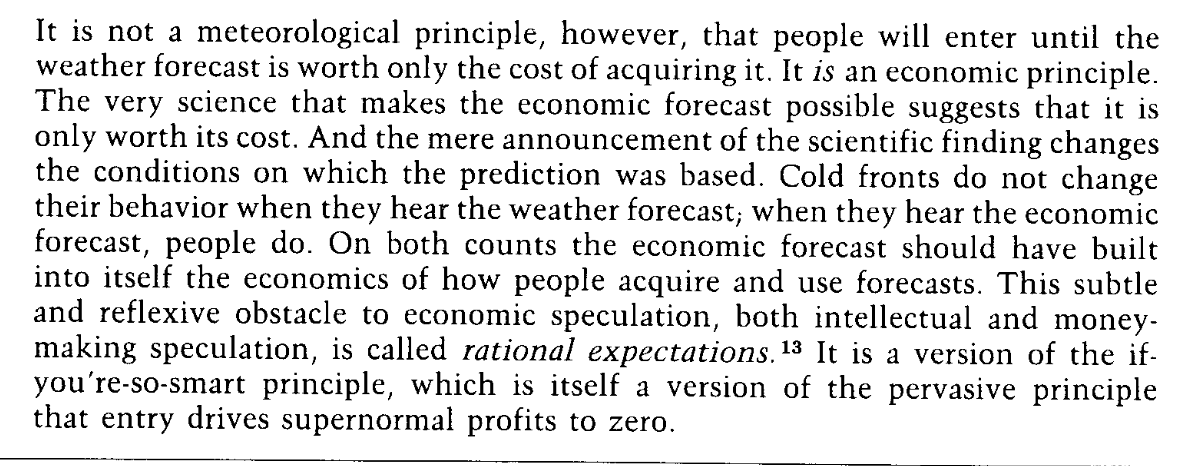
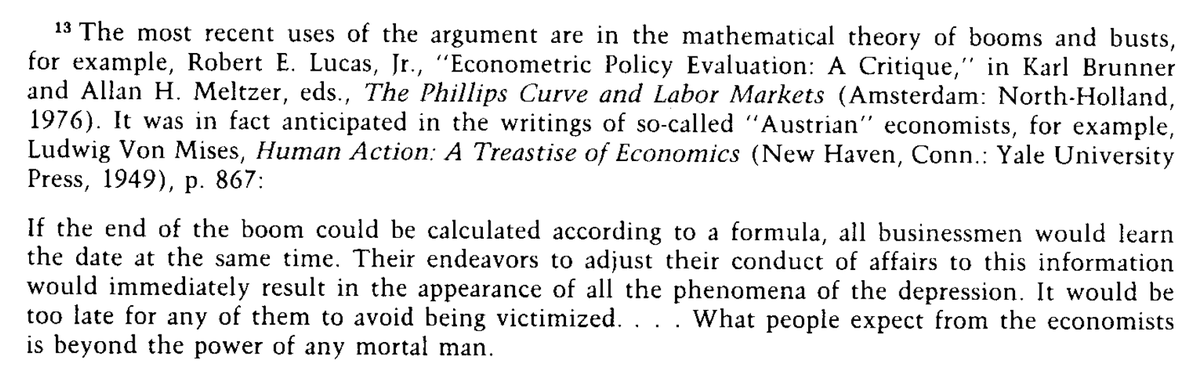
@BrianCAlbrecht You'd definitely enjoy Morgenstern's "Vollkommene Voraussicht und wirtschaftliches Gleichgewicht"—published in 1935.
Deutsch
0
0
1
189
Brian Albrecht
Brian Albrecht@BrianCAlbrecht·
Morning discovery. McCloskey credits Mises with rational expectations
Brian Albrecht tweet mediaBrian Albrecht tweet media
English
9
12
94
6.7K
Mateus Martins Bruno ♰☧𒂼𒄄
Yesterday I read such a poignant and devastating critique to Rawls' analysis of 18th and 19th C. moral theories that I honestly feel embarrassed rn just by looking at the cover of his book. I didn't find it that boring during my MA though, there's plenty there to engage with!
Phil Hoyeck@PAHoyeck

English
1
0
0
193