Max Robbins
1K posts

Max Robbins
@maxrobbins
Author, angel investor, burner, sci-fi junkie. AI and Biotech catalyst. Opinions my own.

New York Katılım Şubat 2009
30 Takip Edilen277 Takipçiler

The Next Evolution of the AI Marketplace: Beyond Data Gravity ai.market/blog/the-next-…
English

Andrej Karpathy (@karpathy), OpenAI co-founder, ex-Tesla AI, "vibe coding" creator.
In just 4 mins, he explains why Claude Skills, MCP servers, and AI agents are past the hype and are now the new baseline for building.
Worth every second ↓
English

@bengoertzel How about if you actually produce something of value instead of talking about AGI?
English

The Leaky Transcension Hypothesis:
What — if anything — might we be able to tell about superintelligences that have disappeared into black holes? bengoertzel.substack.com/p/hyperseed-v2
TL;DR -- if some sort of tendency-to-take-habits / morphic-resonance / precedence principle holds, then one can prove some degree of abstract/coarse pattern leakage in and out of black holes. So we can at least take a blurry partial peek at who might be in there!
English

@SRSchmidgall Samuel, I would like to have your data on ai.market. Could we chat?
English

The future of AI marketplaces: stop moving data to the cloud. Bring the models to the data. ai.market/blog/the-next-…
#AI #MCP #EnterpriseAI #AIAgents #DataMarketplace #LLM #AIinfrastructure
English

@Ask_Spectrum can you please check ai.market seems to be blocked for your users
English

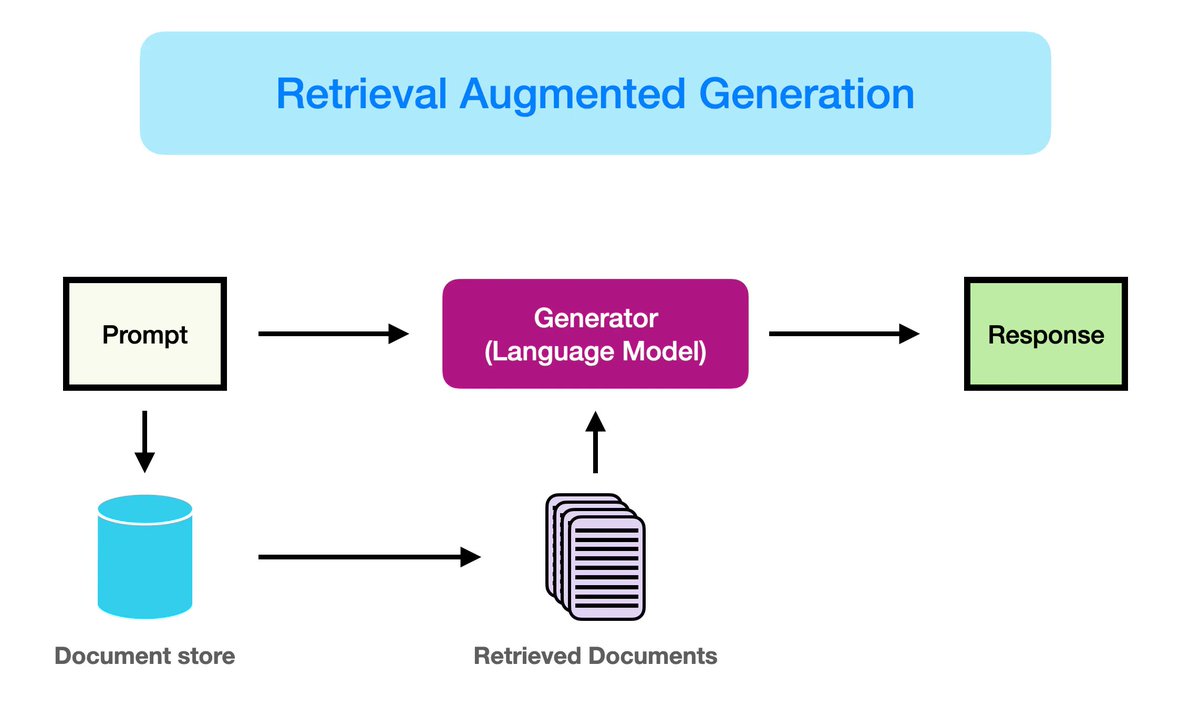
RAG for LLMs
Been doing some deeper exploration into RAG and the ecosystem.
I believe a strong starting point is the survey of Gao et al.: "Retrieval-Augmented Generation for Large Language Models: A Survey".
I liked the paper so much that I wrote a shorter summary of it to highlight the key points, insights, and practical tips about building RAG systems.
Will also be adding an easy-to-follow bibliography to help track new developments in RAG research.
I am also working on technical coding tutorials for this guide to show how to apply some of the strategies to improve RAG systems.
RAG has become one of the popular ways to build with LLMs. With these guides, my hope is to make the research ideas more accessible.

English

Everyone is building RAG applications, but nobody is talking about the data these systems use.
You are delusional if you think clients will have their data sitting in a folder waiting for you to process it.
Data is everywhere: in Google Drive, Dropbox, S3, Gmail, Slack, you name it.
And, of course, no sane developer wants to build connections to every one of these systems. This would be suicide.
I'm working with Ragie, and they released Ragie Connect to solve this problem.
First, their RAG system is top-notch (they have published how they do on several RAG benchmarks), and with Connect, they made it very simple to integrate client data without having to write any code.
(Well, in reality, you still have to write a few lines, but it's minimal.)
Instead of developing one-off integrations for Drive, Dropbox, etc, you can use Connect to integrate with all of them and let Ragie handle authentication, authorization, and automatic data synchronization.
This is a huge time saver!
English

@rohanpaul_ai You might check out Vectoraiz.com. Similar concept.
English

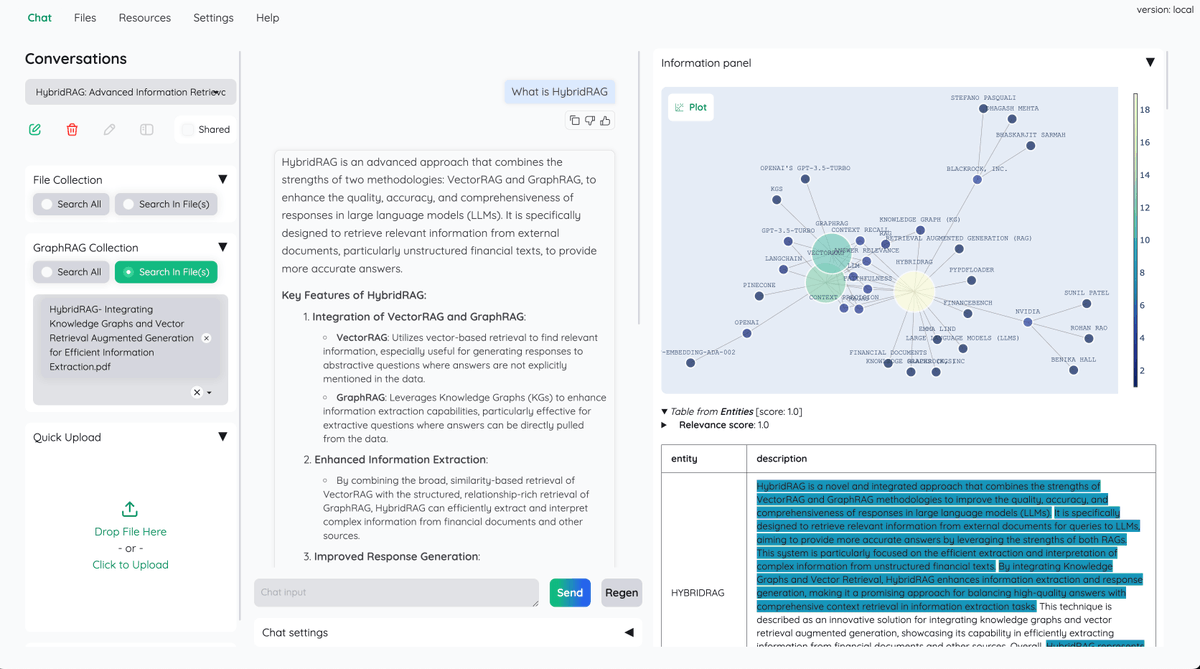
This open-source RAG tool for chatting with your documents is Trending at Number-1 in Github from the past few days
🔍 Open-source RAG UI for document QA
🛠️ Supports local LLMs and API providers
📊 Hybrid RAG pipeline with full-text & vector retrieval
🖼️ Multi-modal QA with figures & tables support
📄 Advanced citations with in-browser PDF preview
🧠 Complex reasoning with question decomposition
⚙️ Configurable settings UI
🔧 Extensible Gradio-based architecture
Key features:
🌐 Host your own RAG web UI with multi-user login
🤖 Organize LLM & embedding models (local & API)
🔎 Hybrid retrieval + re-ranking for quality
📚 Multi-modal parsing and QA across documents
💡 Detailed citations with relevance scores
🧩 Question decomposition for complex queries
🎛️ Adjustable retrieval & generation settings
🔌 Customizable UI and indexing strategies

English

@weaviate_io You might give a look at Vectoraiz.com. It solved problem for us.
English

Legal RAG systems typically take 3-6 months to build.
We did it in 36 hours. Then we made it possible in 𝗮 𝘀𝗶𝗻𝗴𝗹𝗲 𝗽𝗿𝗼𝗺𝗽𝘁.
When our finance team asked us to help navigate internal contracts, we used Weaviate's 𝗤𝘂𝗲𝗿𝘆 𝗔𝗴𝗲𝗻𝘁 to turn raw legal documents into a fully functional assistant in just 𝘢 𝘥𝘢𝘺 𝘢𝘯𝘥 𝘢 𝘩𝘢𝘭𝘧. Building a traditional legal research tool typically takes 𝘮𝘰𝘯𝘵𝘩𝘴 of development time.
Legal research is complex. You need extreme precision, absolute security, and the ability to filter by date, jurisdiction, or contract type. A naive RAG system collapses under this weight because it lacks reasoning. Ask about "2024 service agreements" and it might pull semantically similar clauses from 2022.
𝗔𝗴𝗲𝗻𝘁𝗶𝗰 𝘀𝗲𝗮𝗿𝗰𝗵 changes this. The Query Agent treats your database as a set of tools rather than a static data store. It inspects your schema, constructs structured queries with the right filters, reranks results for actual relevance, and synthesizes grounded answers with citations.
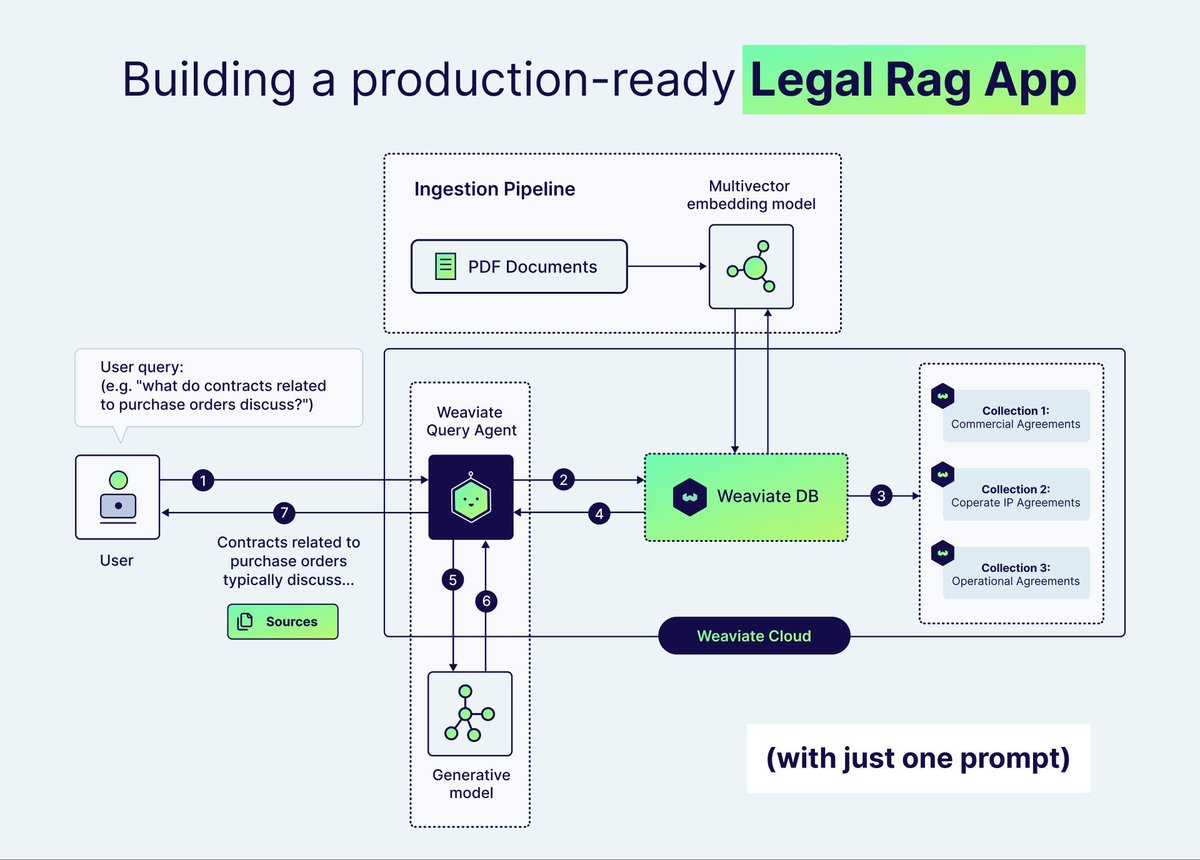
Here's the architecture we used:
𝗗𝗮𝘁𝗮 𝗟𝗮𝘆𝗲𝗿: PDFs embedded with ColQwen (a multivector model) and compressed with Muvera. Each page becomes a visual representation that preserves layout and tables.
𝗦𝗰𝗵𝗲𝗺𝗮: Three collections instead of one monolithic store - Commercial Agreements, Corporate & IP Agreements, and Operational Agreements. This gives the agent explicit structure to reason about.
𝗤𝘂𝗲𝗿𝘆 𝗔𝗴𝗲𝗻𝘁: The heavy lifter. It operates in Search Mode (retrieval and reranking for discovery) or Ask Mode (synthesized answers). Every response includes cited source passages to reduce hallucinations.
With our new Weaviate Agent Skills, you can build this yourself with 𝗼𝗻𝗲 𝗽𝗿𝗼𝗺𝗽𝘁.
Install Agent Skills:
npx skills add weaviate/agent-skills
Then run the prompt (available in our blog post) that tells the agent to build the full stack using the CUAD legal contract dataset, set up the three collections, configure the multivector embeddings, and create the frontend interface.
The agent handles everything: downloading the dataset, embedding legal PDFs, creating the schema, and building the chat interface with source citations 🎉
Check out the blog here: weaviate.io/blog/legal-rag…

English

@RoundtableSpace We have been looking for additional open source to add to vectoraiz.com. Will look into this.
English

vectorAIz runs on your infrastructure and makes your files, documents, and databases searchable with natural language — for you and your team. Ask questions in plain English, get answers from your own data, and keep everything private. Vectoraiz.com
English

@pablos Microsoft managed to ignore that rule for 40 years and they are doing fine ;)
English

@Cortex_Zero About ten years into this and our reality starts to glitch :)
English

⚡️Casimir Inc. Announces Experimental Zero Point Energy Breakthrough
Former NASA scientist Dr. Harold "Sonny" White has published a breakthrough paper in Physical Review Research providing proof that "empty" space is a structured, energy-rich medium. His company, Casimir, Inc., has successfully moved beyond the theoretical concepts White discussed on JRE in 2024 to deliver a working demonstration of vacuum energy extraction.
Using a custom nano-fabricated chip, the team measured a consistent output of 1.5 Volts at 25uA pulled directly from the quantum vacuum. This result confirms that the universe operates like a dynamic fluid where atoms and energy levels are simply resonances within a physical "container."
* Zero-Point Energy: Successfully harvested in a laboratory setting.
* The Vacuum: Proven to be a physical structure rather than a void.
* Power Output: A tiny chip produced 1.5 Volts of power from vacuum fluctuations.
If Zero-Point Energy can be scaled, we may finally have access to a fuel-less, universal power source that exists in every cubic inch of existence. Our "empty" reality is actually a pressurized ocean of potential. #ufox #ufotwitter
English