Mariano Bono

88 posts

Mariano Bono banner
Mariano Bono

Mariano Bono

@mbono1980

I am software engineer working on system software: C++, Qt and Linux

Torino Katılım Haziran 2014
38 Takip Edilen23 Takipçiler
Mariano Bono
Mariano Bono@mbono1980·
@antirez This really struck me ... I was asking myself how a young engineer can develop this kind of experience to understand the best design? Reading code (ai generated or not) isn't enough. Write code the old way and going crazy into the debugger is fundamental for this
English
0
0
0
63
Mariano Bono
Mariano Bono@mbono1980·
@mitchellh It Will be interesting to use a third model as judge maybe GPT 5.6 or maybe more than one judge
English
0
0
0
48
Mitchell Hashimoto
Mitchell Hashimoto@mitchellh·
I'm having a lot success using Fable xhigh as a planner/architect, using GPT 5.5 xhigh (subscription) as a coder, then Fable xhigh again as a judge. At API pricing, planning+judge costs are in the ~few dollar range compared to typical $50+ full round trips. I've seen some others using dumber/cheaper coders, but GPT 5.5 even at xhigh compared to Fable 5 is very cheap and very fast. And GPT 5.5 is just... really good. Still been less than 24hrs since the re-release so the longevity of this approach is unclear, but its been working really well.
English
286
209
5.7K
1M
Mariano Bono retweetledi
Mitchell Hashimoto
Mitchell Hashimoto@mitchellh·
Creator of Sqlite on pull requests: "You say, oh, it's free. No. It's not free. What you're doing is asking me ... to maintain it for you, to to document it for you, to test it for you, to maintain it for you for the next 25 years. That's not free." Yep. Wise words from a wiser man than me. I've told people for the past decade and I have recent posts on here saying the same: the merge button is the easy part. Its the decade+ (Richard says 25 years) that follows where you've accepted the transfer of maintenance thats hard.
English
60
396
6K
284.6K
Mariano Bono retweetledi
antirez
antirez@antirez·
OpenAI may delay GPT6 (or even 5.6) before making sure could not be blocked like Fable. Or they could play it smart, publishing only the benchmarks that show the improvements on certain area, providing a very censored model in the cyber-security side, and cross their fingers.
English
25
12
293
22.3K
Mariano Bono retweetledi
John Carmack
John Carmack@ID_AA_Carmack·
I admire Fabrice Bellard. He is almost certainly a better overall programmer than I am.
Spencer Baggins@bigaiguy

A French engineer who lives quietly in Paris has spent 30 years writing software that the entire internet now runs on without knowing his name. He wrote the code that streams every YouTube video, every Netflix show, every TikTok clip. He wrote the code that runs the virtual servers underneath AWS, Google Cloud, and Microsoft Azure. He calculated more digits of pi than anyone in history. He has no Twitter. He has no marketing. He just keeps shipping. His name is Fabrice Bellard. Here is the story, because almost nobody outside the systems programming world knows what one man has built. Fabrice was born in 1972 in Grenoble, France. He studied at École Polytechnique, the top French engineering school. He never went to Silicon Valley. He never built a startup empire. He just wrote code. In 2000 he started a project called FFmpeg, an open-source multimedia framework for encoding, decoding, and streaming video. He was 28. The project did one thing nobody else had done well. It handled every video and audio format that existed, in one library, on every operating system. He led it himself for years. Today FFmpeg is the invisible engine of the internet. YouTube uses it. Netflix uses it. VLC uses it. Chrome and Firefox use parts of it. Every Android phone, every iPhone, every smart TV, every video editing tool you have ever touched runs FFmpeg somewhere underneath. If you have watched a video on a screen in the last 20 years, Fabrice's code processed it. He was not done. In 2003 he started QEMU, a machine emulator and virtualizer. He wrote it solo until version 0.7.1 in 2005. QEMU lets you run any operating system on any other operating system. It became the foundation of modern virtualization. KVM, the Linux kernel hypervisor, runs on top of QEMU. Every major cloud provider, AWS, Google Cloud, Microsoft Azure, IBM Cloud, runs virtual machines on infrastructure built around it. The Quick Emulator is the most cited piece of cloud infrastructure code on Earth. He kept going. In 2001 he won the International Obfuscated C Code Contest with a small C compiler that grew into TCC, the Tiny C Compiler. TCC can compile and boot a Linux kernel from source in under 15 seconds. In 2004 he calculated the most digits of pi ever computed at the time, using a personal desktop computer and an algorithm he derived himself called Bellard's formula. In 2011 he wrote a complete PC emulator in pure JavaScript that runs Linux in your browser, a project called JSLinux that engineers still cannot believe is real. In 2019 he released QuickJS, a small but complete JavaScript engine that fits where V8 cannot. In 2021 he released NNCP, a neural network based lossless data compressor that immediately took the lead on the Large Text Compression Benchmark. Then he turned his attention to large language models. He built TextSynth Server, a web server with a REST API for running LLMs locally. He released ts_zip and ts_sms, compression utilities that use language models to compress text and short messages at ratios traditional algorithms cannot reach. He released TSAC, a very low bitrate audio compression system. In December 2025 he released Micro QuickJS, a new JavaScript engine for microcontrollers, separate from QuickJS, designed for environments with almost no memory. Fabrice co-founded a telecom company called Amarisoft in 2012, where he serves as CTO. Amarisoft builds 4G and 5G base station software used by carriers and labs around the world. He has been running it for over a decade while continuing to ship personal projects from his own home page at bellard dot org He has no Twitter. He has no Instagram. He gives almost no interviews. His personal website is a flat list of projects with no styling, no fonts, no marketing copy. Just titles and links. A quiet French engineer who never moved to Silicon Valley wrote the code that quietly runs the internet. He is still shipping.

English
149
717
10.9K
674.9K
Mariano Bono retweetledi
Spencer Baggins
Spencer Baggins@bigaiguy·
A French engineer who lives quietly in Paris has spent 30 years writing software that the entire internet now runs on without knowing his name. He wrote the code that streams every YouTube video, every Netflix show, every TikTok clip. He wrote the code that runs the virtual servers underneath AWS, Google Cloud, and Microsoft Azure. He calculated more digits of pi than anyone in history. He has no Twitter. He has no marketing. He just keeps shipping. His name is Fabrice Bellard. Here is the story, because almost nobody outside the systems programming world knows what one man has built. Fabrice was born in 1972 in Grenoble, France. He studied at École Polytechnique, the top French engineering school. He never went to Silicon Valley. He never built a startup empire. He just wrote code. In 2000 he started a project called FFmpeg, an open-source multimedia framework for encoding, decoding, and streaming video. He was 28. The project did one thing nobody else had done well. It handled every video and audio format that existed, in one library, on every operating system. He led it himself for years. Today FFmpeg is the invisible engine of the internet. YouTube uses it. Netflix uses it. VLC uses it. Chrome and Firefox use parts of it. Every Android phone, every iPhone, every smart TV, every video editing tool you have ever touched runs FFmpeg somewhere underneath. If you have watched a video on a screen in the last 20 years, Fabrice's code processed it. He was not done. In 2003 he started QEMU, a machine emulator and virtualizer. He wrote it solo until version 0.7.1 in 2005. QEMU lets you run any operating system on any other operating system. It became the foundation of modern virtualization. KVM, the Linux kernel hypervisor, runs on top of QEMU. Every major cloud provider, AWS, Google Cloud, Microsoft Azure, IBM Cloud, runs virtual machines on infrastructure built around it. The Quick Emulator is the most cited piece of cloud infrastructure code on Earth. He kept going. In 2001 he won the International Obfuscated C Code Contest with a small C compiler that grew into TCC, the Tiny C Compiler. TCC can compile and boot a Linux kernel from source in under 15 seconds. In 2004 he calculated the most digits of pi ever computed at the time, using a personal desktop computer and an algorithm he derived himself called Bellard's formula. In 2011 he wrote a complete PC emulator in pure JavaScript that runs Linux in your browser, a project called JSLinux that engineers still cannot believe is real. In 2019 he released QuickJS, a small but complete JavaScript engine that fits where V8 cannot. In 2021 he released NNCP, a neural network based lossless data compressor that immediately took the lead on the Large Text Compression Benchmark. Then he turned his attention to large language models. He built TextSynth Server, a web server with a REST API for running LLMs locally. He released ts_zip and ts_sms, compression utilities that use language models to compress text and short messages at ratios traditional algorithms cannot reach. He released TSAC, a very low bitrate audio compression system. In December 2025 he released Micro QuickJS, a new JavaScript engine for microcontrollers, separate from QuickJS, designed for environments with almost no memory. Fabrice co-founded a telecom company called Amarisoft in 2012, where he serves as CTO. Amarisoft builds 4G and 5G base station software used by carriers and labs around the world. He has been running it for over a decade while continuing to ship personal projects from his own home page at bellard dot org He has no Twitter. He has no Instagram. He gives almost no interviews. His personal website is a flat list of projects with no styling, no fonts, no marketing copy. Just titles and links. A quiet French engineer who never moved to Silicon Valley wrote the code that quietly runs the internet. He is still shipping.
Spencer Baggins tweet media
English
386
4.6K
25.6K
3.2M
Mariano Bono
Mariano Bono@mbono1980·
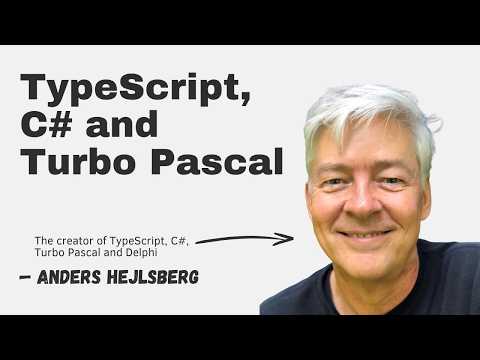
Turbo Pascal was my first serious IDE. The interview is very interesting #pascal #turbopascal
The Pragmatic Engineer@Pragmatic_Eng

“All of that has to happen within 200 milliseconds”. Anders Hejlsberg(@ahejlsberg) - creator of TypeScript, C# & Turbo Pascal - on why the TypeScript compiler is lazy and deferred: “In an IDE, the compiler is a service and what we do in that service is we basically take a program that is perpetually broken, because you're typing, and yet we try to syntactically or semantically analyse it. We need to know when you press `.here` - what could come next? Well, that means we need to know what is the type of thing you dotted on. In order to figure that out, we may have to resolve stuff, we may have to look at ASTs over here and whatever. And, all of that has to happen within 200 milliseconds or else people think the IDE is slow. Well, what if you have 500,000 lines of code? You can't compile all of those in 200 milliseconds. So you’ve got to be super, super deferred and interactive. You’ve got to do minimal amounts of work, and that's how our compiler is built: it tries to front load, for example, you have 500,000 lines of code, let's say, in 500 files. Well, we could build the ASTs for 499 of the files and just sit on them. We don't have to rebuild those because you're not editing in those files. We just have to update the AST of the current file you're in. So, that goes 500 times faster than if we had to do all of it. And then we don't actually have to figure out all of the types in here either. We can just start where you're at and then just resolve just enough to answer the question that you're needing an answer for right now. And so everything is lazy and deferred and functional and reusable inside the compiler. It's a very different way of writing compilers than what the textbooks will traditionally teach you.”

English
0
0
0
7
Mariano Bono retweetledi
antirez
antirez@antirez·
What Europe should do right now: 1. Call all the European researchers working on AI and return them back with same salary (or they can stay but switch career). 2. Fill EU places having GPUs with money, and put those people there. 3. AI partnerships with China + India.
English
353
365
3.2K
209.5K
Mariano Bono retweetledi
antirez
antirez@antirez·
The Internet just discovered GPT is better than Opus 🤨 Would love to understand the process that allowed the obvious to take months, otherwise my trust on the average AI expertise, which is already very low, may drop further.
English
130
55
892
103K
Mariano Bono retweetledi
The Pragmatic Engineer
The Pragmatic Engineer@Pragmatic_Eng·
Early Turbo Pascal had a “debugger” that wasn’t really a debugger. Anders Hejlsberg(@ahejlsberg) - creator of Turbo Pascal, C#, TypeScript & Delphi - on how they used the compiler to surface errors: “The first versions of Turbo Pascal didn't have a debugger. You would just use `writeln` statements and then you'd just see what happened. But often, if you had some error and it blew up with a runtime error: we would print out the address of the runtime error, which is where the program counter was at that point and then we had a mode in the compiler where we would say, compile, but stop at this address. And so the compiler was real simple. It would just produce object code, and then once it hit that address, it would just say, well, whatever I'm syntactically looking at right now, that must have been around where the error was. So that was how you could go to the line where the error had occurred. It's not like we had line maps or debuggers or any of that stuff. We just had the compiler, and it was just easy to make it stop at a certain address in the object output and then show you where it was in the source code.”
English
0
6
63
8.1K