Mad Dog

7.3K posts

Mad Dog banner
Mad Dog

Mad Dog

@mcsurfnut

Earth Katılım Şubat 2017
326 Takip Edilen145 Takipçiler
Mad Dog
Mad Dog@mcsurfnut·
@DavidPocock Sounds risky, let’s write some papers, hire consultants add some bureaucracy and build nothing.
English
0
0
0
4
David Pocock
David Pocock@DavidPocock·
Looking forward to seeing the detail of the govt’s new “national expectations” on AI data centres. Data centres offer economic & sovereign capability opportunities but also carry big energy, water & national security risks that have to be managed. And we need to make sure multinational tech giants wanting to build them here pay tax! 🇦🇺ns deserve better than giving big tech a free ride. smh.com.au/politics/feder…
English
39
47
179
3.9K
Mad Dog
Mad Dog@mcsurfnut·
@FurkanGozukara Thanks Furkan….. what other random predictions have you heard?
English
0
0
0
1
Furkan Gözükara
Furkan Gözükara@FurkanGozukara·
Absolute bombshell. Col. Macgregor predicts Putin has already delivered a terrifying ultimatum to Netanyahu: If Israel dares to use a nuclear weapon in the Middle East, Russia will drop a nuclear weapon on Israel. The US has no idea what it just walked into.
English
1.2K
7.6K
21.5K
1.1M
Mad Dog
Mad Dog@mcsurfnut·
@samlutd @peter_tulip It’s all trade-offs, I don’t really know what the optimal level is. But the idea solutions only sits on the supply side is silly.
English
1
0
1
31
.
.@samlutd·
@mcsurfnut @peter_tulip So you can agree One Nation’s “pause” to immigration is economically implausible?
English
1
0
2
37
Peter Tulip
Peter Tulip@peter_tulip·
Australia’s most successful politician, Peter Malinauskas was asked about national policy priorities “If I pick one area of policy that requires on-going sustained effort around the country it is undoubtedly housing... For me, it’s all in on housing” 1/3
English
16
1
36
6.5K
Mad Dog
Mad Dog@mcsurfnut·
@samlutd @peter_tulip It was a metaphor, and I wouldn’t suggest necessarily stopping it - but would leave the option open. If the university sector requires levers of international students that are otherwise unsustainable - it’s the university sector that needs to change.
English
1
0
1
43
.
.@samlutd·
@mcsurfnut @peter_tulip When did I say we should import more migrants than we can house? I didn’t. “Turning the tap off” though implies zero migration though and that would be objectively destructive to the economy. The University sector would go bust overnight.
English
1
0
3
35
Mad Dog
Mad Dog@mcsurfnut·
@samlutd @peter_tulip The idea that we must import more migrants than we can house, because we need waiters is kinda dumb eh. If you’re suggesting we have other or knows to solve as well - I agree.
English
2
0
1
47
.
.@samlutd·
@mcsurfnut @peter_tulip I hope you enjoy the hospitals, universities and hospitality industry shutting down when you turn the tap off xx
English
1
0
3
44
Mad Dog
Mad Dog@mcsurfnut·
@ctindale Taleb on ‘just in time’ and ‘optimisation’ is a useful.
English
0
0
0
38
🇦🇺Craig Tindale
Infrastructure resilience should place itself above all other matters. When a single power outage can shut Australia’s largest ammonia plant for months, it shows how tightly coupled the system has become. Ammonia sits upstream of fertiliser, explosives, and diesel exhaust fluids. Remove it and the effects move quickly: fertiliser supply tightens, crop yields come under pressure, mining inputs are constrained, and costs propagate through food and energy. Critical industrial nodes are operating with limited redundancy, high energy dependence, and long repair timelines. Efficiency has replaced resilience. All because of a power outage . The issue is the lack of slack and resilience in the system.
Andrey Sizov@sizov_andre

Houston, we have a problem. Australia's largest #ammonia plant (#Yara Pilbara) will be shut for two months to repair damage caused by a power outage, amidst a global supply crunch for the vital fertiliser and explosives ingredient - Boiling Cold #oatt #wheat
English
10
13
75
7.8K
Laura Loomer
Laura Loomer@LauraLoomer·
Is there anything worse than a crying baby on a plane? I wish parents would control their children. It’s so disruptive. I refuse to believe a baby cries for 10 hours. At some point this is just bad parenting, right?
English
19.5K
360
5.9K
4.3M
Mad Dog
Mad Dog@mcsurfnut·
@peter_tulip Indexation makes sense in nearly all scenarios - including income tax brackets.
English
0
0
0
25
Peter Tulip
Peter Tulip@peter_tulip·
The capital gains discount raises issues of income averaging, retrospectivity, incentives to save, etc. However, the crux is whether changes in asset prices that simply reflect inflation should be taxed. Why don't opponents of the discount argue that?
English
12
1
36
2.4K
Mad Dog
Mad Dog@mcsurfnut·
@GadSaad Pattern recognition is oppression.
English
0
0
0
14
Gad Saad
Gad Saad@GadSaad·
Don't worry. It will all work out. Anyone who identifies the exact same pattern across innumerable countries is a bigot.
Ryan Dally@Ryandally08

#BREAKING A large group of Middle Eastern men march through Sydney’s Pitt St Mall screaming “Allahu Akbar” Welcome to Anthony Albanese’s multicultural Australia. This would be very confronting for any normal Australian just trying to go about their day.


English
174
1.1K
4.8K
112.6K
Mad Dog
Mad Dog@mcsurfnut·
@NatedawgO7 @Adam_Creighton Drop the grievance and redistribution nonesense. He’s a making a correct technical point - coming over the top with feels is silly.
English
0
0
2
34
Nath_Sparky
Nath_Sparky@NatedawgO7·
@Adam_Creighton How many IPs you own Adam? Imagine being such a loser to defend property investors in a housing crisis.
English
2
0
16
309
Adam Creighton
Adam Creighton@Adam_Creighton·
The 50% Capital Gains Tax 'Discount' hasn't been a discount at all. · When inflation exceeds half the nominal return, it’s a tax increase compared to the old Indexation method, new IPA research shows; · In fact, as inflation soars beyond 4% the Discount will likely produce tax rates on real capital gains near 100% for many investors; · Reducing the so-called Discount to 33% with 4% inflation could elicit tax rates of 80% and 54% after 10 years, for average nominal returns of 6% and 8%, respectively; · The older Indexation method was a more consistent predictable system for taxing capital gains. ipa.org.au/research/austr…
Adam Creighton tweet media
English
17
15
110
3.9K
Mad Dog
Mad Dog@mcsurfnut·
@Adam_Creighton Indexing makes way more sense, and is much fairer you’ll note governments have an aversion to it - ala indexing income tax brackets.
English
0
0
3
48
Mad Dog
Mad Dog@mcsurfnut·
@ctindale @GuthmannR the goal is worthwhile but how do we avoid Government tyranny, and bloated bureaucracy?
English
0
0
0
5
🇦🇺Craig Tindale
🇦🇺Craig Tindale@ctindale·
Hayek’s own framework concedes the point once rivalry is introduced. He writes that “competition… is a process of discovery,” but that assumes a stable order where discovery can play out. Under state rivalry, the process is interrupted by coercion and manipulation. The constraint is survival. Mises is explicit about the boundary. He states, “The liberal program… has nothing to do with war and conquest,” which reads as a clean separation between economics and security. That separation won't hold once another state is willing to impose outcomes by force or game the free market system. The market won't price invasion risk in a way that preserves sovereignty; it selects for surrender. Friedman pushes the efficiency line furthest, arguing that “the great virtue of a free market system is that it does not care what colour people are; it only cares what they can produce.” That neutrality assumes exchange remains voluntary in a rivalrous system; exchange can be cut, seized, or redirected. Production capacity without control over it does not secure autonomy. In fact, such a system is logically ludicrous for a state to follow A state that optimises for cost minimisation in its defence base accepts a distribution of outcomes with a fat tail in the event of a loss of sovereignty. That tail cannot be diversified away. Even monetary doctrine collapses at this boundary. A gold standard binds issuance to reserves. If reserves are insufficient relative to the scale of mobilisation required, the constraint shifts from discipline to incapacity, then surrender. Hamilton’s position sits on this line. Public credit and coordinated finance were instruments of survival, not distortions of it. Once rivalry is active, central coordination enters as a condition of persistence. Markets can allocate within the system. They do not guarantee the system will continue to exist. The problem is that this magical thinking about the importance of efficiency of all other considerations creates incentives for geopolitical rivals to exploit such a system. For example, China subsidises critical metal refining so that nothing can be made in our own economy without their permission
English
1
0
1
39
Rafael R. Guthmann
Rafael R. Guthmann@GuthmannR·
Hayek's fundamental argument about information economics implies that central planning is impossible because the information required for economic activity is only manifested in the practice of economic activity by the agents. Blocking private enterprise means blocking the process by which this information is manifested. It's not a problem of the central planner lacking computational power, or even a problem of providing incentives in order to extract the information (i.e., it's not a problem of mechanism design). His argument is that this information fundamentally does not exist in a form that can be articulated and communicated through, lets say, writing. Lets consider an example: can the average person write down their utility function in a piece of paper and give the paper to the government in such a way that the central planning computer can replicate that person's consumption patterns over a period of lets say, a year?
Daron Acemoglu@DAcemogluMIT

Coming back to Hayek’s argument, there was another aspect of it that has always bothered me. What if computational power of central planners improved tremendously? Would Hayek then be happy with central planning?

English
70
202
1.4K
133.3K
Mad Dog
Mad Dog@mcsurfnut·
@respeculator 100% this - infuriating discourse in Australia at the moment.
English
0
0
0
17
Respeculator
Respeculator@respeculator·
If ur fix to a physical shortage of “energy”… is to.. a) slug the existing “energy” suppliers with additional taxes to minimise their profits and; b) cut consumer taxes to increase affordability You will discourage increased supply and encourage increased demand. Markets work naturally with price - no need to fuck around and intervene.
English
6
13
104
6.1K
Mad Dog
Mad Dog@mcsurfnut·
@steve_hanke Sachs always talking up the USA, true patriot.
English
0
0
0
12
Steve Hanke
Steve Hanke@steve_hanke·
Distinguished Columbia Univ. Prof. Jeff Sachs on current geopolitics: "In many ways, the US can not compete with China [in both manufacturing and diplomacy]... And I think we all feel it's not a temporary phenomenon but really the end of the US [and Western] led geopolitics."
English
106
302
1.2K
116.1K
Mad Dog
Mad Dog@mcsurfnut·
@alex_avoigt That’s what I would say if I was pro China or pro hydro carbons.
English
0
0
0
4
Alex
Alex@alex_avoigt·
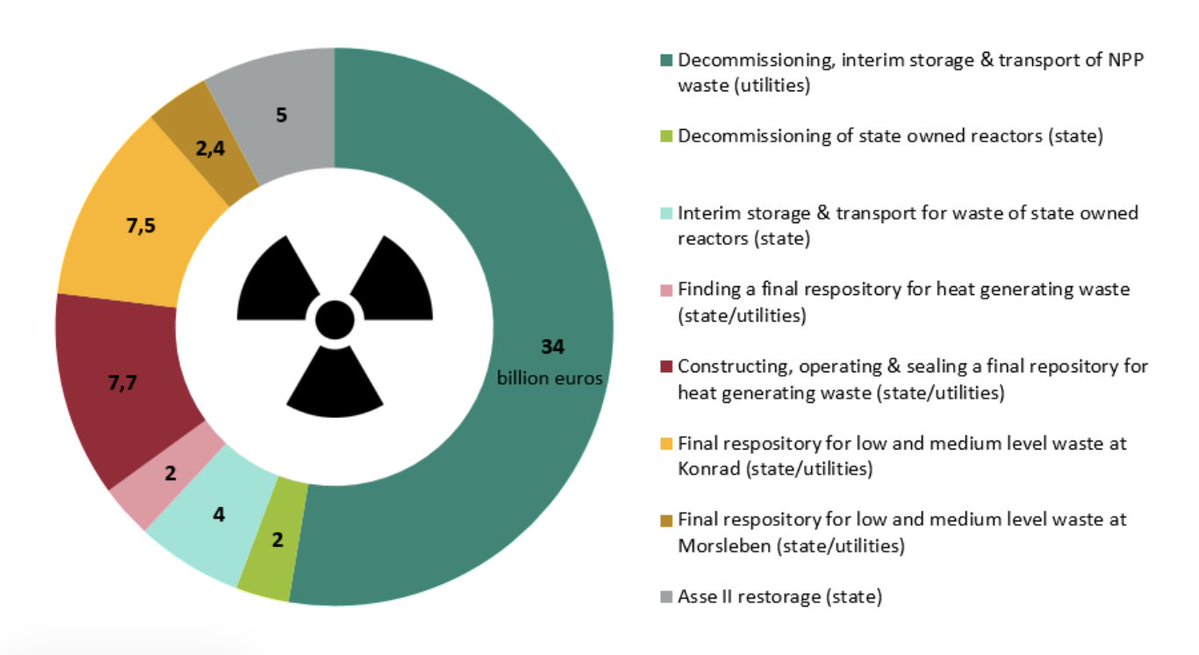
For anyone who still hasn't grasped why nuclear power plants are the stupidest idea imaginable: New nuclear power plants cost up to 49 cents per kilowatt-hour in Europe. Solar power costs between 3 and 6 cents. Thats 16 times more expensive electricity For those now dreaming of small power plants (SMR): SMRs produce five to 30 times more nuclear waste than large reactors, and nuclear waste is a massive cost driver. Professor Dr. Lesch calls the idea of ​​using old nuclear waste as fuel "a wonderful fairy tale that has yet to come true anywhere in the world." For all now claiming storage is no cost driver take a look what Germany had to pay and all other countries with nuclear energy generation must pay for decommissioning and storing nuclear facilities and waste in the future:
Alex tweet media
English
291
122
346
24.7K
Mad Dog
Mad Dog@mcsurfnut·
@ctindale @GuthmannR Agree, need to establish and maintain the boundary conditions for rational economics to operate within. It was naive to believe all nations/players would play by the same rules.
English
1
0
0
26
🇦🇺Craig Tindale
🇦🇺Craig Tindale@ctindale·
@mcsurfnut @GuthmannR And look what’s happened to the entire West we’ve become dependent on a foreign actor who has gamed the naive free market system with a form of state capitalism that we can label inefficient from our own serfdom to it .
English
1
0
1
53
Mad Dog
Mad Dog@mcsurfnut·
@ctindale @GuthmannR Hayek presents the ideal model within a set of bounds . If market participants are moving beyond ‘rational’ pricing because of non-economic forms of leverage, the system is weaker/failing/inefficient. Statecraft/Govt. should aim to create the ideal conditions within the bounds.
English
1
0
0
36
🇦🇺Craig Tindale
🇦🇺Craig Tindale@ctindale·
Hayek’s case for markets rests on rivalry as a discovery process. Competition reveals dispersed, tacit knowledge through prices. No actor holds the full picture; the system learns by letting rivals act. That logic is highly dependant on a structure: decentralised actors, voluntary exchange, and information revealed through transactions. His framework breaks down under stress First, rivalry itself changes the information. Actors won’t just reveal preferences; they withhold, mislead, and position. Prices start to carry strategy as much as underlying conditions. The signal becomes part of the game. The discovery process is no longer clean. Second, the moment rivalry shifts from firms to states, the mechanism collapses. Coercion replaces exchange, secrecy replaces disclosure, and coordination runs through power, not prices. Hayek’s framework operates within a system .In an environment between state actors his system becomes an exploit for foreign actors . It will never explain competition between systems where information is classified and outcomes are shaped directly. Then it becomes a dangerously naive system for a state actor to follow . AI compresses both these problems. It aggregates behaviour, predicts actions, and acts ahead of the transaction. The “discovery” Hayek describes gets pre-empted. Information is inferred and deployed before it reaches the market. Prices follow the model, rather than revealing underlying knowledge. At that point, the distinction between market coordination and planning narrows. Both run optimisation over large datasets. The constraint is no longer dispersed knowledge; it is control over data and inference. Hayek’s insight holds in a slower, decentralised setting. Under strategic foreign rivalry and AI-driven prediction, the mechanism he relies on is altered at the source. Which renders him obsolete for international markets and sovereign security Hamilton , Eisenhower on the other hand grounds liberty in state capacity rather than leaving it to spontaneous market outcomes. In his view, freedom depends on economic independence, and that requires deliberate coordination of finance, industry, and credit. He argues that key sectors will not form at the necessary scale through private incentives alone, so the state must organise capital, protect emerging industries, and build a national financial system. This is why he treats public credit, a central bank, and industrial policy as foundations of liberty: without them, the nation remains dependent on external supply and constrained in its political choices. His sequence is structural, build capacity first, then allow competition to operate within it.
English
1
1
7
1K
Arnaud Bertrand
Arnaud Bertrand@RnaudBertrand·
Iran seems to be following a strategy of unveiling more and more impressive military capabilities as the war goes on. They just fired long-range ballistic missiles at Diego Garcia, one of the most strategically significant U.S. military bases in the world (hosting B-52 bombers, nuclear subs, etc.), nearly 5,000km away from them in the middle of the Indian ocean 👇. Diego Garcia has never been hit before in any war in its 5 decades of existence, and no-one knew Iran had these types of capabilities (Iran themselves said their ballistic missile range was limited to 2,000 kilometers). Two days ago, they also took down an "unkillable" F-35 fifth-generation fighter jet, something which has never happened before (militarywatchmagazine.com/article/footag…). They've also managed to take control of the world's most strategic oil chokepoint, and have proven they can hit any strategic target in the wider Middle-East, even the most protected ones (such as Israel's Haifa oil refinery: aljazeera.com/news/2026/3/19…). All in all, it sounds almost unbelievable but Iran appears to have a genuine form of escalation dominance over the United States military, with its trillion dollar budget. In a very real way, it's even more impressive than Vietnam or Afghanistan: those countries resisted a superpower, Iran appears to be competing with one. It also makes you think: what comes next? And that's exactly what escalation dominance is all about: keep raising the stakes until the other side blinks. It's about making Trump think "wait, I thought I was picking a fight with the skinny kid and turns out he's Bruce Lee."
Arnaud Bertrand tweet media
The Spectator Index@spectatorindex

BREAKING: Iran fired two ballistic missiles at US-UK base at Diego Garcia in the Indian Ocean, according to Wall Street Journal report.

English
1.2K
5.8K
20K
1.7M