meh

26 posts

meh

meh

@mehfdfsda

meh?

Katılım Eylül 2024
70 Takip Edilen3 Takipçiler
meh
meh@mehfdfsda·
@immanuel_vibe nats is great, jetstream is meh, but good enough to handle load <50k rps with 1 stream. so if you don't expect a lot of data, it's quite convenient
English
0
0
0
42
meh
meh@mehfdfsda·
@immanuel_vibe there are a lot of nuances when dealing with nats, coming from main experience with kafka, I was suprised that there's no way to scale nats jetstream horizontaly, also, jetstream fsyncs data every 2 mins, so you will receive ack from the server even if data is not on a disk.
English
1
1
4
679
Immanuel
Immanuel@immanuel_vibe·
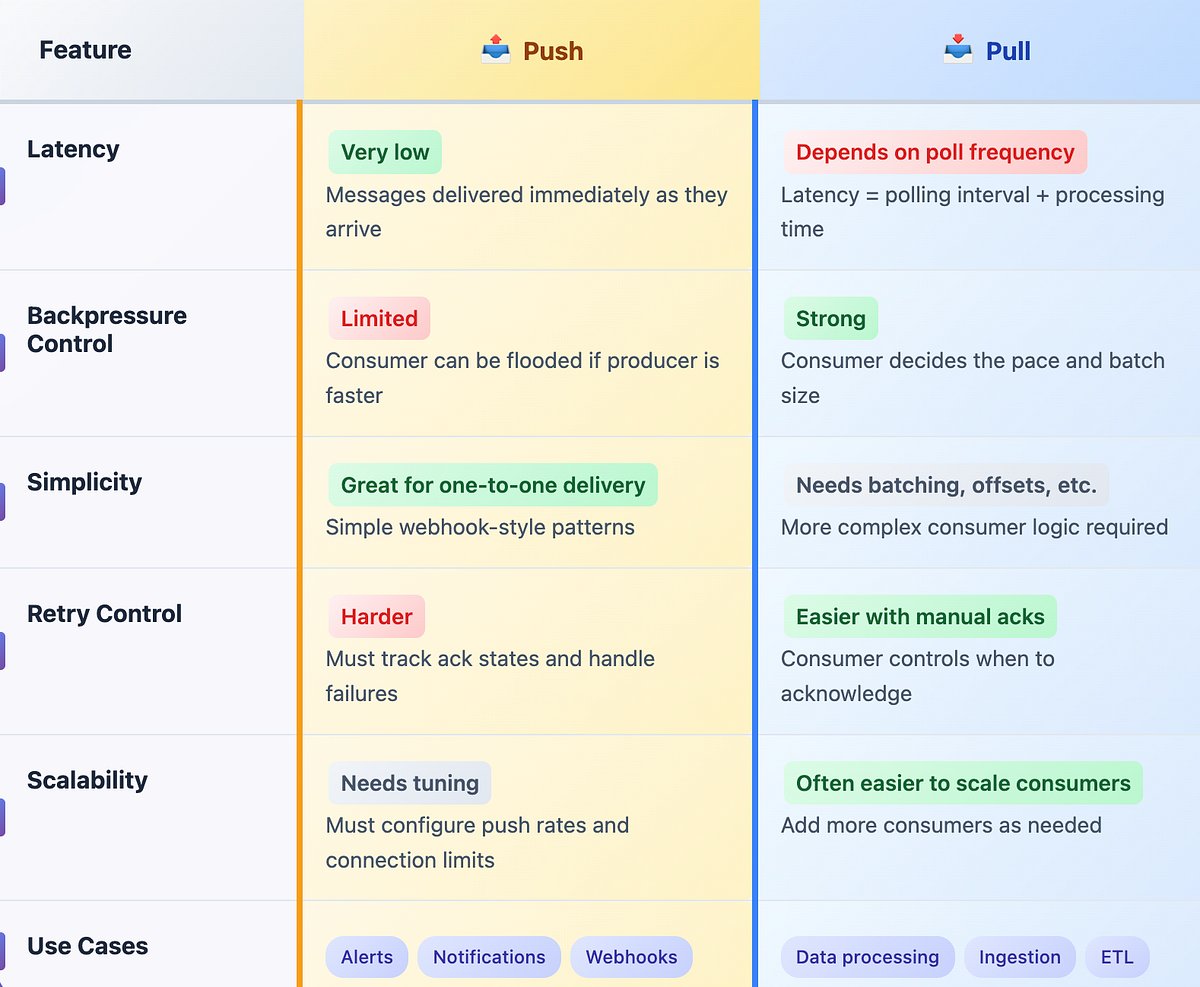
Kafka vs NATS isn't just brokers - it's pull vs push Kafka consumers pull records by offset. You decide when to read That's great for backpressure, batch jobs, and replay-heavy pipelines NATS flips the game: push consumers get data the moment it lands. Fast. Reactive. Zero lag vibes JetStream lets you mix both — push for fan-out, pull for controlled workers. Best of both worlds Push consumers + slow handlers = silent memory pressure. Always cap `max_ack_pending` Pull mode in NATS is perfect for autoscaling workers — fetch N messages, then scale pods Kafka tip: tuning `max.poll.interval.ms` matters more than people think — miss it and you trigger rebalances suffering Rule of thumb: streams & reprocessing → Kafka. Event-driven reactions & low latency → @nats_io #kafka #nats #golang #cloud #messaging #cloud_computing #cloud_native #devops #sre
Immanuel tweet media
English
2
20
145
9.6K
kepano
kepano@kepano·
what's one improvement you'd like to see in @obsdmd in 2026?
English
306
6
311
52.4K
meh
meh@mehfdfsda·
@0xlelouch_ why do you log on err return?
English
0
0
1
17
Abhishek Singh
Abhishek Singh@0xlelouch_·
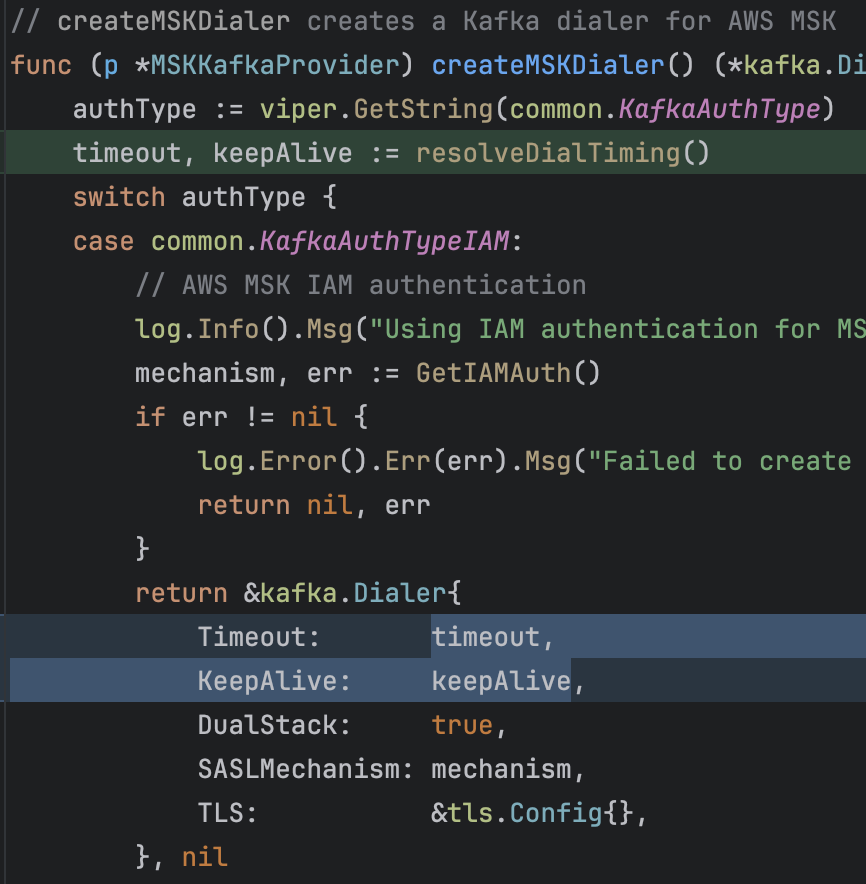
I have been working with kafka recently for writing a consumer in golang that simply reads data from kafka and saves it to clickhouse for audit purposes. Encountered a bug while migrating the consumer from confluent to AWS MSK (managed serverless kafka). The connection was reset by peer from time to time, but this happened only in case of AWS MSK and not confluent kafka. Debugged the issue, this happens because AWS MSK traffic normally flows through an AWS Network Load Balancer whose default idle timeout is 350s. If no I/O happens before that deadline, the NLB silently closes the socket, yielding ECONNRESET to the next read. Confluent’s managed brokers (or other busy consumers) tend to keep the connection active, either because of shorter broker-side keep alive intervals or simply because higher traffic prevents idling so we don’t see resets as often. The solution was to add a KeepAlive timeout in the setting that is slightly less than 350s (i kept it at 240s), so the client proactively sends keep-alive probes and MSK keeps the connection open.
Abhishek Singh tweet media
Igor De Souza@Igfasouza

Fast Kafka Consumer with Virtual Thread. Each time the listener receives a new messages it processes them in a separate Virtual Thread. #apachekafka Of course this make lose the message ordering within the single partition! choose your weapon!

English
14
23
350
44.2K
meh
meh@mehfdfsda·
@brankopetric00 lol at my previous job another team was spending 20k a month on some high cardinality metric, I decided to take a look at where this metric was used and couldn't find any dashboard, when I asked them about it a guy just said they didn't care.
English
0
0
0
990
Branko
Branko@brankopetric00·
Company spent $18k/month on Datadog. Leadership loved the dashboards. I dug into what we actually used: - 12 people logged in per month - 89% of metrics never viewed - Alerts had 97% false positive rate (team ignored them) - We were ingesting 2.4TB of logs daily - Retention: 180 days (compliance needed 30) Moved to: - Grafana + Prometheus (self-hosted) - Loki for logs - PagerDuty for critical alerts only - 30-day retention New cost: $340/month (hosting + PagerDuty). The controversial part? Engineers initially hated it because I killed their "observability theater." But incidents got resolved faster because we only tracked what mattered.
English
123
175
4.1K
427.3K
Armin Ronacher ⇌
Armin Ronacher ⇌@mitsuhiko·
In the past I usually wrote tests against postgres stuff by creating a transaction and rolling back. This is getting harder and harder, particularly if you have more than one service. I wonder what people do nowadays for tests to run efficiently and concurrently.
English
36
4
131
21.6K
EGOIST
EGOIST@localhost_5173·
@mehfdfsda changing model can be done with ctrl-m
English
1
0
0
191
EGOIST
EGOIST@localhost_5173·
Best AI chat wrapper in your opinion:
English
5
0
2
3.2K
meh
meh@mehfdfsda·
@RaillyHugo I'm sorry about this, it's fixed now.
English
1
0
1
35
Ankush Desai
Ankush Desai@ankushpd·
I have been thinking about creating a community/channel/forum of developers interested in "formal and semi formal methods" applied to distributed systems (everything open source). Including techniques like model checking, deterministic simulation, etc. Are there forums like this already? Suggestions?
English
21
6
115
5.2K
meh
meh@mehfdfsda·
@nohokthen For me "else" is just a big red flag that something in the design is wrong 99% of the time.
English
2
0
0
55
Nohokthen
Nohokthen@nohokthen·
Question, Go is very good at providing one way to do things. Why did they keep the “switch” keyword? I can’t find information about that
English
6
0
7
2.9K
⚡️JohnnyBoy⚡️
⚡️JohnnyBoy⚡️@permablaster·
@BowTiedMara @levelsio Westerners in general are heavily brainwashed. They worry about some far flung invisible climate change extinction yet if you show them a picture of what their city looked like 25 years ago they call you a fascist.
English
2
0
12
812
@levelsio
@levelsio@levelsio·
I think people not sure how crazy the climate change mindvirus is in Europe So they think I make up these stories But I don't lie, daily occurence, everything here is eco and about climate change and degrowth
Iner@iner_li

@levelsio Incredible rage bait content, come on Pieter

English
207
56
2.2K
548.6K
DHH
DHH@dhh·
I remember Google's big keynotes feeling like a cheap copy of Apple's. That age is over. What a tour de force. Incredible bandwidth and breadth. youtu.be/VHI200c5ngE?si…
YouTube video
YouTube
English
40
52
1.3K
264.5K
Aidan Beltskeys
Aidan Beltskeys@Aidanbeltskeys·
@dhh Hard to not sound hyperbolic, but it feels like this is the beginning of the end for Apple. The time has come where the usefulness/quality of product Google is shipping is undeniably better. I’ve got basic UI bugs on AppleTV and my IPhone.
English
2
0
33
4.2K
meh
meh@mehfdfsda·
@craigkerstiens my fav \set QUIET ON \x auto \timing \pset linestyle unicode \pset null NULL \set QUIET OFF \set HISTFILE ~/.psql/history- :DBNAME
English
0
0
2
55
Craig Kerstiens
Craig Kerstiens@craigkerstiens·
What's folks favorite setting they have in their psqlrc?
English
3
0
5
1.1K
meh
meh@mehfdfsda·
@craigkerstiens how do you check for all of that? Do you have some kind of note with all queries you need to run? Mind sharing?:)
English
2
0
0
36
Craig Kerstiens
Craig Kerstiens@craigkerstiens·
Personally I try to aim for an every 3-6 month check-up on my database and check: * Unused indexes * Bloat * Cache hit ratio * Index usage Even if you're not on Crunchy Bridge still something you should have handy queries for and check in on regularly x.com/crunchydata/st…
Crunchy Data@crunchydata

Checking on your unused indexes every once in a while is a good idea. • Every write or update action that includes indexed data has to be updated. So unused indexes add unnecessary work for the database. • Indexes can take up storage space that you can save. They also take up space on backups and replicas. When you find unused indexes, you can delete them, or do more research to see if something in your data model changed and the index should be changed. You can query Postgres' internal tables directly to see what indexes are not used. Generally the pg_stat_user_indexes table and the pg_index table are the place to look. If you're a Crunchy Bridge customer, we show this in the Insights panel under Unused Indexes. Here's a sample query for finding unused indexes. SELECT schemaname || '.' || relname AS table, indexrelname AS index, pg_size_pretty(pg_relation_size(i.indexrelid)) AS "index size", idx_scan as "index scans" FROM pg_stat_user_indexes ui JOIN pg_index i ON ui.indexrelid = i.indexrelid WHERE NOT indisunique AND idx_scan < 50 AND pg_relation_size(relid) > 5 * 8192 ORDER BY pg_relation_size(i.indexrelid) / nullif(idx_scan, 0) DESC NULLS FIRST, pg_relation_size(i.indexrelid) DESC;


English
2
3
28
2K