
Sabitlenmiş Tweet
Meter
398 posts

Meter
@meter
Enterprise networks built from the ground up.
Katılım Ağustos 2014
150 Takip Edilen2.5K Takipçiler

lil personal news 🥳
i've joined meter.com to help build out the new era of networking infrastructure!
cody@devlooskie
new portfolio for a new era ! lmk what u think: looskie.com
English
Meter retweetledi

A hundred years ago, you could scarcely see the sky above Manhattan.
Telephone and power companies pulled individual lines to individual buildings, every service separately strung to every address in the city.
Then people started asking a simple question: why would anyone move into a building that did not already have these things? This question created the utility industry.
Anil Varanasi (@acv) thinks the internet is at exactly that inflection point. We are roughly two decades into widespread internet use, and the same question is beginning to form:
Why would any building not come with a network already built in?
Mario Gabriele@mariogabriele
Much of the fear around AI centers on misalignment – the idea that powerful systems might act against human interests. @vincentweisser worries about something different: what happens if advanced AI systems are perfectly aligned with the interests of a small group of institutions? That concern led him to co-found @PrimeIntellect, a startup building open infrastructure for training and deploying advanced AI models. In our conversation, we explore: • The intellectual influences that shaped Vincent’s thinking about intelligence and progress, including David Deutsch and Nick Bostrom • The Zuzalu experiment and what it suggests about the future of scientific communities • Vincent’s predictions for the next five years of AI Thank you to the partners who make this possible - @meetgranola: The app that might actually make you love meetings: granola.ai/mario - @brexHQ: The intelligent finance platform: brex.com/mario - @Rippling: Stop wasting time on admin tasks, build your startup faster: rippling.com/mario (00:00) Introduction to Vincent Weisser (09:35) An overview of Prime Intellect (21:18) Vincent’s intellectual influences (31:48) Funding science outside traditional institutions (43:45) Deciding to build Prime Intellect (51:39) Training models on Prime Intellect (1:03:48) The Zuzalu experiment (1:11:13) Predictions for the next five years
English

The Varanasi brothers are Silicon Valley’s greatest secret
Mario Gabriele@mariogabriele
Anil Varanasi (@acv), co-founder and CEO of @meter, is building a new kind of networking company for the AI era. Alongside his brother Sunil, he has helped raise more than $350 million to challenge incumbents like Cisco with a vertically integrated approach spanning hardware, software, deployment, and ongoing operations, all delivered through a utility-style model. Together we explore: • The “burden of knowledge” and why progress is getting harder across fields • Why most companies over-index on technology and ignore business model innovation • The three ways companies create advantage: technology, delivery, and business model • How Meter’s trade-in model borrows from the automotive industry • Why Anil believes “common knowledge” is often wrong Thank you to the partners who make this possible - @dottechdomains: An identity for builders at their core: go.tech/thegeneralistnl - @meetgranola: The app that might actually make you love meetings: granola.ai/mario - @brexHQ: The intelligent finance platform: brex.com/mario Timestamps (0:00) Introduction to Anil Varanasi and Meter (10:25) What Meter actually does (22:55) Why Anil didn’t pursue filmmaking (29:59) The dynamic of working with his brother as a co-founder (35:15) Lessons from successful companies (41:10) Scrapping 18 months of work (59:39) Networking as infrastructure and utility (01:07:28) Rethinking education
English
Meter retweetledi
Anil Varanasi (@acv), co-founder and CEO of @meter, is building a new kind of networking company for the AI era.
Alongside his brother Sunil, he has helped raise more than $350 million to challenge incumbents like Cisco with a vertically integrated approach spanning hardware, software, deployment, and ongoing operations, all delivered through a utility-style model.
Together we explore:
• The “burden of knowledge” and why progress is getting harder across fields
• Why most companies over-index on technology and ignore business model innovation
• The three ways companies create advantage: technology, delivery, and business model
• How Meter’s trade-in model borrows from the automotive industry
• Why Anil believes “common knowledge” is often wrong
Thank you to the partners who make this possible
- @dottechdomains: An identity for builders at their core: go.tech/thegeneralistnl
- @meetgranola: The app that might actually make you love meetings: granola.ai/mario
- @brexHQ: The intelligent finance platform: brex.com/mario
Timestamps
(0:00) Introduction to Anil Varanasi and Meter
(10:25) What Meter actually does
(22:55) Why Anil didn’t pursue filmmaking
(29:59) The dynamic of working with his brother as a co-founder
(35:15) Lessons from successful companies
(41:10) Scrapping 18 months of work
(59:39) Networking as infrastructure and utility
(01:07:28) Rethinking education
English
We’ve acquired @WiredScore.
WiredScore has spent a decade setting the global standard for building connectivity, certifying over 1B square feet across 42 countries. We’ve spent that same time building the infrastructure to deliver it.
Together, we’re connecting the standard to the infrastructure behind it so every business can rent a space, flip a switch, and get to work.
English


It's easy to focus on models and chips right now. But every model, training run, inference step eventually becomes a packet moving across a network.
Networking is the substrate beneath this moment. It's also one of the most overlooked layers of the stack—which is why we're rebuilding it.
Ben spent time with our team to understand the massive opportunity in networking, and what Meter's building to meet it. Thanks for the care you brought to our story.
Ben Butler@bengbutler
English
The internet runs the world. Every purchase you make, every email you send, is packets moving through networks.
We’re building the definitive networking stack to power that at global scale.
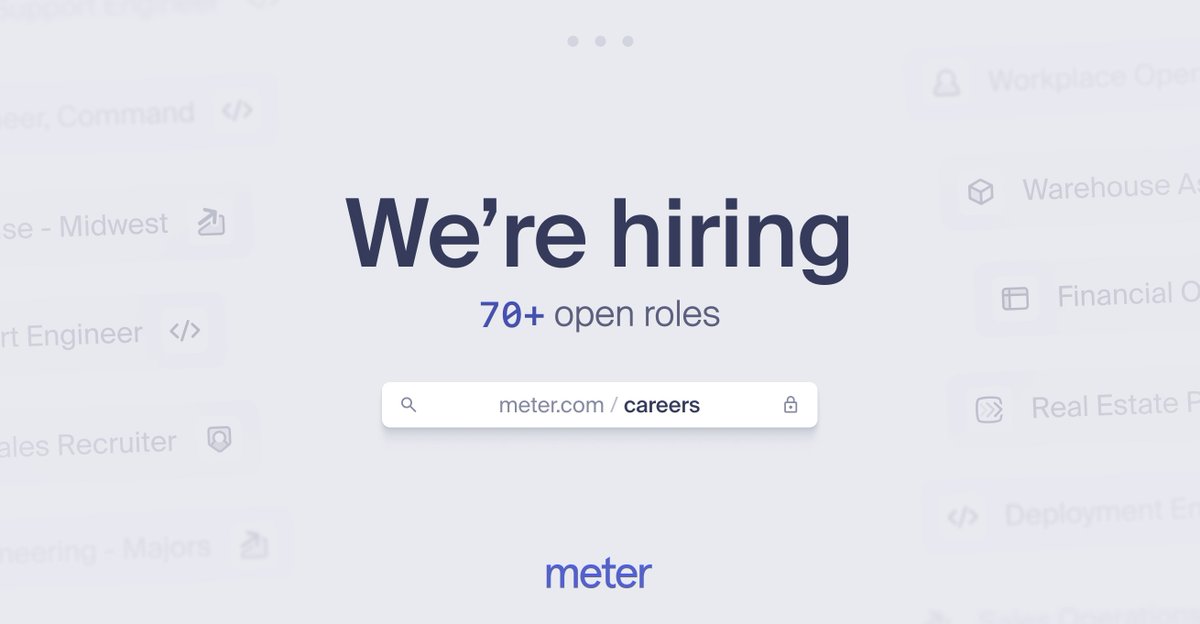
And we're hiring across 70+ roles in GTM, engineering, models, operations, and more to do it.
English
Meter retweetledi

This was one of my favorite interviews of 2025...
Founders often underestimate how much freedom they actually have. @acv and @meter is a reminder of what happens when you use all of it. They ignored the usual advice and built the company their way. It’s no surprise their story doesn’t resemble anyone else’s. Here are just a few examples:
1. They spent four and a half years pre–revenue, just two people. It was essentially Anil and Sunil, alone, for four and a half years before they had a sales ready product and their first customers. They even scrapped an entire year of operating system work once they realized a different technical approach (inspired by an open source project) was better.
2. They literally moved to Shenzhen to learn how the physical world is made. They were blocked by slow hardware iteration in San Francisco, so they just relocated to Shenzhen for over a year.
3. Full vertical integration as a day one decision, not an afterthought. Meter decided from the start to own the entire stack: hardware, software, installation, and ongoing service. This is in a market where most entrants pick one slice (just switches, just access points, etc.) and get trapped as point solutions that end up acquired.
4. Business model treated as part of the product, not a pricing afterthought. They moved networking from “buy hardware” to: Meter provides the hardware, the software, the installation and ongoing support. The customer pays recurring, per square foot, and effectively “don’t pay us if the network doesn’t work.” Anil thinks about business model innovation on the same level as product and technology innovation.
5. Choosing a massive, incumbent dominated market on purpose. Networking is controlled by a few giants like Cisco. They were pulled toward that exact dynamic: a huge, durable market where the initial ramp is brutal, but if you get through it, there are very few new players alongside you.
6. Deliberately avoided the channel in a channel dominated industry. Roughly 90 percent of networking is sold through the channel.Meter refused to use the channel until they were convinced the product was dramatically better in every way, because incumbents could weaponize the channel with discounts to block them. Only after they had hundreds of happy customers and strong tools did they fully embrace channel sales.
7. The team has an extreme time horizon, paired with extreme urgency. Anil thinks in decades: “I care about where Meter ends up in 25 years, not five.” At the same time, he is obsessively focused on what happens in the next few hours and where every report spends time. That “barbell” between multi decade vision and hour by hour intensity is very explicit for him.
8. An allergy to “meta work” and most conventional management. No OKRs or goals at all. They have a strong skepticism of spending time on docs, processes, and coordination that feel like work but do not move the product forward.
English
Meter retweetledi

the @meter team is surprisingly still under the radar, but they've built an exceptional full-stack solution for network engineers.
Brett Berson@brettberson
This was one of my favorite interviews of 2025... Founders often underestimate how much freedom they actually have. @acv and @meter is a reminder of what happens when you use all of it. They ignored the usual advice and built the company their way. It’s no surprise their story doesn’t resemble anyone else’s. Here are just a few examples: 1. They spent four and a half years pre–revenue, just two people. It was essentially Anil and Sunil, alone, for four and a half years before they had a sales ready product and their first customers. They even scrapped an entire year of operating system work once they realized a different technical approach (inspired by an open source project) was better. 2. They literally moved to Shenzhen to learn how the physical world is made. They were blocked by slow hardware iteration in San Francisco, so they just relocated to Shenzhen for over a year. 3. Full vertical integration as a day one decision, not an afterthought. Meter decided from the start to own the entire stack: hardware, software, installation, and ongoing service. This is in a market where most entrants pick one slice (just switches, just access points, etc.) and get trapped as point solutions that end up acquired. 4. Business model treated as part of the product, not a pricing afterthought. They moved networking from “buy hardware” to: Meter provides the hardware, the software, the installation and ongoing support. The customer pays recurring, per square foot, and effectively “don’t pay us if the network doesn’t work.” Anil thinks about business model innovation on the same level as product and technology innovation. 5. Choosing a massive, incumbent dominated market on purpose. Networking is controlled by a few giants like Cisco. They were pulled toward that exact dynamic: a huge, durable market where the initial ramp is brutal, but if you get through it, there are very few new players alongside you. 6. Deliberately avoided the channel in a channel dominated industry. Roughly 90 percent of networking is sold through the channel.Meter refused to use the channel until they were convinced the product was dramatically better in every way, because incumbents could weaponize the channel with discounts to block them. Only after they had hundreds of happy customers and strong tools did they fully embrace channel sales. 7. The team has an extreme time horizon, paired with extreme urgency. Anil thinks in decades: “I care about where Meter ends up in 25 years, not five.” At the same time, he is obsessively focused on what happens in the next few hours and where every report spends time. That “barbell” between multi decade vision and hour by hour intensity is very explicit for him. 8. An allergy to “meta work” and most conventional management. No OKRs or goals at all. They have a strong skepticism of spending time on docs, processes, and coordination that feel like work but do not move the product forward.
English
Meter retweetledi

As a founder, @acv operates on a time horizon shaped like a barbell. He obsesses over the next few hours to work toward outcomes that will take decades.
His company, @meter, provides internet infrastructure for businesses, and he’s singularly focused on building a hardware and software stack that can process all the world’s network packets. Which won’t happen any time soon.
”I don’t care about where Meter ends up in five years. I care about where it ends up in 25 years. But at the same, the next few hours really matter to me,” he says.
Anil started Meter with his brother, Sunil, back in 2015, and made a series of unconventional early bets: They went after a monopolized 40-year old market. They moved to Shenzen for a year to learn how to design and manufacture hardware. They bucked the traditional networking business model and came up with their own.
On this episode of In Depth, he joins @BrettBerson to unpack his journey with Meter so far, ten years in.
They discuss:
(04:06) Why Meter doesn’t do OKRs
(11:43) How Meter’s journey began
(37:39) The secret to finding an excellent market
(49:34) Why Meter didn’t sell via traditional channels
(56:25) Decoupling management from authority
English
@UXbri Caught Glenn's full session - really interesting! Love seeing Command highlighted.
More here for anyone that might be interested: meter.com/command
English

Revolutionary UI: Instant Dashboards with Meter.com – Glenn Jones at UX Brighton 2024
👉 Join us 7 Nov 2025 uxbri.org/2025/?utm_sour… #ai #ux
English

Every year at NeurIPS the WiFi is terrible. This really should be solved by now. How can it be solved for next year?
English


