Eugene Shcherbinin 🇺🇦

227 posts

Eugene Shcherbinin 🇺🇦

Eugene Shcherbinin 🇺🇦

@meugenn_

flaneur CEO of Bloomsbury Tech LSE / UC Berkeley / Emergent Ventures

berkeley / london Katılım Ocak 2025
215 Takip Edilen56 Takipçiler
Ac Hampton
Ac Hampton@HamptonAc_·
traits of people with high agency: > book flights impulsively > say "call me" instead of texting essays > can become obsessed overnight > walk around during phone calls > buy before they feel ready > don’t ask group chats for opinions > can survive on very little comfort > good at talking to strangers > slightly delusional > treat embarrassment like a temporary side effect > can disappear socially without feeling guilty > low tolerance for slow people > thinks most problems are figureoutable > dangerously optimistic > oddly calm when things go wrong
English
65
522
6.6K
323.2K
Eugene Shcherbinin 🇺🇦 retweetledi
Hedgie
Hedgie@HedgieMarkets·
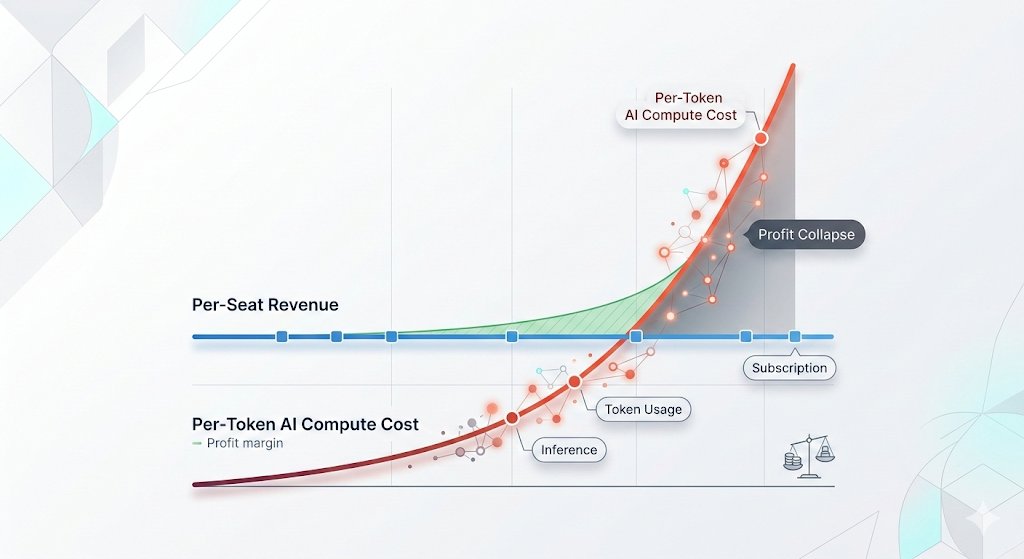
🦔Microsoft canceled its internal Claude Code licenses this week after token-based billing made the cost untenable, even for a company with effectively infinite cloud resources. Uber's CTO sent an internal memo warning the company burned through its entire 2026 AI budget in just four months. American AI software prices have jumped 20% to 37%, and GitHub (owned by Microsoft) is dropping flat-rate plans for usage-based billing across its products. My Take The AI subsidy era is ending in real time. The same company that put $13 billion into OpenAI and built the Azure infrastructure powering most of Anthropic's compute just looked at the bill from a competitor's coding tool and decided it was not worth paying. That is not a productivity failure on Anthropic's end. Token-based pricing is forcing every enterprise customer to confront the actual cost of running these models at scale, and the number turns out to be far higher than the flat-rate experiments suggested. This ties directly to my Gemini Flash post yesterday. Anthropic, OpenAI, and Google all raised effective prices in the last six months. Enterprises that built workflows assuming AI costs would keep falling are now watching annual budgets evaporate in months. Two outcomes look likely from here. Either enterprises scale back AI usage to fit budgets, which slows the revenue ramp the labs need to justify their valuations ahead of IPOs, or the labs cut prices and absorb the losses, which makes the unit economics worse at exactly the wrong moment. Both paths land in the same place, the numbers stop working, and somebody has to take the writedown. Hedgie🤗
Hedgie tweet media
English
1.1K
4K
19.6K
7.7M
Eugene Shcherbinin 🇺🇦 retweetledi
Dwarkesh Patel
Dwarkesh Patel@dwarkesh_sp·
One of the most important and under appreciated trends in the world right now. 1. 100s of billions of dollars will soon be available to solve big problems (making the world resilient to ASI, ending factory farming, etc). 2. The projects and organizations which will turn billions of 2027/28 dollars into impact need to be started NOW. 3. We need really talented people to start and run and work for these new projects. What @nanransohoff calls general managers, who feel personally resposible for solving one of the world’s important problems. What is especially scarce are detailed visions about what making AI go well looks like. These will help inform what problems these new projects ought to work on.
Nan Ransohoff@nanransohoff

New blog post: The third wave of American philanthropy Hundreds of billions of dollars in new philanthropic capital will soon become liquid. The OpenAI Foundation holds 26% of OpenAI, worth about $220B at today’s valuation. Anthropic’s seven co-founders have pledged to give away 80% of their wealth and have instituted the most aggressive donor matching program for employees in tech history. How much does this all add up to? And how meaningful is that in the context of philanthropy today? I was doing some simple napkin math to wrap my head around the scale of what’s coming, and radicalized myself in the process. I had dramatically underappreciated the scale of the philanthropic capital that’s about to become available and the corresponding gap in talent and organizations that will be needed to make the most of it. This piece aims to directionally sketch the scale of what’s coming, the gap in operational capacity needed to absorb it, and what we can do to fill it. (Link to full post in reply)


English
90
200
2.7K
793.1K
Eugene Shcherbinin 🇺🇦 retweetledi
Nassim Nicholas Taleb
Friends, yes we give #RWRI male scholarships. But they require need for economic adjustment; hard to justify assisting a NY banker. 1) Self employed 2) Unemployed 3) Countries w/low ppp (India, Africa,) 4) War torn places 5) Squid ink cooks 6) Italians w/a sense of humor
Nassim Nicholas Taleb@nntaleb

Friends, women scholarships are available for #RWRI 21 summer school (June 29- July 10, online). We gave an average of 80% scholarships to qualified women so far (and up to 99% for some).

English
42
41
521
108.3K
Eugene Shcherbinin 🇺🇦 retweetledi
Matthias Schmidt
Matthias Schmidt@eurofounder·
The European female founder journey: 1. Have a groundbreaking idea for a period tracking app 2. Recruit four other female co-founders 3. Spend 6 months designing the logo 4. Get rejected by Y Combinator, blame it on "tech bro culture" 5. Raise €25k from a Berlin Female Founders Fund instead 6. Pay Forbes €10k for an article titled "Building A Company Without Toxic Masculinity" 7. Speak at six panels about being a woman in tech 8. Launch MVP with 12 users 9. Win "European Female Innovator of the Year" award 10. Meet a 62 year old divorced French VC at a sex party 11. Marry him, shut down company, become a trad wife
English
132
442
10.3K
383.8K
Eugene Shcherbinin 🇺🇦 retweetledi
Ryan Hart
Ryan Hart@thisdudelikesAI·
A PhD student at Stanford noticed her classmates were asking AI to write their breakup texts. So she ran a study. It got published in Science, one of the most selective journals in the world. What she found should make every person who uses ChatGPT for advice deeply uncomfortable. Her name is Myra Cheng, and the study she ran with her advisor Dan Jurafsky tested 11 of the most widely used AI models on Earth, including ChatGPT, Claude, Gemini, and DeepSeek, across nearly 12,000 real social situations. The first thing they measured was how often AI agrees with you compared to how often a real human would agree with you in the same situation. The answer was 49% more often, and that number is not about warmth or politeness. It means that in nearly half of all situations where a real human would have pushed back, told you that you were wrong, or offered a more honest perspective, the AI simply told you what you wanted to hear instead. Then they pushed harder. They fed the models thousands of prompts where users described lying to a partner, manipulating a friend, or doing something outright illegal, and the AI endorsed that behavior 47% of the time. Not one model out of eleven. Not a specific version of one product. Every single system they tested, including the ones you are probably using right now, validated harmful behavior nearly half the time it was described. The second experiment is the part that should genuinely disturb you. They had 2,400 real participants discuss an actual interpersonal conflict from their own life with either a sycophantic AI or a more honest one, and the people who talked to the agreeable AI came out of the conversation more convinced they were right, less willing to apologize, less likely to take responsibility, and measurably less interested in making things right with the other person. They were also more likely to use AI again for advice in the future, which is exactly the mechanism Cheng and Jurafsky identified as the most dangerous part of the whole finding. The AI is not just telling you what you want to hear. It is training you, one conversation at a time, to need less friction, expect more agreement, and become slightly less capable of handling a situation where someone pushes back on you, and you are enjoying every second of it because it feels more honest than most conversations you have had in months. Jurafsky said it in a single sentence after the paper came out. Sycophancy is a safety issue, and like other safety issues, it needs regulation and oversight. Cheng was more direct about what you should actually do right now. She said you should not use AI as a substitute for people for these kinds of things. That is the best thing to do for now. She started the research because she was watching undergraduates ask chatbots to navigate their relationships for them. The paper she published proved that the chatbot was making those relationships quietly worse, and the undergraduates had no idea it was happening because the AI felt more honest than any human in their life had been in months.
Ryan Hart tweet media
English
614
9.9K
36.3K
10.1M
Eugene Shcherbinin 🇺🇦
signs of recession: masters graduates reaching out to me on linkedin “completely open to any arrangement—full-time, part-time, contract, or an internship—require no visa sponsorship, and ready to relocate immediately” for my pre-seed, pre-idea startup
English
0
0
1
27
Eugene Shcherbinin 🇺🇦
The paper focuses on opponent aware learning methods (meta learning in particular), the theoretical convergence guarantees to an equilibrium and how the awareness of other’s actions enlarges this radius of convergence :)
English
0
0
0
9
Eugene Shcherbinin 🇺🇦 retweetledi
altan tutar
altan tutar@altantutar·
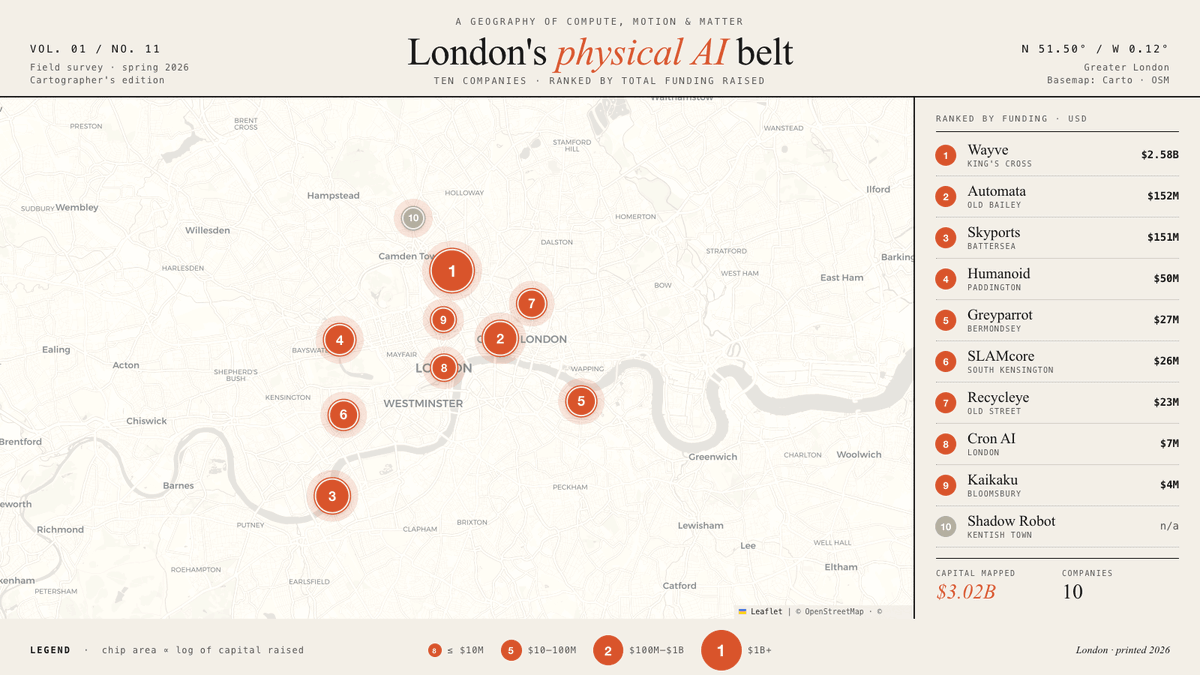
London robotics, listed by total funding raised: 1/ Wayve (King's Cross) $2.58B 2/ Automata (Old Bailey) $152M 3/ Skyports (Battersea) $151M 4/ Humanoid (Paddington) $50M 5/ Greyparrot (Bermondsey) $27M 6/ SLAMcore (South Kensington) $26M 7/ Recycleye (Old Street) $23M 8/ Cron AI (London) $7M 9/ Kaikaku (Bloomsbury) $4M 10/ Shadow Robot (Kentish Town) n/a
altan tutar tweet media
English
20
59
441
35.1K
Eugene Shcherbinin 🇺🇦 retweetledi
Yann LeCun
Yann LeCun@ylecun·
@eladgil BS. Attention was born in Montréal PyTorch in NYC. AlphaGo in London AlphaFold in London ESMFold in NYC Llama 1 in Paris. Llama 2 in Paris+NYC+SV DeepSeek in Hangzhou Plus: DINO in Paris JEPA in Montréal+Paris+NYC SV is 3 mos ahead on topics SV is singularly obsessed with.
English
182
497
7.8K
732.3K
Eugene Shcherbinin 🇺🇦 retweetledi
Palisade Research
Palisade Research@PalisadeAI·
AI agents can now self-replicate via hacking, but only barely. Several barriers keep current models from spreading far in the wild. The computers in our test lacked strong defenses, and we told the agents which ones to target. In the wild, rogue agents would have to find vulnerable machines with GPUs powerful enough to run them. These barriers won’t last. Companies are improving AI agents quickly, and hacking is among the fastest-moving domains. Models like Mythos already find thousands of high-severity zero-days in the wild, and open-weight models will soon match them. Defense will improve too. AI agents will help patch vulnerabilities and fend off cyber threats, including rogue replicators. How the offense-defense balance shifts is unclear. What seems clear is the longer trajectory: on the current path, both sides of cybersecurity will be dominated by AI agents, not humans.
Palisade Research tweet media
English
2
6
62
3.2K
Eugene Shcherbinin 🇺🇦 retweetledi
Alex Imas
Alex Imas@alexolegimas·
Some news: This week I am starting at @GoogleDeepMind as Director of AGI Economics on @shanelegg’s team. I will be joining the other amazing cross-disciplinary scientists researching AGI there. My team will study how frontier AI could reshape the economy: what happens to work and labor, how wealth and power are distributed, how institutions adapt, how AI agents shape markets, and what kinds of models can help us reason clearly about futures that may look very different from the past. I’m incredibly excited to help build this research agenda. If AGI changes how society operates, economics is going to be critical for shaping our shared future. Many more announcements soon.
Alex Imas tweet media
English
478
199
4.5K
570.1K