Michael Stumo

11.4K posts

Michael Stumo

Michael Stumo

@michael_stumo

From trade advocate to public service at OMB. Father of Samya Rose Stumo—fighting for aviation safety. Economy, industry, & policy. My views, not my employer’s.

Katılım Şubat 2018
560 Takip Edilen3.2K Takipçiler
Michael Stumo retweetledi
(((Alan Tonelson)))
(((Alan Tonelson)))@AlanTonelson·
Wow! MIT & University of Chicago economists found that US "workers in communities that were more exposed to competition from Mexican imports saw a significant shortening of their life spans after [NAFTA] went into effect in 1994"! Great catch by @AnaSwanson. HT @NeilMunroDC
English
1
2
4
128
Michael Stumo retweetledi
United States Trade Representative
The globalist status quo is on the side of foreign countries perpetuating unfair trade practices, not the American worker.
English
9
41
152
4.4K
Michael Stumo retweetledi
Rapid Response 47
Rapid Response 47@RapidResponse47·
.@USTradeRep Ambassador Greer: "We have flipped the direction and the trend in the trade deficit. Our trade deficit with China has gone down by 30% over the past year... our trade deficit with the rest of the world, since last April, has gone down by 17%."
English
24
254
1.1K
53.2K
Michael Stumo retweetledi
United States Trade Representative
For nearly 100 years, the United States has prohibited the importation of goods made with forced labor. The Trump Administration is taking action to ensure our trading partners follow suit.
English
28
128
591
14.4K
Michael Stumo retweetledi
Kaia Rhodes
Kaia Rhodes@kaiarhodes·
The Department of the Interior and the Office of Management and Budget's Made in America Office today announced that the Department will prioritize the sourcing of uniforms and other textiles made in the United States. doi.gov/pressreleases/…
English
17
81
553
8.9K
Michael Stumo retweetledi
Brandon Luu, MD
Brandon Luu, MD@BrandonLuuMD·
Students who took notes by hand scored ~28% higher on conceptual questions than laptop note-takers. Writing forces your brain to process and compress ideas instead of copying them.
Brandon Luu, MD tweet media
English
446
5.2K
24.5K
1.5M
Michael Stumo retweetledi
MAHA Action
MAHA Action@MAHA_Action·
🚨 RFK Jr. Says Home Cooking Can Be Cheaper Than Fast Food He argues that preparing meals at home can cost less than relying on fast food. “Every American can feed themselves cheaper than fast food.”
English
38
73
396
6.2K
Michael Stumo retweetledi
Trump War Room
Trump War Room@TrumpWarRoom·
BESSENT: "The ultimate purpose of tariffs is to reshore production. The revenues are a very nice incidental along the way. In a way, it’s kind of payback for the offshoring, for the unfair trade practices. But at the end of the day, we want to reshore manufacturing in the U.S."
English
147
1.6K
8.2K
136.2K
Michael Stumo retweetledi
TheBlaze
TheBlaze@theblaze·
Vance: "If you are building a furniture facility in NC, we are going to cut your taxes. But if you are trying to bring in foreign furniture to undercut the jobs of the people of NC, we are going to raise your taxes by 50% and put a big fat tariff on foreign companies bringing that stuff to the United States."
English
38
477
3.7K
66.3K
Michael Stumo retweetledi
United States Trade Representative
Ambassador Greer launched Section 301 investigations into acts, policies, and practices of 60 economies to determine whether foreign governments have taken sufficient steps to prohibit the importation of goods produced with forced labor. Learn more: ustr.gov/about/policy-o…
United States Trade Representative tweet media
English
21
101
266
18.3K
Michael Stumo retweetledi
Corey A. DeAngelis, school choice evangelist
Indiana Governor Mike Braun just signed a bill that requires public schools to teach the "success sequence" (diploma, job, marriage before children) and requires public universities to accept the Classic Learning Test for admissions.
English
9
47
350
8.8K
Michael Stumo retweetledi
Rapid Response 47
Rapid Response 47@RapidResponse47·
.@BrendanCarrFCC: "We have started a proceeding to look at encouraging the onshoring of call centers...we’re looking at imposing standard English proficiency requirements...and we’re also looking at how foreign-originated robocalls can sometimes take advantage of some of those call centers."
English
56
245
1.2K
53.1K
Michael Stumo retweetledi
Michael Pettis
Michael Pettis@michaelxpettis·
Mainstream trade economists have recently been passing around this NBER Working Paper that, perhaps not surprisingly, reinforces the mainstream academic view of trade intervention. The paper argues that trade generally raises welfare by enabling specialization and exchange, that tariffs distort this system and so reduce welfare, and that while large countries may gain slightly through terms-of-trade manipulation, global retaliation and trade wars quickly eliminate those gains. While this may sound pretty conclusive, and seems to support the almost universal assumption by academic economists that trade intervention under any conditions always reduces welfare for the country that intervenes, it is important to understand the assumptions behind the model. A model is circular. It does not create new "truths" but rather restates the underlying assumptions in a logical (some would say "circular") way. Among other things this means that if the assumptions underlying a model are not fully consistent with real conditions, the conclusions of the model have no validity in the "real" world. Models can be very useful when widely accepted assumptions lead logically to a seemingly counterintuitive conclusion, but this is incredibly rare. Otherwise the role of economic models is mostly to create an air of scientific rigor for a decidedly non-scientific discipline. It turns out that this particular model depends on several strong assumptions. It assumes that firms are price takers, that there is free entry and exit in the global trading system, and that prices equal marginal cost (which means, among other things, that production isn't subsidized to an extent that significantly changes trading patterns). Most importantly, the model assumes that global trade is broadly balanced, i.e. that a change in exports by any country is matched by an equivalent chnage in imports. These are all very typical assumptions in a lot of academic trade models, not because they describe reality, but because they make it much easier to model, but not one of them is a reasonable description of the real world. They assume that we live and trade in the world of Econ 101, i.e. an idealized world of free and balanced trade, in which countries maximize global output by specializing in their areas of comparative advantage, and in which countries do not intervene in their external accounts. Like most academic trade models, in other words, it assumes a global trading system that clearly does not reflect the actual global trading system. Every one of the assumptions listed above is regularly violated, most obviously the assumption of broadly balanced trade. But based on this very unrealistic set of assumptions, it seems to suggest policy recommendations. Basically what this model (and most other mainstream trade models) tells us is that in a world of balanced and output-maximizing trade, if governments intervene to create trade imbalances, they will reduce total output. But that should be obvious. I fully agree with the conclusion, in other words, and if you start with an existing system that already maximizes global output, it is no great insight that any distortion in that system will reduce global output. The problem is that because the underlying assumptions are not clearly stated, and because there is no attempt to judge the validity of the conclusions under more realistic conditions, it is easy to conclude that even in the highly distorted, unbalanced global trading system of the real world, in which major economies use massive trade intervention to externalize the cost of domestic policy distortions, this paper implies that countries with open external accounts always benefit by keeping them open. But if we do in fact live in a global trading system in which some major governments already intervene heavily through trade and industrial policies, distorting trade in ways that create trade imbalances and reduce total output, wouldn't it follow that other governments that haven't done the same could subsequently implement trade and industrial policies designed to reverse these imbalances, in which case they would raise global output? I recognize that it is very hard to compose publishable papers on complex topics based on models that assume deep, persistent trade imbalances, firms that are not price takers, massive intervention on the part of major economies in their external accounts, trade patterns based not on comparative advantage but on competitive advantage, and the transmission of industrial policies from more closed economies to more open economies. But that, in fact, is the world in which we live. The conclusions of models that are built on a completely different set of assumptions may on occasion be intellectually interesting, but they should have little to no bearing on actual policymaking.
NBER@nberpubs

Neoclassical economics emphasizes that international trade acts like an improvement in technology that is mutually beneficial. Tariffs are a tax on this trading technology, from Ralph Ossa and Stephen J. Redding nber.org/papers/w34915

English
16
62
283
65.9K
Michael Stumo retweetledi
U.S. Department of Labor
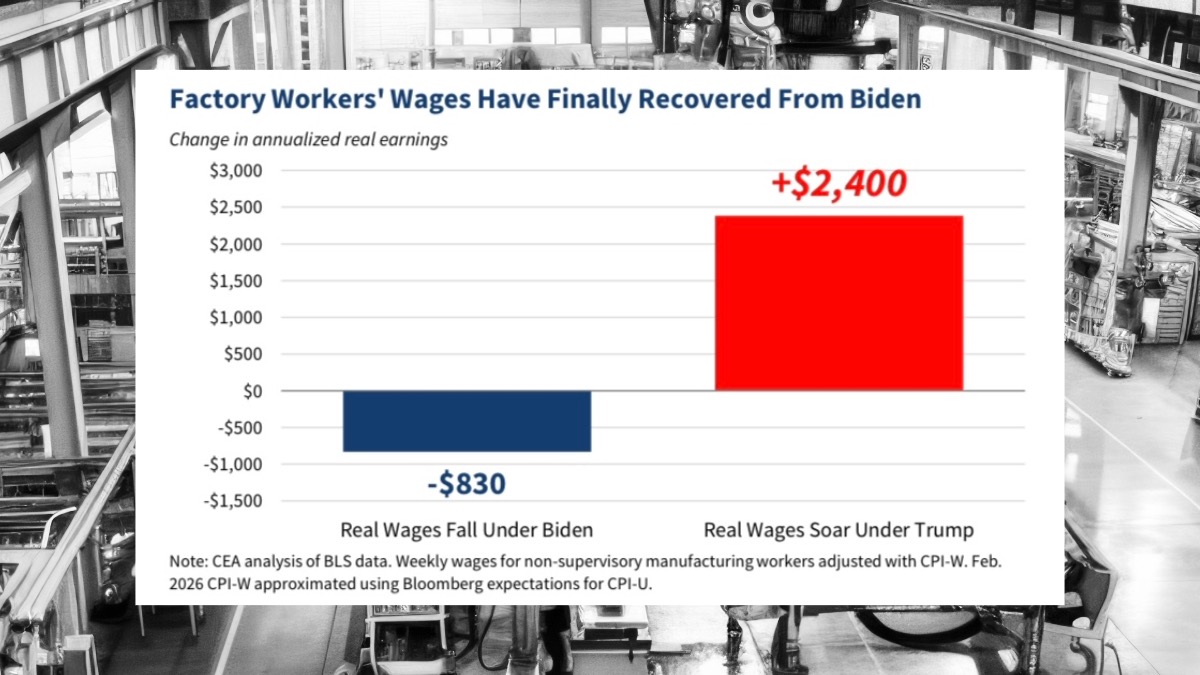
After years of decline under Biden, real wages are rising again thanks to @POTUS! Manufacturing workers’ weekly earnings are up 5.1% year over year 🇺🇸
U.S. Department of Labor tweet media
English
152
109
471
20.8K
Michael Stumo retweetledi
Mel
Mel@Villgecrazylady·
How is it even remotely possible that a university which graduates about 1,800 students each semester with degrees in software engineering needs to look outside our country for a software engineer?
Chris Brunet@chrisbrunet

Arizona State University (@ASU) just posted a notice of intent to hire a H-1B software engineer Salary: $107,100 No American software engineer in Arizona was qualified for this job.

English
583
4.4K
22K
535.2K
Michael Stumo retweetledi
U.S. Department of Education
Parents are the best educators. Literacy starts at home!
U.S. Department of Education tweet media
English
319
2.2K
13.8K
648.9K
Michael Stumo retweetledi
Brendan Carr
Brendan Carr@BrendanCarrFCC·
Americans get frustrated when they call a U.S. business and end up speaking with someone at a call center located in a foreign country. Language & communications barriers only make it harder for callers to get the results they want. So the FCC is seeking comment on several ideas that could help, including ✅ Facilitating the onshoring of foreign call centers ✅ Requiring operators at call centers to be proficient in American Standard English ✅ Further cracking down on illegal robocalls from abroad through the use of targeted tariffs or bonds. The FCC’s proposals focus on the call centers run by the communications providers regulated by the FCC. And could represent steps for the government to build on more broadly.
Brendan Carr tweet media
English
2.7K
4.8K
22.1K
1M
Michael Stumo retweetledi
Peter Navarro
Peter Navarro@RealPNavarro·
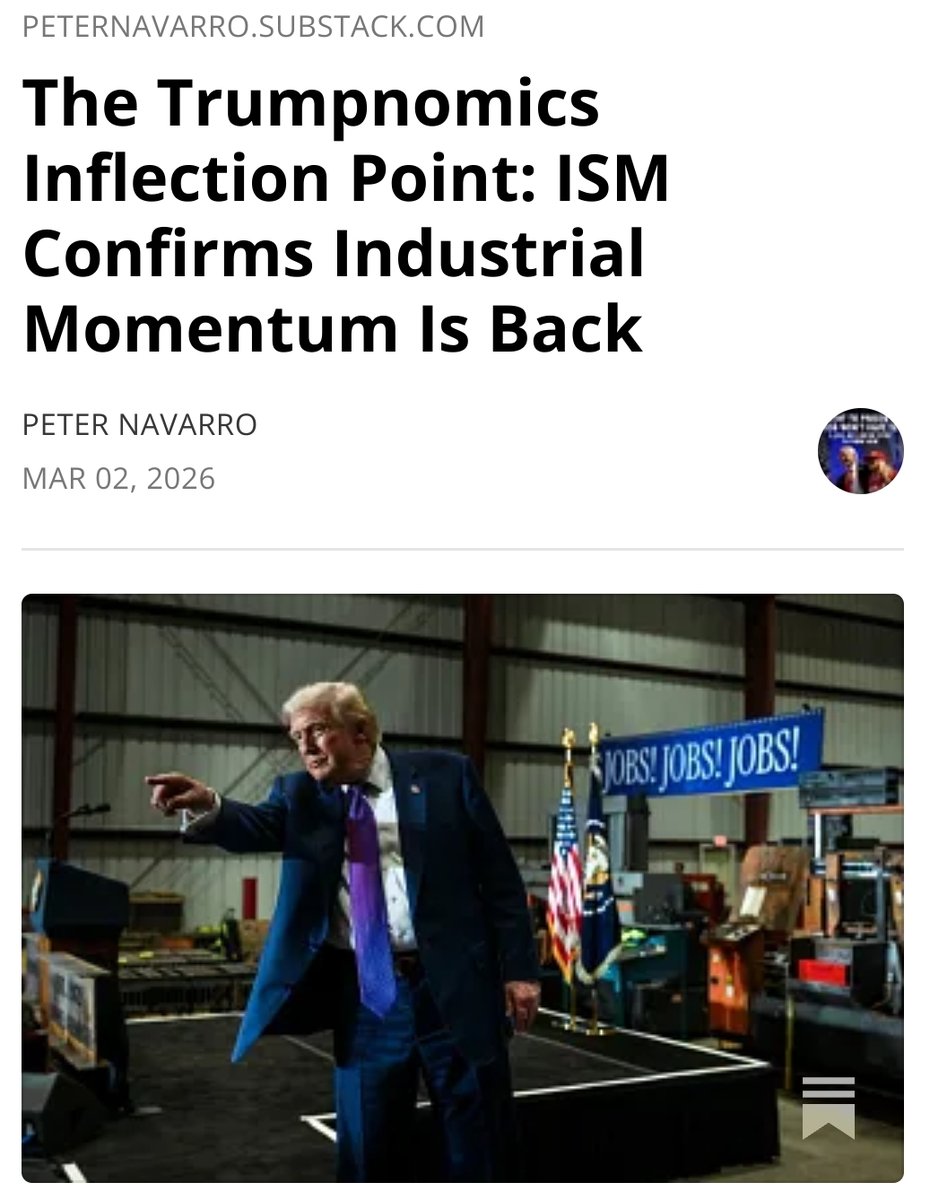
🚨For the 2nd straight month, the ISM Manufacturing Index registered above the magic 50 threshold signaling EXPANSION. 🏭President Trump's policy shift is propelling a REBIRTH of American manufacturing. Read my new piece here.👇 peternavarro.substack.com/p/the-trumpnom…
Peter Navarro tweet media
English
12
88
258
6.5K