Commonplace

1.9K posts

Commonplace banner
Commonplace

Commonplace

@commonplc

A magazine about what matters in America, from @AmerCompass. https://t.co/fKDQQ2Uayg

Washington, DC Katılım Şubat 2024
444 Takip Edilen4.2K Takipçiler
Sabitlenmiş Tweet
Commonplace
Commonplace@commonplc·
"There is a vulnerability at the heart of the U.S. economy so profound that it imperils our national sovereignty, and most Americans have no idea that it exists. "The public is well aware of China’s manufacturing dominance, which exceeds that of the United States, Europe, and Japan combined. The scale is alarming, yet it is not the real danger. The deeper, more insidious vulnerability is that China has secured control over a narrow set of manufacturing chokepoints that the entire U.S. industrial base relies on to function. "Economies are complex systems, and complex systems fail at their bottlenecks. This is what systems theorists call a reverse salient—a critical, rate-limiting node that constrains what the larger system can produce. A system can often absorb the loss of non-critical parts, but the loss of essential hubs creates cascading failure across the entire network. "Critical minerals are the most consequential reverse salient in the American economy today, underpinning nearly every essential industrial process. China does not merely dominate these sectors; in many instances, it maintains near-total control. "For years, Washington viewed the decline of domestic industrial capacity as an unfortunate but acceptable byproduct of globalization. The prevailing logic was rooted in the principle of comparative advantage: If another nation could produce an input more cheaply, the United States was better served by importing it and focusing capital on higher-value activities. But this framework implicitly assumed that all market participants were optimizing for economic return. Beijing was optimizing for control. "America looked at industries and asked how profitable they were. China asked how important they were. Where Washington saw dirty, low-margin, old-economy businesses, Beijing saw strategic chokepoints that would grant leverage over vast downstream sectors." @michaeljmcnair explains China's Chokehold on American supply chains.
Commonplace tweet media
English
2
4
9
2K
Commonplace
Commonplace@commonplc·
"The same playbook the Trump administration is applying to critical minerals will likely be replicated across these other sectors: identify the bottleneck, accelerate permitting, use federal financing to catalyze private capital, coordinate demand, and work with trusted allies to create durable, non-Chinese supply chains. "For now, the United States remains closer to the starting line than the finish line. But the strategic shift is real. Washington has begun to understand that the strength of an economy is not determined only by its most advanced industries, but also by its weakest links." @michaeljmcnair makes the case that China has a chokehold on America's economy, and argues that the Trump administration's response to the critical minerals crisis may be a pattern worth replicating.
Commonplace tweet media
English
1
3
5
1.9K
Commonplace
Commonplace@commonplc·
"There is a vulnerability at the heart of the U.S. economy so profound that it imperils our national sovereignty, and most Americans have no idea that it exists. "The public is well aware of China’s manufacturing dominance, which exceeds that of the United States, Europe, and Japan combined. The scale is alarming, yet it is not the real danger. The deeper, more insidious vulnerability is that China has secured control over a narrow set of manufacturing chokepoints that the entire U.S. industrial base relies on to function. "Economies are complex systems, and complex systems fail at their bottlenecks. This is what systems theorists call a reverse salient—a critical, rate-limiting node that constrains what the larger system can produce. A system can often absorb the loss of non-critical parts, but the loss of essential hubs creates cascading failure across the entire network. "Critical minerals are the most consequential reverse salient in the American economy today, underpinning nearly every essential industrial process. China does not merely dominate these sectors; in many instances, it maintains near-total control. "For years, Washington viewed the decline of domestic industrial capacity as an unfortunate but acceptable byproduct of globalization. The prevailing logic was rooted in the principle of comparative advantage: If another nation could produce an input more cheaply, the United States was better served by importing it and focusing capital on higher-value activities. But this framework implicitly assumed that all market participants were optimizing for economic return. Beijing was optimizing for control. "America looked at industries and asked how profitable they were. China asked how important they were. Where Washington saw dirty, low-margin, old-economy businesses, Beijing saw strategic chokepoints that would grant leverage over vast downstream sectors." @michaeljmcnair explains China's Chokehold on American supply chains.
Commonplace tweet media
English
2
4
9
2K
Commonplace retweetledi
Daniel Kishi
Daniel Kishi@DanielMKishi·
In this week's Understanding America, I ask: Are Immigrants Filling Jobs America Wouldn't Need? @commonplc A new paper by Daron Acemoglu, David Autor, and coauthors on how demographics affect growth finds that a shrinking pool of young workers lifted output per worker, because scarce labor induces productivity. The mechanism should inform our immigration policy. commonplace.org/p/are-immigran…
English
2
6
18
3.1K
Commonplace retweetledi
Michael McNair
Michael McNair@michaeljmcnair·
“There is a vulnerability at the heart of the U.S. economy so profound it imperils our national sovereignty, and most Americans have no idea it exists. The public is well aware of China’s manufacturing dominance. The scale is alarming, yet it is not the real danger. The deeper, more insidious vulnerability is that China has secured control over a narrow set of manufacturing chokepoints that the entire U.S. industrial base relies on to function.” My latest report for @commonplc breaks down the mechanics of this leverage and the national security logic behind US industrial policy: open.substack.com/pub/commonplac…
English
11
30
160
24.9K
Commonplace retweetledi
Matt Mehan
Matt Mehan@MTMehan·
He = Aristotle. A great conversation with @Chris_Griz and @oren_cass on citizenship, corruption, and the education of leading citizens (about which we only scratched the surface!)...
Matt Mehan tweet media
English
1
2
9
1.1K
Commonplace retweetledi
Drew Holden
Drew Holden@DrewHolden360·
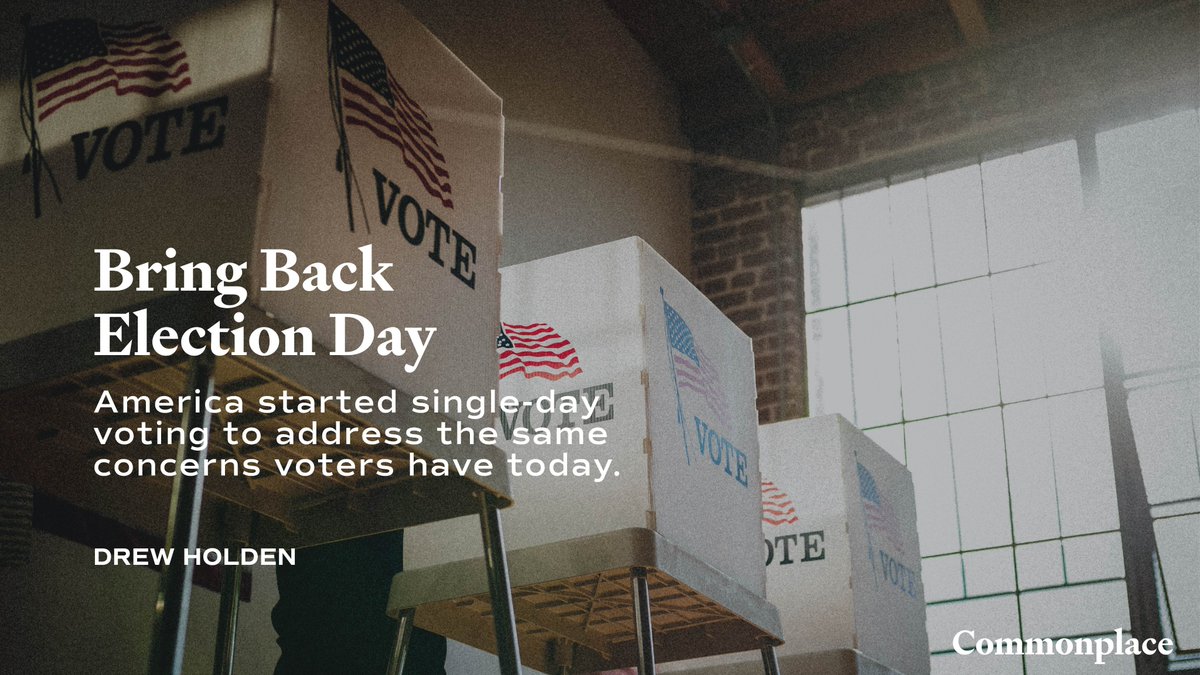
"If this suggestion [to restore Election Day] feels radical, it’s worth asking why so many of these alternatives to regular voting exist in the first place. With COVID over, why do states still mail out ballots to everyone? Why don’t you need an ID of some kind to vote, when you do need one to enter a bar or buy cough syrup? Why do we allow early voting to begin with, given everything a voter can learn about a candidate in the months before Election Day?" From my latest, in @commonplc, on why we should Bring Back Election Day.
Drew Holden tweet media
English
2
15
52
3.8K
Commonplace retweetledi
Commonplace
Commonplace@commonplc·
"If this suggestion [to bring back Election Day] feels radical, it’s worth asking why so many of these alternatives to regular voting exist in the first place. With COVID over, why do states still mail out ballots to everyone? Why don’t you need an ID of some kind to vote, when you do need one to enter a bar or buy cough syrup? Why do we allow early voting to begin with, given everything a voter can learn about a candidate in the months before Election Day?" @DrewHolden360 argues for the return of a real Election Day.
Commonplace tweet media
English
1
0
1
364
Commonplace retweetledi
Oren Cass
Oren Cass@oren_cass·
I wrote about this @commonplc: premise of Obamacare is to insure highest cost patients by imposing a huge tax on middle-class households in the form of sky-high premiums far above value they get from their insurance. This only works until people catch on. commonplace.org/p/oren-cass-ho…
English
12
15
114
14.3K
Commonplace retweetledi
Drew Holden
Drew Holden@DrewHolden360·
"The erosion of Election Day voting has created an untenable system. "Take, for example, this year’s California primaries. It took a full week to determine the outcome in the governor’s race; in fact, as of early July, numerous counties still haven’t reported their official results. California now provides mail-in ballots for all residents—which can be accepted up to a week after Election Day—and rather than backing off following the pandemic the state has layered on additional levels of bureaucracy. "For some perspective, many less-developed countries are able to count votes far faster. Colombia held its presidential election on Sunday, June 21; 99% of the vote had been counted by the next morning. "That California, a state with the GDP of Japan, takes multiple weeks to count votes will naturally give rise to the same types of concerns that motivated Congress in 1845. No amount of finger-wagging about the low rate of voter fraud convictions will cause ordinary Americans to look the other way when a country like Colombia counts votes in a matter of hours while California takes a month." Me on the dangers of the appearance of voting irregularities, in @commonplc.
Drew Holden tweet media
English
1
11
25
3.9K
Commonplace
Commonplace@commonplc·
"The recent shift away from in-person voting feels dramatic to the electorate because it is. As late as 1996, about 90% of voters cast their ballots in-person on Election Day. Since then, individual states have slowly chipped away at electoral safeguards, undermining both the institution and public faith therein: making it easier for voters to get an absentee ballot; loosening rules about how those ballots are submitted; extending timelines for when ballots could be accepted; and more. "The COVID-19 pandemic broke voting open. Nearly a year after '15 Days to Slow the Spread,' nine states and the District of Columbia mailed absentee ballots to all registered voters regardless of whether or not they requested one; 11 states eliminated the need for an excuse to vote absentee; and 18 states (plus D.C.) allowed votes to be counted even if they were received after Election Day. Those legal changes shifted the way Americans cast their ballots, making mail-in voting the most popular method in 2020. "In most cases, these 'temporary,' lockdown-induced fixes—meant to allow voters to safely get to the polls during a pandemic—have remained on the books in the years since it ended. "In the wake of COVID, the continuation of these efforts were promoted as 'voter rights,' and efforts to sunset them derided as 'voter suppression,' as if the ability to choose the nation’s leaders without putting on your shoes was God-given. Opposing an ever-easier path to voting was branded 'Jim Crow 2.0' by Democrats and the legacy media, allegedly meant only to stop black voters." @DrewHolden360 explores why Americans have lost trust in our election system, and why reviving Election Day as a day of national obligation might restore trust.
Commonplace tweet media
English
1
4
15
2K
Commonplace
Commonplace@commonplc·
"Regardless of how much fraud or abuse can be proven, the truth is that the mere appearance of foul play constitutes a national crisis, one that could prove disastrous if not remedied. Luckily, there’s a simple—and historically grounded—answer to this problem: restoring Election Day to its original understanding." @DrewHolden360 explains how a return to single-day voting could restore faith in elections.
Commonplace tweet media
English
1
3
9
2.2K