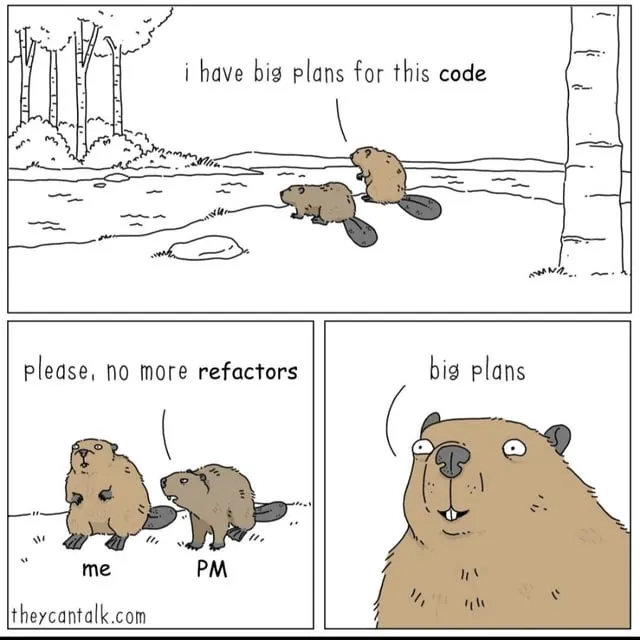
The thing that should be on top of everyone's mind right now, based on the Bun port to Rust, is that you can put that same amount of effort into *refactoring and fixing your existing architecture*. Things that were previously far too dangerous or invasive, that would've taken months of effort for teams, can be done in days.
You can say the code it generated was "slop" - which, okay, fine. It's slop. Guess what? We can improve on that foundation at the same rate. The refactoring rate is off the charts. Build comprehensive UAT, so that the product doesn't regress - which you can build and maintain now, because the rate at which you can produce it has increased so dramatically. You would never have built it with humans, because it would have ground your velocity to a halt, and everyone would've hated living under its yolk.
But now? All those engineering instincts about how the system could be better, if only you could refactor it with what you know now? It's days of effort.
Of course in order to actually work that way, you have to *also* give up the fact that you understand the architecture through understanding every line of code. If you have a team who understood the code base in one shape, then they wake up tomorrow and it's a new shape, that's a brand new kind of trust and alignment problem. Of course your agents understand it, because they will ingest all that context anyway.
This is how Swamp ships bug fixes on average within 4 hours of them being reported. A new version of swamp ships 7 times a day, on average. The rate of improvement is the highest I've ever experienced.
We haven't given up on engineering discipline. We've moved it from working on the software we produce (swamp) to working on the machine that produces it. We understand deeply how swamp works. We evolve it over time. The code is an artifact of that understanding, rather than the other way round.
@joelhooks Sol has been worse than fable at this for me, sometimes failing to actually send the stuff it typed into the other harness , etc. might need some better skills or something - have you done much tweaking ?
@michaelvessia multicursor was just the vehicle for *Atoms*.
i personally don't care about multicursor (though it will be nice to have live-update of visual-block edits).
Neovim multicursor (local branch 😇) is in a "mergeable" state now (but you can see some bugs in this demo :D)
This will quite literally be a killer feature: Vim will have no choice but to copy it (like :terminal and jobs).
No changes needed from any plugin; everything Just Works, including "surround" plugins. Visual-mode and completion were the trickiest parts...
The architecture is the Right Way: all user input is structured as Atoms. Plugins can subscribe to Atoms and react to literally any user action.
@mattpocockuk Built this internally with effect cli, the two concepts I added over the skills spec are Dependencies (both other skills and expected CLIs/mcps etc) as well as Packs (install N related skills at once to more easily satisfy dependencies). Skill catalog is validated at compile time
I think I need to ship my own installation CLI for my skills. It means I could:
- Ship skills more customized to individual agents (/claude-handoff, /codex-handoff)
- Track dependencies (/grilling must be installed if /wayfinder is, for instance)
- Improve the update story for skills you've messed with (provide a prompt to grab the latest skills)
npx @ai-hero/skills init
WDYT?
@wyatt_sg When the good people of our industry realize they need to instrument their apps with otel, and that doing so is quite painful, Effect will be there waiting to embrace them
@devinjameson Things being in the training data is overrated imo, if the tool lends itself well to back-pressure and you can point the agent towards examples or the source itself, i've found they do quite well.
@iximiuz Similar vertical tab and both have their own cli etc but the main difference is it's a multiplexer so you don't need to run tmux directly, can connect remotely , sessions persist on laptop close etc. Can keep using iterm if you want. But cmux is awesome too
Turbulent times! I haven't changed my toolset in a decade, and the past 12 months have already forced me to make a bunch of transitions:
Vim → VS Code → Cursor → Claude Code and Zed
Sublime Text → Obsidian for notes and Zed for editing
iTerm2 → cmux (literally today)
amp orbs might seem like any other cloud environment thing but a key difference is you can use ur chatgpt sub with amp orbs but can't with cursor cloud or devin
@ericclemmons You can rename them - I've actually gotten into the habit of having the agent control herdr via skills, so it can name things automatically!
Going to give herdr another go.
The blocker last time was it didn’t set the tab title to what OpenCode/claude emitted, so I’d have 12 tabs that all said “OpenCode”
But the persistence and durability is too good
@Vedankt@onehappyfellow I wound up taking abstract algebra before linear algebra for some scheduling reasons. Had to get prereq waived by the dept. Wound up being just fine , maybe this was why
@onehappyfellow I remember my ta in group theory asking me not to view everything from a linear or matrix algebra angle to understand stuff easier bc I would regret it later on
@TheNoahHein i lucked out, i thought i wasted my best years on rs/wow lol. maybe cope but i do attribute my ability to outgrind pretty much everyone to the absurd hours i put into runescape
who knew that thousands of hours of ruenscape and dota2, paired with a devrel career, prepared me for the never-ending context switching that AI is demanding of knowledge workers.
Play grindy and competitive videogames kids 👍👍👍