
Mimar Aslan

5K posts

Mimar Aslan banner
Mimar Aslan

Mimar Aslan

@mimaraslan

@TurkeyJUG Leader, @OracleACE Pro, @JakartaEE Ambassador, JCP Contributor, Generative AI Project Manager, Java Software (Trainer, Author), MSc Computer Engineer

🇹🇷 Türkiye, İstanbul Katılım Mayıs 2010
390 Takip Edilen4.2K Takipçiler
Sabitlenmiş Tweet
Mimar Aslan
Mimar Aslan@mimaraslan·
I have been selected again by Oracle as OracleACE Pro in Java. ❤️ 🏆🥇 2023 🏆🥇 2024 🏆🥇 2025 Thanks Oracle #Java #Oracle #OracleACE #OracleACEPro #MimarAslan #TurkeyJUG #TürkiyeJUG
Oracle ACE Program@oracleace

🚀 The 2025/2026 #OracleACE Program members are here! ♠️ Big congrats to all the new and returning leaders helping shape the Oracle community. 🎉 See the full list 👉 social.ora.cl/60174jPu1 👏✨

English
1
1
5
1.1K
Mimar Aslan retweetledi
Oracle ACE Program
Oracle ACE Program@oracleace·
📅 Voxxed Days Zürich 2026 — March 24 🇨🇭 Several #OracleACE speakers will be on the agenda—come learn from their sessions, ask questions, and network with fellow software professionals 🤝💡 Voxxed Days Zürich brings developers together to dive into the most important topics in our industry with expert speakers and great hallway conversations. social.ora.cl/6010hvXJa #OracleACE
Oracle ACE Program tweet media
English
0
2
7
181
Mimar Aslan retweetledi
Venkat Subramaniam
Venkat Subramaniam@venkat_s·
The CFP for @dev2next 2026 closes in about a month. The amazing program committee has been reviewing proposals as they come in. Are your talks in? I invite you to submit here: dev2next.com/cfp
English
0
4
4
1.4K
Mimar Aslan retweetledi
Josh Long
Josh Long@starbuxman·
only through the magic of a great show like JavaOne could I get to sit down with legendary Java author Cay Horstmann podbean.com/ew/pb-w4k7i-1a…
English
0
6
22
2.1K
Mimar Aslan retweetledi
💻☕ Richard Fichtner
💻☕ Richard Fichtner@RichardFichtner·
Day 2 at JavaOne: What I didn’t expect was how consistent the message of the day would be. In one of the sessions, “Just-In-Time Compilation for Java Performance: Recent and Ongoing Improvements,” Roberto Castañeda Lozano walked us through what has changed in the JVM. Not over the last decade. Just from Java 21 to 26. And that alone was enough to make me pause. He showed how much effort is going into the JIT compiler. How the JVM is getting better at understanding our code, optimizing it, removing allocations, and using modern CPUs more effectively. Even fundamental things like subtype checks are being reworked, leading to real-world gains—Netflix is seeing up to 3.5x improvements in certain scenarios. What makes this different is not a single breakthrough. It’s the accumulation. Each release adds something small. A better optimization here, less overhead there, smarter decisions in the runtime. None of it feels dramatic on its own. But together, over time, it compounds into something significant. Sitting there, you start to realize that the system gets faster not because we rewrite everything, but because the platform keeps moving forward underneath us. Java rewards patience. Later that day, Brian Goetz took the stage and told a story from his college days. He struggled with writing an essay and, after receiving a bad grade, argued that writing was hard. His professor responded: “Writing is not hard; thinking is hard.” That line reframes what we’re seeing. If the platform keeps improving performance for us, and tools increasingly help us write code faster, then the real leverage shifts. Not into syntax. Not into micro-optimizations. But into how we think about problems, systems, and decisions. And this is where it connects to a broader theme. Java doesn’t chase hype cycles. It evolves. Quietly, steadily, and with a focus on long-term stability. That can make it easy to underestimate. Especially if your mental model is stuck a few versions behind. But days like this make it clear: if you stay with the platform, it keeps paying you back. Before you optimize your code, try upgrading to Java 26 and measure first. There’s a good chance the JVM already did the work for you.
💻☕ Richard Fichtner tweet media
English
2
12
40
1.7K
Mimar Aslan retweetledi
Dan Vega
Dan Vega@therealdanvega·
JDK 26 is preparing to make `final` actually mean final. No more sneaky reflection hacks. Here's what you need to know about this change and why it matters. youtu.be/j-y0m6j6TBc
YouTube video
YouTube
English
2
16
118
7.6K
Mimar Aslan retweetledi
Bruno Souza
Bruno Souza@brjavaman·
"Microsoft runs on Java. We have over 2.5 million JVMs in production across Microsoft" @JavaOne keynote!!!
Bruno Souza tweet media
English
11
113
987
145.1K
Mimar Aslan retweetledi
Raphael De Lio
Raphael De Lio@RaphaelDeLio·
Yesterday, @bsbodden and I delivered our Designing Multi Agent Systems with Spring AI hands-on lab at JavaOne in San Francisco. More than 35 people showed up and it was the lab with most registrations of the day. 🙏🙌☕️
Raphael De Lio tweet media
English
1
5
22
981
Mimar Aslan retweetledi
💻☕ Richard Fichtner
💻☕ Richard Fichtner@RichardFichtner·
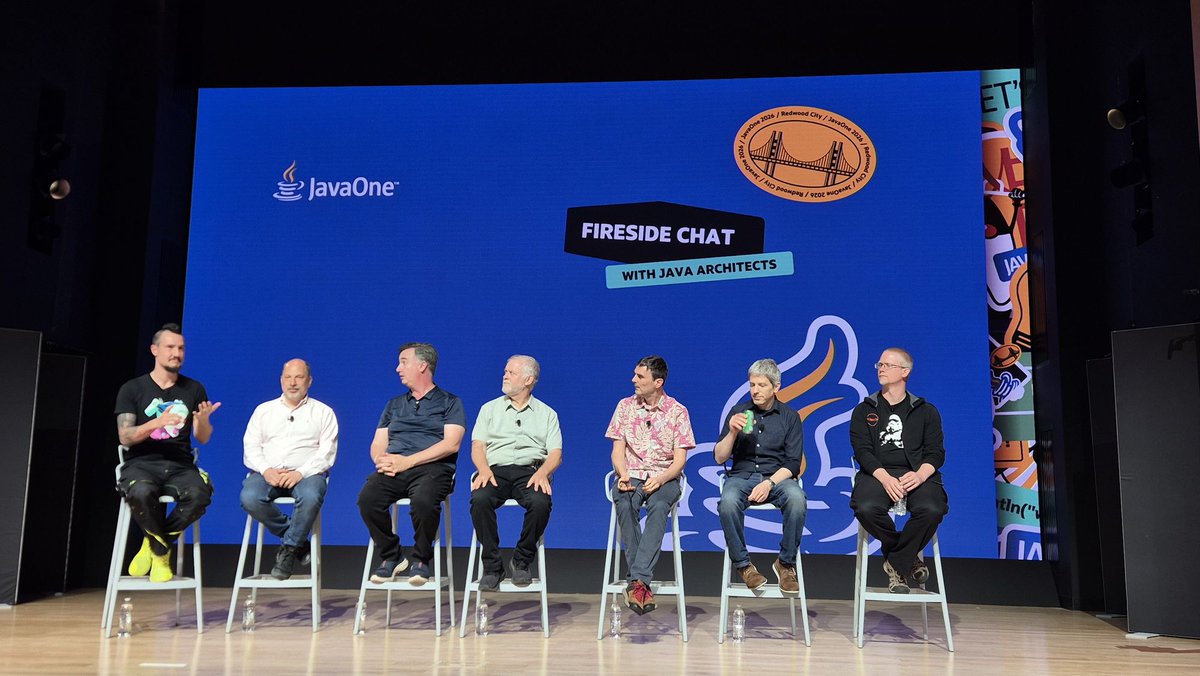
“Lombok is like cocaine. At first, it feels awesome, but after a while, you regret your choices.” I heard that quote at JavaOne last year. It made me laugh back then. Today, during the fireside chat with the Java architects, it came back to me. Brian Goetz, Ron Pressler, John Rose, Alex Buckley, Dan Heidinga, and Paul Sandoz were answering questions directly from the audience. I got the impression that these discussions are not about quick wins. They’re about long-term impact. One Topic was: Java Modules Why aren’t they widely used? The answer was refreshingly honest: Adoption is hard because the surrounding ecosystem isn’t where it needs to be—especially build tools. And that led to the obvious follow-up: Why doesn’t Oracle just ship a build tool with the JDK? The answer, implicitly, was just as interesting: Because their time is better spent on things only they can do. The JDK, the runtime, the language—those are areas where no one else can step in. Build tools? That’s something the community can own. Another Topic was: Streams and performance. There’s often this perception that Streams are “slow.” But the nuance matters: The performance gap shows up in specific edge cases—not in everyday code. And the design choice behind Streams was very intentional: Favor code that developers can read, understand, and maintain. For most applications, that’s the bigger win. What’s interesting is where things might go next. With Project Babylon, there’s a path to optimize these patterns further—without forcing developers to rewrite everything. Write clear code today. Let the platform get smarter underneath you over time. ...And then there’s Lombok. That quote from last year still holds up because it captures a tension many teams feel. Lombok helped fill gaps in the language. But it does so by stepping outside of it. Now that Java itself is evolving—records, pattern matching, and more—the need for those workarounds is shrinking. What stayed with me most today wasn’t a single feature. It was the way these architects think. They’re not optimizing for the next release cycle. They’re thinking in decades. We’re in good hands. #JavaOne
💻☕ Richard Fichtner tweet media
English
8
38
186
15.9K
Mimar Aslan retweetledi
Java
Java@java·
Java is hitting the small screen! 🎥 At #JavaOne, we debuted the first trailer for the upcoming Java documentary from the team at @CultRepo. Take a peek, and mark your calendar for this summer for the full feature. 📆 social.ora.cl/6014B6nc8n
English
4
34
122
11K