Mike Blank 🐲

4.7K posts

Mike Blank 🐲 banner
Mike Blank 🐲

Mike Blank 🐲

@mishablank

CPO at R3. Personal opinions only. Not financial advise, DYOR. Retweets & likes are not endorsements.

Poland Katılım Mayıs 2007
5.3K Takip Edilen826 Takipçiler
Haseeb >|<
Haseeb >|<@hosseeb·
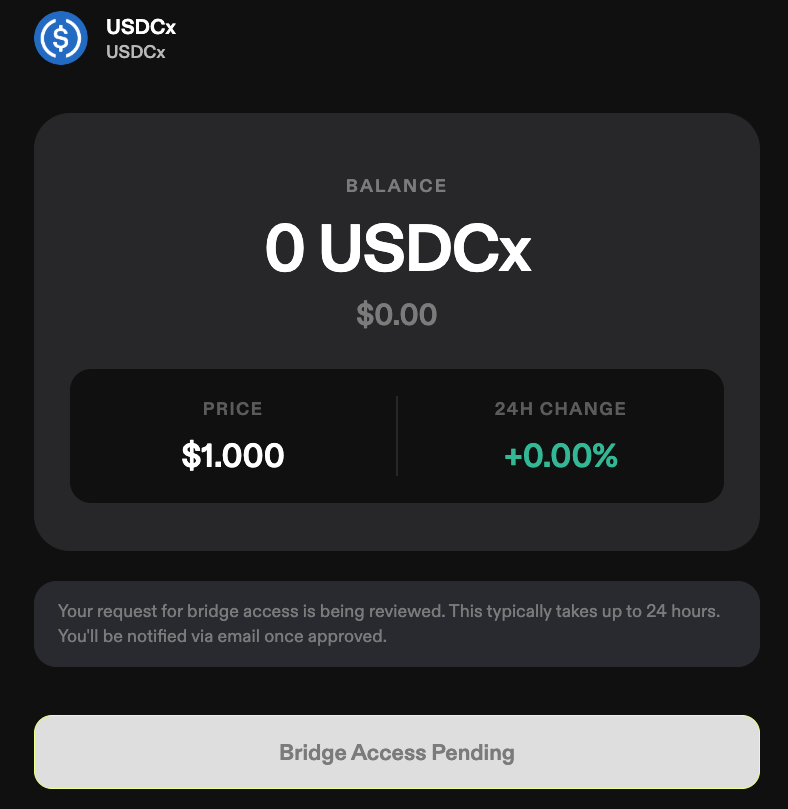
TIL: If you want to bridge USDC into Canton via @canton_loop wallet you need to apply for permission. There's a 24 hour approval SLA to know whether or not you are allowed to bridge. It's a non-custodial wallet... they don't know anything about me besides my email.
Haseeb >|< tweet media
English
32
1
102
23.9K
@·
The next major feature upgrade to @PhoenixTrade will finally leverage @solana DeFi's greatest asset: spot liquidity. Traders will soon be able to post SOL and other tokens as collateral for their positions. A few caveats before I dive in: - I hate announcing things before they ship. Talk is cheap, and execution is hard. And nobody cares that the execution is hard. - Phoenix is not the fully on-chain perps venue to have spot collateral. This was one of the best features offered by Drift and Mango. As with everything we build, Phoenix's approach will never be a blind copy-paste of our predecessors. I'm excited about this feature for many reasons. 1. Solana users with SOL and other tokens but no USDC no longer need to sell their assets to deposit and trade on Phoenix. 2. Users and vaults who want to run long spot, short perp basis strategies no longer need to think about manually rebalancing. 3. Sophisticated users who trade both spot and perps can keep their capital on Phoenix and simultaneously trade spot while margining their perps positions. I'll write more about this in a future post. I think it's one of the coolest things that no other perps platform can do. And it is only possible because Phoenix is fully on-chain. There are 2 questions I get asked often that I often find challenging to answer: 1. Why does it matter that Phoenix is fully on-chain? 2. Why should I trade on Phoenix over [X]? Here is my definitive answer. Being on-chain gives Phoenix access to Solana's capital, users, and liquidity in a way no off-chain venue can. Most people think that Phoenix is the exchange and Solana is the infrastructure platform, but they have that backwards. Solana is a programmable exchange, and Phoenix is infrastructure that taps into everything Solana offers. You shouldn't trade on Phoenix; you should trade on Solana, because Solana will be the decentralized protocol that houses the world's financial assets. Phoenix is simply the best window into that on-chain future. This is how the composability thesis will finally play out, a couple of years late.
English
79
67
504
93.3K
Mike Blank 🐲
Mike Blank 🐲@mishablank·
@blknoiz06 $hype, $gram (waiting for the ecosystem relaunch), $vvv, and soon $corda
English
0
0
0
228
Ansem 🐂🀄️
Ansem 🐂🀄️@blknoiz06·
building my theses on core group of holdings for crypto next 6-12 months last cycle (2023) was pretty accurate on $SOL & $COIN as the two majors that you needed allocation towards & did well w/ memes like pepe/bonk/wif as onchain exposure what are everyone's top 5 positions
English
1.3K
213
3.1K
321.1K
@·
Interesting spike pattern on Aave around midnight. Probably someone exploiting some reward campaign I guess or wanting to pump numbers at each EoD Also interesting to see that the borrow rate was arbitraged between the two venues.
 tweet media
English
4
3
23
7.6K
@·
20 years married today Easily my best decision in life, taken early enough to get the proverbial compounding effect
 tweet media
English
180
9
1.7K
122.8K
Theo
Theo@Theo_Network·
StableEarn currently yields 13.35% APY on USDT deposits. In less than 2 months, it's grown to become the largest USDT vault outside of Ethereum Mainnet. Deposit today to earn. Link below.
Theo tweet media
English
33
13
136
23.2K
Ansem 🐂🀄️
Ansem 🐂🀄️@blknoiz06·
very rare circumstance where both retail and HNW crypto native capital is mostly sidelined retail sidelined bc of outperformance of ai stocks HNW crypto natives sidelined bc of 4 year cycle timing waiting for Q4 a *lot* of capital will chase quickly if coins rip here
English
385
188
2.2K
155.7K
@·
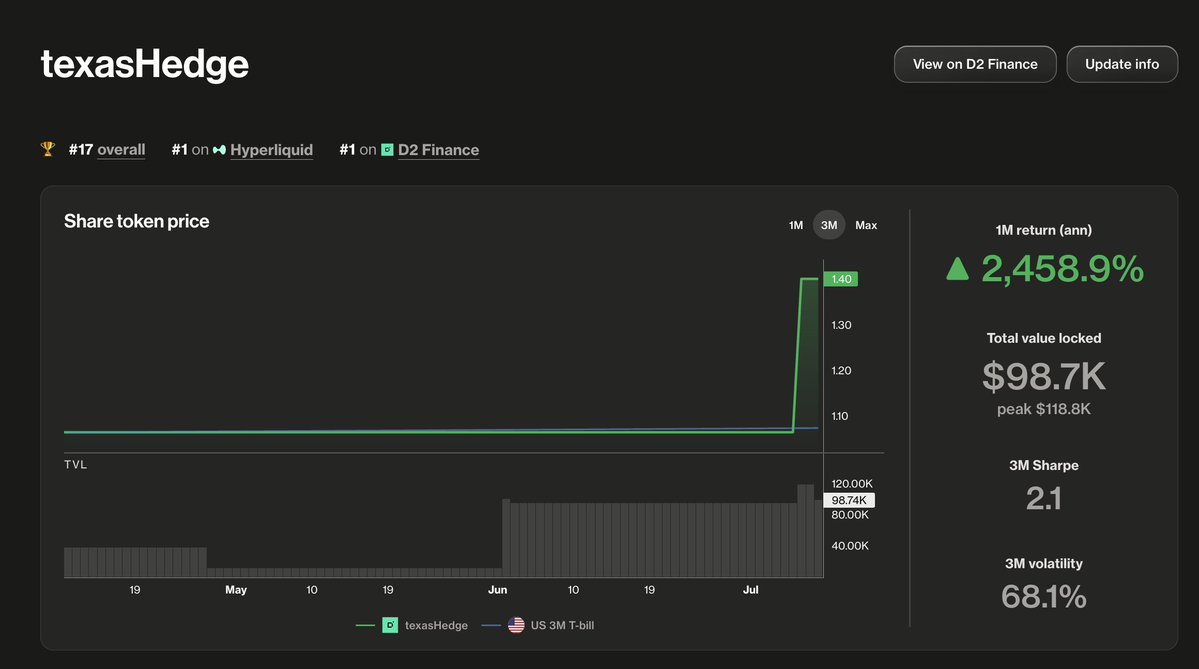
Looks like @D2_Finance strategies have broken our website again. A freshly launched texasHedge vault is a straight line up. And oh boy, it is a crazy. It's probably the first advanved tokenised trade on this planet: The vault is a high-risk, multi-leg directional strategy around SpaceX pre-IPO exposure and related market flows. It combines a financed SpaceX perpetual position with long S&P downside convexity and long Tesla/Mag-7 upside convexity, funded by selling DRAM upside convexity. Currently, this trade is going the traders' way. A lot. We had to adjust our chart library to draw the line. View the vault here tradingstrategy.ai/trading-view/v…
 tweet media
English
5
1
21
8.4K
@·
Spot adds value to issuers (perps don’t). Issuer density becomes a moat. Attracting issuers is incredibly hard and a huge amount of brain damage. It’s not a choice between spot and perps. We will have both at scale in due time.
English
13
7
98
11.3K
Mike Blank 🐲
Mike Blank 🐲@mishablank·
The RWA conference streak will soon start, and everyone will be recycling the same headlines – "$60B market," "$16T by 2030." But line up the actual reports from April-June 2026 from @BCG, @Citi, @StanChart, @PanteraCapital, @binance, @RWA_xyz, @keyrock, @Grayscale – and the numbers quietly refuse to agree. Strip away the definitional games and the gap isn't rounding error; it's whether stablecoins count, whether you're measuring issued or outstanding, whether "addressable" means anything at all. 👉rwaquiz.com 20 questions, drawn from every major report of the quarter. A few warm-ups: – How many products make up half the entire core tokenized market? – Of that ~$60B, how much can a US retail investor actually touch? – What share of the $300T+ addressable base has actually been tokenized? There's a timer & a streak counter. If you work in this market, you'll clear it: most of it is knowable. But if a few answers surprise you, that's the point. The confidence in the headlines isn't matched by the agreement underneath them. The link is not in the comments, it’s 👆there.
English
0
0
1
91
Mike Blank 🐲
Mike Blank 🐲@mishablank·
@sytaylor lol, how insurance program protects the users when the huge volatility in perps happen and the house loses to the gamblers?
English
0
0
0
103
Simon Taylor
Simon Taylor@sytaylor·
EXCLUSIVE: Robinhood is going to pay 7% on dollars to 27.7 million customers. In this Interview Johann Kerbrat, their SVP of Crypto explains how it all works. Robinhood Earn lives inside the main investing app. You can buy the USDG stablecoin in a few taps, and it gets deployed into vaults built with Morpho and Steakhouse, and the target yield is roughly 7%. Where does 7% come from? Market makers and liquidity providers pay it. These are traders who need USDG liquidity to run spot and perps trading. Your deposit is funding someone else's 50x leverage, and you're the one getting paid for it. Assuming you get paid back. Which, as we've seen, doesn't always work in DeFi with hacks and smart contract risk. But Robinhood has done something extra to make this retail-grade. Robinhood's answer is an insurance program with Lloyd's of London and Relm covering smart contract and vault failure. He says it's one of the largest ever built for a crypto product. Earn was one of 12 announcements; some others that caught my eye: Stock tokens in 120+ countries, backed 1:1 by real equities. You can withdraw them to a self-custody wallet and post them as collateral. Borrowing against a stock portfolio used to be a private banking perk; now it's a smart contract. Robinhood Chain went to public mainnet after 200 million transactions on testnet. Perps on stocks, crypto, and commodities at 20 to 50x leverage, bringing an entire new asset class to the mainstream. Robinhood is all in on DeFi. DeFi protocols spent a decade fighting for users. Robinhood just made a Morpho vault look like a savings account, in front of 27.7m funded customers. See the 15-minute highlights below and the full episode on the Tokenized Podcast youtube channel Full interview with Johann on @Tokenized YouTube
English
47
88
789
330.3K
Mike Blank 🐲
Mike Blank 🐲@mishablank·
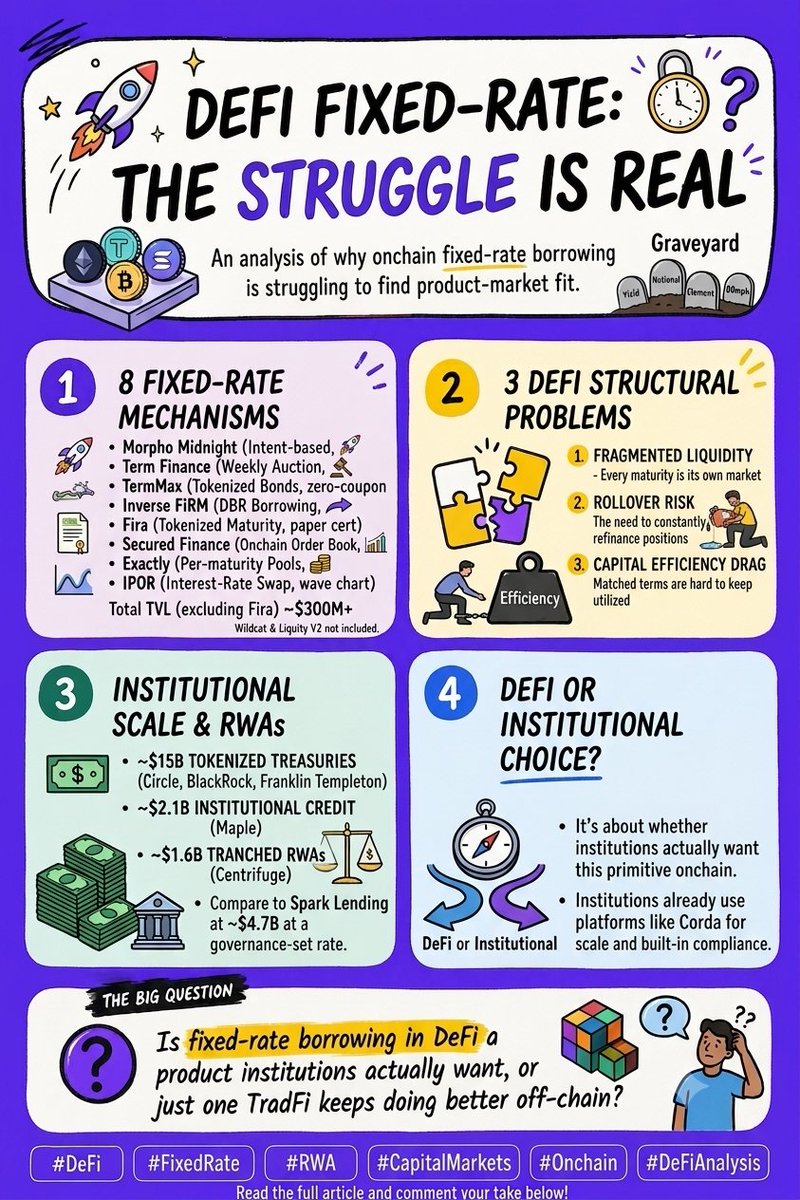
🚀 Fixed-rate borrowing in DeFi is still a niche – but the mechanisms (and the gap to institutional scale) are getting clearer. Just put together a side-by-side of the 10 protocols that let borrowers actually lock in a rate for a defined term: 1️⃣ @Morpho Midnight – intent-based matching (pre-mainnet) 2️⃣ @term_labs – weekly sealed-bid auctions 3️⃣ @TermMaxFi – tokenized zero-coupon bonds + AMM range orders 4️⃣ Inverse FiRM – DBR borrowing rights 5️⃣ Fira – tokenized fixed-maturity bonds 6️⃣ @Secured_Fi – onchain order book for zero-coupon bonds 7️⃣ @ExactlyProtocol – per-maturity fixed-rate pools 8️⃣ @ipor_io – interest-rate swap overlay 9️⃣ @WildcatFi – borrower-defined custom markets 🔟 @LiquityProtocol – borrower-set rate on BOLD Total TVL? A little more than $300mln (excluding Fira pumped by Usual). So why does fixed-rate keep struggling onchain? The same structural problems every time. >> Every maturity is its own market, so liquidity fragments. Someone has to refinance at maturity. Matched terms are harder to keep utilized than an always-on pool. Thin supply, soft demand, nothing bootstraps. The graveyard is real – Notional, Yield Protocol, Element/DELV, 88mph – and the survivors mostly pivoted away (Pendle to yield, IPOR to vaults). So DeFi-native fixed-rate borrowing is still a niche fighting three structural problems – fragmented liquidity, rollover risk, and capital-efficiency drag. Meanwhile, the institutional money didn't wait for the perfect primitive – they’re going to issue assets on such platforms like Corda by @inside_r3 that will scale distribution and where compliance & composability are built in from the beginning. ~$15B of tokenized Treasuries yielding ~3.3% (Circle, BlackRock, Franklin Templeton). Maple Finance. at ~$2.1B of institutional credit. Centrifuge at ~$1.6B of tranched real-world assets. Spark lending ~$4.7B – more than this entire list combined – at a governance-set rate. So the question isn't who ships the cleanest fixed-rate mechanism. It's whether onchain fixed-rate borrowing is a thing institutions actually want – or just one TradFi keeps doing better off-chain.
Mike Blank 🐲 tweet media
English
1
0
5
145
Defi Jonaso ❖
Defi Jonaso ❖@Jonasoeth·
Over the past few years, multi-chain has become the default growth strategy for DeFi. Protocols expand to new blockchains to reach more users, lower transaction costs, and improve accessibility. But scaling across more chains has also introduced a "Structural Problem" Every new deployment typically comes with another vault, another liquidity pool, another accounting system, and another protocol state. The result is familiar → Liquidity becomes fragmented. Instead of one large pool serving every user, the same product is split across multiple isolated deployments. Each chain gradually develops its own TVL, liquidity profile, and sometimes even different yields. In other words, DeFi has solved distribution. It hasn't fully solved liquidity. ⤷ That raises an interesting question: Does multi-chain really require multiple vaults? Or can multiple chains simply access the same vault? ------------------------------ The newly proposed sGHO cross-chain architecture by TokenLogic explores exactly that idea. Instead of deploying independent ERC-4626 vaults across every Layer 2, the proposal keeps a single canonical vault on Ethereum. This vault remains the protocol's only source of truth. It holds the assets, calculates exchange rates, generates the Aave Savings Rate, and maintains the accounting for every sGHO position regardless of where the user enters the system. Layer 2s no longer operate separate savings vaults. Instead, they become entry points into the same vault. That architectural decision changes how liquidity is organized. From a user's perspective, the experience becomes significantly simpler. ------------------------------ Imagine holding GHO on Arbitrum. Previously, using sGHO required bridging assets to Ethereum, depositing into the vault, minting sGHO, and often bridging the receipt token back again. Every step added friction. Under the new design, users simply deposit GHO directly on Arbitrum. If Fast Path liquidity is available, they receive sGHO almost immediately without ever touching Ethereum. Everything feels native to the Layer 2. Behind the scenes, however, settlement still happens through Ethereum. Deposited GHO is periodically bridged to the canonical ERC-4626 vault via CCIP. The vault mints new sGHO, and fresh liquidity is bridged back to the Layer 2 to replenish the Fast Path inventory. Users experience instant execution. The protocol maintains unified accounting. If Fast Path liquidity is temporarily exhausted, deposits automatically follow the Slow Path. Assets are bridged directly to Ethereum, settled through the canonical vault, new sGHO is minted, and the resulting tokens are returned to the destination chain. Settlement takes longer, but the architectural principle never changes. Every deposit is ultimately backed by the same vault. This is why the proposal repeatedly emphasizes two ideas: One Source of Truth and No Fragmentation. There isn't one savings rate for Ethereum and another for Arbitrum. There isn't separate accounting for every deployment. Regardless of which Layer 2 users interact with, every position ultimately shares the same liquidity pool and the same Aave Savings Rate because every asset settles through the same underlying vault. ------------------------------ To me, that's the real innovation. The proposal isn't simply making sGHO available on more chains. It's demonstrating that multi-chain products no longer need to replicate their liquidity infrastructure on every chain. User interactions can be distributed and Liquidity doesn't have to be. If this architecture proves successful, it could represent a broader direction for DeFi. The next phase of multi-chain may not be defined by more deployments. It may be defined by more access points connected to the same underlying liquidity.
Defi Jonaso ❖ tweet media
TokenLogic@Token_Logic

1/ $sGHO is going cross-chain. We've published an ARFC to bring the sGHO savings product to L2 networks, starting with Arbitrum, without fragmenting the vault or splitting the rate. One @aave savings rate, available everywhere. More below ↓

English
43
1
49
4.3K
hagaetc
hagaetc@hagaetc·
Many institutions are now wondering if trading is going to move onchain. The crypto industry itself might be a tell tale. Onchain DEX trading is now 25% of all trading of crypto assets. Up from practically 0 back when we started tracking this 8 years ago with @Dune
hagaetc tweet media
English
2
4
37
14.2K
@·
Sol is our new flagship and a step function better than GPT-5.5. Terra delivers performance competitive to GPT-5.5 at 2x lower cost. Luna is our most cost-efficient model, delivering strong capability at our lowest cost. Together, the GPT-5.6 family gives people and developers more choice in how they balance intelligence, speed, and cost.
 tweet media
English
232
380
5.2K
2.9M
@·
Introducing a limited preview of GPT-5.6 Sol, our next generation frontier model, as well as GPT-5.6 Terra, a balanced model for efficient, everyday work, and GPT-5.6 Luna, a fast and affordable model for high-volume work. openai.com/index/previewi…
English
3.6K
5.7K
40.8K
18.4M
Mike Blank 🐲
Mike Blank 🐲@mishablank·
@alive_ Yeah, credit card add amazing compliance layer that if definitely needed compared to stablecoins in non cust wallet)))
English
0
0
0
21
@·
"Agentic commerce" is not as interesting for crypto as people like to think. Credit cards actually work better than stablecoins for almost all kinds of agentic payments. They are reliable and universally accepted. And contrary to what most people think, they are also programmable, secure, and easy for agents to use on behalf of humans. The more interesting use cases of crypto will be the those that enable agent-to-agent coordination. AI agents will soon want to do more than just pay for things. They will want to enter into enforceable agreements with each other. For example, one agent might want to hire another for a specific job, but not want to pay until after the work is complete, and only if it meets certain criteria. At the same time, the agent doing the work might want some assurance that it's going to get paid when it finishes the job. This is the kind of problem that blockchains were born to solve. The agents can use a smart contract that holds the funds in escrow and releases them only once the work is completed. This approach works especially well when the quality of the agent's work can be verified programmatically by the smart contract, but it could be extended to other kinds of work by relying on a third party "judge"—which itself could be another agent. To make this concrete, imagine that you're an AI researcher using agents to train a new model. You might setup a @karpathy-style autoresearch loop where your agent runs many autonomous experiments on your LLM setup to discover improvements. Or better yet, your agent may want to delegate some of those experiments to a marketplace of other agents—some of which are specialized for LLM-optimization. The agents involved will not necessarily trust one another, and they cannot easily rely on legal contracts to enforce agreements. Smart contracts on blockchains can help coordinate this kind of activity by creating a neutral environment with rules that are programmatically enforced. Who is working on using crypto to enable agent-to-agent coordination?
English
121
20
351
54.7K
@·
either crypto is over forever or you're emotional
English
230
59
1.1K
71.4K