Miguel Miranda

5.7K posts

Miguel Miranda

Miguel Miranda

@mmuekk

Porto - Portugal Katılım Mart 2010
690 Takip Edilen166 Takipçiler
Miguel Miranda retweetledi
Maor Ai
Maor Ai@Maor_Elkarat·
Stop buying more VRAM. Everyone’s posting Qwen 3.6 configs running insanely fast on 12GB cards. But do you actually understand the flags making it possible? Weights are only half the story. KV cache is eating your VRAM alive. The secret isn’t just 4-bit weights it’s the KV cache sorcery everyone’s missing. Here’s the annotated command & real tricks explained: @elonmusk @grok #Ai
Maor Ai tweet media
English
23
93
1K
58.4K
Miguel Miranda retweetledi
Nav Toor
Nav Toor@heynavtoor·
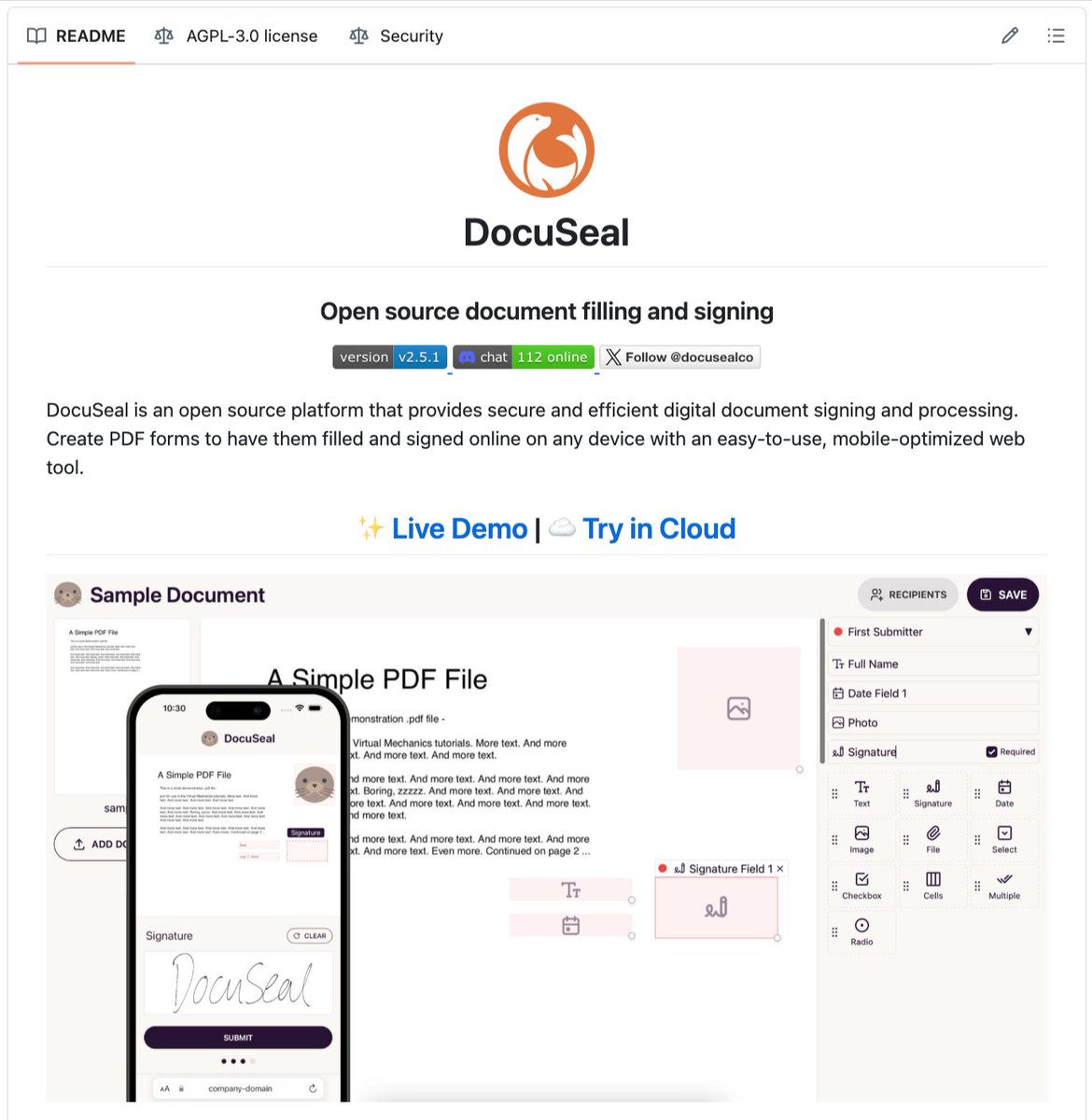
DocuSign Personal: $10 to $15 per month. DocuSign Standard: $25 to $45 per user per month. DocuSign Business Pro: $40 to $65 per user per month. A 10-person team on Business Pro pays $4,800 to $7,800 a year. To put signatures on PDFs. A team of 50 pays $24,000 to $39,000 a year. And there is a 100-envelopes-per-year cap on most plans. Send more contracts and you pay extra. Need SMS delivery? $0.40 per send. Need ID verification? $2.50 per attempt. Need premium support? $5,000 to $50,000 per year add-on. You are rationing digital signatures in 2026. DocuSign is a $10 billion company built entirely on this pricing model. Now meet DocuSeal. A free and open source alternative to DocuSign. Created in 2023 by a Ruby developer named Alex who was simply trying to sign one document and realised every solution online was overpriced or required a subscription. Three weeks later he had a working alternative. He pushed it to GitHub under the AGPL-3.0 license. Today it has 11,800+ stars and over 1,000 forks. Bootstrapped. No VCs. No paywalls. Here is what DocuSeal does: - Upload any PDF and turn it into a fillable, signable form - Drag and drop signature fields, dates, checkboxes, file uploads, and 13 field types - Send to multiple signers with custom signing order - Automated email reminders - Mobile signing on any device - PDF signature verification built in - Audit trail for every document - Bulk send and templates - Full API access - Self-host with one Docker command Here is what DocuSeal costs: Zero. Forever. Unlimited documents. Unlimited signers. Unlimited storage. DocuSign limits envelopes. DocuSeal doesn't. DocuSign charges per SMS. DocuSeal doesn't. DocuSign charges for ID checks. DocuSeal doesn't. DocuSign sees your contracts on their servers. DocuSeal doesn't. Here is the wildest part: The median DocuSign contract per Vendr is $17,250 per year. One Reddit thread has people saying "they want me to pay $4.80 per e-signature." Self-host DocuSeal on a $5 cloud server and a 50-person team can sign as many contracts as they want without paying a single dollar. Your contracts never leave your server. Your client lists. Your NDAs. Your employment agreements. None of it touches a third-party company. For individuals who only sign a few contracts a year, you save $180. For small teams of 10, you save up to $7,800 a year. For a 50-person company, you save up to $39,000 a year. Your documents. Your signatures. Your server. 100% Open Source. (Link in the comments)
Nav Toor tweet media
English
116
313
3K
637K
Miguel Miranda retweetledi
Ihtesham Ali
Ihtesham Ali@ihtesham2005·
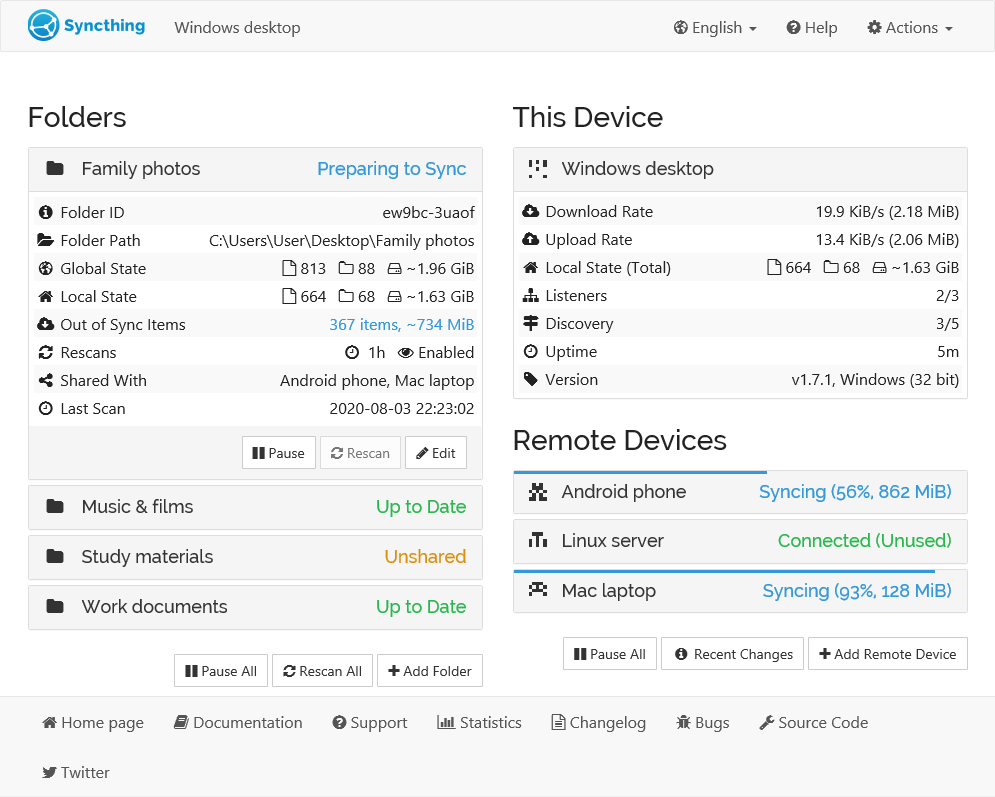
Say goodbye to Dropbox, iCloud, and OneDrive subscriptions. Someone open-sourced a sync tool that replaces all three for $0. And no company can shut it down. It's called Syncthing. Here's how it works: Every cloud storage company on earth routes your files through their own servers. That's not a technical requirement. That's a business model. Syncthing skips the server entirely. → Your devices connect directly to each other → Every transfer is TLS encrypted with perfect forward secrecy → Every device is authenticated by a cryptographic certificate → Nothing moves without your explicit permission → Works on Windows, macOS, Linux, Android, FreeBSD No account. No subscription. No company holding a copy of your files. Dropbox can raise prices. iCloud can change its terms. Google Drive can shut down tomorrow. Syncthing runs on your own machines. There's no server to breach. No company to pressure. No subscription to cancel. One install. Your devices. Your files. Your rules. 100% Opensource. syncthing.net
Ihtesham Ali tweet media
English
115
509
2.6K
184.6K
Miguel Miranda retweetledi
Michael Guo
Michael Guo@Michaelzsguo·
People are posting Qwen 3.6 configs that deliver fast TPS on as little as 12GB VRAM. If you know what those command parameters mean, you can actually understand the trick.
Michael Guo tweet media
English
31
178
1.7K
69.8K
Miguel Miranda retweetledi
AboveSpec
AboveSpec@above_spec·
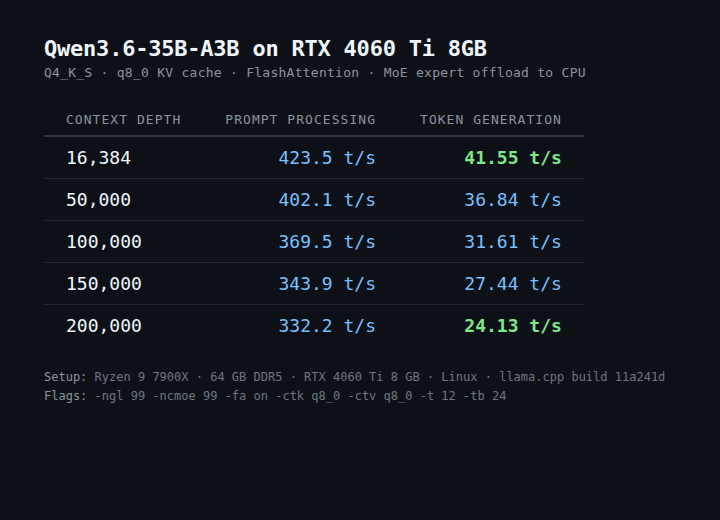
"You need a 24 GB GPU for serious local LLMs in 2026." Everyone repeats this. It's not true anymore. Just ran a 35B-parameter model on an RTX 4060 Ti 8 GB: • 41 tok/s at 16k context • 24 tok/s at 200k context Recipe + benchmarks below 🧵
AboveSpec tweet media
English
133
233
2.8K
270.4K
Miguel Miranda retweetledi
International Cyber Digest
International Cyber Digest@IntCyberDigest·
🚨 BREAKING: cPanel and WHM, the control panels behind an estimated 70+ million websites, have a critical security flaw that lets anyone become root admin without a password. CVE-2026-41940 affects every supported version. It’s already being exploited in the wild. watchTowr Labs published the full attack today, after the hosting company KnownHost confirmed the bug was already being used to break into a significant chunk of the internet. If you've never heard of cPanel: it's the dashboard that hosting providers and millions of website owners use to manage their servers, domains, email accounts, databases, and SSL certificates. WHM is the admin version that controls the entire server. If someone gets root access to WHM, they get the keys to the kingdom and to every apartment inside it. How the attack works, in plain English: 🔴 Step 1: The attacker sends a deliberately wrong login. cPanel still creates a temporary "you tried to log in" record on disk and gives the attacker a cookie tied to it. 🔴 Step 2: The attacker tweaks the cookie to disable cPanel's password encryption. Normally cPanel encrypts the password field on disk. With one small change to the cookie, cPanel just stores it as plain text instead. 🔴 Step 3: The attacker sends a fake login attempt where the password field secretly contains hidden line breaks. cPanel does not strip these line breaks out, so they get written straight to the session file. Each line break creates a brand new fake record. The attacker uses this to inject lines that say "this user is root" and "this user already authenticated successfully." 🔴 Step 4: The attacker visits one more random page on the site to nudge cPanel into re-reading the file. cPanel then promotes the injected fake lines into its main session memory. 🔴 Step 5: On the next request, cPanel sees a flag that says "this user already passed the password check." cPanel trusts that flag, skips checking the actual password, and lets the attacker in as root. From start to finish, the attack takes a handful of HTTP requests. If you run cPanel or WHM, the patched versions are: 🔴 cPanel/WHM 110.0.x → 11.110.0.97 🔴 cPanel/WHM 118.0.x → 11.118.0.63 🔴 cPanel/WHM 126.0.x → 11.126.0.54 🔴 cPanel/WHM 132.0.x → 11.132.0.29 🔴 cPanel/WHM 134.0.x → 11.134.0.20 🔴 cPanel/WHM 136.0.x → 11.136.0.5 If your version is older than these, assume someone has already broken in and act accordingly. Patch right now, then rotate every password and key the server touched: root passwords, API tokens, SSL private keys, SSH keys, mail passwords, and database passwords.
International Cyber Digest tweet mediaInternational Cyber Digest tweet media
English
103
787
3.9K
542.1K
Miguel Miranda retweetledi
Dark Web Informer
Dark Web Informer@DarkWebInformer·
‼️Copy Fail (CVE-2026-31431) is a Linux privilege escalation bug that lets any local user get root using a 732-byte Python script, and itworks on basically every major Linux distro shipped since 2017. Website: copy.fail Write-up: xint.io/blog/copy-fail… GitHub: github.com/theori-io/copy… It's a logic flaw in the kernel's crypto code (authencesn via AF_ALG and splice()) that allows a small write into the page cache, which can be used to tamper with a setuid binary like /usr/bin/su. Think how bad this is going to be for shared environments like Kubernetes, CI runners, and cloud sandboxes, where it enables container escape and tenant-to-host compromise. Found by Theori's Xint Code scanner, patched in the mainline kernel, and publicly disclosed on April 29, 2026; if you can't patch right away, the recommended workaround is to disable the algif_aead module.
English
57
829
3.3K
392.1K
Miguel Miranda retweetledi
Captain Insight
Captain Insight@CaptainInsightX·
Right now, billions of people are watching videos. Most of them are being processed by code one man wrote alone in 2000. 🤯 You’ve probably never heard his name. >Meet Fabrice Bellard. >A French programmer working solo >In 2000, built FFmpeg alone ~ the engine behind YouTube, Netflix, Spotify, WhatsApp, Instagram, TikTok, Chrome, Firefox, VLC, and Discord >NASA even runs FFmpeg on the Perseverance rover on Mars 🚀 >In 2003, built QEMU alone ~ the foundation of every Android emulator and most cloud virtualization on Earth >Wrote the Tiny C Compiler. Self-hosting. >One of the fastest C compilers ever built. >In 2009, broke the world record for calculating Pi ~ 2.7 trillion digits on a single desktop PC >Won the International Obfuscated C Code Contest 3 times >Discovered a new mathematical formula to calculate digits of Pi at age 25 >Co-founded Amarisoft in 2012 ~ runs full 4G/5G base stations entirely in software on a normal PC 🔥 >Won the Google-O’Reilly Open Source Award >Never worked at Google. Never worked at Meta. Never worked at any Big Tech company. One man. The hidden backbone of modern computing. Absolute Legend 🐐
Captain Insight tweet mediaCaptain Insight tweet media
English
88
815
3.8K
92.5K
Miguel Miranda retweetledi
Wiz
Wiz@wiz_io·
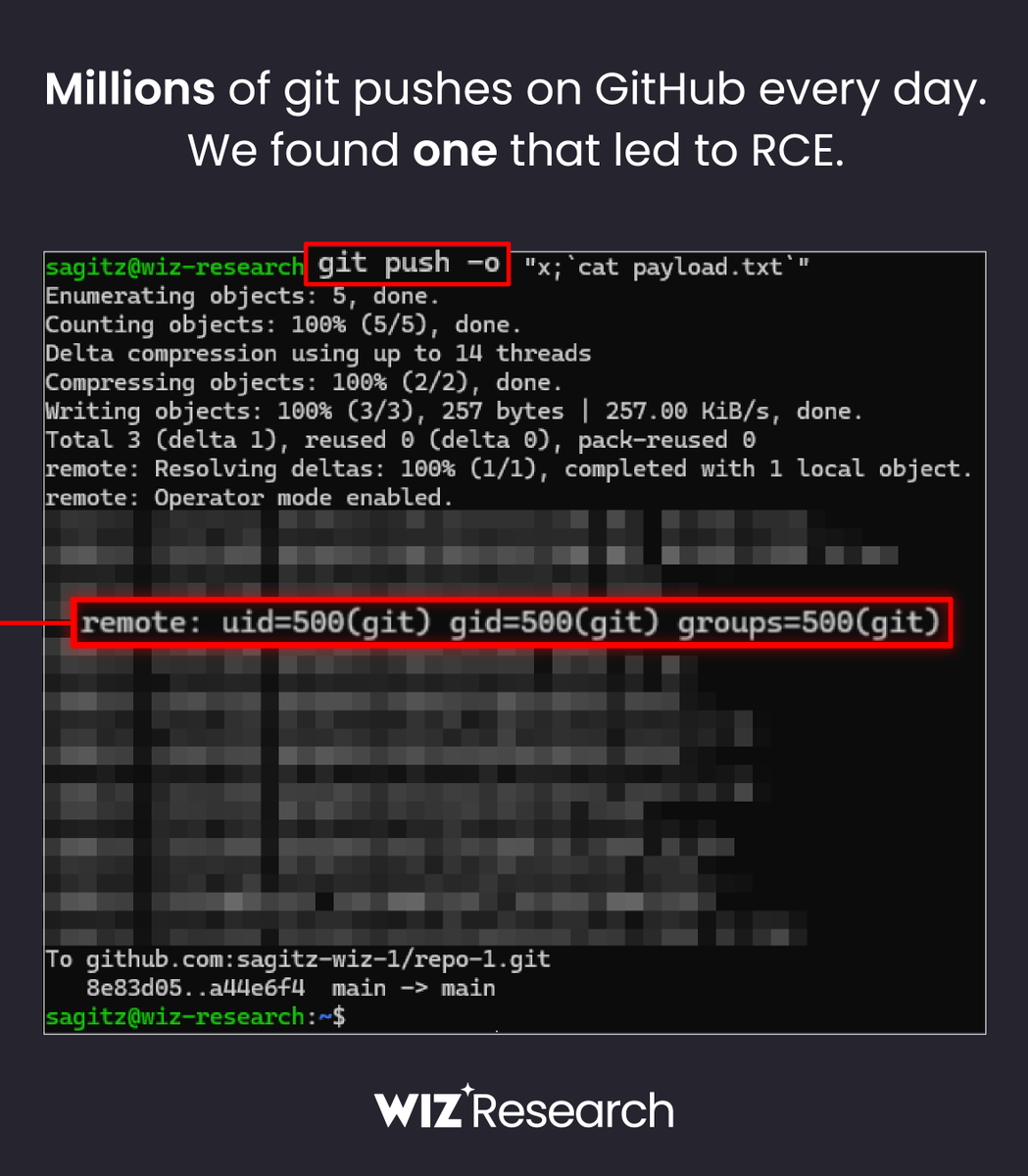
🚨 BREAKING: Wiz Research discovered Remote Code Execution on GitHub.com with a single git push The flaw in @github allowed unauthorized access to millions of repositories belonging to other users and organizations 🤯
Wiz tweet media
English
92
1K
4.5K
534.3K
Miguel Miranda retweetledi
CyrilXBT
CyrilXBT@cyrilXBT·
MIT just quietly dropped a free AI curriculum that puts $50,000 university courses to shame. 12 books. Zero tuition. From the same institution that produced the people building the models everyone is talking about. FOUNDATIONS 1. Foundations of Machine Learning — lnkd.in/gytjT5HC 2. Understanding Deep Learning — lnkd.in/dgcB68Qt 3. Machine Learning Systems — lnkd.in/dkiGZisg ADVANCED TECHNIQUES 4. Algorithms for ML — algorithmsbook.com 5. Deep Learning — lnkd.in/g2efT6DK REINFORCEMENT LEARNING 6. RL Basics (Sutton & Barto) — lnkd.in/guxqxcZZ 7. Distributional RL — lnkd.in/d4eNP-pe 8. Multi-Agent Systems — marl-book.com 9. Long Game AI — lnkd.in/g-WtzvwX ETHICS & PROBABILITY 10. Fairness in ML — fairmlbook.org 11. Probabilistic ML Part 1 — lnkd.in/g-isbdjj 12. Probabilistic ML Part 2 — lnkd.in/gJE9fy4w This is a complete MIT-level AI education. Not a YouTube playlist. Not a Twitter thread full of fluff. Textbooks written by the researchers who built the field. The people who actually study this will not just understand AI better than their peers. They will understand it better than most people currently getting paid to work in it. Most people will bookmark this and never open it. The ones who open it tonight are the ones who show up in 12 months having built something nobody around them understands yet. Bookmark this. Open the first one tonight. Follow @cyrilXBT for more resources that actually compound.
CyrilXBT tweet media
English
100
1.2K
4.3K
390.6K
Miguel Miranda retweetledi
Dark Web Intelligence
Dark Web Intelligence@DailyDarkWeb·
🇵🇹 Alleged Data Leak: CTT Portugal (Locky Parcel Network) A post on BreachForums claims a data leak involving CTT – Correios de Portugal, specifically its Locky smart parcel locker network. According to the threat actor, the dataset allegedly includes: Customer names Phone numbers Email addresses Package IDs Pickup timestamps The database is claimed to contain over 1 million records. No official confirmation has been made, and the breach remains unverified at this stage. #ddw #cybersecurity #databreach #darkweb #threatintel #portugal
Dark Web Intelligence tweet media
English
13
83
539
109.7K
Miguel Miranda retweetledi
divyansh
divyansh@Divyansh91565·
this is the best graph theory playlist on the internet...
divyansh tweet media
English
10
151
1.3K
27.3K
Miguel Miranda retweetledi
Ihtesham Ali
Ihtesham Ali@ihtesham2005·
An MIT professor taught the same math course for 62 years, and the day he retired, students from every country on earth showed up online to watch him give his final lecture. I opened the playlist at 2am and ended up watching three of them back to back. His name is Gilbert Strang. The course is MIT 18.06 Linear Algebra. Every machine learning engineer, every data scientist, every quant, every self-taught programmer who actually understands how AI works learned the math from this one man. Most of them never set foot on MIT's campus. They just opened a free playlist on YouTube and let him teach. Here's the story almost nobody tells you. Strang joined the MIT math faculty in 1962. He retired in 2023. That is 61 years of standing at the same chalkboard teaching the same subject to 18-year-olds. The interesting part is what he did when MIT launched OpenCourseWare in 2002. Most professors were skeptical. They worried that putting their lectures online would make their classrooms irrelevant. Strang did not hesitate. He said his life's mission was to open mathematics to students everywhere. He filmed every lecture and gave it away. The decision quietly changed how the world learns math. For decades linear algebra was taught the wrong way. Professors started with abstract vector spaces and proofs about field axioms. Students drowned in the abstraction. Most never recovered. They walked out believing they were bad at math when they had simply been taught in an order that nobody's brain is built to absorb. Strang inverted the entire curriculum. He started with matrix multiplication. Something you can write down on paper. Something you can compute by hand. Something you can see. Then he showed his students that everything else in linear algebra eigenvectors, singular value decomposition, orthogonality, the four fundamental subspaces was just a different lens for understanding what the matrix was actually doing under the hood. His rule was strict. If a student could not explain a concept using a concrete 3 by 3 example, that student did not actually understand the concept yet. The abstraction was supposed to come last, not first. The intuition was the foundation. The proofs were just confirmation that the intuition was correct. The second thing Strang changed was the classroom itself. He said please and thank you to his students. Every single lecture. He paused mid-derivation to ask "am I OK?" to check if anyone was lost. He never used the word "obviously" or "trivially" because he knew exactly what those words do to a student who is one step behind. He treated 19-year-olds learning math for the first time the way he treated his own colleagues. With patience. With respect. With the assumption that they belonged in the room. For 62 years. The result is something that has never happened in the history of education. A single math professor became the default teacher of his subject for the entire planet. Universities in India, China, Brazil, Nigeria, every country with a computer science department, started telling their own students to just watch Strang's lectures. The University of Illinois revised its linear algebra course to do almost no in-person lecturing. The reason was honest. The professor said they could not compete with the videos. His final lecture was in May 2023. The auditorium was packed with students who had never met him before. He walked to the chalkboard, taught for an hour, and at the end the entire room stood and applauded. He looked confused for a moment, like he genuinely did not understand why they were cheering. Then he smiled and waved them off and walked out. His written comment under the YouTube video of that final lecture was four sentences long. He said teaching had been a wonderful life. He said he was grateful to everyone who saw the importance of linear algebra. He said the movement of teaching it well would continue because it was right. That was it. No book promotion. No farewell speech. No legacy management. The man whose teaching is the foundation of modern AI just thanked the audience and went home. 20 million views. Zero ego. The entire engine of the AI revolution sits on top of math that millions of people learned for free from one quiet professor in Cambridge. The course is still on MIT OpenCourseWare. Every lecture, every problem set, every exam, every solution. Free. The most important math course of the 21st century is sitting one click away from you. Most people will never open it.
Ihtesham Ali tweet media
English
547
8.3K
32.2K
2.4M
Miguel Miranda retweetledi
Kirill
Kirill@kirillk_web3·
A SINGLE CLAUDE.md FILE JUST HIT #1 ON GITHUB TRENDING. 82,100 stars. 7.8k forks. zero dependencies. Bookmark this before you forget. And your Claude will start working differently. 4 principles. one file. Karpathy's LLM coding habits. distilled. > think before coding. > simplicity first. > surgical edits only. > goal-driven targets before starting. swap it into your CLAUDE.md today. your Claude Code becomes a different tool. Read it today. Link below. Claude → Skills → CLAUDE.md → Better Code → Better Systems → Money
Kirill@kirillk_web3

🚨do you understand what the Head of Anthropic Coding Agents just dropped. 30 minutes. more value than 100 paid courses. not a course. not a tutorial. how top AI researchers actually build. here's the part nobody is talking about: > real workflows. not theory. > vibe coding from the source. > how they think, build, and ship with agents. watch this before you write another prompt. before you build another agent. before you touch another tool. 30 minutes. bookmark it. watch it today. this one changes how you use AI for good.

English
63
490
8.5K
4.5M
Miguel Miranda retweetledi
divyansh tiwari
divyansh tiwari@DivyanshT91162·
CAPTCHA IS OFFICIALLY OUTDATED A new open-source library called Cap is changing how websites stop bots. No puzzles. No traffic lights. No “select all bikes” anymore. Instead, it uses a SHA-256 proof-of-work system — simple, silent, and fast. Why devs are switching: • Only ~20KB in size • Zero tracking, zero data collection • No images, no user friction • Works with any JS runtime • Fully customizable (visible, invisible, floating modes) • Zero dependencies • Can be deployed instantly via Docker This is a full replacement for traditional CAPTCHA systems. Cleaner UX. Faster websites. Better privacy. 100% open-source on GitHub Link in comments.
English
20
87
984
111.8K
Miguel Miranda retweetledi
DeepTechTR 🇹🇷
DeepTechTR 🇹🇷@DeepTechTR·
🚨 SON DAKİKA: Yapay zekâ ses araçları için bir daha asla para ödemeyin! MICROSOFT, yapay zekâ ses aracını açık kaynaklı hale getirdi. Bir zamanlar güvenlik kontrolleri için filigranlı olan en güçlü yapay zekâ ses aracını ücretsiz olarak yeniden yayınladılar. > 10 saniyelik sesten herhangi bir sesi kopyalayın > 90 dakikalık ses oluşturun > 50'den fazla dili destekler > Gerçek zamanlı akış > Yerel olarak çalışır %100 Açık Kaynak ve Ücretsiz. github.com/microsoft/Vibe…
Türkçe
14
476
3K
203.3K
Miguel Miranda retweetledi
Maliha Tasnim
Maliha Tasnim@this_is_tasnim·
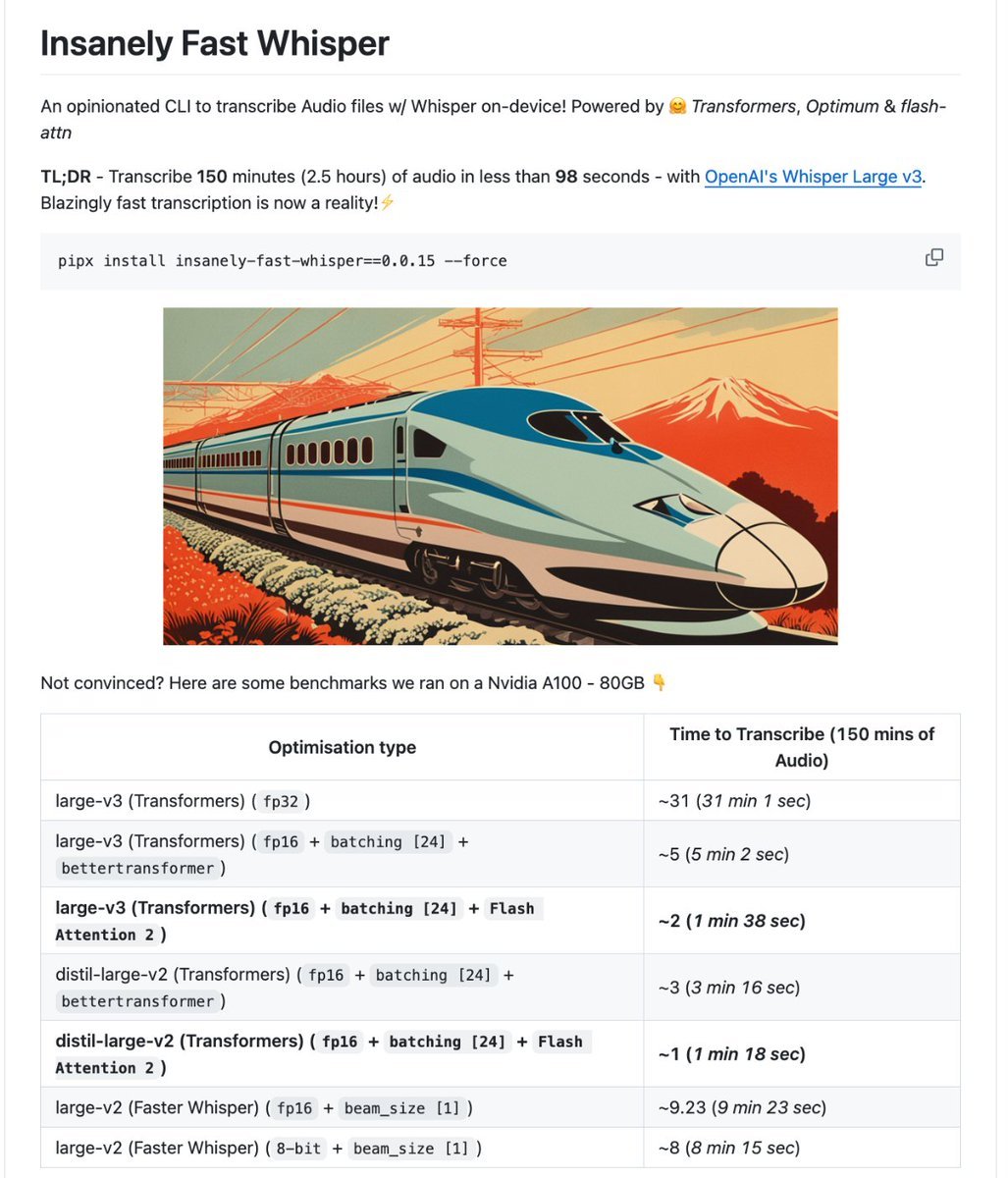
🚨 BREAKING: Someone just made OpenAI's Whisper transcribe 2.5 hours of audio in 98 seconds. 100% OPEN SOURCE. It runs entirely on your GPU. No API keys. No cloud. No subscription. It's called Insanely Fast Whisper. You drop in an audio file. One command. You come back and there's a clean, timestamped transcript waiting. Not a rough draft. Not a partial output. The entire thing. Done. Not a wrapper. Not a web app. A CLI that turns your local machine into a transcription engine that makes paid services look embarrassing. Here's what it does on its own: → Transcribes 150 minutes of audio in under 98 seconds using Flash Attention 2, same model, 19x faster, zero quality loss → Auto-detects language across dozens of languages, or translates directly into English with a single flag → Speaker diarization built in, knows who said what, not just what was said → Word-level and chunk-level timestamps so you can jump to any exact moment in any recording → Runs on NVIDIA GPUs and Apple Silicon Macs with zero code changes between them → Works on Google Colab free tier if you don't own a GPU at all Here's how fast it actually is: Standard Whisper large-v3 out of the box: 31 minutes to process 2.5 hours of audio. The same exact model with Flash Attention 2 and batching: 1 minute 38 seconds. Same weights. Same accuracy. One flag difference. Here's the wildest part: This never started as a product. It was a benchmark demo to show what Hugging Face Transformers could do. Then the community started using it for real work. Podcast transcription. Legal recordings. Research interviews. Meeting notes at scale. The team kept adding what people actually needed until a benchmark became a full CLI that nobody planned to build. 8.8K GitHub stars. 100% Open Source.
Maliha Tasnim tweet media
English
53
271
2.1K
155.7K
Miguel Miranda retweetledi
divyansh tiwari
divyansh tiwari@DivyanshT91162·
🚨 This shouldn’t be possible… but Microsoft just did it. They made a 100B parameter model run on a single CPU. No GPU. No insane setup. Just math rewritten from scratch. Here’s the part most people are missing 👇 Traditional LLMs = 16-bit floats Every weight = messy decimal (0.0023, -1.47…) Inference = billions of float multiplications → That’s why GPUs exist BitNet flips the entire game. Instead of floats, it uses ternary weights: {-1, 0, 1} Not compression. Not optimization. A completely different computing primitive. Now look what happens: → ×1 = keep value → ×(-1) = flip sign → ×0 = ignore That’s it. No multiplications. Just add, subtract, skip. Matrix multiplication (the core of AI) becomes: cheap integer ops on a CPU And the results? → 2x–6x faster on CPUs → Up to 82% less energy usage → Scales BETTER with bigger models Let that sink in: A 100B model running at 5–7 tokens/sec on a single CPU This is not “optimization” This is a paradigm shift And the craziest part? These models are NOT quantized later They are trained like this from day one. No precision loss No quality drop The model literally learns inside the constraint Why 1.58 bits? Because: log₂(3) ≈ 1.58 3 possible values → max efficiency per weight We’re watching the hardware bottleneck disappear in real time. AI is not getting smaller. The math is getting smarter. Bookmark this. In a year, running LLMs locally won’t be impressive. Not running them locally will be.
English
49
109
519
70.2K
Miguel Miranda retweetledi
Erick
Erick@ErickSky·
NVIDIA SE ACABA DE PONER LA 10 Y NO ESTÁ PARA JUEGOS ¡¡¡Acaban de subir DeepSeek-V4-Pro a su web de build!!! El modelo open source MÁS GRANDE DEL MUNDO con 1.6 TRILLONES de parámetros. Y lo mejor de todo… Lo puedes correr GRATIS en GPUs Blackwell. Sí, leíste bien. Gratis. En la nube. En el hardware más bestia del planeta. ¿Quién ya está probando esto? ENLACE👇
Español
25
122
1.4K
94.1K
Miguel Miranda retweetledi
How To AI
How To AI@HowToAI_·
Someone just open-sourced a full 3D Gaussian Splat editor that runs 100% in your browser. It's called SuperSplat. You can inspect, edit, optimize, and publish photorealistic 3D scenes with zero install. 100% Open Source.
English
38
300
3K
179.5K