Marc Noguera

1.5K posts

Marc Noguera

Marc Noguera

@mnoguera

Senior Product Manager with entrepreneur and UX background.

Barcelona Katılım Mart 2007
687 Takip Edilen992 Takipçiler
Marc Noguera retweetledi
Nacho González
Nacho González@nachog·
2/3 - Explicaré la historia de InfoJobs y de las 3 empresas que he vendido. - Explicaré las 3 empresas de Hiring que he co-fundado: InfoJobs, Hireflix y Hirevoice. - Explicaré qué Reclutadores van a DESAPARECER y cuales van a ELEVAR DRASTICAMENTE SU VALOR. - Explicaré que procesos en Hiring han de IAizarse y cuales han de HUMANIZARSE. APÚNTATE QUE ES GRATIXXXX >>>
Español
1
2
9
1.9K
Marc Noguera retweetledi
Nacho González
Nacho González@nachog·
Product Person (“the most underrated hire right now”) ≠ Product Manager. MUST READ >>
signüll@signulll

the most underrated hire right now is a great product person. when i say product person i'm def not talking about a product manager. perhaps i think there has to be somewhat of a new role. i don't have a good name for it yet but maybe something like "product thinker".. someone with an intuitive grasp of the product as it exists, where it's soft, where it sings, & how to iterate it toward something even sharper. in some sense, this person has to cohesively hold in their head where this product should be 2 years from now & work backwards from that. i say this cuz when building was hard, engineering was the bottleneck & the status hierarchy often reflected that. building is no longer hard. which means the variance in outcomes has shifted almost entirely to judgment on what to build, how to sequence it, & how to talk about it. & the story matters as much as the thing. internally, it organizes the team around a shared model of why. externally, it shapes the interpretive frame users bring to their first experience. you can't retrofit narrative onto a product & expect it to land, it has to be load bearing from the start. the rarest version of this person sits at the intersection of culture & deep technology. someone genuinely bilingual. they know what's technically possible & they know which cultural currents are real vs. ephemeral. that combo is what separates products that feel inevitable from products that feel assembled. before ppl clap back with this person has always been valuable, i know.. i am just saying now they might be the most *important* person in the room. their value compounds like never before.


English
2
2
13
2K
Marc Noguera retweetledi
Carlos Sánchez
Carlos Sánchez@chocotuits·
La mayoría de la gente no es consciente de lo peligroso que es compartir el DNI sin marca de agua. Por eso hemos creado Saferlayer, una herramienta gratuita para proteger tus documentos y evitar estafas. Enlace a la app y explicación más detallada a continuación 👇
Español
132
1.4K
3K
625.6K
Marc Noguera retweetledi
Jason Fried
Jason Fried@jasonfried·
Very important to understand this. This is why you can't just think about problems. Plan to solve problems. Or put together the steps ahead of time to solve problems. You have to start working on the thing itself to fully understand. You learn as you go, and you learn the most by making progress.
Cameron Moll@cameronmoll

Universal truth of problem solving: The definition-solving process is circular not linear. You can't fully define a problem without starting to solve the problem. Nor can you predict when the problem is fully defined (or solved for that matter). Clarity will eventually emerge.

English
22
140
1K
135.2K
Marc Noguera retweetledi
Nacho González
Nacho González@nachog·
Banktrack cada vez irá más a empresas (B2B)... ....peeeeero, seguimos manteniendo Plan Personal (B2C). Hoy tocaba Black Friday B2C >>
Español
2
2
12
3.6K
Marc Noguera retweetledi
Javier Escribano
Javier Escribano@fesja·
¡Convocamos los Tardeos de Producto de Diciembre! Nos estamos juntando unos 40 profesionales de producto en cada Tardeo para conocer a otros profesionales y experiencias haciendo producto. Vienen desde líderes de producto e ingeniería, hasta PMs, PDs y EMs. ¿Te vienes?
Javier Escribano tweet media
Español
1
2
3
3.8K
Marc Noguera retweetledi
Jesse Pujji
Jesse Pujji@jspujji·
Facebook & Instagram are NOT listening to your conversations. What they are doing is MUCH more effective! Here’s how it works 1/ The two most valuable pieces of software on earth are: 1. The FB pixel 2. The FB newsfeed When you wonder how $FB is worth > $400BN while Twitter is < $30BN, these two pieces of software are your answer. What are they? 2/ The FB pixel is a tiny piece of code that nearly every website/mobile app on the planet has embedded. It collects anonymized data for FB to aggregate: websites visited, how much time was spent, did you buy or not, etc. 3/ The newsfeed algo looks at that as a signal along with hundreds of other data points like age, friends, what you click on, and even where you post to determine which ad to place in front of you, when. All of this is done in aggregated groups. Not personal/specific to you. 4/ When it works: right message in front of right person at right time….everyone wins. A brand finds a new customer. You find a product you want. FB makes $. 5/ This is a good thing. You get value from it all the time. You’re shopping for a mattress. You go to Casper’s website. Then back to FB/IG. You start getting ads for other mattress companies and even a mattress comparison site. You find the right choice, you buy! 6/ So, back to FB listening to us. They have a way more effective and smarter system... If me and @mrsharma get lunch, FBs systems can figure it out (still anonymously of course) How? 7/ Our devices were near each other for about an hour at neither of our houses around lunchtime. FBIG knows the last 10 websites each of us visited. (This is all done based on device codes not our names/personal info). It bets that we talked about a few of these websites. 8/ it also leverages a common bias in our brains. A cognitive bias known as the Baader–Meinhof phenomenon AKA the frequency illusion. You know how when you buy a new item like a car/computer/shoes, you immediately notice it EVERYWHERE. 9/ It’s not that it’s gotten more frequent, it’s that your brain is more aware of it. Your brain is picky on what it allows you to pay attention to. This bias makes you think things are more frequent than it truly is. In short, you only notice the ads from your conversation... 10/ So after lunch, it shows us each ads based on the other person's browsing history. We didn’t discuss 9/10 of the websites the other person visited so we don’t even notice that. But the 1 we happened to discuss JUMPS out at us. And we conclude: FBIG has been listening!! 11/ In reality, they use tech, data and tools available to most mobile apps and some smart probabilistic modeling plus know about the frequency illusion. They do not listen. Think: The computing power required to constantly listen would kill your phone in less than an hour. 12/ Also, it would also require FB hacking apple/google devices microphones (extremely unlikely) Even though it may feel creepy at times, the result is good: more relevant ads which improve the experience for everyone! 13/ Before you judge, remember this super smart algo helps consumers discover new products every day. And helps millions of small biz owners grow their businesses every day. It’s become a crux of the internet economy and digital marketing. 14/ So that’s the rundown on why it seems like FBIG is listening when they are not! While I have your attention… I've put all my experience bootstrapping biz’s into creating a FREE email course to help you: •Find biz ideas •Learn how to sell more •Build without VC money Want in? Get it for free below 👇👇👇
Jesse Pujji tweet media
English
18
66
397
140.3K
Marc Noguera retweetledi
Dani Sanchez-Crespo
Dani Sanchez-Crespo@DaniNovarama·
Últimamente han aparecido varios informes sobre el uso y abuso de pantallas en niños pequeños, alertando en retrasos en su desarrollo. Así que hoy quiero dar cinco consejos prácticos sobre niños y tecnología, que es un tema que me pilla cerca. Dentro hilo.
Español
57
1.6K
3.9K
634.2K
Marc Noguera retweetledi
Angel
Angel@ancude·
En Unity y más concretamente a su CEO (ex de EA, por cierto) se les ha ido la olla completamente. Contexto: Unity es un motor gráfico para desarrollar videojuegos que se caracteriza por su facilidad de uso. Lleva años siendo uno de los más usados precisamente por eso y porque el precio también era muy ajustado, pagando a razón de los beneficios que se sacasen con el juego. Bueno, pues eso ha cambiado. Unity pretende cobrar por cada instalación que se haga de un juego que use su motor. El fee es pequeño, unos 20 céntimos, pero ahora viene el drama: - No explican cómo se va a contabilizar cada instalación - El cambio de tarifa es RETROACTIVO Esta nueva forma de cobro afectará a toda empresa que venga usando Unity desde cualquier momento, no desde que apliquen la nueva tarifa. Es una auténtica barbaridad. Y el tema de las instalaciones; te compras un juego en (p.ej) GOG y lo instalas en tu PC, en el de tu pareja y ya de paso, en el del trabajo. El cliente ha pagado UNA vez por el juego, pero la desarrolladora va a tener que pagar TRES veces. No tiene sentido. Unity además es usado por muchos juegos indie que terminan costando muy poco, también en juegos para móviles, lo cuál hace que ese fee de 20 céntimos, contado por instalaciones, pueda terminar en una sangrada desproporcional. El mundo de los videojuegos es muy complejo y dinámico, la gente se cambia o mejora su PC, tiene varias consolas, comparte cuentas... Cobrar a las desarrolladoras por instalaciones es un abuso absoluto. A ver cómo termina la historia, por lo pronto muchas empresas (las que pueden permitírselo) ya han anunciado que dejarán de usar Unity. Otras por ahora siguen pidiendo aclaraciones de cómo carajos van a contar dichas instalaciones de forma coherente — spoiler: no pueden.
Unity@unity

We want to acknowledge the confusion and frustration we heard after we announced our new runtime fee policy. We’d like to clarify some of your top questions and concerns: Who is impacted by this price increase: The price increase is very targeted. In fact, more than 90% of our customers will not be affected by this change. Customers who will be impacted are generally those who have found a substantial scale in downloads and revenue and have reached both our install and revenue thresholds. This means a low (or no) fee for creators who have not found scale success yet and a modest one-time fee for those who have. Fee on new installs only: Once you meet the two install and revenue thresholds, you only pay the runtime fee on new installs after Jan 1, 2024. It’s not perpetual: You only pay once for an install, not an ongoing perpetual license royalty like a revenue share model. How we define and count installs: Assuming the install and revenue thresholds are met, we will only count net new installs on any device starting Jan 1, 2024. Additionally, developers are not responsible for paying a runtime fee on: - Re-install charges - we are not going to charge a fee for re-installs. - Fraudulent installs charges - we are not going to charge a fee for fraudulent installs. We will work directly with you on cases where fraud or botnets are suspected of malicious intent. - Trials, partial play demos, and automation installs (devops) charges - we are not going to count these toward your install count. Early access games are not considered demos. - Web and streaming games - we are not going to count web and streaming games toward your install count either. - Charity-related installs - the pricing change and install count will not be applied to your charity bundles/initiatives. For additional questions, we have updated our blog and FAQ resources. ⬇️ Blog: on.unity.com/3ZiIwlB FAQ: on.unity.com/44NMZ0R Forums: on.unity.com/45RgrnV

Español
4
118
41
27.6K
Marc Noguera retweetledi
Patrick Campbell
Patrick Campbell@Patticus·
The past 10 years I made companies $2.4 billion by fixing one piece of their business: Their pricing. Why'd they need me? Because even the smartest people don't know how their pricing strategy should change over time. So here's the exact pricing path to follow for growth 👇
English
34
69
560
219K
Marc Noguera retweetledi
Juanra Doral
Juanra Doral@JuanraDoral·
Desde 2005 estoy en facilisimo y hemos pasado por muchas fases. La cosa sigue pero, siendo realista, no le veo 15 años de futuro... Por eso, me abro a alternativas de empleo o negocios😁 bit.ly/JuanraDoralCV
Español
0
9
7
1.8K
Marc Noguera retweetledi
Vahe Baghdasaryan
Vahe Baghdasaryan@vahebagdasar·
27 tips I learned from changing @coinstats' pricing model, increasing the price by almost 3x, and running tens of monetization experimentations over the past ten months 🧵
English
6
6
45
0
Marc Noguera retweetledi
Dan Hockenmaier
Dan Hockenmaier@danhockenmaier·
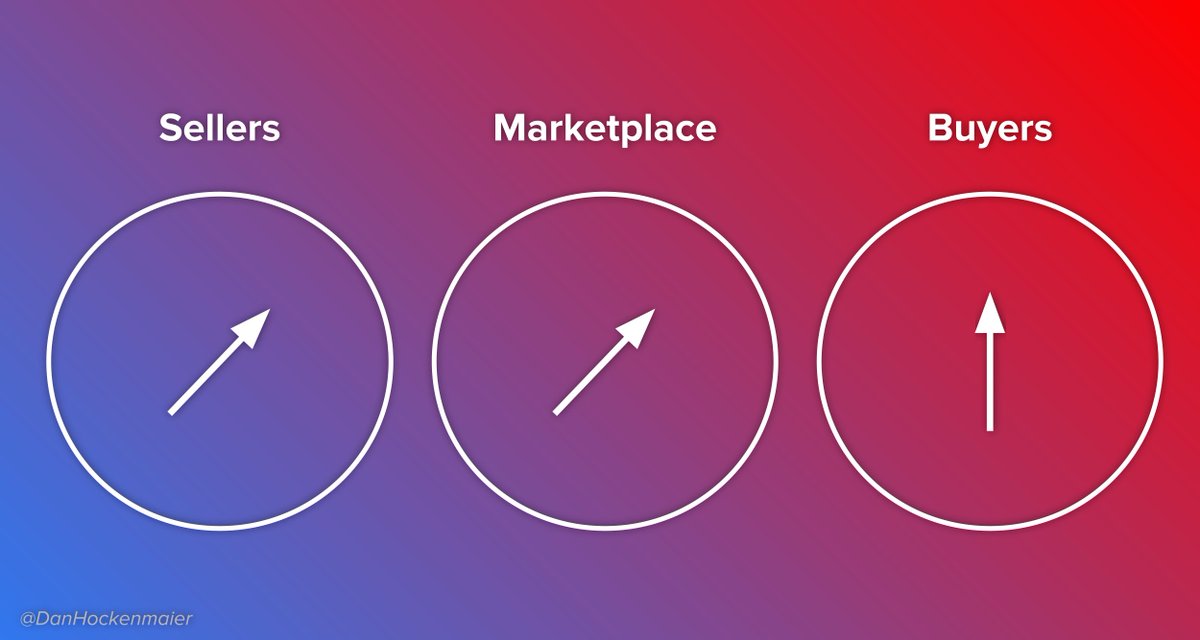
Successful marketplaces create value for everyone, but they are especially good at creating massive consumer surplus for buyers. Here is why that is and how the economics of an industry are transformed by a marketplace (which may be useful as you think about marketplace pricing): There is a lot of debate over whether to focus on supply or demand in a marketplace. But long term, every marketplace is demand-constrained. If a marketplace can provide sellers with more customers, they are usually happy to take them as long as they are at least as profitable as their existing business. And if there is initially a supply shortage, marketplaces make it easy for new sellers to enter. So marketplaces are incentivized to charge sellers as much as they were paying before, and compete by giving as much value as they can back to buyers to aggregate demand and grow the market. As a result, everyone wins, but especially buyers: Buyers are MUCH better off. It is a lot easier to make purchases, and they don't have to pay anything extra. And they usually get things like guarantees and shipping at or below cost. If you try to charge them, someone else won't, and they will win. Angie’s List had a tidy business charging customers a subscription fee for access, until HomeAdvisor and Thumbtack ate their lunch by giving it away for free, opting to only monetize on the supply side. Sellers have similar costs before and after a marketplace. But they get a more scalable customer acquisition channel, and there are more customers to go around, so their businesses grow. The marketplace gets to keep a fraction of the value they create, determined by how much more efficiently they can do what sellers used to do themselves.
Dan Hockenmaier tweet media
English
1
5
53
18.2K
Marc Noguera retweetledi
Shreyas Doshi
Shreyas Doshi@shreyas·
Posting another reminder for my PM Habits seminar (this upcoming Sunday, April 23) because some folks missed my tweet for my last open seminar (which was on Time Management for PMs) and couldn't access the recording as a result. Link: lu.ma/shreyaspmhabits (must register)
Shreyas Doshi@shreyas

I am hosting a seminar on April 23! Topic: PM Habits We will cover some of my habits related to meetings, reviewing metrics, dealing with Slack, planning time, skills growth, etc and also principles so you can adapt these to your context. Register here: lu.ma/shreyaspmhabits

English
0
4
35
31.2K
Marc Noguera retweetledi
Xavier Boronat
Xavier Boronat@xboronat·
Hola famíliar, amic, conegut i saludat! No sé si saps, però fa un temps vaig obrir una òptica amb un soci, @optica_claret.1981. I l’òbjectiu és donar solucions als roblemes visuals a un preu just. Som una òptica de barri, al districte de Gracia a Barcelo… instagr.am/p/Co2rmP-DgcN/
Xavier Boronat tweet media
Català
1
2
9
514
Marc Noguera retweetledi
Itamar Gilad
Itamar Gilad@ItamarGilad·
Too much focus is put on improving product managers as individuals - skills, mindset, development. This is local optimization. Good #ProductManagement requires system thinking. The biggest success factor is the mindset of the org.
English
2
4
26
3K
Marc Noguera retweetledi
RevenueCat
RevenueCat@RevenueCat·
Correlation ≠ causality, but there's something interesting happening to the rate of price changes and experiments, as apps become bigger and more successful: 🧵
English
1
7
19
7.6K
Marc Noguera retweetledi
Carlos Fenollosa
Carlos Fenollosa@cfenollosa·
Estamos a punto de descubrir qué nos hace humanos Irónicamente, la solución no llegará debatiendo entre diferentes escuelas de filosofía, sino de forma empírica, de la mano de una máquina Siente el vértigo del progreso y la emoción de la incertidumbre 👇 getrevue.co/profile/cfenol…
Español
3
4
8
0
Marc Noguera retweetledi
Mauricio Prieto
Mauricio Prieto@mauprieto·
eDreams Prime now has 3.6 million subscribers (eDreams, Opodo, GoVoyages). If you are or were an eDreams Prime subscriber, I would love to know your experience by completing this short survey (takes less than 3 minutes and will share results): form.typeform.com/to/xzVFTOlR RTs🙏!
English
0
3
1
0
Marc Noguera retweetledi
Carlos Fenollosa
Carlos Fenollosa@cfenollosa·
Quedan muchos flecos por pulir, pero ya está aquí, amigos. Estamos presenciando en directo los inicios de la singularidad. Llevo veinte años estudiando IA y te aseguro que me está volando la cabeza 🤯 No exagero, mira 👇
Español
39
663
2K
0