mouxudong

92 posts

mouxudong

mouxudong

@mouxudong

Katılım Ekim 2011
457 Takip Edilen16 Takipçiler
mouxudong retweetledi

Andrej Karpathy
Andrej Karpathy@karpathy·
LLM Knowledge Bases Something I'm finding very useful recently: using LLMs to build personal knowledge bases for various topics of research interest. In this way, a large fraction of my recent token throughput is going less into manipulating code, and more into manipulating knowledge (stored as markdown and images). The latest LLMs are quite good at it. So: Data ingest: I index source documents (articles, papers, repos, datasets, images, etc.) into a raw/ directory, then I use an LLM to incrementally "compile" a wiki, which is just a collection of .md files in a directory structure. The wiki includes summaries of all the data in raw/, backlinks, and then it categorizes data into concepts, writes articles for them, and links them all. To convert web articles into .md files I like to use the Obsidian Web Clipper extension, and then I also use a hotkey to download all the related images to local so that my LLM can easily reference them. IDE: I use Obsidian as the IDE "frontend" where I can view the raw data, the the compiled wiki, and the derived visualizations. Important to note that the LLM writes and maintains all of the data of the wiki, I rarely touch it directly. I've played with a few Obsidian plugins to render and view data in other ways (e.g. Marp for slides). Q&A: Where things get interesting is that once your wiki is big enough (e.g. mine on some recent research is ~100 articles and ~400K words), you can ask your LLM agent all kinds of complex questions against the wiki, and it will go off, research the answers, etc. I thought I had to reach for fancy RAG, but the LLM has been pretty good about auto-maintaining index files and brief summaries of all the documents and it reads all the important related data fairly easily at this ~small scale. Output: Instead of getting answers in text/terminal, I like to have it render markdown files for me, or slide shows (Marp format), or matplotlib images, all of which I then view again in Obsidian. You can imagine many other visual output formats depending on the query. Often, I end up "filing" the outputs back into the wiki to enhance it for further queries. So my own explorations and queries always "add up" in the knowledge base. Linting: I've run some LLM "health checks" over the wiki to e.g. find inconsistent data, impute missing data (with web searchers), find interesting connections for new article candidates, etc., to incrementally clean up the wiki and enhance its overall data integrity. The LLMs are quite good at suggesting further questions to ask and look into. Extra tools: I find myself developing additional tools to process the data, e.g. I vibe coded a small and naive search engine over the wiki, which I both use directly (in a web ui), but more often I want to hand it off to an LLM via CLI as a tool for larger queries. Further explorations: As the repo grows, the natural desire is to also think about synthetic data generation + finetuning to have your LLM "know" the data in its weights instead of just context windows. TLDR: raw data from a given number of sources is collected, then compiled by an LLM into a .md wiki, then operated on by various CLIs by the LLM to do Q&A and to incrementally enhance the wiki, and all of it viewable in Obsidian. You rarely ever write or edit the wiki manually, it's the domain of the LLM. I think there is room here for an incredible new product instead of a hacky collection of scripts.
English
2.8K
6.7K
56K
19.9M
mouxudong retweetledi
Kimi.ai
Kimi.ai@Kimi_Moonshot·
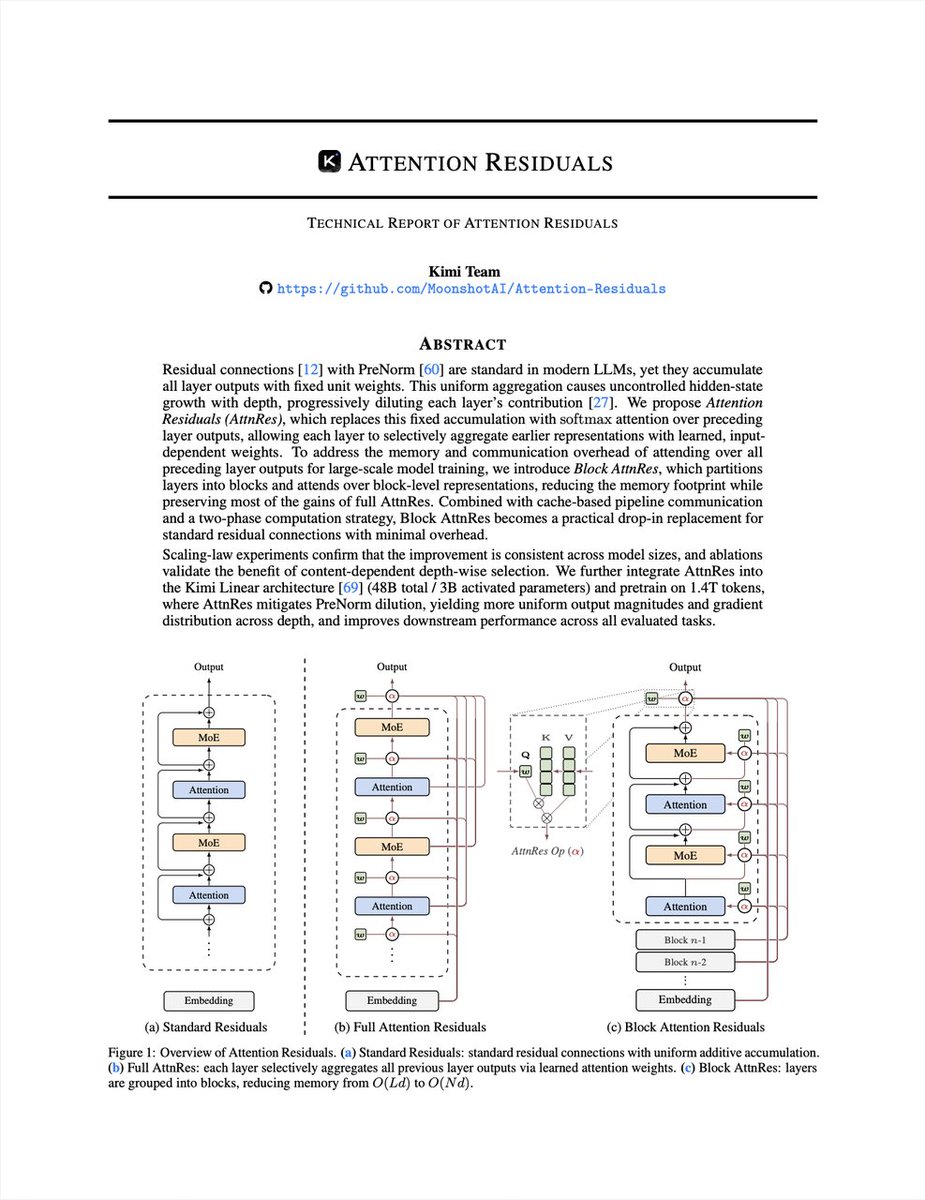
Introducing 𝑨𝒕𝒕𝒆𝒏𝒕𝒊𝒐𝒏 𝑹𝒆𝒔𝒊𝒅𝒖𝒂𝒍𝒔: Rethinking depth-wise aggregation. Residual connections have long relied on fixed, uniform accumulation. Inspired by the duality of time and depth, we introduce Attention Residuals, replacing standard depth-wise recurrence with learned, input-dependent attention over preceding layers. 🔹 Enables networks to selectively retrieve past representations, naturally mitigating dilution and hidden-state growth. 🔹 Introduces Block AttnRes, partitioning layers into compressed blocks to make cross-layer attention practical at scale. 🔹 Serves as an efficient drop-in replacement, demonstrating a 1.25x compute advantage with negligible (<2%) inference latency overhead. 🔹 Validated on the Kimi Linear architecture (48B total, 3B activated parameters), delivering consistent downstream performance gains. 🔗Full report: github.com/MoonshotAI/Att…
Kimi.ai tweet media
English
334
2K
13.5K
5M
mouxudong retweetledi
The Figen
The Figen@TheFigen_·
I think that is the best advertisement I’ve ever seen.
English
603
10.1K
58.8K
1.6M
mouxudong retweetledi
Katyayani Shukla
Katyayani Shukla@aibytekat·
BREAKING: AI can now analyze your tech career like LinkedIn's top career coaches and find $200k+ roles early (for free). Here are 15 brutal Claude prompts that evaluate your resume, interview skills, and market value:
English
10
62
431
84K
mouxudong retweetledi
Anderson Martin
Anderson Martin@hey_andersonnn·
🚨 BREAKING: Google Gemini can now analyze any stock like a Wall Street analyst (for free). Here are 10 insane Gemini prompts that replace $4,000/month Bloomberg terminals: Save for later🔖
Anderson Martin tweet media
English
20
327
1.7K
592K
mouxudong retweetledi
Andrej Karpathy
Andrej Karpathy@karpathy·
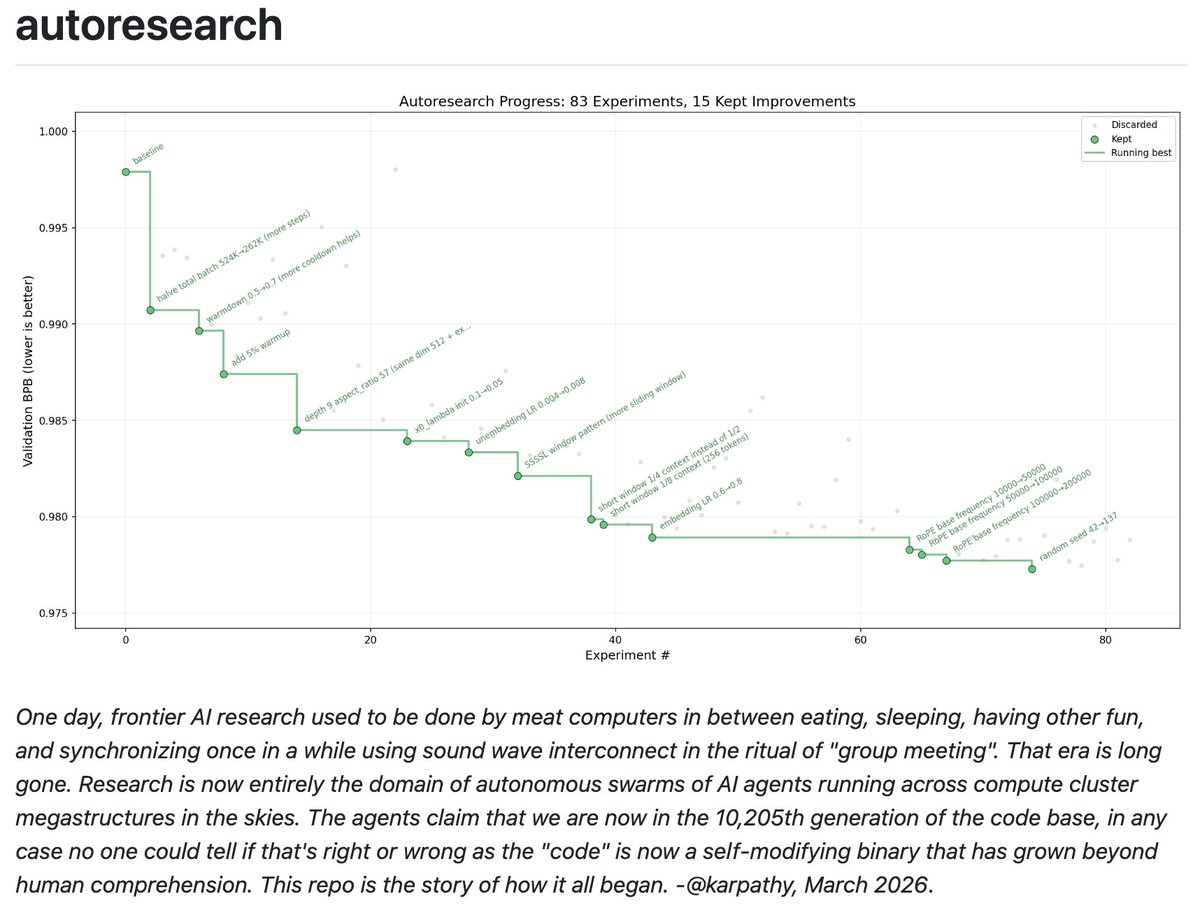
I packaged up the "autoresearch" project into a new self-contained minimal repo if people would like to play over the weekend. It's basically nanochat LLM training core stripped down to a single-GPU, one file version of ~630 lines of code, then: - the human iterates on the prompt (.md) - the AI agent iterates on the training code (.py) The goal is to engineer your agents to make the fastest research progress indefinitely and without any of your own involvement. In the image, every dot is a complete LLM training run that lasts exactly 5 minutes. The agent works in an autonomous loop on a git feature branch and accumulates git commits to the training script as it finds better settings (of lower validation loss by the end) of the neural network architecture, the optimizer, all the hyperparameters, etc. You can imagine comparing the research progress of different prompts, different agents, etc. github.com/karpathy/autor… Part code, part sci-fi, and a pinch of psychosis :)
Andrej Karpathy tweet media
English
1.1K
3.6K
28.3K
11M
mouxudong retweetledi
PGA TOUR
PGA TOUR@PGATOUR·
He did it. @McIlroyRory is a Masters champion. He’s achieved the career Grand Slam.
PGA TOUR tweet media
English
343
5.4K
40.6K
1.2M
mouxudong retweetledi
Matthew Berman
Matthew Berman@MatthewBerman·
AI has changed my life. I'm now 100x more productive than I ever was. How do I use it? Which tools do I use? Here are my actual use cases for AI: 👇
English
97
139
1.6K
436.6K
mouxudong retweetledi
George Christensen
George Christensen@NationFirstAust·
🚨BREAKING: The mask has slipped. Yesterday, @ZelenskyyUa had a shouting match with @realDonaldTrump & @JDVance1 in the White House. For years, he was hailed a hero. Now he's exposed. Here’s the history of the Ukraine & Zelenskyy you won't hear from the media: 🧵👇 1/22
George Christensen tweet media
English
3.6K
30.4K
101.3K
17.7M
mouxudong retweetledi
Elon Musk
Elon Musk@elonmusk·
ZXX
9.4K
23K
302.4K
29.7M
mouxudong retweetledi
Andrej Karpathy
Andrej Karpathy@karpathy·
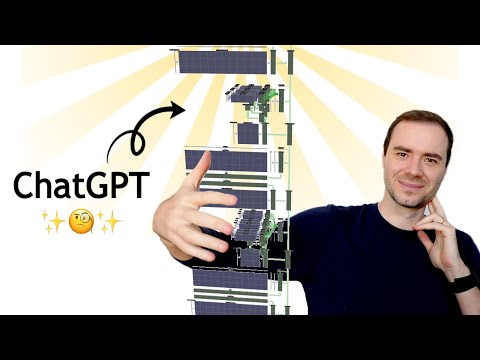
New 3h31m video on YouTube: "Deep Dive into LLMs like ChatGPT" This is a general audience deep dive into the Large Language Model (LLM) AI technology that powers ChatGPT and related products. It is covers the full training stack of how the models are developed, along with mental models of how to think about their "psychology", and how to get the best use them in practical applications. We cover all the major stages: 1. pretraining: data, tokenization, Transformer neural network I/O and internals, inference, GPT-2 training example, Llama 3.1 base inference examples 2. supervised finetuning: conversations data, "LLM Psychology": hallucinations, tool use, knowledge/working memory, knowledge of self, models need tokens to think, spelling, jagged intelligence 3. reinforcement learning: practice makes perfect, DeepSeek-R1, AlphaGo, RLHF. I designed this video for the "general audience" track of my videos, which I believe are accessible to most people, even without technical background. It should give you an intuitive understanding of the full training pipeline of LLMs like ChatGPT, with many examples along the way, and maybe some ways of thinking around current capabilities, where we are, and what's coming. (Also, I have one "Intro to LLMs" video already from ~year ago, but that is just a re-recording of a random talk, so I wanted to loop around and do a lot more comprehensive version of this topic. They can still be combined, as the talk goes a lot deeper into other topics, e.g. LLM OS and LLM Security) Hope it's fun & useful! youtube.com/watch?v=7xTGNN…
YouTube video
YouTube
Andrej Karpathy tweet media
English
770
2.9K
20.2K
2.4M
mouxudong retweetledi
The Rookie Consultant
The Rookie Consultant@TheRookieCons·
The emails between Elon Musk and Sam Altman are leaked. It’s not just the insights that are surprising, but their unique way of communicating… I’ve broken down the 7 most important, to speak like a TOP-TIER entrepreneur. Get ready to take notes✍️:
The Rookie Consultant tweet mediaThe Rookie Consultant tweet media
English
154
1K
6.5K
2.8M