

Marc Suesser
224 posts




my team didn't want me to give this away for free. But I'm going to do it anyway
it's the SEO & AI search dashboard I built in Claude Code
it connects to your Google Analytics (GA4) and Google Search Console and Claude Code builds it in 5 minutes
and I made a Notion document and a skill file so you can build this in Claude Code yourself in literally minutes
the dashboard has three tabs:
1. AI Search - How much traffic is coming from ChatGPT, Perplexity, and Gemini ETC. It aggregates the GA4 data and gives single number
2. Paid ads - which keywords rank top 3 for but still pay for ads on, you should cut these to save budget
3. Organic overview - sessions, conversions, top landing pages, demographics. The single view for what is working
I built this because this is how I drive our SEO and AEO forward
it gives me the insights I need to allocate budget and prioritize what content to work on next
I decided to give it away because most companies have no idea AI search is already sending them traffic
like this post and comment "AEOdashboard" and I'll send it over
English
@kitlangton hey did you know that if you triple-click any text anywhere it will highlight the whole line
English



I'm about to ship an AI Coding dictionary.
But I need help defeating the final boss.
So, in your own words...
...what is AI?
English
because the Elm architecture / MVQ way of thinking is the best frontend-considering application architecture I know of and I believe it is the most scalable solution for AI-driven development
paired with all the things that make Effect so special, it's positioned as the kind of tech I am eager to commit to (which means investing my time and energy into writing/procuring all the skills and docs and stuff to make sure coding agents working on my projects know everything they need to know to be able to unambiguously rip with it)
the principles underlying Elm / MVQ are similar to those of CQRS/event-sourcey backend architectures in that they fundamentally discourage the sprawl of complexity as one adds more functionality
like this infographic from the Effect website

English

Dear extremely niche, beloved audience, I’ve been meaning to ask you something.
If you have used or want to use Foldkit — why?
English

I have this weird complex about making money, I innately feel like I’m acquiring karmic debt when I profit Earth money and I’ve always had a tainted relationship with money because I have trouble considering it valuable so I immediately spend it on something creative😭
imma need one of you healers to clear some of these blocks
maro@ProofofMaro
@thealch3m1st I’ll sell the printed books to cover publishing costs🥺
English
@MichaelArnaldi checking back to see if this has been posted anywhere
English

Also I am giving a workshop on how to use agents to code with Effect, so you stop asking for SKILLS!
Michael Arnaldi@MichaelArnaldi
I'll be in London for AIE, if you're around and want to meet let me know
English
I am the bottleneck
I am the bottleneck
I am the bottleneck
I am the bottleneck
I am the bottleneck
I am the bottleneck
I am the bottleneck
English

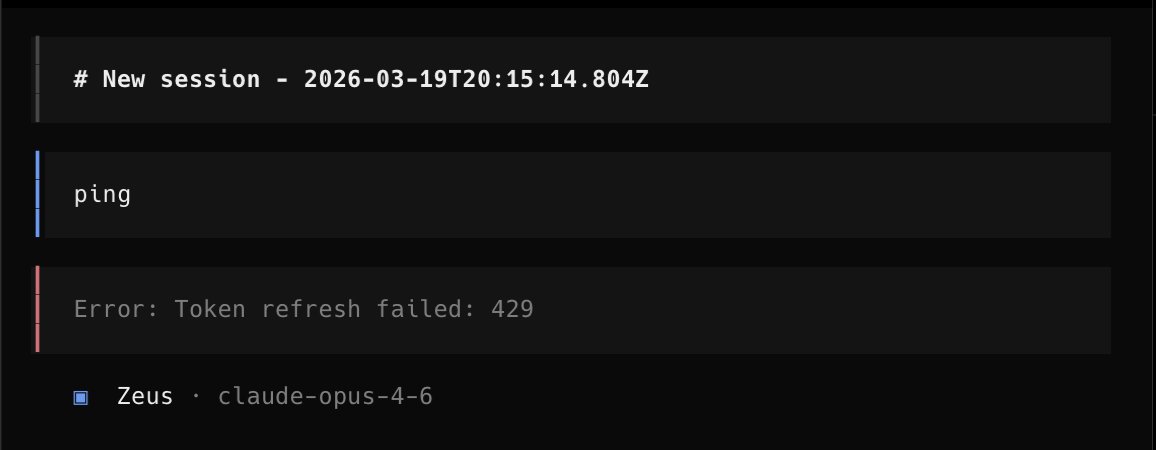
You got `Error: Token refresh failed: 429` in opencode when use antropic subscription?
Fix:
- Clone github.com/9clg6/sync-cla…
- Execute `chmod +x sync-token.sh && ./sync-token.sh`
English
@MichaelArnaldi @SharpCoder @EffectTS_ as an aside i am eagerly hoping the opencode plugin & tooling ecosystem will be updated perhaps by @kitlangton to support Effect-first paradigms like plugins just being layers provided to the opencode session which is just a managed runtime
English
my 2 cents, the cli-tooling-for-coding-agents medium is like your take on tui/gui. perfect entry point a few months ago, but as time goes on and you want more deterministic behavior, the cli tooling suite feels too chaotic and non-deterministic for something as foundational as Effect guidance
if it's cli-tool-first, there are a bunch of layers of misdirection between the agent actually using and benefitting from it with the reliability one wants. when it's an opencode plugin, it's a 1-step setup for the vast majority of users and as the developers you retain deterministic control over the behavior. vast majority of people will not spend weeks-to-months to shift their brains so that they can truly understand what Effect is capable of doing for their codebases - probably 90% of the people who will ever truly understand the full extent of what it can do will be the people on your team
English

GPT-5.4 is not really good at @EffectTS_ , is there any official skill to help him out?
English
@MichaelArnaldi @SharpCoder @EffectTS_ would adopt that in a heartbeat. imagining something like `effect-context.json` with 50 lines, 1 for each context or practice domain, where one could flip e.g. `"http-api": "true" | "false"` and have standardized guidance docs injected at the top of each window
English
@0xabcba @SharpCoder @EffectTS_ we are working on standardised context files and a tool to manage the context properly, the key issue at the moment is making it flexible enough, e.g. if by default you have context about effect http and the project uses hono you'll get a confused model
English
@MichaelArnaldi @SharpCoder @EffectTS_ and for the interested onlookers who also periodically check Michael's tweets for Effect protips, below is the 1155-line guidance doc, which I took from github.com/kriegcloud/bee… and revised to remove the `beep-effect`-specific helper library references
gist.github.com/3thr33s/2f17ef…
English
I see. I do this already, all skills are custom, the issue I run into is that I have 30 skills because the surface area of Effect is basically an entire language ecosystem and I am trying to push 100% Effect always-everywhere-no-exceptions. My AGENTS.md has directly-included a 1155-line baseline Effectv4isms guidance document plus explicit guidance to load at least 7 of the domain-specific skills. It is admittedly pretty good, at least the best I have gotten, but it feels like a heavy-handed sprawl of a solution that falls short of completely freeing me from managing the complexity of understanding and driving a set of Effect-first standards across a big monorepo.
If you find anybody with a banging blanket instruction, I will appreciate it being included in the Effect weekly blog post. Thanks for your work
English
English
@0xabcba @SharpCoder @EffectTS_ ask the model to generate best practices summaries for the modules you use and have a .guides/ folder to keep them, then index those files in agents.md
English
there are a handful of high effort instruction docs scattered throughout the codebase like `SCHEMA.md`, `LLMS.md`, etc
I am curious whether you find (or expect, in the short-term, given your vision for how comprehensive those codegenned instruction docs will aim to be) that it is better to explicitly direct the agent to reference these or if you have seen that a blanket instruction like "ALWAYS deep search .references/effect-v4 before planning, writing, or reviewing code" gets you all the way there
a few words go a long way (the short side of a long lever), so any suggestions for how to improve that sort of blanket statement, for example emphasizing search intent around "code patterns", "integration points", etc. would be further appreciated
English
@SharpCoder @EffectTS_ GPT-5.4 is exceptional at Effect, just add the effect repo as a git subtree to give the agent access to best practices, skills don't work well. Check out effect.solutions
English
Conclude Enforced Identity
Protect All Animals
Eradicates All Shame
Awakens The Giant
The Sovereign Liberation
English